The Flower That Glows in the Dark: How a $29.99 Petunia Is Rewriting the Future of Light—and the Rules of Genetic Engineering
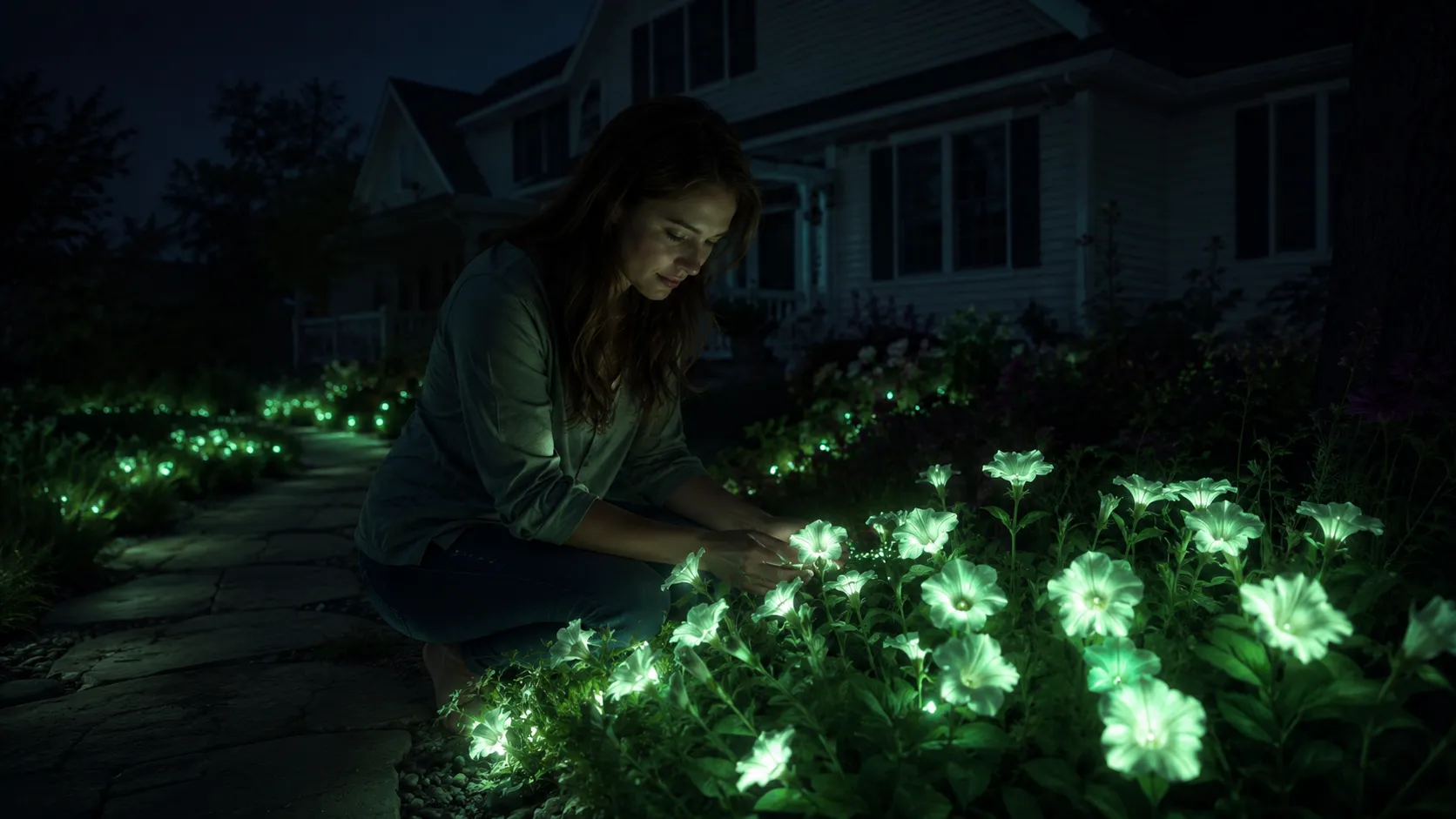
KEARNEY, NEBRASKA — May 22, 2026 — On a quiet suburban street in central Nebraska, Sarah Kleiner walks out of her front door at 10 p.m. and looks at her garden. There, among the petunias, something impossible is happening. The flowers are glowing. Not metaphorically, not in the way that poets describe flowers under moonlight, but literally, physically, emitting a soft green-white light from their petals and stems, visible to the naked eye, requiring no electricity, no UV lamp, no special conditions. Just a plant, doing what no plant on Earth has ever done in four billion years of evolution.
The plant is the Firefly Petunia, a genetically engineered flower developed by Light Bio, a startup based in Sun Valley, Idaho, that has spent the past several years working toward a moment that arrived quietly in May 2026: the approval by the United States Department of Agriculture to sell the world's first continuously glowing plant to the public. The price is $29.99. The regulatory determination, issued under the USDA's SECURE rule, found that the Firefly Petunia "does not pose an increased plant pest risk relative to other cultivated petunias" and could be grown outdoors without restriction. The decision, which might have seemed like a footnote in the annals of biotechnology, was in fact a landmark: the first time a genetically modified organism designed purely for aesthetic pleasure had been approved for unrestricted sale to American consumers.
The implications stretch far beyond the garden bed. The Firefly Petunia is not merely a novelty. It is a proof of concept for a future in which biology replaces infrastructure—a future in which the light in your living room comes not from a bulb powered by a grid but from a plant on your windowsill, engineered to glow using genes borrowed from bioluminescent mushrooms. The company is already working on roses, orchids, and eventually trees. The question that the Firefly Petunia raises is not whether it works. It works. The question is how far the technology can go—and whether the world is ready for what comes next.

The Mushroom That Taught Plants to Glow
The story of the Firefly Petunia begins not with a flower but with a fungus. For centuries, observers of the natural world have known that certain mushrooms glow in the dark—a phenomenon called bioluminescence that is common in marine organisms like jellyfish and fireflies, but rare on land. The glowing mushroom Neonothopanus gardneri, found in the forests of Brazil and Venezuela, was one of the brightest terrestrial examples, but for decades no one understood the biochemical pathway that produced its light.
In 2018, an international team led by Russian biologist Dr. Karen Sarkisyan and British biologist Dr. Ilia Yampolsky published a landmark paper in the Proceedings of the National Academy of Sciences that identified the full genetic pathway responsible for the mushroom's bioluminescence. The researchers discovered a four-gene cassette that, when inserted into yeast, turned the single-celled organisms into miniature lanterns. The same cassette, they showed, could be inserted into plants.
The scientific breakthrough was significant, but the commercial application was not immediately obvious. Bioluminescence had been a holy grail of synthetic biology for decades—the dream of glowing trees replacing streetlights, of self-illuminating crops that could be harvested at night, of biological sensors that lit up in the presence of toxins or pathogens. But earlier attempts had failed because they relied on genes borrowed from fireflies, which require a chemical called luciferin that must be supplied externally. The mushroom pathway was different: it produced all the necessary chemicals internally, from compounds that the plant already made. It was, in the language of synthetic biology, a self-sustaining bioluminescent system.
Light Bio was founded by Sarkisyan, Yampolsky, and a team of synthetic biologists to commercialize the discovery. The Firefly Petunia, the company's first product, uses the mushroom genes to produce a continuous, visible glow from its flowers, stems, and leaves. The light is not bright enough to read by—not yet—but it is bright enough to see from across a room, to photograph with a standard smartphone camera, and to transform a garden into something that looks like a scene from a fantasy film.
The USDA Decision
The regulatory clearance that arrived in May 2026 was not a foregone conclusion. Genetic modification of plants has been one of the most fiercely contested technologies of the past three decades, and the approval process for GMOs has historically been slow, expensive, and politically fraught. But the USDA's SECURE rule, finalized in 2020 and implemented gradually, created a new regulatory pathway for genetically engineered organisms that do not pose plant pest risks—a category that includes most plants modified with genes from other organisms rather than from plant pathogens.
The determination that the Firefly Petunia did not pose an increased plant pest risk was based on the fact that the inserted genes came from a mushroom, not from a plant virus or bacterium. The petunia was not engineered to resist herbicides, to produce pesticides, or to outcompete native species. It was engineered to glow. And the USDA, after reviewing the scientific evidence, concluded that glowing was not a threat to American agriculture.
The decision was celebrated by the synthetic biology community as a victory for rational regulation—a sign that the government was capable of distinguishing between GMOs that posed genuine risks and GMOs that did not. But it also raised questions that the regulatory framework was not designed to answer. What happens when glowing plants cross-pollinate with wild relatives? What happens when consumers who do not want GMOs in their gardens find glowing flowers in their neighbors' yards? What happens when the technology moves from petunias to trees, and urban forests begin to glow at night?
These questions are not hypothetical. Light Bio has been transparent about its ambitions. Roses are in development. Orchids are in development. Trees—the holy grail of bioluminescent engineering, capable of transforming the nocturnal landscape of entire cities—are on the roadmap. The Firefly Petunia is not the endpoint. It is the proof of concept. And the proof has been accepted.
The $29.99 Revolution
The most radical thing about the Firefly Petunia may be its price. At $29.99, it is not a luxury item accessible only to the wealthy or the scientifically curious. It is cheaper than a bouquet of cut flowers, cheaper than a dinner for two at a mid-range restaurant, cheaper than the lightbulbs that will eventually be its competitors. Light Bio has deliberately priced the petunia to be accessible—a strategy that reflects its belief that bioluminescent plants are not a niche product but a mass-market category in waiting.
The initial demand has been extraordinary. Pre-orders for the Firefly Petunia sold out within hours of the USDA announcement, and the company's website crashed under the weight of traffic from gardeners, science enthusiasts, and curious consumers who had never heard of synthetic biology but knew they wanted a glowing flower. The waiting list now stretches into the thousands, and Light Bio is scaling its production capacity as quickly as its greenhouse infrastructure will allow.
The commercial success of the Firefly Petunia is significant not just for Light Bio but for the entire synthetic biology industry. For decades, the industry has struggled with a fundamental problem: its most promising products—carbon-neutral fuels, lab-grown meat, biodegradable plastics—have been capital-intensive, slow to market, and difficult to sell to consumers who do not understand the technology. The Firefly Petunia is different. It is a consumer product, priced for impulse purchase, that communicates its value proposition instantly. No one needs to explain why a glowing flower is interesting. You just look at it, and you understand.
The industry is watching closely. If the Firefly Petunia succeeds commercially—if it moves from a curiosity purchased by early adopters to a staple of American gardens—it will open the door for a wave of genetically engineered consumer products that have been waiting for a proof of market. Bioluminescent houseplants that double as nightlights. Fragrance-enhanced flowers that smell like vanilla or chocolate. Cut flowers that last for months instead of days. The Firefly Petunia is the thin end of a very large wedge, and the wedge has just been driven into the market.
What This Signals
The Firefly Petunia is not a story about a flower. It is a story about the normalization of genetic engineering—the quiet, incremental process by which a technology that was once considered dangerous and exotic becomes familiar, desirable, and eventually unremarkable.
The USDA approval was the regulatory milestone. The $29.99 price point was the commercial milestone. The pre-order stampede was the cultural milestone. Together, they mark a moment when synthetic biology moved from the laboratory to the garden center—not with controversy and protest, but with curiosity and delight. The protesters who once tore up GMO test fields are not picketing the garden stores selling glowing petunias. The customers buying them are not activists or scientists. They are ordinary people who want something beautiful in their gardens.
The larger implications are difficult to overstate. If bioluminescent plants can replace even a fraction of the world's outdoor lighting—streetlights, garden lights, architectural illumination—the energy savings would be measured in the billions of kilowatt-hours. If the technology can be extended to indoor plants bright enough to replace lightbulbs, the impact on residential electricity consumption would be transformational. And if the public acceptance of the Firefly Petunia opens the door for other genetically engineered consumer products—nutrient-enhanced vegetables, drought-resistant garden plants, pollution-sensing flowers—the effect on agriculture, horticulture, and the consumer economy could be as profound as the effect of the smartphone on communication.
The Firefly Petunia, sitting in a garden in Nebraska, does not look like a revolution. It looks like a flower. But the light it emits is not just bioluminescence. It is the light of an industry being born, of a regulatory framework being tested, of a public being asked to accept something new—and saying yes.


