The Five Friends Who Bet Everything on Building the World's First Hybrid Satellite Eye
BENGALURU — May 26, 2026 — In 2020, five final-year students at IIT Madras sat in a hostel room and asked themselves a question that most aerospace engineers spend entire careers avoiding. What if you could put two completely different kinds of cameras on the same satellite? Not one optical camera that takes beautiful pictures in daylight and goes blind the moment a cloud passes over. Not one radar sensor that can see through storms and darkness but produces images that look like a grainy ultrasound. Both. On one platform. Working together. The question was technically elegant and commercially insane—the kind of problem that had defeated every satellite manufacturer for a generation because the two sensors interfered with each other, the data streams were incompatible, and the engineering complexity was orders of magnitude greater than building two separate satellites.
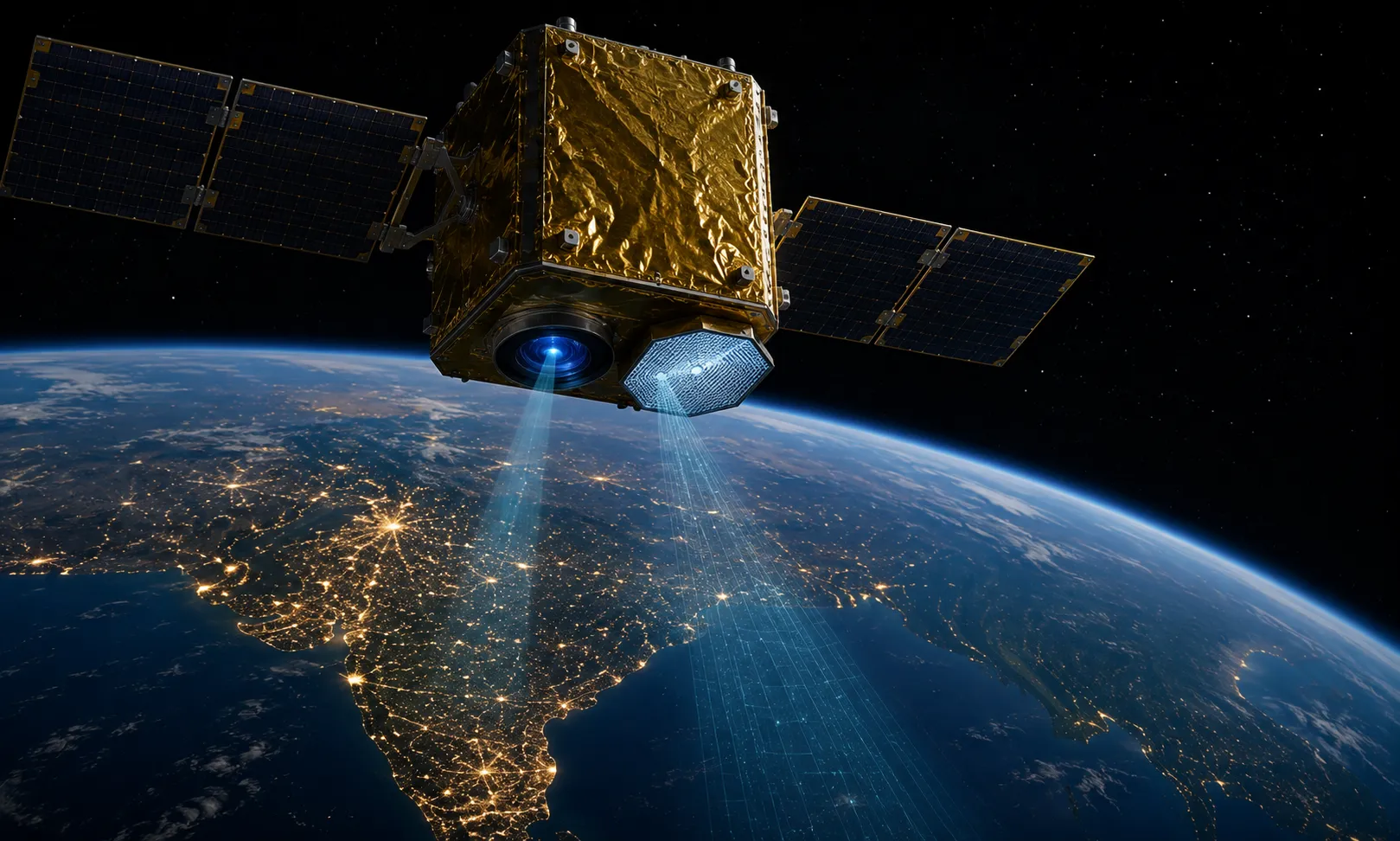
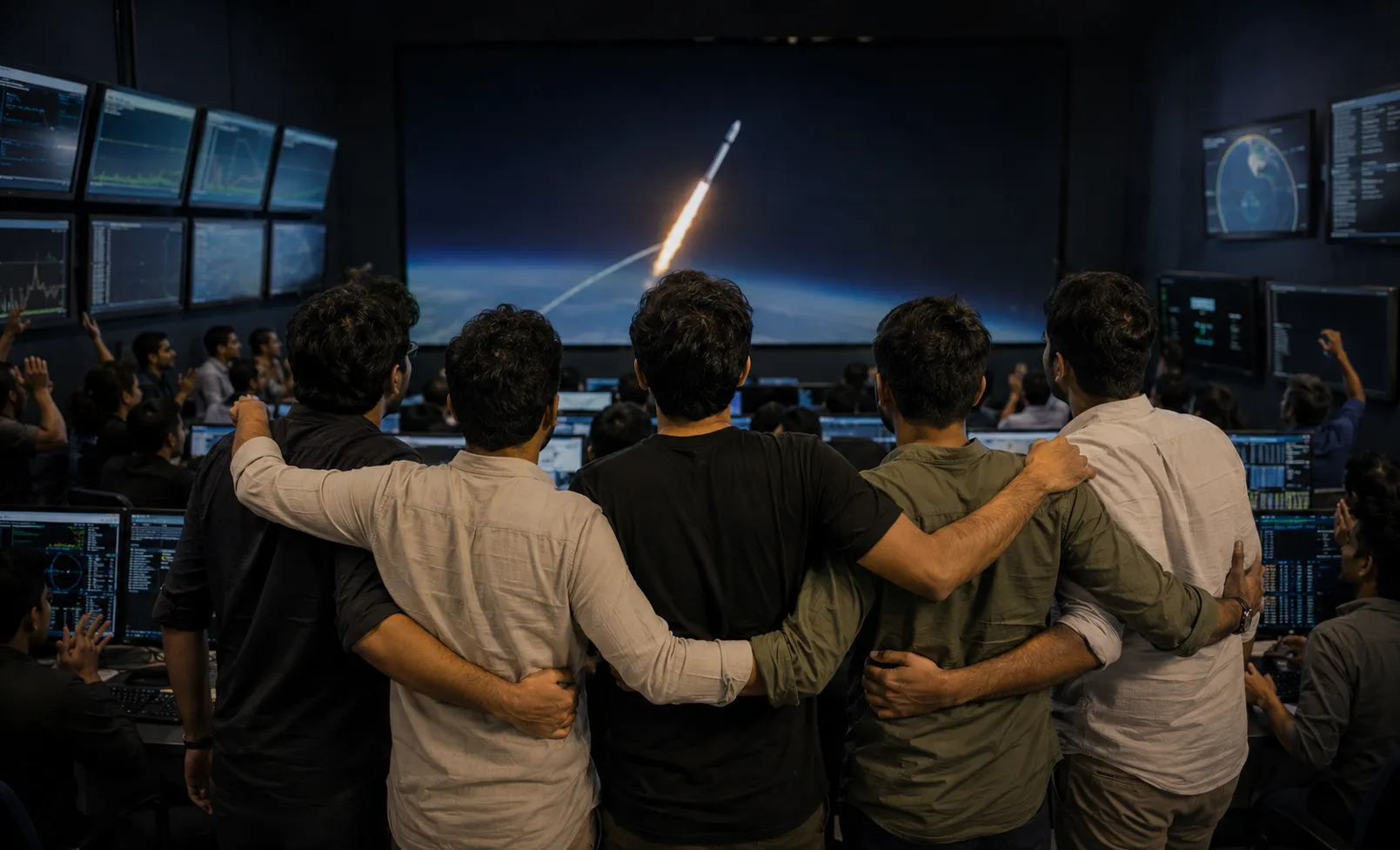
On May 3, 2026, the five friends—now the founding team of Bengaluru-based GalaxEye—watched a SpaceX Falcon 9 rocket lift off from Vandenberg Space Force Base in California carrying the answer to that hostel-room question. Mission Drishti, a 190-kilogram satellite, is the world's first operational OptoSAR platform: a single spacecraft that combines electro-optical imaging and synthetic aperture radar into one sensor package. It is the largest Earth observation satellite ever built by a private Indian company. It can see in daylight and in darkness, through clear skies and through monsoon clouds, producing images sharp enough to identify a car while also penetrating the thickest storm to map floodwaters below. And it was designed, built, and tested entirely in India, by a startup whose founders were still undergraduates when they began.
The satellite has now successfully separated from its launch vehicle, established communication with ground stations, and begun its commissioning phase—the delicate process of bringing each subsystem online, calibrating the sensors, and verifying that the platform can deliver on the promises its designers made. "With the satellite now successfully in orbit, our immediate focus is on completing its commissioning," founder and CEO Suyash Singh said. "As we move through this phase, we are already witnessing strong global interest in the differentiated datasets enabled by our OptoSAR payload." The interest is not hypothetical. Defence agencies, agricultural insurers, disaster-management authorities, and maritime surveillance operators around the world have spent years waiting for a single platform that could provide persistent, all-weather, day-and-night imagery without the trade-offs that have defined Earth observation since the first spy satellite was launched in 1960.
The Hostel-Room Genesis
The GalaxEye founding story is the kind of narrative that venture capitalists hear a hundred times and almost never believe. Five undergraduates at IIT Madras—Suyash Singh, Denil Chawda, Pranit Mehta, Rakshit Bhatt, and Arjun Sreedhar—decided during their final year that they wanted to build a satellite company. Not an app. Not a marketplace. A satellite company. In India. Where private spaceflight was, at the time, effectively illegal.
The five had met through Avishkar Hyperloop, an IIT Madras student team that was competing in Elon Musk's global Hyperloop competition. The experience of building a complex, high-stakes engineering project from scratch taught them something that their coursework never could: that young Indian engineers, given the right problem and the right team, could build hardware that competed with the best in the world. When the Hyperloop competition ended, they looked for the next problem—and found it in Earth observation.
The insight that drove them was not technological. It was commercial. The global Earth observation market was enormous and growing, driven by demand from defence, agriculture, insurance, and climate monitoring. But the existing supply was fragmented into two incompatible architectures. Optical satellites—like those operated by Maxar, Planet Labs, and Pixxel—produced gorgeous, high-resolution images in clear weather and were useless the moment a cloud appeared. Synthetic aperture radar satellites—like those operated by Capella Space and Iceye—could see through any weather but produced images that were difficult to interpret without specialised training. Customers who needed both capabilities had to buy data from two different providers, match the images manually, and accept that the optical and radar images were taken at different times from different angles.
The GalaxEye team asked a question that was so obvious it was startling: what if a single satellite could do both? The answer, they discovered after months of research, was that no one had built one because it was incredibly difficult. The two sensor types operated at different frequencies, required different power levels, and generated different data formats. The optical sensor needed a stable, vibration-free platform to produce sharp images. The radar sensor required a powerful transmitter that generated the very vibrations the optical sensor could not tolerate. The two systems interfered with each other in ways that were fundamental, not incidental. The industry had solved the problem by not solving it—by building two separate satellites, two separate constellations, two separate business models.
The five friends decided to solve it anyway. They incorporated GalaxEye in 2021, raised a seed round from Speciale Invest and a roster of angel investors, and began the long, painstaking work of designing a satellite that could do what no satellite had done before. The early years were spent in simulation, in component testing, in the iterative, unglamorous work of making two incompatible systems compatible. The founders have described those years as a series of small, incremental victories punctuated by long periods of failure. A prototype that worked in the lab would fail in thermal vacuum testing. A fix for the vibration problem would introduce a new problem with the power supply. The work was exhausting, underfunded, and deeply uncertain. The team persisted.
Five years later, the satellite that emerged from that process is in orbit. It is the largest Earth observation satellite ever built by a private Indian company, and it is the first of its kind in the world. The IIT Madras hostel room where the question was first asked is still there, unchanged. The five friends who asked it are no longer students. They are the founders of a company that has just put a machine into space that no one else on Earth has built.
The OptoSAR Advantage
The technical achievement of Mission Drishti is best understood through its applications—the things the satellite can do that no existing platform can match.
Consider disaster response. A cyclone makes landfall on India's eastern coast. The optical satellites that would normally provide imagery of the damage are blinded by the storm's residual cloud cover. The radar satellites that could see through the clouds are designed for broad-area surveillance, not for the high-resolution damage assessment that emergency responders need. Mission Drishti, operating in OptoSAR mode, can use its radar to penetrate the clouds, map the extent of flooding, and simultaneously use its optical sensor—in the gaps between cloud bands—to capture high-resolution imagery of damaged infrastructure. The data is collected from the same platform, at the same time, from the same angle, which means the optical and radar images can be overlaid and compared without the geometric corrections that make multi-satellite fusion slow and imprecise. The disaster-response agency that receives the data can see, within hours, exactly where the roads are washed out, exactly which bridges are standing, and exactly where the floodwaters are receding.
Consider agriculture. A crop insurer needs to verify a farmer's claim that his wheat crop was destroyed by an unseasonal hailstorm. The optical satellite image shows the field after the storm—but the image was taken two days after the event, and the farmer's neighbour claims the damage was done by poor irrigation, not hail. The SAR image, taken through the storm itself, shows the precise extent of the hail swath, the exact time the damage occurred, and the condition of the field before the storm cleared. The combination of the two datasets—the before-and-after optical imagery, the through-the-storm radar imagery—provides a forensic record that neither sensor could provide alone.
Consider defence. A naval surveillance agency is tracking a vessel that has turned off its Automatic Identification System transponder—the maritime equivalent of a licence plate. Optical satellites cannot see the ship at night. Radar satellites can see it but struggle to identify it. Mission Drishti, operating in OptoSAR mode, can track the vessel through darkness using radar, then capture a high-resolution optical image at dawn that confirms its identity. The vessel cannot hide in the dark, and it cannot hide in the clouds. The combination of sensors makes the ocean transparent.
The commercial market for this capability is large and growing. GalaxEye plans to expand Mission Drishti into a constellation of 10 satellites by 2030, creating a domestic Earth observation network that can provide persistent, all-weather coverage of the entire planet. The company has not disclosed its pricing, but the market for satellite imagery is projected to exceed $10 billion by 2030, and the segment that is all-weather, persistent, and high-resolution—the segment that GalaxEye is creating—has no incumbent. The first company to build a constellation of OptoSAR satellites will own a category. The five friends from IIT Madras intend to be that company.
The Private Space Moment
The launch of Mission Drishti is not occurring in isolation. It is part of a broader structural shift in India's space industry—a shift that has transformed the sector from a government monopoly into a competitive, venture-backed, globally oriented ecosystem in less than five years.
The same month that GalaxEye launched its satellite, Skyroot Aerospace became India's first space-tech unicorn, valued at $1.1 billion. Dhruva Space secured ₹105 crore in government funding for a 500-kilogram-class satellite platform. Pixxel and Sarvam AI announced plans to build India's first orbital AI data centre. Agnikul Cosmos successfully conducted a cluster firing of four 3D-printed rocket engines. The Indian space startup ecosystem, which barely existed a decade ago, is now attracting capital at a pace that has surprised even optimistic observers. Space-tech funding in India has more than doubled over the past year, and the country now hosts more than 300 space startups—up from a single entity in 2014.
The regulatory environment has been reshaped to accommodate this growth. The Indian Space Policy 2023 opened the sector to private participation. IN-SPACe, the regulatory clearinghouse, has streamlined the process by which private companies can access ISRO's testing infrastructure, launch ranges, and technical expertise. The result is a space industry that is increasingly capable of competing with the American, European, and Chinese companies that have dominated the global market for decades. GalaxEye's decision to launch on a SpaceX Falcon 9 rather than an Indian rocket reflects the global nature of the industry—the best launch vehicle for a given payload, regardless of nationality—and the company's ambition to serve customers worldwide.
The broader significance of Mission Drishti is not the technology itself. It is what the technology represents. The five friends who asked an impossible question in an IIT Madras hostel room have built a satellite that no one else in the world has built. The satellite is in orbit. The sensors are calibrating. The data is about to flow. The global customers who have been waiting for persistent, all-weather, day-and-night Earth observation will soon have a supplier that is not American, not European, not Chinese—but Indian. The hostel room is still there. The friends who asked the question are now the founders who answered it. The machine they built is 500 kilometres above the Earth, seeing what no machine has seen before. The era of Indian private space has a new champion. It is 190 kilograms, wrapped in gold foil, and it is just getting started.


