The Fintech That Thinks Monthly SIPs Are a Colonial Hangover—And Just Raised $12M to Prove It
NEW DELHI — May 2026 – There are approximately 300 million self-employed people in India. They run kirana shops, jewellery stores, automobile dealerships, tea stalls, and tailoring businesses. They earn money daily, in irregular pulses that swell during festivals and contract during monsoons. They are, by any measure, the productive backbone of the Indian economy. And the modern financial system, with its monthly SIPs, its fixed-deposit ladders, and its credit scores built around salaried income, was not designed for them. It was designed, in a sense, against them.
Bachatt, a Delhi-based fintech startup founded in 2025, has built its entire thesis around closing this gap. In March 2026, the company raised $12 million in Series A funding led by Accel, with participation from Lightspeed Venture Partners and Info Edge Ventures. The round, which brought total funding to $16 million, will be used to scale its savings platform and launch AI-driven wealth advisory and instant credit products—all designed for a user base that traditional banks have either ignored or misunderstood.
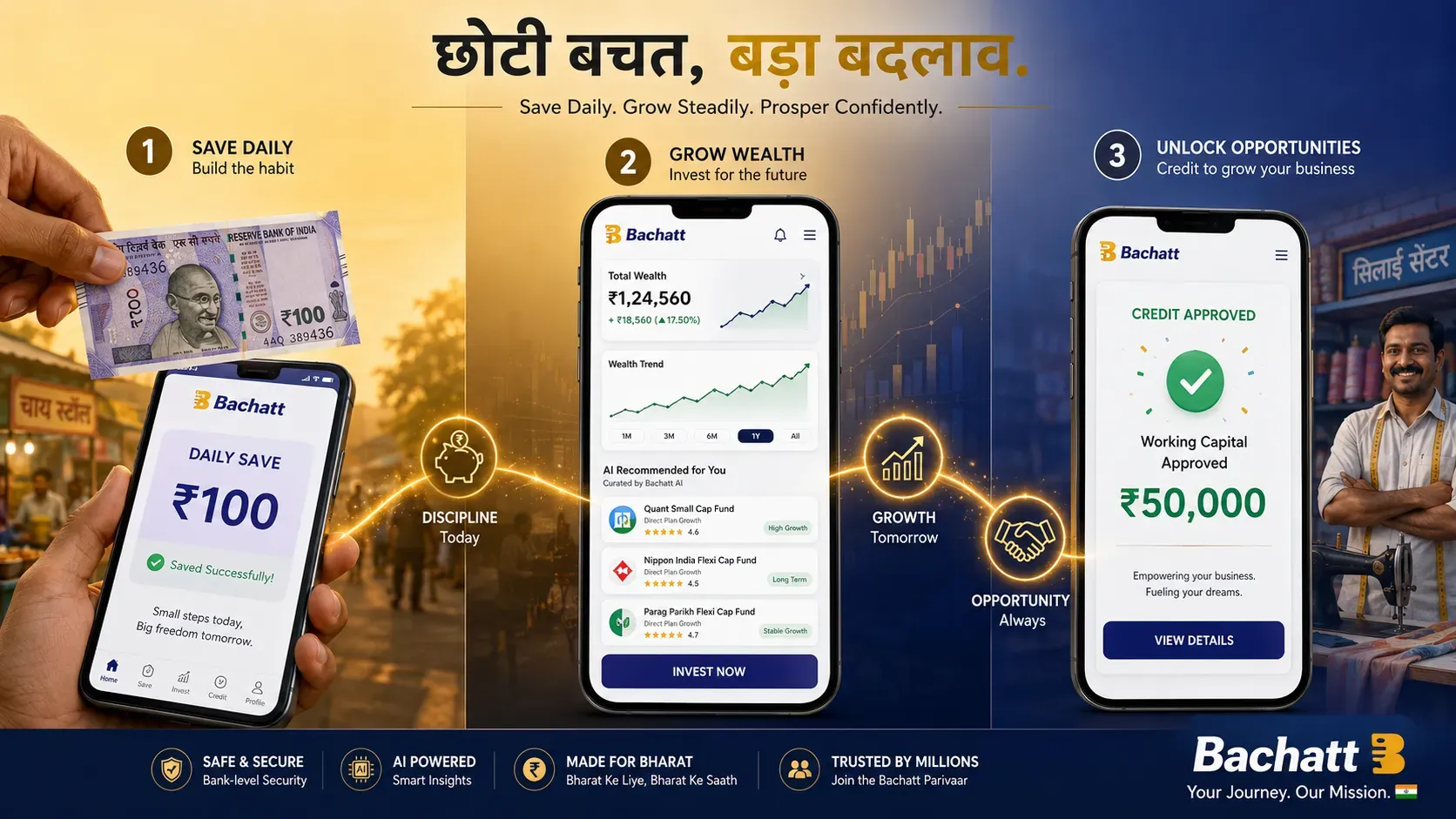
The company's name, bachatt, means "savings" in Hindi. Its flagship product is almost provocatively simple: invest as little as ₹100—roughly $1.20—in debt mutual funds from SBI, ICICI, and Axis AMC. Pause, top up, or withdraw instantly. Save daily, weekly, or monthly, depending on what your cash flow allows. No lock-in periods designed for salaried employees with predictable paychecks. No penalties for irregular contributions. Just a savings vehicle that bends to the shape of a real economic life.
The SIP and Its Discontents
The Systematic Investment Plan, or SIP, is the crown jewel of India's mutual fund industry. It allows investors to contribute a fixed amount monthly into a diversified portfolio, smoothing out market volatility through rupee-cost averaging. It has brought millions of Indians into the formal investment system. It is also, for the 300 million self-employed, a fundamentally alien construct.
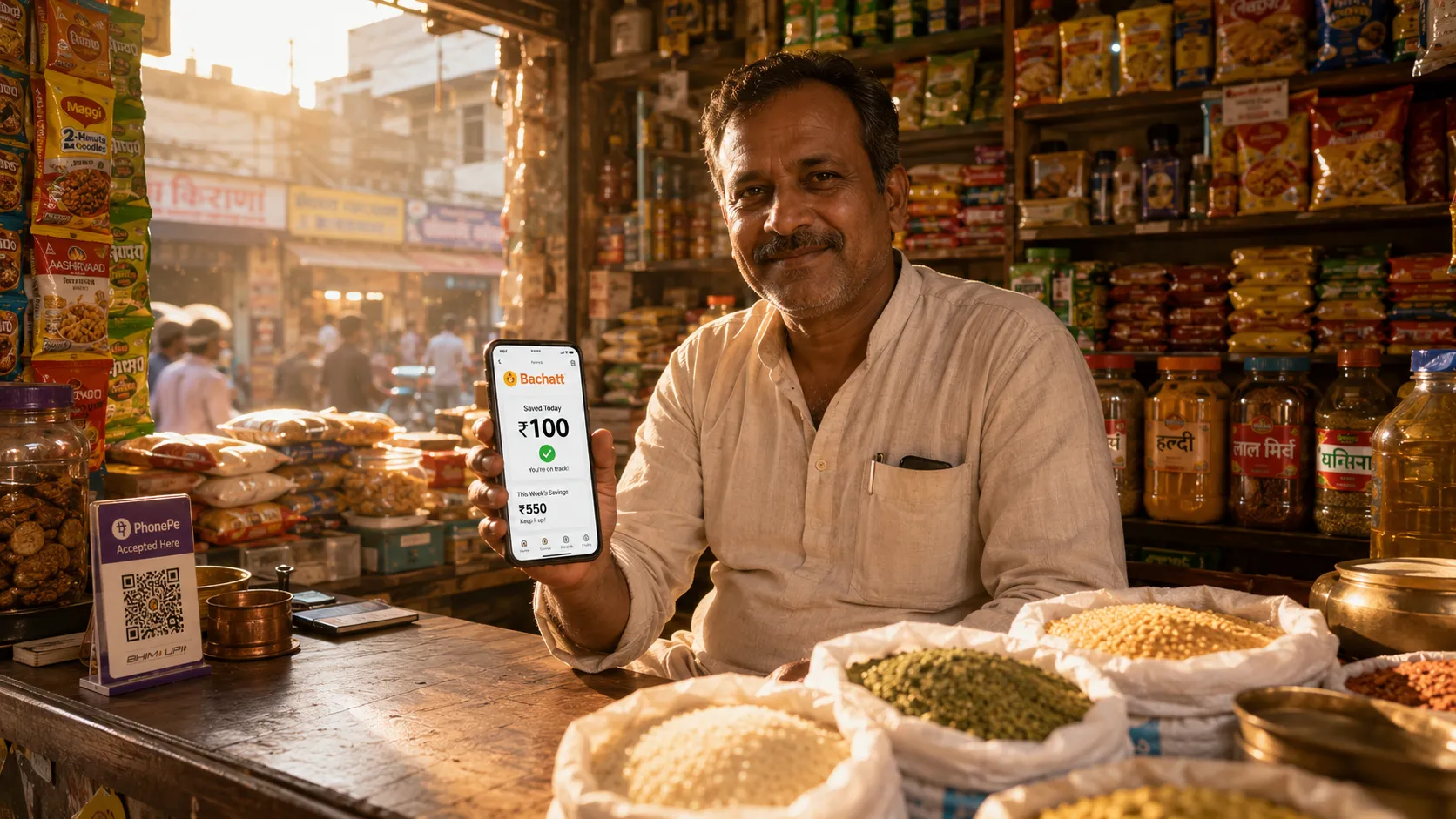
A kirana shopkeeper does not have a payday. She has a good Tuesday and a bad Wednesday. Her cash flow is daily, variable, and seasonal. Asking her to commit to a fixed monthly contribution—and penalizing her if she misses it—is like asking a farmer to commit to a fixed amount of rainfall. The financial product does not fit the financial life it is supposed to serve.
Bachatt's insight is that the product should bend to the user, not the other way around. Its daily savings model allows contributions as small as ₹100, invested in debt mutual funds that offer better returns than savings accounts while maintaining high liquidity. Users can pause contributions during lean periods, top up during festivals, and withdraw instantly when a supplier needs to be paid. The AI engine behind the platform tracks over 4,000 mutual fund schemes and market patterns to optimize returns, but the user never sees the complexity. What they see is a savings account that actually earns interest—and a financial system that finally seems to understand how they live.
Since launching in May 2025, Bachatt has acquired over 3 million users and processed more than 2 million mutual fund transactions in February 2026 alone. The platform's trajectory suggests a market that was not difficult to capture—because it had never been served in the first place.
From Savings to Wealth to Credit
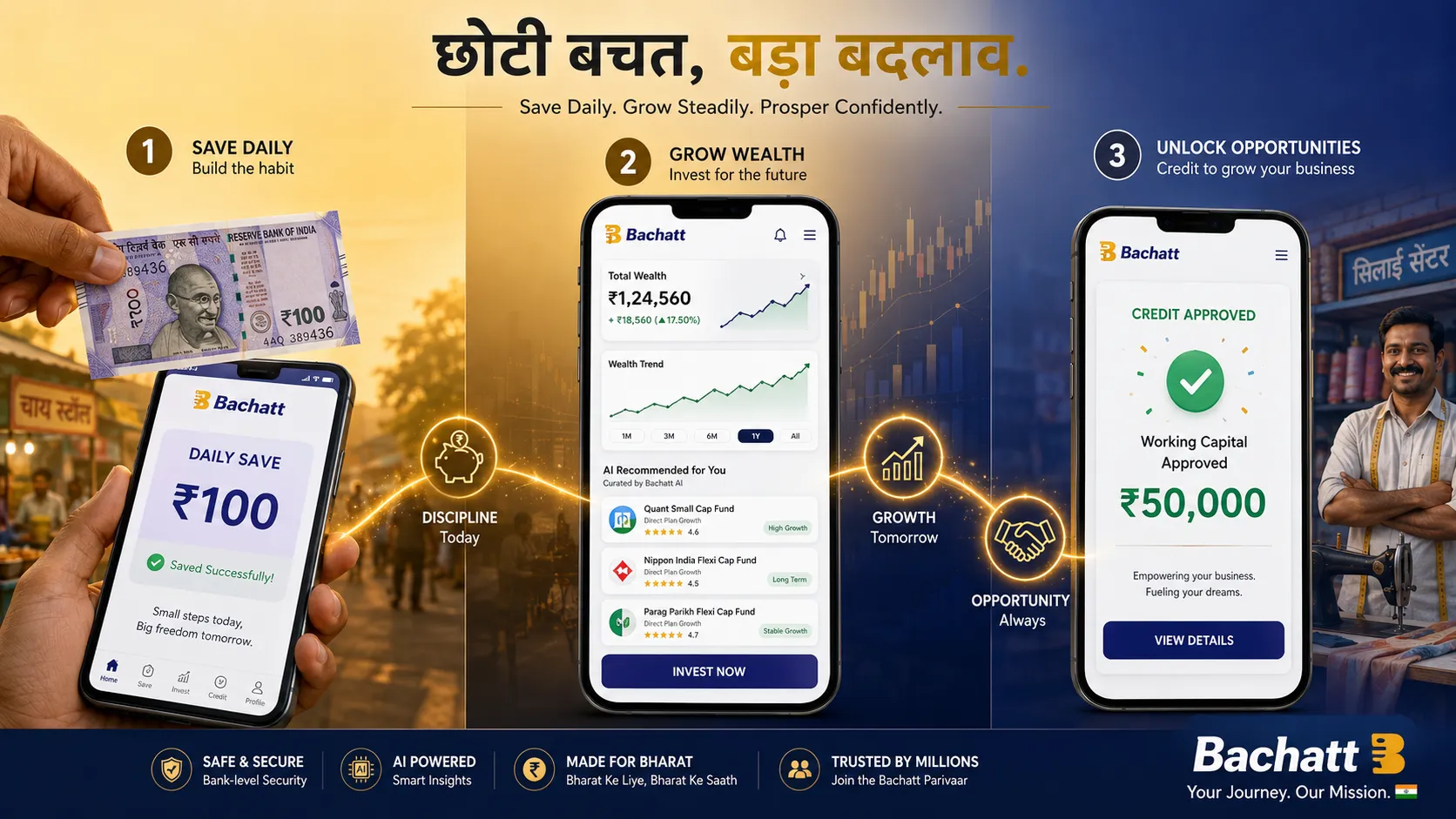
Bachatt's ambitions extend well beyond daily savings. The company is building two new product lines: an AI-led wealth advisory service and an instant credit offering for working capital. The wealth product uses a proprietary engine that monitors market patterns across thousands of mutual fund schemes to identify investment opportunities and make personalized recommendations. The credit product aims to provide near-instant working capital loans to merchants, with approval times measured in minutes rather than weeks.
The credit piece is particularly significant because it addresses a structural market failure. India's self-employed have an estimated credit gap exceeding $300 billion. Traditional banks cannot underwrite them effectively because the standard tools—salary slips, employment verification, credit scores—do not capture the reality of their financial lives. Bachatt's data advantage is its relationship with the user's cash flows. By observing daily savings patterns, withdrawal behavior, and seasonal income rhythms, the platform can build a credit profile that is far more predictive than a conventional credit score. A kirana shopkeeper who saves ₹100 every day for six months, pauses for Diwali, and resumes in November is demonstrating discipline and income stability that a static credit report would never capture.
The combination of savings, wealth, and credit on a single platform creates a flywheel. Users start with savings, build a transaction history, become eligible for credit, and eventually graduate to wealth products. Each product deepens the relationship and generates data that improves the next product. The flywheel is a classic fintech architecture, but Bachatt is applying it to a user base that has been locked out of the flywheel entirely.
What Every Entrepreneur Can Learn
Bachatt's story offers a sharp set of lessons for any founder building for underserved markets.
First, design for the user's life, not for the product's convenience. The SIP is a beautiful financial instrument for people with predictable monthly incomes. It is a burden for everyone else. Bachatt's daily savings model did not require inventing a new asset class or a new regulatory framework. It simply required redesigning the user interface—the contribution frequency, the minimum amount, the pause and withdrawal features—to match the rhythm of a self-employed life. The most powerful innovations are often not technological. They are empathetic.
Second, underserved markets are not small markets. Three hundred million self-employed Indians represent one of the largest addressable populations for financial services on Earth. The fact that they have been underserved is not evidence that the market is small. It is evidence that the market was invisible to the people who design financial products. The entrepreneur who can see what incumbents cannot see can build a very large business before the incumbents even realize there is something to compete for.
Third, data generated through a primary financial relationship is a defensible moat. Bachatt's credit underwriting advantage is not its AI models. It is the daily savings data that no credit bureau possesses. By becoming the primary financial interface for its users—the app they open every day to save ₹100—Bachatt is building a behavioral dataset that will compound over time. Incumbents can copy features. They cannot copy years of daily transaction data.
The Road Ahead
Bachatt's challenges are considerable. India's fintech market is one of the most competitive in the world, with well-funded players like Groww, Zerodha, and PhonePe expanding their product suites to capture adjacent segments. The regulatory environment for mutual fund distribution and digital lending is evolving, and compliance costs will rise as the platform scales. And converting 3 million users—many of them acquired during a period of rapid, low-cost growth—into a profitable, long-term customer base will require product discipline that is difficult to maintain in a venture-backed sprint.
But the structural opportunity is immense. The Indian mutual fund industry manages over ₹60 trillion in assets, and penetration among the self-employed remains in the single digits. The credit gap is measured in hundreds of billions. The wealth advisory market for non-salaried Indians is essentially greenfield. Bachatt has positioned itself at the intersection of a massive unmet need, a sophisticated AI-driven product stack, and a flywheel architecture that deepens its moat with every transaction. The company's name means savings. Its ambition is something larger: to be the financial operating system for the most underserved—and perhaps the most economically vital—population on the planet.


