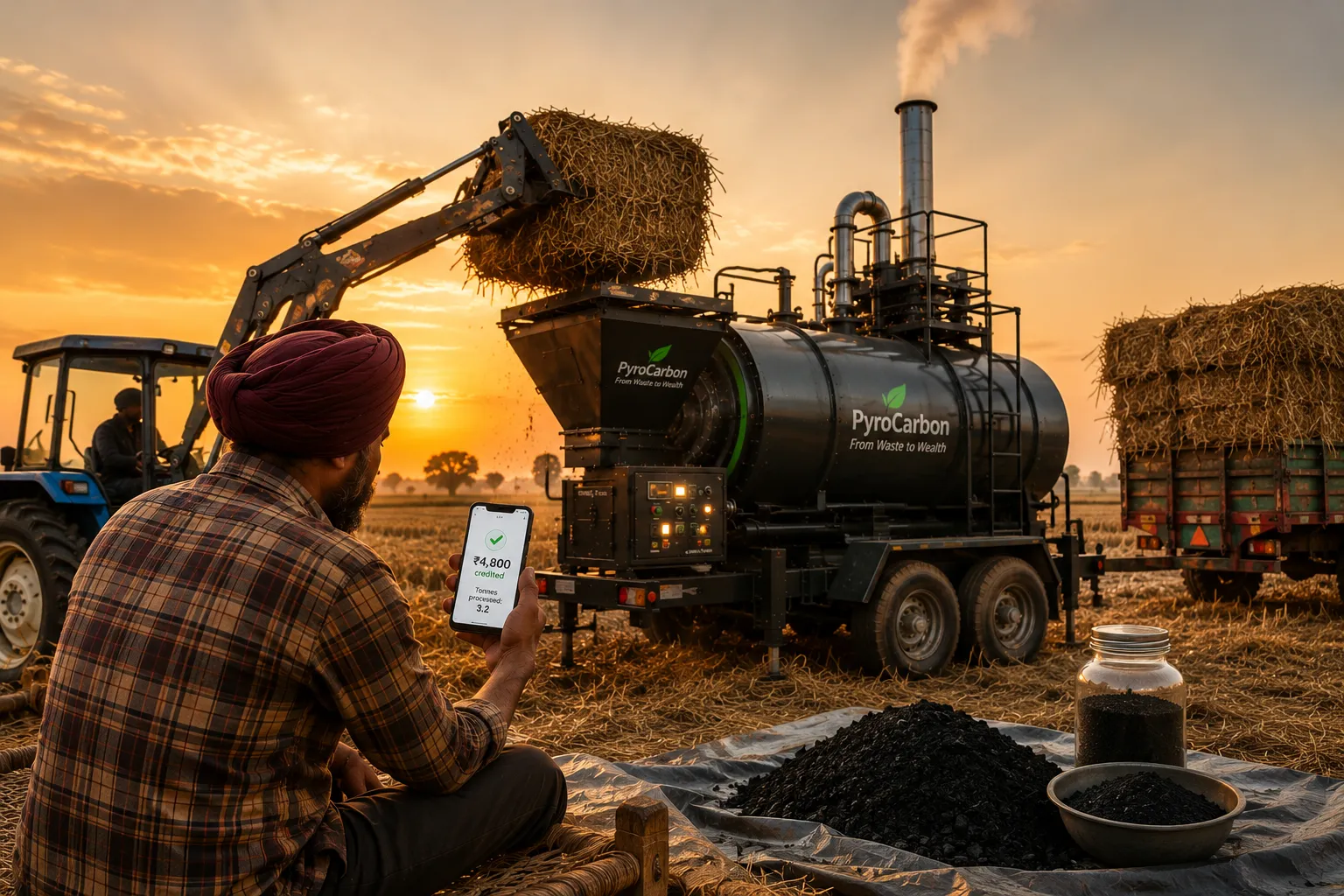
The Farm Boy and the IIT Engineer Who Turned Crop Smoke into a ₹120 Crore Carbon Empire
CHANDIGARH — May 24, 2026 — The autumn of 2022 was the year the air in Delhi became a crime scene. For weeks, a thick grey pall of smoke from burning rice stubble in Punjab and Haryana settled over the National Capital Region, pushing the Air Quality Index past 400—"severe," the colour code for a public health emergency. Schools closed. Flights were grounded. The Supreme Court summoned government officials and demanded answers. The chief ministers of the agrarian states pointed at helpless farmers who had no choice but to clear their fields for the next planting season. The farmers pointed at the government, which had promised them affordable alternatives and delivered none. The smoke, season after season, was nobody's fault and everybody's problem.
In a village outside Patiala, a 24-year-old named Gurvinder Singh watched the fires burn and saw something different. He was a farmer's son who had studied computer science at a modest college in Punjab, then landed a job at a Bengaluru agritech startup, where he'd spent two years watching venture capitalists pour money into apps that helped farmers sell vegetables. The apps worked, more or less, but they did nothing about the smoke. Every October, the fields of his village, like the fields of every village around it, were set alight—not out of malice, but out of arithmetic. The cost of clearing the stubble by machine was higher than the value of the wheat that would replace it. The market had failed. The state had failed. The only thing that worked was a match.
Singh quit his job in 2023 and moved back to Punjab. He recruited two unlikely partners: an IIT Delhi chemical engineer named Dr. Neha Kapoor, who had spent six years researching biomass pyrolysis at a government laboratory but had never built a commercial product, and a B2B sales veteran from Cargill named Vikramjit Singh (no relation), who had spent a decade selling agricultural inputs to the same farmers who were burning their fields. The three co-founders launched PyroCarbon with ₹50 lakh of their own savings and a conviction that the smoke billowing over northern India was not waste. It was feedstock.
On May 21, 2026, PyroCarbon closed a $15 million (approximately ₹125 crore) Series A funding round led by Peak XV Partners, with participation from Climate Angels, the Neev Fund, and a syndicate of investors. The round values the company at approximately $75 million post-money. The capital will fund the construction of 20 new biochar production facilities across Punjab and Haryana, expand the company's fleet of portable pyrolysis kilns, and scale its carbon credit verification platform, which has already pre-sold more than ₹120 crore worth of credits to European and North American buyers.
The company has signed multi-year offtake agreements with Nestlé India, Britannia, and ITC for the biochar it produces—a charcoal-like material that, when mixed into soil, improves water retention, reduces fertiliser requirements, and sequesters carbon for centuries. It has partnered with state governments in Punjab and Haryana to provide its portable kilns to farmer cooperatives at no cost, recovering the investment through the sale of carbon credits. And it has done something that no government programme, no Supreme Court order, and no amount of public shaming has managed to do: it has made stubble burning unprofitable.
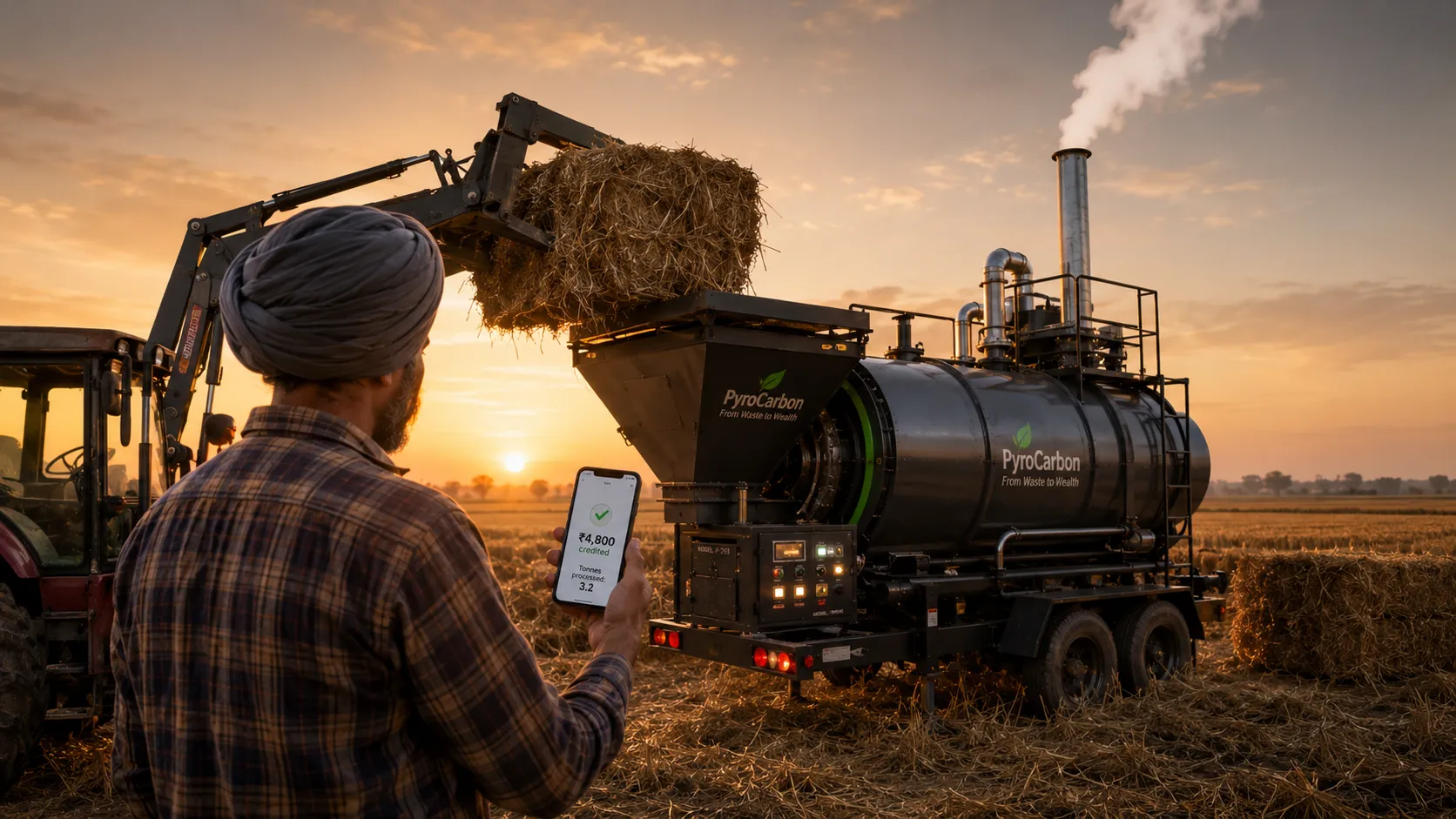
The Machine That Ate the Smoke
The core technological insight behind PyroCarbon is deceptively simple: if you heat agricultural waste in the absence of oxygen—a process called pyrolysis—it does not burn. It breaks down into two useful products. One is a gas that can be burned to sustain the pyrolysis process itself, making the system self-powering after initial ignition. The other is biochar: a stable, carbon-rich solid that looks like charcoal and behaves, in soil, like a miracle amendment. It holds water. It holds nutrients. It provides a habitat for beneficial microbes. And it locks carbon into a form that will not return to the atmosphere for hundreds of years.
The problem that had defeated previous attempts to commercialise biochar in India was not the science. It was the logistics. Building a large, centralised pyrolysis plant required transporting millions of tonnes of low-density crop residue across hundreds of kilometres of rural roads—a cost that erased the value of the biochar before it was even produced. The economics of centralisation, which worked for sugarcane and palm oil, collapsed for rice stubble.
PyroCarbon's solution was to invert the model. Instead of bringing the stubble to the factory, the company brings the factory to the stubble. Its portable pyrolysis kilns are mounted on flatbed trailers that can be towed by a standard tractor. A single kiln can process the residue from roughly 200 acres of rice paddies per season, producing approximately 60 tonnes of biochar and generating verified carbon credits for approximately 100 tonnes of CO₂ equivalent. The kiln moves from farm to farm, village to village, following the harvest as it sweeps across the state. The farmer pays nothing. The company recovers its costs—and then some—through the sale of biochar and carbon credits.
The unit economics are compelling. PyroCarbon sells biochar to food companies at approximately ₹15,000 per tonne, a price that reflects its value as a soil amendment and a sustainability credential. It sells verified carbon credits to European and North American buyers at approximately $25 per tonne of CO₂ equivalent, a price that has risen steadily as corporate net-zero commitments have tightened the market for high-quality removal credits. The combined revenue from biochar and carbon credits is more than enough to cover the cost of operating the kilns, paying the farmers, and generating a margin for the company. The ₹120 crore in pre-sold credits is an advance against a market that is growing at a compound annual rate of more than 40 percent.
The Carbon Credit Engine
The most strategically significant piece of PyroCarbon's business is not the kilns or the biochar. It is the carbon credit verification platform that the company has built alongside its physical operations.
Carbon credits are only as valuable as the trust that underpins them. A buyer in London who purchases a credit representing one tonne of CO₂ removed from the atmosphere needs to know—with a high degree of confidence—that the tonne was actually removed, that it would not have been removed anyway, and that it will stay removed for a meaningful period. These three criteria—additionality, permanence, and verifiability—are the holy trinity of carbon markets, and they have been notoriously difficult to satisfy for agricultural projects. How do you prove that a particular batch of biochar was produced from stubble that would otherwise have been burned? How do you prove that the carbon in that biochar will remain sequestered for a century, rather than decomposing in a decade?
PyroCarbon's platform uses a combination of satellite monitoring, IoT sensors on the kilns, and blockchain-based tracking to build a verifiable chain of custody for every tonne of carbon it sequesters. The satellite imagery—sourced from Pixxel, the Bengaluru-based hyperspectral imaging startup—shows, at the parcel level, which fields were burned in previous years and which were instead harvested for pyrolysis. The IoT sensors on the kilns record the temperature, duration, and feedstock input of every batch, generating a digital fingerprint that is uploaded to a distributed ledger. The biochar is weighed, sampled, and analysed for carbon content before it is sold. The credits are issued by Gold Standard, the most rigorous voluntary carbon market registry, and tracked on the blockchain from issuance to retirement.
The platform is expensive to build and maintain, but it creates a structural moat. A buyer who trusts PyroCarbon's verification methodology is unlikely to switch to a competing provider whose methodology is less transparent. A food company that uses PyroCarbon's biochar in its supply chain can point to a verified, auditable chain of custody that demonstrates the carbon impact of its purchase. The verification platform is not a cost centre. It is a competitive advantage.
The company's partnership with Pixxel is particularly significant because it illustrates the convergence of India's deeptech ecosystem. Two Bengaluru-based startups—one in Earth observation, one in carbon removal—are building complementary pieces of a carbon verification infrastructure that the global market desperately needs. The satellite that detects a field that was not burned, the kiln that processes the residue, the blockchain that tracks the credits, the buyer in London who retires them against a net-zero commitment—all of these are nodes in a system that PyroCarbon is assembling, piece by piece.
The Food Company Offtake
The commercial validation of PyroCarbon's approach arrived not from a venture capitalist but from a procurement department. Nestlé India, which sources milk, wheat, and spices from tens of thousands of farmers across Punjab and Haryana, signed a multi-year offtake agreement with PyroCarbon in early 2026. The agreement commits Nestlé to purchasing a specified volume of biochar annually for distribution to the farmers in its supply chain, at a price that covers PyroCarbon's production costs plus a margin. Britannia and ITC followed within weeks, signing agreements of their own.
The food companies are not buying biochar as an act of charity. They are buying it because they have made public commitments to reduce the carbon footprint of their supply chains—commitments that their investors, their customers, and their regulators are increasingly holding them to. Nestlé has pledged to source 50 percent of its key ingredients from regenerative agriculture by 2030. Britannia has committed to becoming carbon-neutral by 2040. ITC has set a target of sequestering 100 million tonnes of CO₂ across its value chain. Biochar, applied to the soils that grow the wheat and rice that go into their products, is one of the few interventions that can demonstrate a measurable, verifiable carbon impact.
The offtake agreements create a structural demand signal that reduces PyroCarbon's market risk. The company knows, before it builds a new kiln, that there is a buyer for the biochar it will produce. The agreements also provide the food companies with a direct line to the farmers in their supply chains—a relationship that has historically been mediated by layers of aggregators, middlemen, and commodity traders. A farmer who receives biochar from PyroCarbon, paid for by Nestlé, and who sees his soil improve and his input costs decline as a result, is a farmer who is more likely to remain a supplier to Nestlé. The biochar is not just a carbon intervention. It is a loyalty programme, rooted in agronomy and verified by satellites.
The scale of the opportunity is measured in millions of tonnes. Punjab and Haryana alone generate approximately 35 million tonnes of rice stubble annually, of which roughly 20 million tonnes are burned in the field. Converting that burned fraction into biochar would sequester approximately 5 million tonnes of CO₂ equivalent per year—roughly the annual emissions of a million passenger vehicles—while producing approximately 6 million tonnes of biochar, enough to treat approximately 1.2 million hectares of farmland. The market for carbon credits alone, at current prices, would be worth approximately $125 million annually. The market for biochar, at current prices, would add another ₹900 crore. The combined opportunity, for the two states alone, exceeds ₹2,000 crore per year—and the same model can be replicated across every rice-growing region in the world.
The Farmer Economics
The farmer who burns his field is not a villain. He is making a rational economic decision under constraints that the market and the state have imposed on him.
The rice-wheat rotation that dominates Punjab and Haryana is a product of the Green Revolution—a package of high-yielding seeds, subsidised fertilisers, and guaranteed government procurement that has made India self-sufficient in food grains but has also created a set of perverse incentives. The farmer plants rice in the monsoon, harvests it in October, and must immediately prepare the field for wheat, which must be planted by mid-November to achieve optimal yields. The window between harvest and planting is roughly two to three weeks. The stubble left behind after the rice harvest is voluminous, low in nutritional value for livestock, and expensive to clear by mechanical means. The cheapest, fastest, and most reliable method of clearing it is fire. The farmer knows the consequences—the smoke, the pollution, the damage to his own lungs and his children's—but the alternatives are economically unviable. He burns because the system demands it.
PyroCarbon changes that calculus. The company pays the farmer for his stubble—not a lot, but enough to cover the cost of mechanical harvesting and leave a small margin. The payment is made directly to the farmer's bank account, via UPI, within 48 hours of the stubble being processed. The farmer does not need to invest in equipment, apply for a government subsidy, or navigate the bureaucratic maze that has defeated previous attempts to solve the stubble-burning problem. He needs only to sign a consent form, allow the PyroCarbon kiln onto his field, and watch as the stubble that was once a liability is transformed into a revenue stream.
The pilot data is striking. In the 2025 harvest season, PyroCarbon deployed 50 portable kilns across 200 villages in Punjab, processing stubble from approximately 10,000 acres. The farmers who participated received an average of ₹4,800 per acre—a total payout of approximately ₹4.8 crore—for stubble that, in previous years, they had burned at a net cost. The participation rate for the 2026 season, which begins in October, is already three times higher than in 2025, driven entirely by word-of-mouth. The farmers who participated in the pilot have become the company's most effective sales force.
The government of Punjab has taken notice. In March 2026, the state agriculture department signed a memorandum of understanding with PyroCarbon to deploy the company's kilns across 500 additional villages in the upcoming harvest season, with the state providing logistical support and the company providing the technology and the offtake. The government of Haryana is in discussions to follow suit. The Supreme Court, which has been monitoring the stubble-burning issue since 2018, cited PyroCarbon in its most recent order as an example of a market-based solution that shows "demonstrable promise." The company that began with a farmer's son, an IIT engineer, and ₹50 lakh in savings is now being held up by the highest court in the land as a model for solving one of India's most intractable environmental crises.
What This Signals
The PyroCarbon story is not primarily about biochar. It is about the structural transformation of agricultural waste from a liability into an asset—and about the convergence of climate finance, deeptech, and rural economics that is making that transformation possible.
For decades, the carbon in India's crop residue was invisible to the market. It had no price. It generated no revenue. The only value it had was the heat it produced when it burned—a value that was captured in the moment of combustion and then dissipated, along with the smoke that choked the lungs of tens of millions of people. The carbon credit market, the satellite imaging technology, the blockchain verification platforms, and the corporate net-zero commitments that have converged on PyroCarbon's kilns are all part of a new architecture that makes the carbon visible—and therefore valuable.
The company is still young. The 20 new biochar production facilities that the Series A round will fund are a fraction of what would be needed to process the full volume of India's crop residue. The carbon credit market is volatile, and the prices that PyroCarbon currently commands could fall if corporate demand weakens or if regulatory standards tighten. The portable kiln technology, while proven, is still being refined for efficiency and reliability. The company has not disclosed its revenue or profitability, and the path to a sustainable, profitable business at scale is not yet guaranteed.
But the direction of travel is unmistakable. The smoke that used to blanket Delhi every autumn is not a fact of nature. It is a market failure. PyroCarbon is fixing that failure—not by appealing to the conscience of the farmer, but by appealing to the arithmetic of the farm. The farm boy who watched his village burn and saw an opportunity, the IIT engineer who spent six years in a government lab and never built a commercial product, and the sales veteran who knew the farmers better than anyone else have together built a company that is turning crop smoke into a carbon empire. The kilns are portable. The credits are verified. The stubble is no longer waste. It is feedstock. The smoke is disappearing. The market is working.


