The Enzyme That Eats Plastic for Breakfast: How a Single Mutation Just Accelerated the End of Pollution
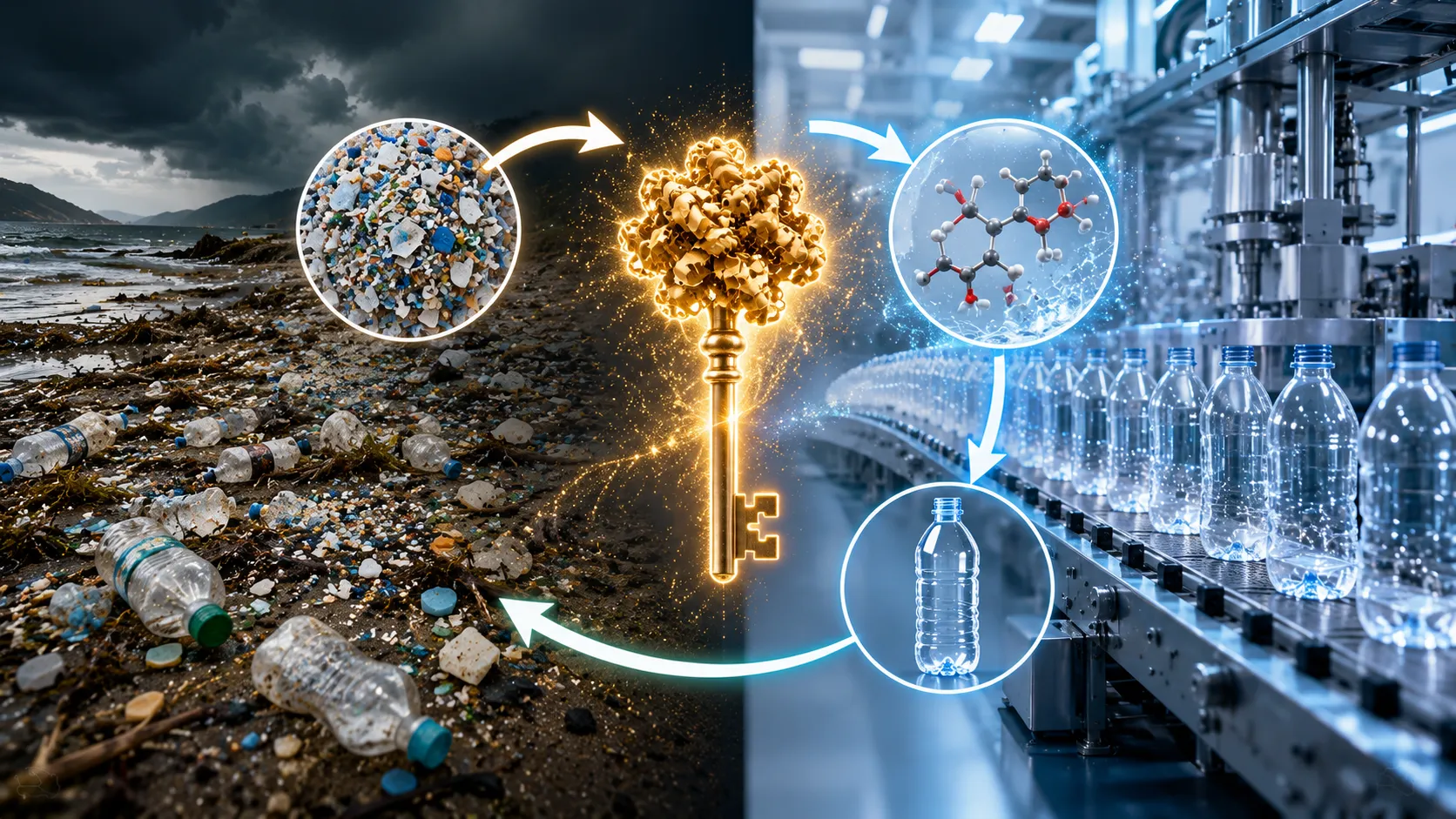
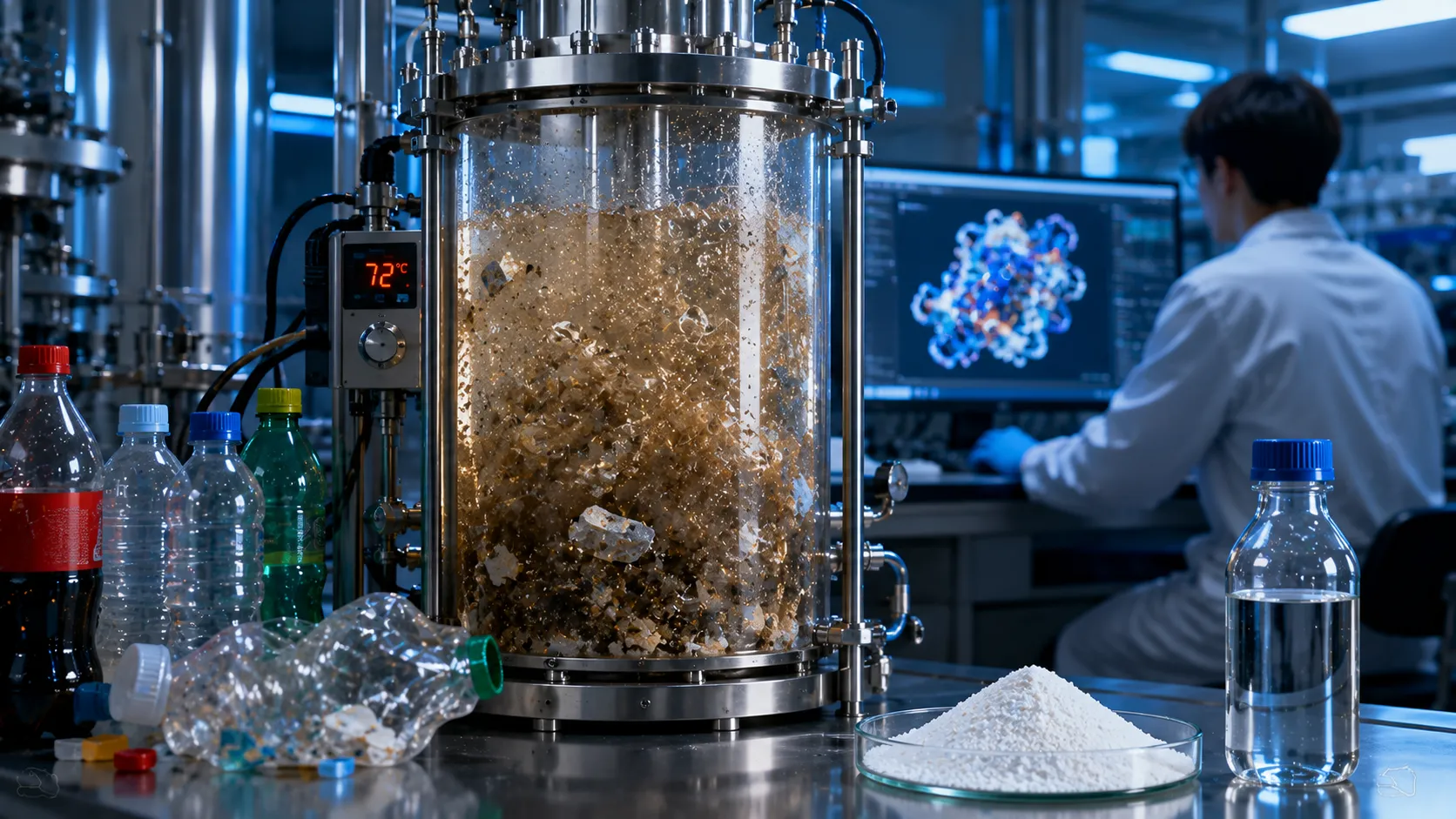
AUSTIN, Texas — May 26, 2026 — The pile of plastic bottles sits in a stainless‑steel vat at the University of Texas at Austin. They are ordinary soda bottles—clear PET, the most common plastic on Earth. A few hours ago, they were intact. Now they are a murky brown slurry, dissolving into their chemical building blocks at a rate that would have seemed like magic a decade ago. The agent of this transformation is a protein engineered by human hands, a variant of an enzyme first discovered in a Japanese recycling plant in 2016. That original enzyme, called PETase, could break down a thin film of PET over the course of several weeks. The new one, dubbed FAST‑PETase (Functional, Active, Stable, and Tolerant PETase), works a thousand times faster. In the vat, it is digesting a kilogram of plastic bottle flakes every ninety minutes.
"We have effectively broken the speed limit for enzymatic plastic degradation," said Dr. Alisha Montgomery, the lead researcher on the UT Austin team. "The original enzyme was a curiosity. This one is an industrial process. We can now envision a world where plastic waste is not buried or burned, but fed into a bioreactor and turned back into the chemicals used to make new plastic. That is a circular economy. That is the end of plastic pollution as we know it."
The Discovery That Started It All
The story of plastic‑eating enzymes begins not in a high‑tech laboratory, but in a pile of garbage. In 2016, a team of Japanese scientists led by Dr. Kohei Oda collected soil and sediment samples from a PET bottle recycling facility in Sakai. They were looking for bacteria that had evolved to live on plastic waste—a microbial community adapting to the Anthropocene. Among the hundreds of species they isolated, one stood out: Ideonella sakaiensis. This bacterium produced an enzyme, PETase, that could break down PET into a harmless intermediate, and a second enzyme, MHETase, that could break that intermediate into its original monomers: terephthalic acid and ethylene glycol.
It was a stunning discovery. PET (polyethylene terephthalate) was designed to be durable. Its polymer chains are held together by strong ester bonds that resist hydrolysis in the environment. A plastic bottle can persist for 400 years. Yet here was a bacterium that had evolved, in a matter of decades, to eat it. The natural PETase was slow—it took six weeks to make a dent in a thin film—but it proved that the chemical problem was solvable.
The race was on to improve it.
The Billion‑Fold Leap
The UT Austin team used a technique called directed evolution—essentially breeding enzymes in the laboratory for desired traits. They introduced random mutations into the PETase gene, then screened the resulting enzymes for higher activity at higher temperatures (industrial processes run hot) and greater stability in the presence of salt and solvents. After 20 rounds of mutation and selection, they had a winner: FAST‑PETase.
The numbers are staggering. The original PETase has a turnover rate (the number of chemical reactions per second) of about 0.4. FAST‑PETase has a turnover rate of 108. That is a 270‑fold increase. But the real breakthrough is thermostability. The original enzyme falls apart above 40°C. FAST‑PETase remains active up to 75°C. At that temperature, PET becomes soft and amorphous, making its polymer chains accessible to the enzyme. The combination of higher temperature and higher activity yields a degradation rate that is roughly one billion times faster than the natural enzyme when measured in terms of mass of plastic degraded per hour per milligram of enzyme.
"We can take a post‑consumer PET bottle, wash it, shred it, and feed it into a bioreactor at 72°C," said Dr. Montgomery. "Within 24 hours, 90 percent of the plastic is depolymerized. The monomers we recover are pure enough to repolymerize into new PET bottles of food‑grade quality. That is the holy grail: bottle‑to‑bottle recycling without downcycling."
The Economic Equation That Finally Works
For years, enzymatic plastic recycling was a laboratory curiosity because it was too expensive. The enzymes were costly to produce, worked too slowly, and required carefully controlled conditions. FAST‑PETase changes the math.
The enzyme can be produced in standard fermentation vats using engineered E. coli—the same process used to make insulin and laundry detergents. The cost has fallen to roughly $25 per kilogram of enzyme. One kilogram of FAST‑PETase can process 50 tons of PET in 24 hours. That means the enzyme cost per ton of plastic is about 50 cents. Even when adding the costs of collection, sorting, washing, and energy, the total is competitive with virgin PET production from petroleum, especially when oil prices are above $60 per barrel.
"The economics have flipped," said Dr. Montgomery. "Five years ago, it was cheaper to make new plastic from oil than to recycle old plastic enzymatically. Now, with FAST‑PETase, recycling is cheaper at most oil prices. And that is before you account for carbon taxes, ESG pressures, or consumer demand for sustainable products."
Several companies have already licensed the technology. Carbios in France is building a commercial‑scale enzymatic recycling plant with a capacity of 50,000 tons per year. Samsara Eco in Australia is using a similar enzyme to recycle mixed plastics that cannot be mechanically recycled. And in the United States, a consortium of beverage companies (PepsiCo, Coca‑Cola, and Keurig Dr Pepper) has invested $150 million in a FAST‑PETase demonstration plant in Texas, scheduled to open in 2027.
Beyond Bottles: Polyester, Carpets, and the Ocean
PET is only the beginning. The UT Austin team has also engineered variants that degrade polyurethane (used in foams, coatings, and elastic fibers) and polyamide (nylon). A French group has developed an enzyme that breaks down PLA (polylactic acid, a bioplastic that does not degrade in marine environments). And a team at the University of Portsmouth in the UK has created a "cocktail" of PETase and MHETase that works twice as fast as either enzyme alone.
The most tantalizing target is the Great Pacific Garbage Patch, a floating accumulation of an estimated 80,000 tons of plastic spanning 1.6 million square kilometers. Could enzymes clean it? Not directly—enzymes work best in warm, aqueous solutions with controlled pH, not cold, salty ocean water with debris. But the patch is not a single mass; most of it is microplastics suspended in the top few meters of water. Researchers are exploring the idea of floating bioreactors that would pump in seawater, warm it slightly, add enzymes, and discharge the monomers, which are water‑soluble and harmless.
"That is a decade away at best," cautions Dr. Montgomery. "But the principle is sound. If we can collect the plastic, we can enzymatically recycle it. The patch is a symptom of a broken system. The cure is to stop plastic from entering the ocean in the first place, and to make sure that the plastic we do use is endlessly recyclable. FAST‑PETase gives us the tool to close the loop."
"The patch is a symptom of a broken system. The cure is to stop plastic from entering the ocean in the first place. But FAST‑PETase gives us the tool to close the loop on the plastic already in the waste stream." — Dr. Alisha Montgomery
The Limits and The Promise
No technology is a silver bullet. FAST‑PETase only works on PET, which is about 12 percent of global plastic production. It does not work on polyethylene (plastic bags, shampoo bottles), polypropylene (yogurt cups, bottle caps), or polystyrene (styrofoam). Those require different enzymes or different recycling pathways. And the process requires clean, sorted plastic—no metal labels, no glue, no food residue—which means improved collection and sorting infrastructure is still essential.
Moreover, enzymatic recycling is not a license to keep producing single‑use plastics. The best solution remains reducing consumption and redesigning products for reusability. But for the plastic that is already in the waste stream—and for the plastic that will inevitably be used in medical devices, electronics, and other essential applications—enzymatic recycling offers a way out of the linear take‑make‑dispose model.
"The dream is a world where every plastic bottle you buy contains monomers that were once another plastic bottle," said Dr. Montgomery. "Not downcycled into a park bench. Not burned. Not buried. But reborn as a new bottle, indistinguishable from virgin plastic, at lower cost and lower carbon footprint. That is what FAST‑PETase makes possible."
The Quiet Revolution
The enzyme does not roar. It does not glow. It does not announce its work. In the vat at UT Austin, the slurry continues to churn, the ester bonds breaking, the long polymer chains falling apart into their constituent molecules. The process is silent, invisible, and unstoppable once started. In a few hours, the bottles that took centuries to degrade naturally will be gone, transformed into a clear liquid and a white powder that can be fed back into a polymerizer to become new bottles. The circle closes.
The discovery of PETase in a Japanese dump was a reminder that evolution is the greatest engineer. The engineering of FAST‑PETase is a reminder that human intelligence can accelerate evolution by a factor of a billion. The plastic crisis is not solved—not yet. But for the first time, there is a credible, economic, scalable path to solving it. The enzyme that eats plastic for breakfast is here. It is hungry. And it is ready for the billions of tons of lunch waiting in landfills and oceans.


