The Engineer and the Journalist Who Bet Their Life Savings on Davangere Dosas: How Two 24-Year-Olds With No Restaurant Experience Built a ₹1 Crore/Month Breakfast Chain That Mumbai Lines Up For
MUMBAI — May 26, 2026 — In 2022, Akhil Iyer was 24 years old, a chemical engineer with an MBA who had spent two years at Morgan Stanley. His girlfriend—now wife—Shriya Narayana was 24, a journalist with a degree in economics and political science from the University of London who had spent years telling other people's stories for a living. They were young, educated, and on trajectories that made their parents proud. They had never run a restaurant. They had never managed a kitchen. They had never stood behind a counter at 6 a.m., watching the first customers of the day decide whether the food they were about to eat was worth the money they were about to spend. And they had an idea that everyone told them was insane.
Akhil's family is from Davangere, the city in central Karnataka that gives its name to the most underrated breakfast in India: the benne dosa. "Benne" means butter in Kannada, and the dosa it describes is unlike any other—crisp on the outside, soft within, finished with a generous dollop of white butter that melts into the crevices and transforms a simple fermented crepe into something transcendent. For decades, Davangere's benne dosa has been a cult object among South Indian food lovers, but it has remained almost entirely confined to its home region—a local treasure that never made the journey to India's largest cities. Akhil grew up on it. He believed the world deserved it. And in 2022, with ₹1 crore pooled from their personal savings and family contributions—no venture capital, no bank loan, no outside investors—he and Shriya opened the first Benne Cafe in a modest space near Akhil's home in Chembur.
Four years later, Benne Cafe is one of Mumbai's most successful bootstrapped restaurant brands. It now operates four outlets across the city—Chembur, Bandra, Powai, and Andheri—with a fifth opening soon. Its revenue reached ₹1 crore per month as of September 2024, up from ₹84 lakh in July, driven by an average of 3,000 daily orders and monthly footfall of approximately 12,000 to 14,000 customers per outlet. It has served over a million customers since its launch. It achieved this growth without spending a single rupee on paid marketing—no Instagram ads, no influencer collaborations, no billboards. Every customer who walked through the door heard about the place from someone else. The benne dosa that Akhil grew up eating in Davangere is now being served to thousands of Mumbaikars every day, and the couple who risked everything to bring it to them have built something that neither the restaurant industry nor their own families expected.
The ₹1 Crore Bet
The decision to open a restaurant was not a carefully calculated risk. It was an all-in bet. Akhil and Shriya pooled ₹1 crore—their personal savings, supplemented by contributions from their families—and poured it into a space near Akhil's home in Chembur. They had no outside investors. They had no bank loan. They had no safety net. If the restaurant failed, they would lose everything they had saved, everything their families had contributed, and the years they had spent building their careers.
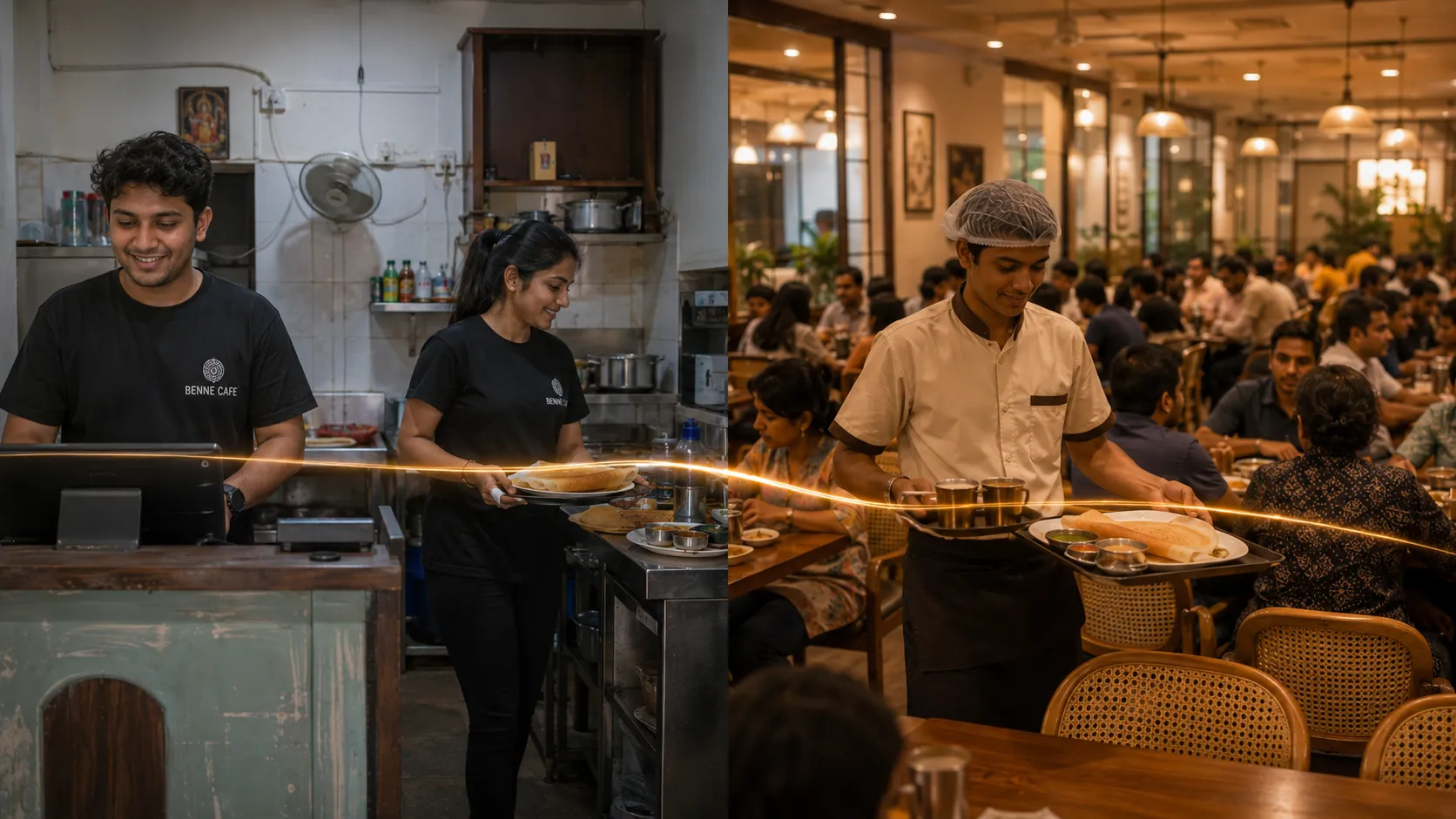
The first months were brutal. Neither Akhil nor Shriya had ever worked in a restaurant before. They had never managed a kitchen, never handled a supplier, and never experienced the particular exhaustion that comes from standing on your feet for twelve hours while customers who have never heard of your brand decide whether to give you a chance. "We did everything ourselves," Akhil told CNBC-TV18. "My days were spent behind the billing counter, and Shriya served tables." There was no front-of-house manager, no marketing team, and no operations head. There was just the couple, a chef from Davangere they had hired to get the batter and chutney right, and a conviction that the food would speak for itself.
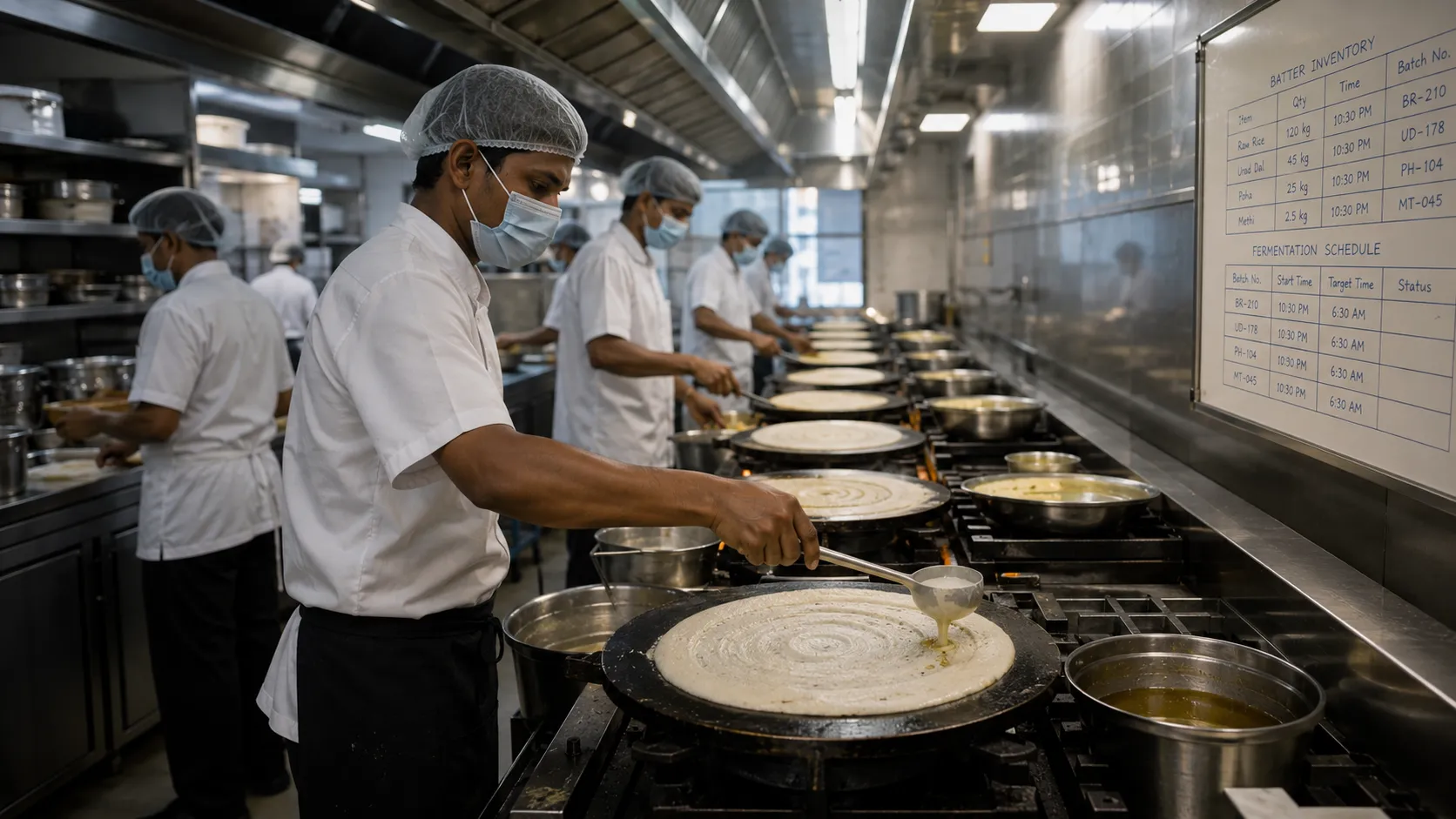
The batter was the key. The benne dosa's distinctive taste comes from a specific fermentation process and a specific ratio of rice to urad dal, and the couple spent months working with their chef to get it exactly right. "Even with professional help in the form of chefs, we spent months getting the batter and chutney right," Akhil said. The chutney—a coconut-based accompaniment that is as essential to the benne dosa as the butter itself—was equally demanding. The couple refused to compromise on quality, even when the economics argued against them. They sourced their butter from a single supplier who understood the specific requirements of the benne dosa. They prepared their batters fresh each day, rejecting the shortcuts that larger chains use to extend shelf life and reduce labour costs. The commitment to quality was not a marketing strategy. It was the product, and the product was all they had.
The first customers came slowly—neighbours, friends, the curious passers-by who noticed a new restaurant had opened on their street. They tasted the dosa. They told their friends. The friends came, tasted, and told more friends. Within months, the tiny Chembur outlet was generating queues that stretched down the block, and the couple who had never run a restaurant before were running one of the most talked-about breakfast spots in the city. "To stand out, we knew we had to serve the most authentic Davangere benne dosa and give customers a reason to keep returning," Akhil said. "The food would be our only marketing—and it turned out to be enough."
The No-Marketing Marketing Strategy
The most remarkable dimension of Benne Cafe's growth is not the revenue or the footfall. It is the channel through which that growth was achieved. The company has never spent a single rupee on paid marketing. No Instagram ads. No influencer collaborations. No billboards. No sponsored posts. The brand that now serves thousands of customers every day across four Mumbai outlets was built entirely on word of mouth.
The decision to avoid paid marketing was not, at first, a strategy. It was a necessity. The couple had poured everything they had into the restaurant itself, and there was simply no budget left for advertising. But what began as a constraint became a philosophy. Akhil and Shriya realised that the customers who discovered Benne Cafe through friends or family were different from the customers who might have discovered it through an Instagram ad. They were more loyal. They were more likely to return. They were more likely to bring their own friends, extending the chain of trust that had brought them through the door in the first place. The marketing that the couple had not paid for was, it turned out, more effective than the marketing they could not afford.
The food was the engine of the word-of-mouth machine. The Benne Cafe menu is deliberately concise—benne dosa, ghee podi dosa, thatte idli, vada, pongal, bisi bele bath, and filter coffee—and every item on it is executed with a consistency that is rare in the Indian restaurant industry. The batter is prepared fresh daily. The butter is sourced from a single supplier. The chutney is made in small batches throughout the day, ensuring that no customer ever receives a portion that has been sitting in a refrigerator for hours. The quality is not aspirational. It is operational, and it is built into the systems that the couple have spent years refining.
The brand's visual identity reinforces the no-marketing philosophy. The outlets are designed to feel like contemporary South Indian canteens—warm, welcoming, and unpretentious. There are no gimmicks, no themed interiors, and no elaborate presentation. The food is served on steel plates, the filter coffee in steel tumblers, and the experience is designed to feel like a neighbourhood institution rather than a chain. The customer who walks into a Benne Cafe for the first time does not feel like she has been sold something. She feels like she has discovered something—and the distinction is the reason she comes back.
The celebrity effect has also played a role in the brand's growth. Shankar Mahadevan, the renowned singer and composer, visited the Chembur outlet and was photographed enjoying a dosa at the cafe. His visit was not arranged by a PR agency. He came because someone told him the dosas were exceptional, and his presence—documented on social media by other customers—gave the brand a visibility that no advertising budget could have purchased. The same pattern repeated with other celebrities, each one drawn by the food, each one amplifying the brand to their followers, each one reinforcing the central thesis of the business: that the best marketing is a product that people cannot stop talking about.
The Business Model That Shouldn't Work
The restaurant industry is not kind to outsiders. The failure rate for new restaurants is among the highest of any business category—estimates suggest that 60 percent close within their first year, and 80 percent within five. The reasons are well-documented: thin margins, high fixed costs, labour shortages, and the simple, brutal reality that most customers will not return if their first experience is disappointing.
Akhil and Shriya entered this industry with no experience, no training, and no safety net—and succeeded anyway. The reasons are instructive. First, they chose a product that was genuinely distinctive. The benne dosa is not a generic South Indian dish that can be found on every street corner. It is a specific, regional delicacy that was almost entirely absent from Mumbai's restaurant scene before Benne Cafe arrived. The couple were not competing with the thousands of Udupi restaurants that already served standard masala dosas. They were creating a category that did not exist in the city, and the customers who discovered it became evangelists.
Second, they maintained obsessive control over quality. The batter, the butter, the chutney, and the fermentation process were all managed with a precision that is more common in manufacturing than in restaurants. The couple understood that consistency was the foundation of trust, and that a single disappointing dosa could undo months of word-of-mouth marketing. They invested in training their kitchen staff to replicate the same process across multiple outlets, ensuring that a benne dosa in Bandra tasted exactly like a benne dosa in Chembur.
Third, they expanded at a pace that their operations could support. The company did not open its second outlet until the first had proven its unit economics and built a loyal customer base. The third and fourth outlets followed the same pattern—each one opened only when the previous ones were stable and profitable, and each one funded by the cash flows that the existing outlets generated. The discipline was not glamorous. It was effective, and it ensured that the company never overextended itself or compromised on quality in pursuit of growth.
The revenue trajectory reflects the model. The company reached ₹1 crore in monthly revenue by September 2024, up from ₹84 lakh in July, driven by approximately 3,000 daily orders and monthly footfall of 12,000 to 14,000 customers per outlet. The growth was not driven by discounting, advertising, or the kind of aggressive promotions that have become standard in the restaurant industry. It was driven by the simple, compounding effect of customers telling other customers that the dosas at Benne Cafe were worth the wait. The brand now employs roughly 120 people across its outlets—a workforce that has grown from the two founders who did everything themselves to a team that can operate four locations simultaneously.
The Marriage That Built a Business
The most powerful dimension of the Benne Cafe story is not the revenue or the growth. It is the partnership at the centre of it. Akhil and Shriya were not married when they opened the first outlet. They were a couple who had decided to bet their life savings on a restaurant, and the stress of that bet—the long hours, the financial pressure, the constant uncertainty—could have destroyed their relationship. Instead, it strengthened it. They got married. They built a business together. And they discovered, through the crucible of entrepreneurship, that the partnership that sustained their personal life was the same partnership that would sustain their professional one.
The division of labour between them is organic rather than formal. Akhil, the engineer and MBA, focuses on operations, finance, and strategy—the mechanical, process-driven side of the business. Shriya, the journalist, focuses on brand, customer experience, and the human dimension of the enterprise—the story that the restaurant tells, and the way customers feel when they walk through the door. The roles are not rigid. They overlap where they need to, and the couple have learned to trust each other's judgment in domains where their partner has more expertise. The trust is not theoretical. It was forged in the months when they were working eighteen-hour days, doing every job themselves, and learning, together, what it meant to build something from nothing.
The broader context is an Indian restaurant industry in which couple-run businesses are among the most successful and least celebrated. The husband-wife team that runs the neighbourhood Udupi, the couple who built the biryani chain, and the partners who turned a family recipe into a packaged-food empire—these are the backbone of the industry, and their stories are rarely told because the founders are too busy running their businesses to tell them. Akhil and Shriya are different only in that they are young, educated, and willing to share what they have learned. The lessons are not complicated. Find a product that is genuinely distinctive. Maintain obsessive control over quality. Expand at a pace the operations can support. Trust each other, and trust the food to do the marketing. The lessons are simple. The execution is not.
The couple have announced plans for a fifth outlet in Mumbai and have not ruled out expansion beyond the city, though they have been deliberate about not committing to a timeline. The brand that began as a single outlet in Chembur is now a chain, and the chain is growing. The customers who queue for dosas on Sunday mornings do not know the story behind the brand—the ₹1 crore bet, the months of learning, the two people who did everything themselves because there was no one else to do it. They know only that the dosa is exceptional, that the filter coffee is perfect, and that they will be back next week. The food, as Akhil predicted, has been the only marketing. It has been enough


