The Drone That Can Carry 200 Kilograms Across the Himalayas: Inside the IIT Kanpur Lab That Spent a Decade Building India's Most Ambitious Flying Machine
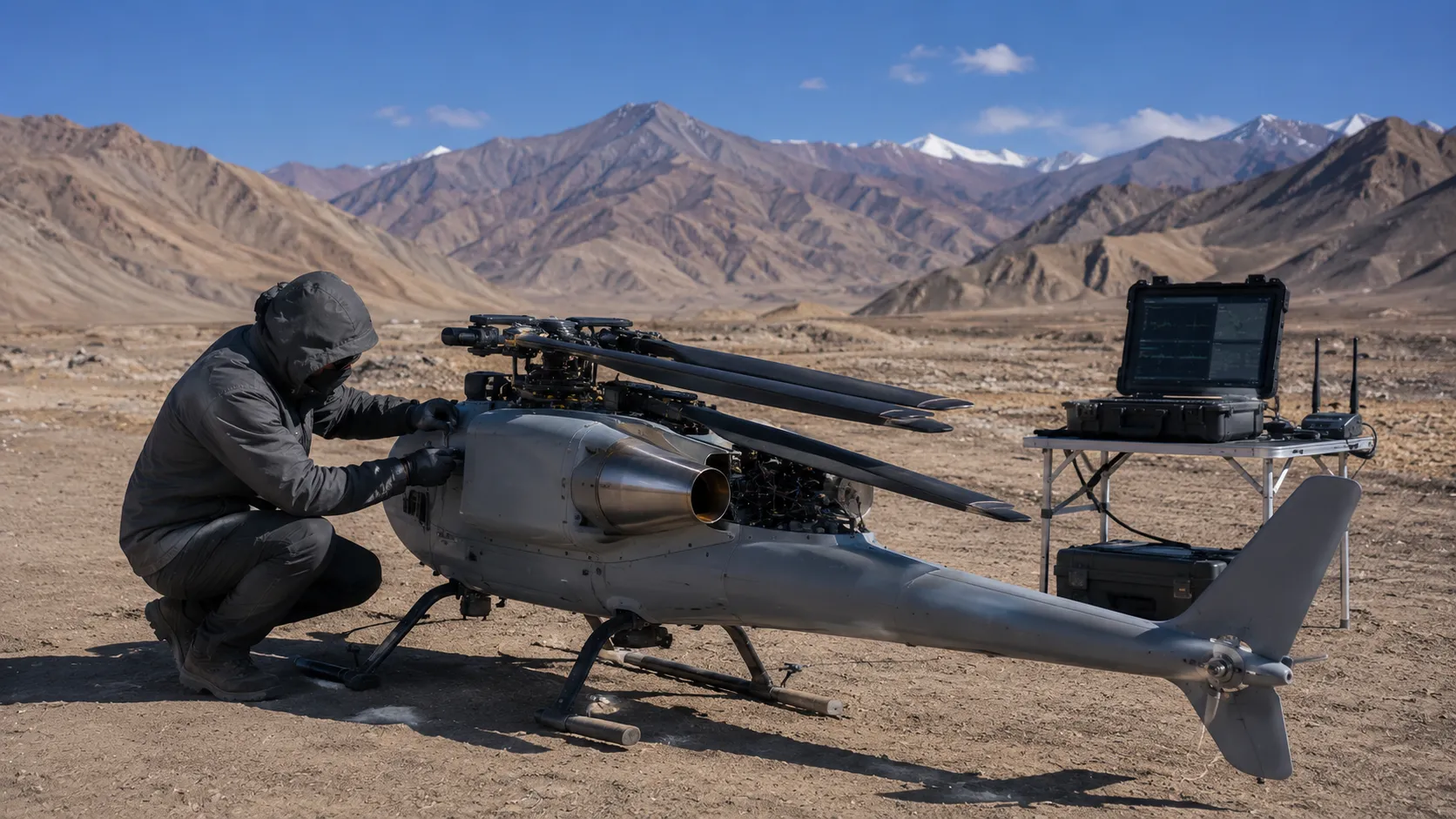
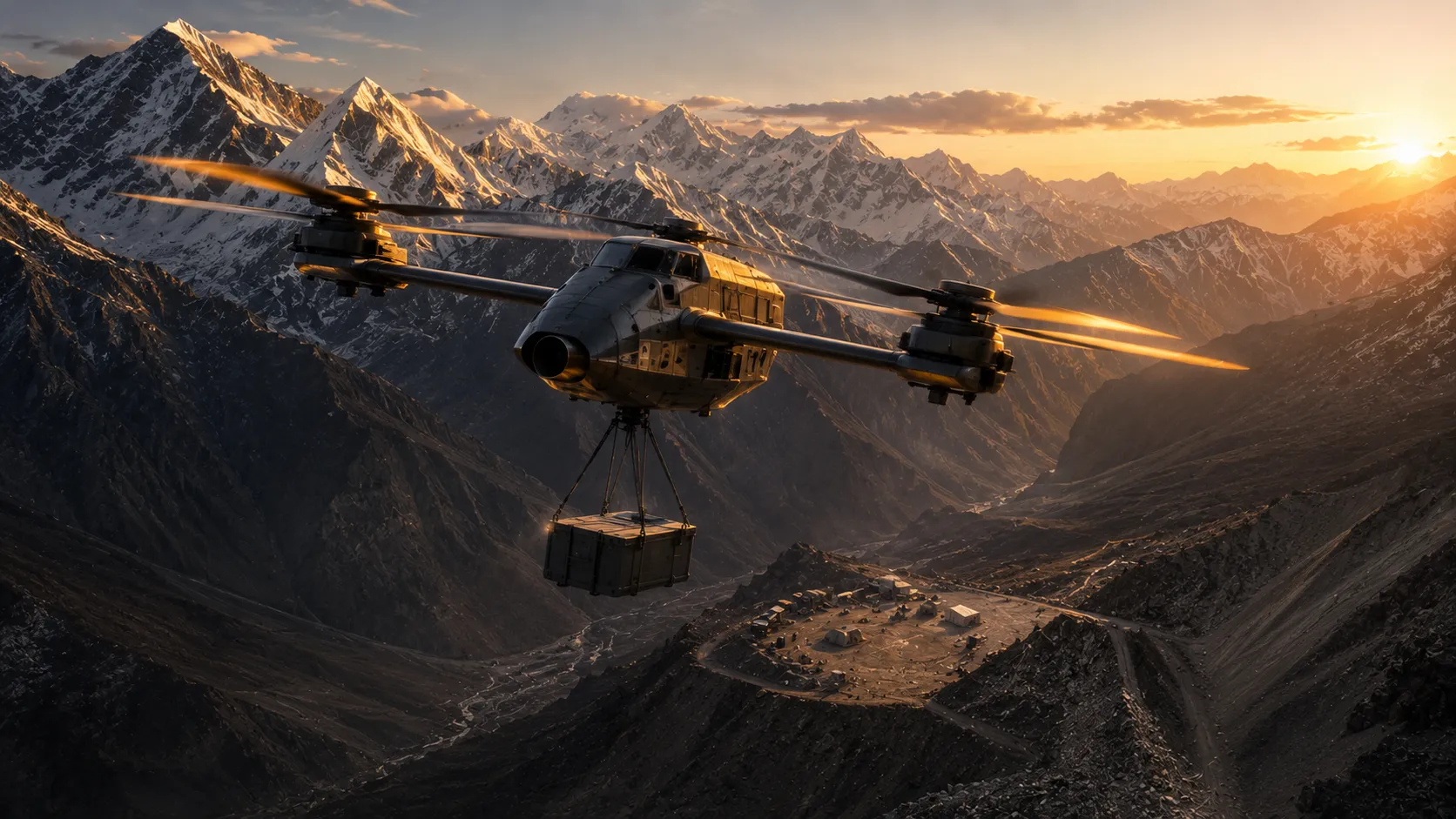
KANPUR — May 24, 2026 — Sometime in the next eighteen months, a machine the size of a small car will lift off from a clearing in the mountains of northern India. It will not need a runway. It will rise vertically, its variable-pitch rotors biting into the thin Himalayan air, a turbocharged internal combustion engine driving an advanced mechanical powertrain that has been designed, tested, and built entirely in India. Slung beneath it will be a payload of 200 kilograms—food, medical supplies, ammunition, construction equipment, whatever the terrain demands. It will fly for two and a half hours, covering 200 kilometres of some of the most unforgiving geography on Earth, and it will land vertically at a forward operating base, a remote village, or a disaster zone that no road has ever reached. Then it will do it again. And again. And again.
The machine is called SABAL-200. It is a vertical take-off and landing uncrewed aerial system—a heavy-lift drone, in the language of the industry—and it represents the most ambitious indigenous unmanned aircraft ever developed in India. On May 15, 2026, the company behind it, EndureAir Systems, received $3.1 million (approximately ₹30 crore) from the government's Research and Development Initiative fund, administered by the Department of Science and Technology through the Technology Development Board. The funding, structured as patient capital, will take the SABAL-200 from Technology Readiness Level 5—an advanced prototype that has demonstrated its core systems in a relevant environment—to TRL 9, a field-ready platform that has been tested, validated, and certified for operational deployment.
The SABAL-200 is not a startup's fever dream. It is the product of more than a decade of rotorcraft research and development at the Indian Institute of Technology Kanpur, where the company was founded in 2018 within the institute's innovation ecosystem. Earlier versions of the platform—SABAL-20 and SABAL-40, named for their payload capacities of 20 and 40 kilograms—have already been deployed across defence and civilian applications, including operations in high-altitude and difficult terrains where conventional helicopters cannot operate and fixed-wing aircraft cannot land. The SABAL-200 is the generational leap: a machine that can carry five times the payload of its predecessors, at ranges and in conditions that no Indian-made unmanned aircraft has ever attempted.
The Decade in the Lab
The origins of the SABAL platform trace back not to a venture capital pitch deck but to a university laboratory. For more than ten years, researchers at IIT Kanpur's rotorcraft lab had been studying the aerodynamics, control systems, and propulsion architectures required to build unmanned vertical take-off and landing aircraft that could operate in India's unique and demanding conditions. The work was incremental, painstaking, and largely invisible to the startup ecosystem that was busy funding consumer apps and e-commerce platforms.
The fundamental challenge of heavy-lift drone design is that the physics does not scale linearly. A drone that can carry 20 kilograms is not simply a larger version of a drone that can carry 5 kilograms. As payload increases, the rotor diameter must grow, the power requirements increase exponentially, and the control systems must compensate for the greater inertia and slower response times of larger machines. At 200 kilograms—roughly the weight of a grand piano—the engineering challenges cross a threshold where conventional electric multirotor architectures become impractical, and the design must incorporate elements of traditional rotorcraft engineering: variable-pitch rotors, mechanical powertrains, and combustion-based propulsion systems.
EndureAir's solution to these challenges is reflected in the SABAL-200's architecture. The platform combines a variable-pitch rotor system—a technology borrowed from conventional helicopters that allows the angle of the rotor blades to be adjusted in flight, improving efficiency and responsiveness—with a turbocharged internal combustion engine and an advanced mechanical powertrain. The combination is unusual in the drone industry, which has been dominated by electric multirotors that are simple, reliable, and limited in payload and range. By choosing a combustion-based powertrain, EndureAir sacrificed the silence and simplicity of electric propulsion for the range and payload capacity that only liquid fuel can provide. A 200-kilogram payload flown 200 kilometres on battery power alone is currently beyond the limits of any commercially available energy storage technology. The SABAL-200's decision to embrace combustion is a recognition that the hardest logistics challenges—supplying forward military positions, delivering relief supplies to disaster zones, moving equipment to remote infrastructure projects—cannot be solved by machines that need to recharge every forty minutes.
The company has said its platforms are based on more than a decade of rotorcraft research and development. Earlier UAV systems, including SABAL-20 and SABAL-40, have been deployed across defence and civilian applications, including operations in high-altitude and difficult terrains—places where the thin air reduces rotor efficiency, where temperatures swing from scorching to freezing in a single day, and where the nearest replacement part is a week away by road. Each deployment generated data that fed back into the design of the next generation. The SABAL-200 is not a prototype leaping from a lab bench into the field. It is the culmination of a development pathway that has been validated, incrementally, over years of real-world operations.
The RDI fund's decision to back the SABAL-200 is significant not just for the quantum of capital—$3.1 million is modest by global aerospace standards—but for the structure of the investment. The funding is classified as patient capital, a term that has become increasingly important in India's deeptech ecosystem. Unlike venture capital, which typically seeks returns within five to seven years, patient capital is designed for technologies that require long development cycles, sustained investment in testing and validation, and a tolerance for the kind of incremental progress that does not fit neatly into quarterly board presentations. "Building deep-tech aerospace systems is a long-cycle effort that extends well beyond prototyping," Abhishek said. "It requires sustained investment across testing, iteration and validation before systems are ready for deployment."
The Technology Development Board, which administers the RDI fund, has been allocated ₹2,000 crore as patient capital to support deeptech firms and industry-led research within India. The RDI fund itself was announced by the central government in November 2025 with a corpus of ₹1 lakh crore, to be deployed over six years, starting with an allocation of ₹20,000 crore in FY26. EndureAir was the first drone company to receive backing in the first cohort announced under the initiative—a distinction that places it at the leading edge of India's push to develop indigenous unmanned aerial capabilities.
The Logistics of the Inaccessible
The military applications of a 200-kilogram-payload drone are obvious, and EndureAir has been clear about the SABAL-200's intended role in defence logistics. The platform is designed to supply forward locations—military outposts, border patrol stations, special forces operating bases—that are beyond the reach of conventional logistics. India's northern borders run through some of the most inaccessible terrain on Earth, where roads are washed out by landslides for months at a time, where helicopters cannot fly in bad weather, and where the cost of delivering supplies by any existing method is measured in lives as well as rupees. A drone that can carry 200 kilograms of ammunition, food, and medical supplies to a forward post without risking a pilot or a helicopter is not a convenience. It is a strategic capability.
But the civilian applications are, in many respects, even more significant. India's infrastructure projects—roads, railways, power lines, pipelines—are increasingly being built in remote regions where the first challenge is not construction but logistics. How do you get cement, steel, and diesel to a work site that is 50 kilometres from the nearest road? How do you supply a village that is cut off by monsoon flooding for three months every year? How do you deliver vaccines, blood, and emergency medicine to a community health centre in the mountains when the road is blocked? These are not hypothetical questions. They are the daily reality of logistics in large parts of India, and the SABAL-200 is designed to answer them.
The company has said the development is expected to support import substitution and create employment opportunities, particularly in Tier 2 and Tier 3 cities, as it expands its manufacturing and operational footprint. The phrasing is careful, but the ambition behind it is clear. India currently imports the vast majority of its unmanned aerial systems, particularly at the heavier end of the payload spectrum. The military operates Israeli Heron and Searcher drones. The logistics sector relies on a patchwork of imported platforms and small, locally assembled quadcopters. A domestically designed, domestically manufactured heavy-lift drone that can be produced at scale would not just serve Indian customers. It would compete for export markets across Asia, Africa, and Latin America—regions that face similar logistics challenges and that have been underserved by the global aerospace industry.
The regulatory environment for drones in India has evolved significantly over the past several years. The Drone Rules, 2021 liberalised the regulatory framework, and subsequent policy interventions have created a more permissive environment for drone operations. The government's Production Linked Incentive scheme for drones and drone components has attracted investment into domestic manufacturing. The RDI fund's backing of EndureAir is part of a broader push to build an indigenous drone industry that can compete globally. The SABAL-200, if it achieves its TRL 9 target, will be the heaviest-lift indigenous drone ever deployed in India—and one of the most capable in its class anywhere in the world.
The RDI Fund and India's Deeptech Moment
The SABAL-200 funding arrived the same week that the Technology Development Board announced it had funded 22 deeptech projects across 14 startups, five MSMEs, and three listed companies as a second-level fund manager for the Research Development and Innovation Fund. The chosen projects illustrated the breadth of the ambition: Dhruva Space secured ₹105 crore for a satellite platform project; QNu Labs, a quantum communications startup, is deploying security-as-a-service across India's defence, telecom, and financial sectors; Eyestem Research is advancing regenerative medicine with a cell therapy for incurable retinal diseases.
The RDI Fund's structure represents something India has never attempted at scale: a government equity co-investment model inspired by Israel's Yozma programme of the 1990s. Before Yozma, Israel had a single venture capital fund and roughly 51 startups. Within a decade, the ecosystem had exploded to 80 funds. Out of that crucible emerged foundational deeptech companies like Waze and Mellanox. The first RDIF disbursal has been described as India's potential "Yozma moment"—the moment when state capital acts as a catalyst for private investment in frontier technology.
EndureAir's position as the first drone company to receive backing in the first cohort announced under the initiative places it at the centre of that moment. The $3.1 million is not a grant. It is an investment, structured as patient capital, that will be judged by its returns—financial, technological, and strategic. The company must now demonstrate that the SABAL-200 can move from an advanced development stage to a field-ready platform on schedule and on budget. The government, which has placed a bet on indigenous heavy-lift drone technology, is watching.
The Road to TRL 9
The path from TRL 5 to TRL 9 is long, expensive, and littered with the wreckage of promising aerospace projects that could not survive the transition from prototype to product.
TRL 5 means the system's basic components have been validated in a relevant environment—the engine has run, the rotors have spun, the control systems have functioned, and the machine has flown in conditions that approximate its intended operating environment. TRL 9 means the system has been proven through successful mission operations—it has flown real payloads over real distances in real conditions, repeatedly, reliably, and safely. The gap between the two is where aerospace projects go to die. It is the gap that requires flight testing, failure analysis, redesign, more flight testing, certification, regulatory approval, and the accumulation of thousands of hours of operational data that prove the machine will not fail when it is carrying a critical payload to a forward operating base in the Himalayas.
The $3.1 million from the RDI fund is designed to close that gap. The capital will fund research and development, technology upgrades, manufacturing capability, and field-testing infrastructure. The company has said the funding is structured as patient capital—a recognition that the path from TRL 5 to TRL 9 cannot be compressed into a venture capital timeline. The SABAL-200 will need to fly, fail, be redesigned, and fly again. The process cannot be rushed. The only thing that can be provided is the capital, the time, and the institutional support to see it through.
The broader context is an Indian drone industry that is attracting capital, talent, and regulatory attention at a pace that has surprised even optimistic observers. The government has identified unmanned aerial systems as a strategic sector. The military is expanding its drone procurement programmes. The civilian market—agriculture, infrastructure, logistics, emergency response—is beginning to open up as regulations evolve and costs decline. EndureAir, with its decade of rotorcraft research, its proven smaller platforms, and its ambitious SABAL-200 programme, is positioned at the intersection of all these trends.
What This Signals
The SABAL-200 is not yet a product. It is a prototype, funded by patient government capital, built on a decade of university research, designed to solve logistics challenges that have bedevilled the Indian military and Indian infrastructure for generations. The $3.1 million from the RDI fund is the largest single investment the programme has received, and it will be consumed quickly by the demands of flight testing, manufacturing scale-up, and field validation.
But the direction of travel is unmistakable. India's drone industry is moving from small, imported quadcopters to large, indigenously designed unmanned aircraft that can carry meaningful payloads over meaningful distances. The SABAL-200 is the leading edge of that transition—a machine that combines variable-pitch rotor technology, a turbocharged combustion engine, and an advanced mechanical powertrain into a platform that can lift 200 kilograms, fly 200 kilometres, and land vertically on a patch of cleared earth in the mountains.
The IIT Kanpur lab that spent a decade studying rotorcraft aerodynamics has produced a company that is now building the heaviest-lift indigenous drone in Indian history. The machine is not yet field-ready. The testing is not yet complete. The certification is not yet granted. But the patient capital has arrived, the engineering foundation has been laid, and the logistics challenges that the SABAL-200 was designed to solve—the forward outposts, the disaster zones, the remote infrastructure projects—are not going away. The drone that can carry 200 kilograms across the Himalayas is not a distant ambition. It is a prototype, in a hangar in Kanpur, preparing for its next test flight. The mountains are waiting.


