The Consciousness Upload: Why Brain‑Computer Interfaces Are About to Redefine Being Human
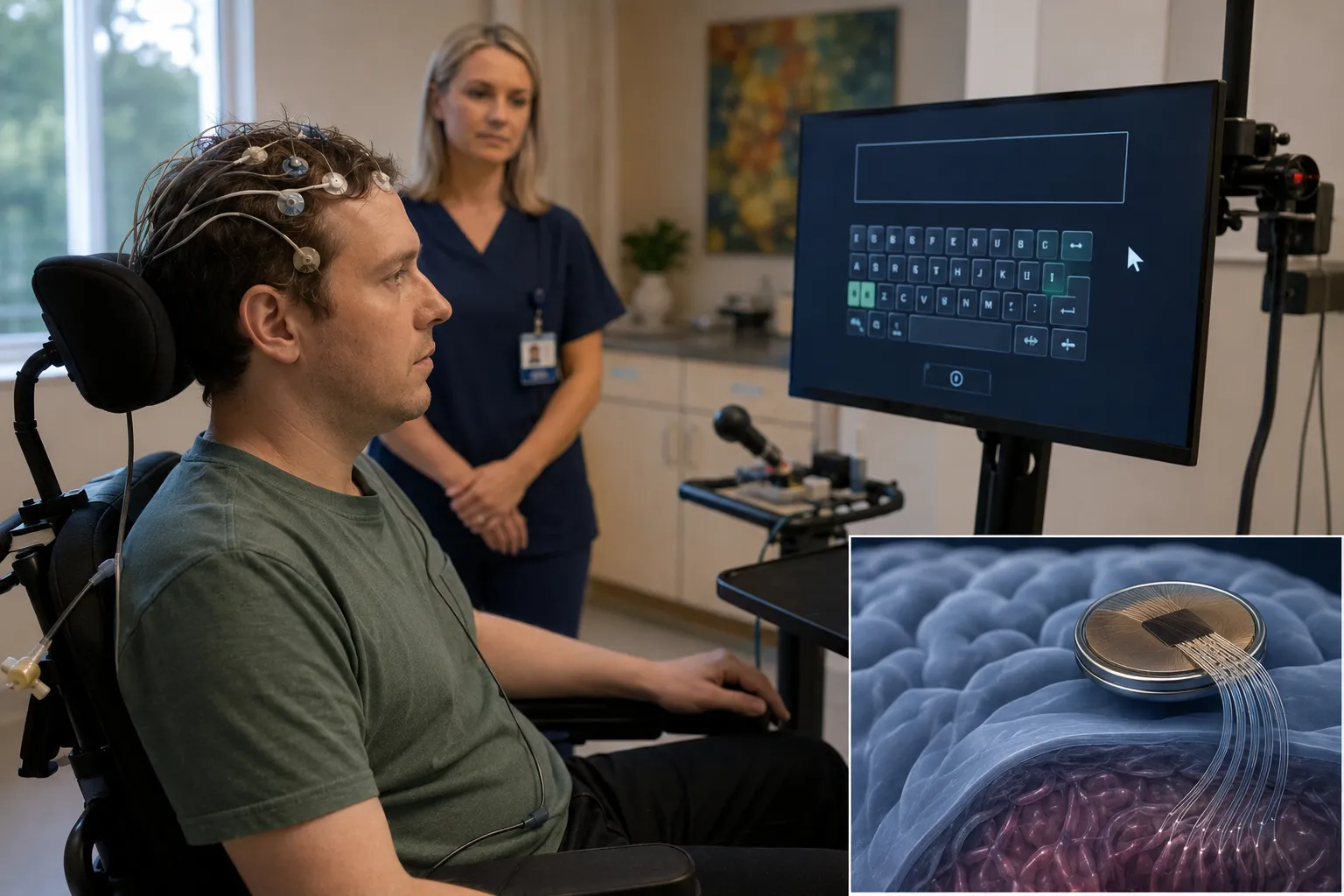
SAN FRANCISCO, Calif. — May 26, 2026 — The patient is a 29‑year‑old man named Alex. Four years ago, a diving accident left him paralyzed from the neck down. He cannot move his arms or legs. He cannot feed himself. He breathes with a ventilator. But he can think. And thinking, it turns out, is enough. Implanted in his motor cortex is a coin‑sized device with 1,024 flexible electrodes, thinner than a human hair, each listening to the faint electrical chatter of his neurons. The device, from Elon Musk's Neuralink, transmits that chatter wirelessly to a small receiver on his chest, which relays it to a nearby computer. An AI model, trained on months of Alex's attempted movements, decodes his neural firing patterns into commands: move cursor up, click, type letter. Alex can now browse the web, send emails, play chess, and control a robotic arm. He does all of this with his thoughts alone.
"I am not a cyborg," Alex says, his eyes moving across a screen, a cursor following his imagined hand. "I am still me. But the me part now includes a computer. I don't feel the chip. I just feel the freedom. For the first time since the accident, I can tell someone to go away without asking a nurse to type it."
Alex is one of approximately 150 people worldwide who have received a long‑term, high‑bandwidth brain‑computer interface (BCI). The technology has moved from academic labs to commercial products in just five years. Neuralink, Synchron, Blackrock Neurotech, and a dozen startups are racing to refine implants that allow humans to control digital devices directly with their minds. The first applications are medical: restoring communication for the locked‑in, movement for the paralyzed, sight for the blind. But the long‑term vision is universal. If a BCI can read a paralyzed person's intention to move a cursor, it can read anyone's intention to do anything. The same technology that lets Alex type with his thoughts could one day let you type with your thoughts—no keyboard, no voice, no gesture. And from there, the slope gets slippery. Thought‑to‑text becomes thought‑to‑search becomes thought‑to‑purchase becomes thought‑to‑everything. The boundary between the self and the machine dissolves.
"I don't feel the chip. I just feel the freedom. For the first time since the accident, I can tell someone to go away without asking a nurse to type it." — Alex, Neuralink patient
How a BCI Works: Reading the Brain's Whispers
The brain does not think in English. It thinks in electrochemical spikes, action potentials that travel along neurons at speeds up to 120 meters per second. Each spike is a binary event—firing or not firing—but the meaning emerges from the pattern of firing across populations of thousands or millions of neurons. To decode that pattern, you need electrodes that can record from many neurons simultaneously, and algorithms that can translate those recordings into commands.
The first BCIs, developed in the 1990s, used penetrating electrode arrays (the Utah array) that recorded from about 100 neurons. They worked, but the wires passed through the skull, risking infection. Modern BCIs are fully implantable, wireless, and vastly more capable. Neuralink's device records from 1,024 channels. A prototype from the Allen Institute records from 10,000. The theoretical limit, given current electrode density, is about 100,000 channels—enough to decode complex intentions, memories, and even imagined speech.
The decoding algorithms are deep neural networks trained on hours of the user's own neural data. The user imagines moving a cursor up; the network learns which neurons fire in that pattern. The user imagines saying the word "coffee"; the network learns the pattern for that subvocalization. Over time, the network adapts as the user's neural representations change (neuroplasticity). The result is a closed loop: the user thinks, the BCI decodes, the computer acts, the user sees the result, the brain adjusts, the BCI adjusts. The learning is mutual.
"We are not reading minds in the science fiction sense," says Dr. Leigh Hochberg, a neurologist at Brown University and a leader in the BrainGate consortium. "We are decoding motor intentions—the desire to move a cursor, to speak a word. We cannot read memories, dreams, or private thoughts. But we are getting closer. The question is not whether we will eventually decode more complex cognition. The question is whether we should."
The Medical Miracle: Restoring What Was Lost
The first generation of BCIs is unambiguously good. Alex's implant has given him a degree of independence that no other technology could provide. Other patients have achieved similar results.
A locked‑in patient with ALS, who could not move any voluntary muscle including his eyes, used a BCI to spell words at 15 characters per minute—slow, but enough to tell his family he loved them. He later used the BCI to write a book.
A stroke survivor with aphasia (loss of speech) used a BCI that decoded his subvocal attempts to speak. The system recognized 50 words with 90 percent accuracy, allowing him to say "thirsty" or "pain" without moving his lips.
A blind patient received a BCI connected to a camera mounted on glasses. The system converted visual information into patterned electrical stimulation of the visual cortex, producing phosphenes—dots of light—that allowed him to navigate around obstacles and recognize large letters.
"This is not experimental," says Dr. Hochberg. "This is clinical reality. The FDA has granted breakthrough device designation to three BCI systems. They are being used in hospitals, not just labs. For patients with severe disability, the risk‑benefit ratio is overwhelmingly positive."
The Consumer Frontier: Typing Without Typing
If a BCI can restore function to the paralyzed, it can also enhance function for the healthy. The consumer BCI market is the elephant in the room. Neuralink has stated publicly that its long‑term goal is a "full brain interface" for everyone, allowing "symbiosis with AI." Synchron has demonstrated a BCI that works through the blood vessels (no open brain surgery) and can be controlled via an iPhone app. Several companies sell non‑invasive EEG headsets that allow users to play simple games or control smart home devices with concentration—though these are slow and unreliable compared to implants.
The leap from medical to consumer will require three breakthroughs: safety (no infection, no rejection, no tissue damage), bandwidth (enough channels to make the interface faster than typing or voice), and price (low enough for the mass market). The first two are in sight. The third will come with scale.
"Imagine a world where you can type 150 words per minute by thinking," says Dr. Ramesh Rao, director of the Qualcomm Institute at UC San Diego. "Imagine searching the internet just by thinking of what you want. Imagine controlling your car, your thermostat, your entire digital life without lifting a finger. That is not science fiction. That is the logical endpoint of the technology we have today. The only question is whether we, as a society, are ready for it."
The Dark Side: Privacy, Agency, and Inequality
The consumer BCI raises three terrifying possibilities.
Privacy. A BCI that reads motor intentions could, with sufficient resolution, read other cognitive states. Could an employer require job candidates to wear a BCI and measure their focus during interviews? Could an insurer raise your rates if your neural patterns show risk‑seeking? Could a government compel a suspect to "replay" their memories? The Fourth Amendment was written for physical spaces, not neural firing patterns. The law has no answer.
Agency. If a BCI can read your intention to move, it can also write intentions—stimulating neurons to make you move, or feel, or want. This is the stuff of nightmare: a hacked BCI could make you purchase products, send messages, or even commit acts against your will. The security requirements for consumer BCIs are orders of magnitude higher than for smartphones. We are nowhere close.
Inequality. The rich will get the best BCIs first. They will type faster, learn faster, communicate faster. The gap between enhanced and natural humans will widen into a chasm. If BCIs become the primary interface for high‑skill work, the un‑implanted will be unemployable. We have seen this pattern with every transformative technology from literacy to computers. BCIs will accelerate it.
"We are sleepwalking into a new layer of inequality," says Dr. Nita Farahany, a Duke law professor and author of The Battle for Your Brain. "BCIs are not like smartphones. They are not external. They go inside you. They have the potential to access your innermost thoughts. We need a legal framework for neural rights—the right to cognitive liberty, the right to mental privacy, the right to not be compelled to interface. We need it now, before the technology is embedded and the norms are set."
"We need a legal framework for neural rights—the right to cognitive liberty, the right to mental privacy, the right to not be compelled to interface. We need it now, before the technology is embedded." — Dr. Nita Farahany, Duke University
The Transhumanist Dream: Merging with AI
The most visionary—or delusional—proponents of BCIs see them as the next step in human evolution. If you can type with your thoughts, you can also download information directly into your brain. If you can download information, you can learn a language in minutes. If you can learn a language in minutes, you can integrate an AI assistant that lives in your cortex, whispering answers to questions before you finish thinking them. If that AI assistant is connected to the cloud, you become a distributed intelligence: part human, part machine, part network.
"This is not about fixing broken people," says Greg Gage, a neuroscientist and entrepreneur. "This is about upgrading the human condition. We have always used tools to extend ourselves—books, telescopes, computers. BCIs are the first tools that live inside the loop of cognition. They don't just extend our output. They change the input. They change what it means to think."
Elon Musk has been the most vocal proponent. He has repeatedly predicted that Neuralink will enable "superhuman cognition" and "AI symbiosis" within a decade. Critics call him a hype artist. Supporters call him a visionary. The truth is somewhere in between: the technology is real, the trajectory is upward, but the timeline is uncertain. The brain is still the most complex object in the known universe. We are learning to read its whispers. We are far from shouting back.
The Path to 2030
The next five years will be decisive. Neuralink plans to implant 10 more patients in 2026 and 100 in 2027. Synchron's device, which is less invasive (it goes through the jugular vein to the motor cortex), has already been implanted in 20 patients and is seeking FDA approval for commercial sale. Blackrock Neurotech's Utah array has been used in dozens of academic studies and is now being commercialized.
Meanwhile, the ethical and legal debates will intensify. The Neurorights Initiative, based at Columbia University, has drafted a model "Neural Bill of Rights" that includes five principles: the right to mental privacy, the right to personal identity, the right to free will, the right to fair access, and the right to protection from algorithmic bias. Chile has already amended its constitution to include "neural rights." The European Union is considering similar legislation. The United States has held congressional hearings but no bills have passed.
"We are in the early days of the internet again," says Dr. Farahany. "Nobody in 1995 could have predicted social media, misinformation, surveillance capitalism. We are making the same mistakes, but this time the stakes are higher. The data is not your clicks. It is your thoughts. We must regulate before the horse has left the barn."
The Patient's Voice
Alex, the Neuralink patient, is not a philosopher. He is a young man who wants to live. He uses his BCI to play online poker, message his mother, and control the lights in his room. He does not worry about neural rights or transhumanism. He worries about the battery life of his implant (eight hours, needing a daily recharge). He worries about the software updates that occasionally break his cursor control. He worries about the future: will Neuralink continue to support his device if the company pivots to consumer products?
"I don't think about merging with AI," he says. "I think about scratching my nose. I can't. But I can tell the computer to call a nurse, and the nurse will scratch it for me. That's a miracle. I'll let the philosophers worry about the rest."
The cursor moves across his screen. He selects a letter. Then another. Then another. He is typing a message. It takes time. But it takes less time than it did yesterday. The AI learns. The brain adapts. The machine becomes part of him. That is the promise and the peril. We are not there yet. But we are on the path. And the path leads to a place where the mind and the machine are no longer separate. The only question is what we will become when they meet.


