The Company That Powers Every AI App You Use—And the 13 Cloud Providers It Had to Scramble to Find Just to Keep the Lights On
SAN FRANCISCO — May 22, 2026 — Erik Bernhardsson has spent the past six months doing something no CEO of a serious infrastructure company ever wants to do: calling up cloud providers he has never heard of and begging them for spare GPU capacity. His company, Modal Labs, is not a small startup struggling to find compute. It is a $4.65 billion business that just raised $355 million in Series C funding, quintupled its annualized revenue from $60 million to $300 million since September, and counts biotech companies, hedge funds, and weather-forecasting firms among its customers. And yet, Bernhardsson has been forced to cast an ever-wider net for the chips his customers need, expanding Modal's roster of cloud suppliers from five to thirteen in a matter of months, including names he admits he had never encountered before the great GPU famine of 2026 forced him to go looking.
"I had never heard of them before," Bernhardsson told Reuters on Wednesday, describing some of the providers he has added to Modal's network. He did not name them. He did not need to. The statement alone captured the defining tension of the AI infrastructure market in 2026: demand is accelerating so fast that even a company growing at 5× annual revenue, backed by Redpoint Ventures and General Catalyst, with a war chest of $355 million in fresh capital, is scrambling to secure enough compute to keep its customers' AI systems running.
Modal is not a household name. It does not build large language models or compete with OpenAI and Anthropic. It is something rarer and, in the current environment, arguably more valuable: the infrastructure layer that sits between the companies building AI applications and the cloud providers that supply the chips on which those applications run. Modal provides inference capacity—the computing power required to run a trained AI model and generate responses to user queries—and a sandbox product that lets developers test AI-generated code before deploying it. It is the plumbing. But in 2026, the plumbing is the scarcest resource in the technology industry, and the plumbers are naming their price.

The Two-Tranche Round That Told the Story
The structure of Modal's Series C round is as revealing as its size. The company raised capital in two tranches. The first closed at a $2.5 billion valuation—more than double the $1.1 billion valuation from the fall. But before that tranche had even settled, more investors began knocking on Bernhardsson's door. The second tranche closed at $4.65 billion. In the space of a single funding round, Modal's valuation nearly doubled again.
The velocity of the re-pricing is a signal. Modal's revenue has grown fivefold since September, from an annualized rate of $60 million to approximately $300 million. The growth is being driven by a single, structural shift: AI is writing more code, and all of that code needs to run somewhere. "Coding for the last six months has been driving everything," Bernhardsson said. His customers include biotech companies running AI-powered drug discovery simulations, hedge funds executing algorithmic trading strategies, and weather-forecasting firms generating high-resolution climate models. Each of these workloads requires enormous quantities of inference compute, and each of them is growing as AI models become more capable and more integrated into enterprise workflows.
The two-tranche structure was not a negotiation tactic. It was a reflection of how quickly the market was moving. The investors who committed at $2.5 billion were getting a price that, within weeks, looked cheap. The investors who committed at $4.65 billion were paying a premium to secure access to a company whose revenue trajectory was bending sharply upward. The round was led by Redpoint Ventures and General Catalyst, with General Catalyst taking a board seat. Accel and Menlo Ventures participated in the second tranche. The final tally—$355 million—made Modal one of the most valuable AI infrastructure startups on Earth.
The Compute Bottleneck That Nobody Escapes
Modal's scramble for GPU capacity is not unique. It is the defining operational challenge of the AI industry in 2026. The four largest hyperscalers—Amazon, Microsoft, Alphabet, and Meta—are on track to spend approximately $725 billion on AI infrastructure this year, and a significant portion of that spending is being consumed by component price inflation rather than real capacity expansion. Memory chip prices have surged as DRAM capacity is diverted into AI servers. Nvidia's GPUs, the dominant hardware for AI inference, remain supply-constrained despite the company's relentless production ramp. The result is an environment in which even the largest buyers of compute are being forced to diversify their supplier base, seeking capacity from smaller, less established cloud providers who have managed to secure GPU allocations that the hyperscalers have already booked solid.
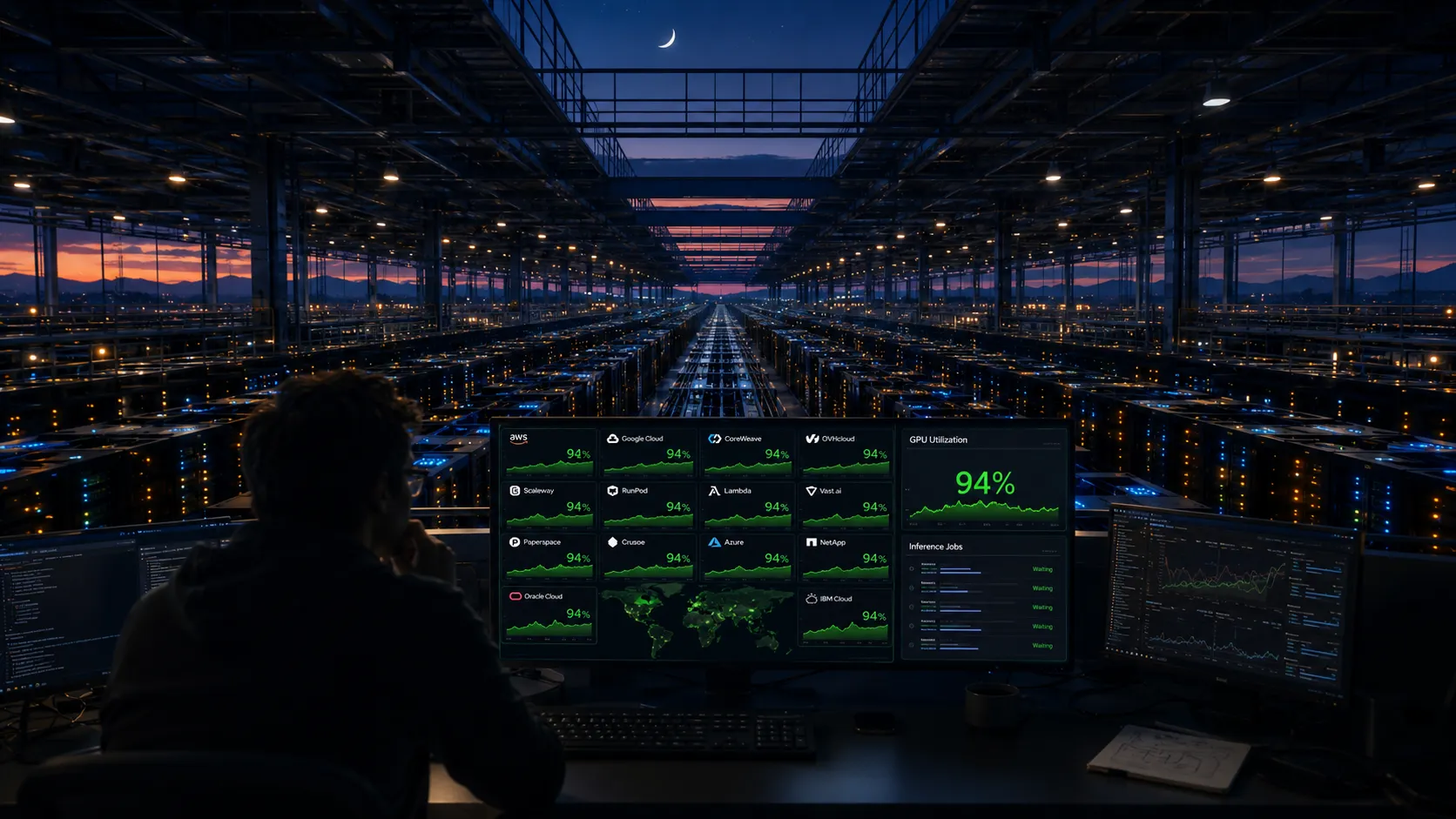
Modal has expanded its supplier network from five cloud companies to thirteen in the past year. Some of those providers, Bernhardsson acknowledged, were ones he had never heard of before the GPU shortage forced him to go looking. The admission is striking because it underscores how fragmented the AI compute market has become. The hyperscalers—AWS, Azure, Google Cloud—dominate the public conversation about AI infrastructure. But beneath them, a growing ecosystem of regional and specialized cloud providers has emerged, each with its own allocation of GPUs, its own pricing model, and its own limitations on capacity. Modal's job is to aggregate that fragmented supply into a unified, reliable platform that its customers can depend on.
The challenge is not merely operational. It is existential. Modal's customers—biotech firms, hedge funds, weather forecasters—are running workloads that cannot tolerate interruptions. A drug discovery simulation that loses access to GPUs mid-run may need to be restarted from scratch, costing days of compute time and millions of dollars in wasted resources. A trading algorithm that experiences latency spikes can lose money in fractions of a second. Modal's value proposition is that it can abstract away the complexity of the underlying GPU market, providing reliable inference capacity regardless of which cloud provider supplies the physical chips. But that abstraction is only as good as the diversity of the supplier base, and the supplier base, in 2026, is being stretched to its limits.
The AI Coding Surge
The revenue growth that has propelled Modal from $60 million to $300 million in annualized revenue in six months is not coming from a single source. It is coming from the structural shift in how software is being built.
AI coding assistants—Anthropic's Claude Code, GitHub Copilot, Cursor, and a growing roster of competitors—are generating an increasing share of the world's production software. That code needs to be tested, validated, and deployed before it reaches production. Modal's sandbox product provides an environment where developers can test AI-generated code in a controlled setting, verifying that it works as intended before embedding it in their applications. The sandbox has become one of the company's fastest-growing product lines, driven by the same AI coding surge that is transforming software development.
But the sandbox is only half the story. Once AI-generated code is deployed, it needs to run somewhere—and increasingly, it runs on Modal's inference platform. The same biotech company that uses AI to design a new protein molecule needs GPU capacity to simulate its behavior. The same hedge fund that uses AI to generate a trading strategy needs GPU capacity to execute it. The same weather forecaster that uses AI to model a hurricane's trajectory needs GPU capacity to render the prediction. Modal is the common infrastructure across all of these use cases, and the demand for that infrastructure is growing faster than the supply of GPUs.
What This Signals
The Modal Labs story is not primarily about a startup raising $355 million at a $4.65 billion valuation. It is about the structural bottleneck that is defining the AI industry in 2026: the mismatch between the speed at which AI applications are being built and the speed at which GPU capacity is being deployed.
The AI coding surge has produced an explosion of new applications, each of which requires inference compute to function. But the physical infrastructure required to supply that compute—the data centers, the GPUs, the networking equipment, the power plants—takes years to build. The result is a bottleneck that is being felt by every company in the AI ecosystem, from the largest hyperscalers to the smallest startups. Modal's scramble to find thirteen cloud providers, some of them previously unknown, is a symptom of that bottleneck. The two-tranche funding round that nearly doubled in valuation within weeks is a measure of how urgently the market is seeking solutions.
The company that Bernhardsson has built is not glamorous. It does not make headlines. It does not compete with OpenAI or Anthropic. But in a world where AI code is proliferating faster than the hardware required to run it, the company that can reliably connect applications to compute capacity—regardless of which cloud provider supplies the physical chips—is essential infrastructure. The $355 million round is the market's judgment that essential infrastructure, in the AI economy of 2026, is worth roughly $4.65 billion. The next test is whether Modal can continue to find compute providers it has never heard of—and whether those providers can keep the lights on.


