The Coconut Plantation That Lost Money on Every Tree: How a Kerala Couple's Search for Healthy Snacks Became a Mission to Save India's Farmers—One Millet Cookie at a Time
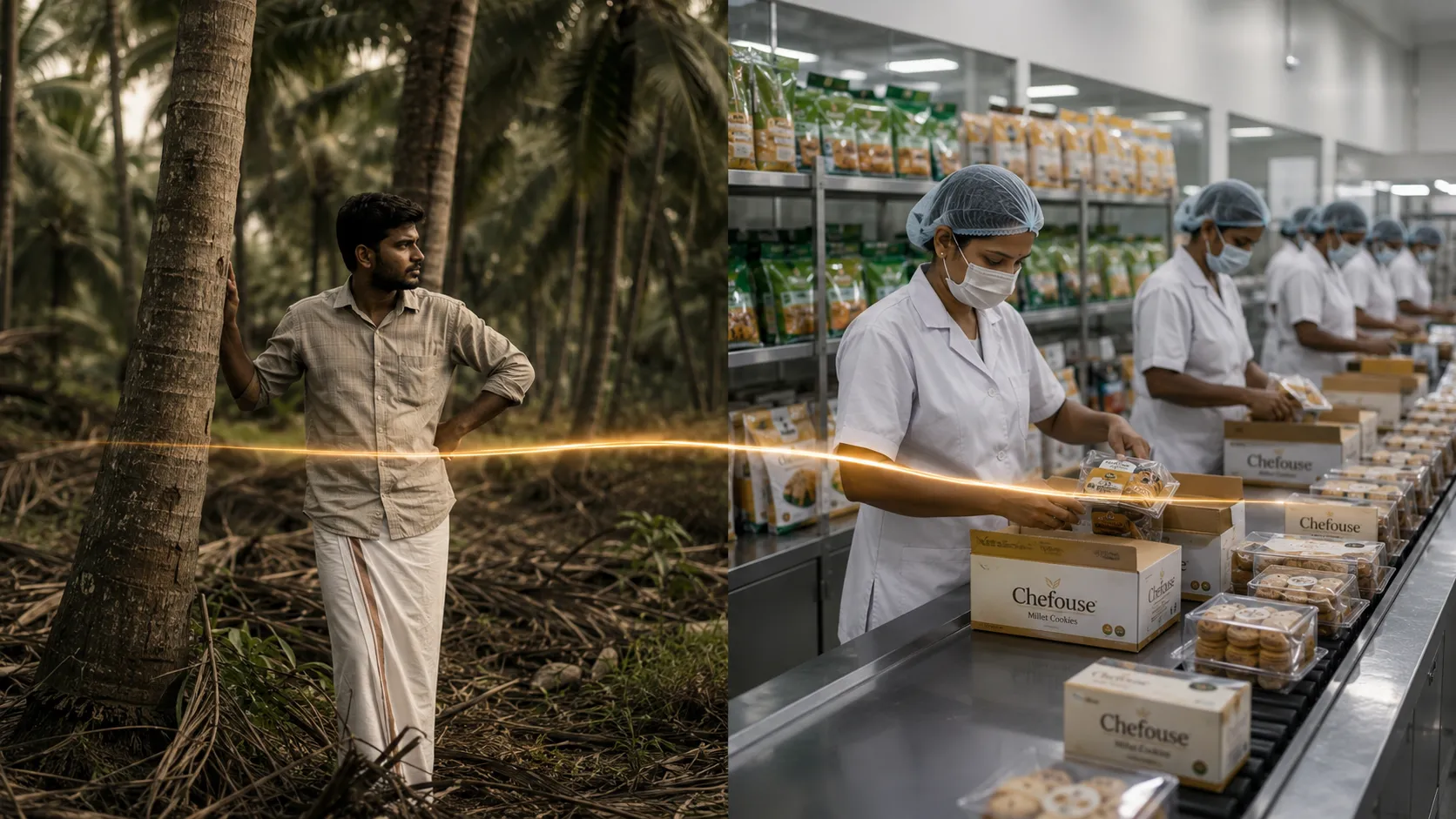
KOZHIKODE, KERALA — May 26, 2026 — Years ago, fresh out of school, Noorudheen Kuttaloorpari found one of his greatest joys in visiting his father's coconut plantation in Malappuram. Every day, he would water the plants and marvel at the lush greenery and the sprawling paddy fields nearby. The abundance of nature filled him with pride, and he naturally assumed that the plantation was a source of prosperity. Then reality struck. The price of a coconut barely touched ₹6, while the cost of cultivation was ₹7. The plantation was running at a loss. "This wasn't just our story," Noorudheen wrote years later. "It was the story of countless farmers in the region. Those who worked tirelessly to create the lush, green landscapes were struggling to make ends meet."
The realisation planted a question that would take years to answer: what if the solution was not to sell the coconut, but to transform it? What if the way to save India's farmers was not to increase their yields, but to increase the value of what they already grew? The question lingered through years of travel across the country, through conversations with agricultural officers and immersion in farming magazines, through a growing conviction that a single value-added factory would not be enough. "What was needed was a movement," Noorudheen wrote, "one that could lead to the massive introduction of new value-added products from our agricultural bounty, transforming India's produce into various forms suited for different countries and exporting them."
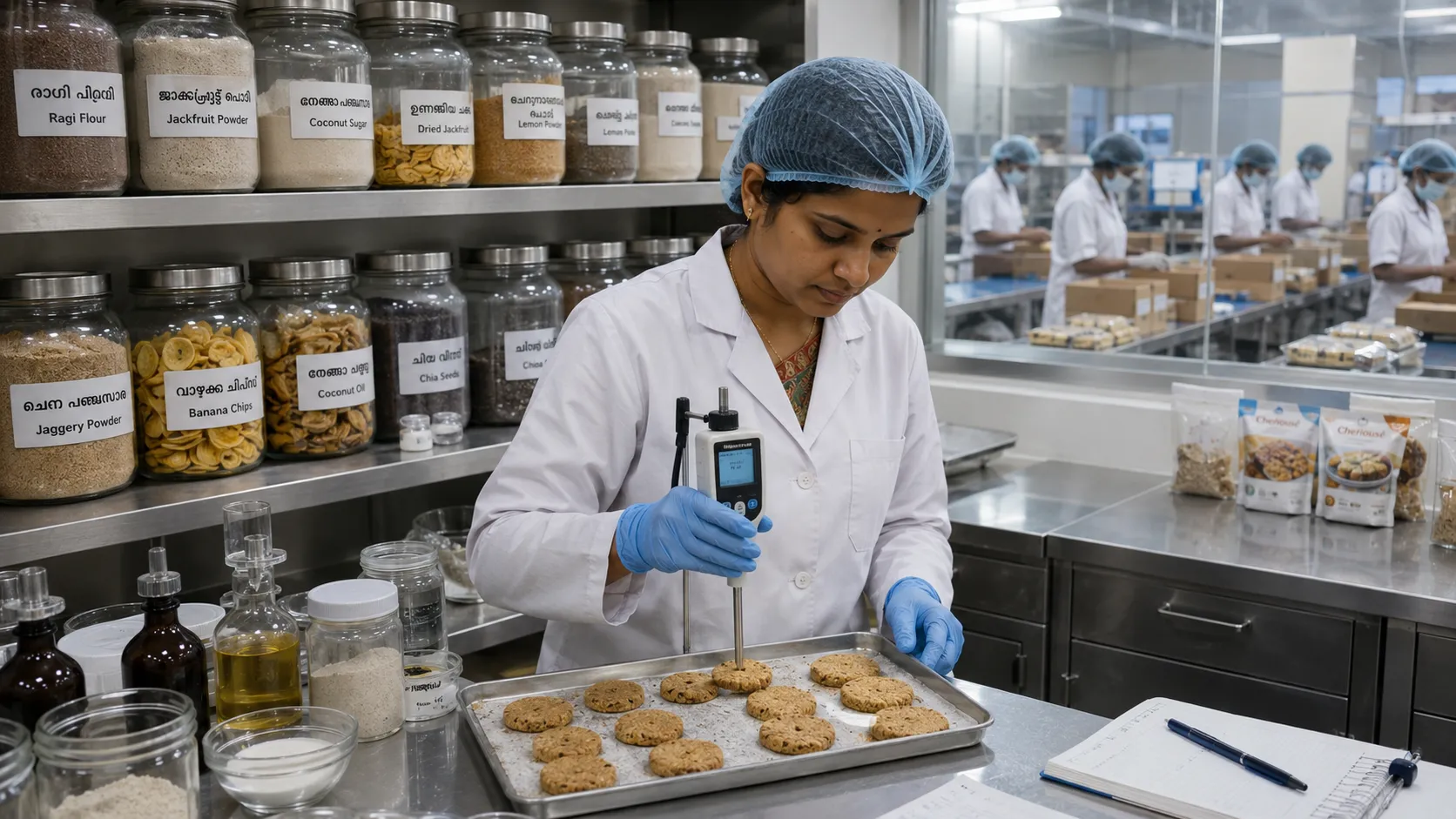
Today, that movement has a name. Chefouse—the spelling a deliberate collision of "chef" and "house"—is a Kozhikode-based startup founded by Noorudheen and his wife, Fathima Fasmina, that is building a decentralised network of village-based food factories across Kerala. The company produces nutrient-dense snacks from locally sourced superfoods: millet, jackfruit, ragi, and bananas. It currently offers 11 products, with an ambitious pipeline of over 200 traditional recipes set to launch at a rate of one new product every month. It operates a manufacturing and R&D centre at Kakkanchery in Kozhikode, with a second facility coming up in Mattannur, Kannur. The couple plans to establish 20 units across the state and then expand nationally. And it was all born from a search that began not in a boardroom, but in a kitchen—when two parents went looking for healthy snacks for their children and discovered that the market had almost nothing to offer.
The Parents Who Couldn't Find a Healthy Snack
The origin story of Chefouse does not begin with agriculture. It begins with a pantry. Noorudheen and Fathima, like millions of Indian parents, wanted healthy snacks for their children—food that was nutritious, natural, and free of the refined flour, refined sugar, and artificial additives that dominate the packaged-snack industry. They searched supermarket shelves, scanned ingredient labels, and found almost nothing. The "healthy" snacks were either imported and expensive, or Indian and misleading—products that claimed to be nutritious but were, on closer inspection, little more than maida and sugar rebranded for the wellness generation.
Frustrated by the market's failure, the couple turned inward—to their own kitchen, to the food traditions they had inherited from their families, and to the ingredient culture of Kerala. They began experimenting with traditional recipes that used millets instead of refined flour, jaggery instead of white sugar, and locally grown superfoods—jackfruit, bananas, ragi—that were abundant in Kerala but almost entirely absent from the packaged-food aisle. The snacks they produced in their home kitchen were not just healthier than the market alternatives. They tasted better—deeper, more complex, more connected to the land. The children loved them. The neighbours asked for more. The couple began to wonder whether what they had built for their own family could be built for others.
The decision to turn the idea into a startup was not a leap of faith. It was an informed bet. Both Noorudheen and Fathima came from families with experience in the food business in the Gulf countries—the network of Indian-owned restaurants, catering operations, and food trading companies that serve the massive South Asian diaspora in the Middle East. The family background gave them something that most first-time food entrepreneurs lack: an understanding of what it takes to produce food at scale, to manage supply chains, and to navigate the regulatory requirements of multiple markets. It also gave them an understanding of what the global consumer wanted—and the confidence to believe that an Indian snack brand, built on Indian ingredients and Indian food traditions, could compete in international markets.
The couple launched Chefouse with a thesis that was both commercial and philosophical. Commercially, they believed that the market for healthy, ingredient-led snacks was large and growing—driven by the same consumer shift that had transformed the food industries in the West, and that was now arriving in India with generational force. Philosophically, they believed that the packaged-food industry had a responsibility to the farmers who grew its ingredients—and that a company that sourced directly from farmers, paid fair prices, and invested in the revival of forgotten crops could be both profitable and purposeful. "Beyond a business, our goal is to introduce to the world the delicious diversity and nutritious richness of the local snacks from different parts of India," Noorudheen said. The statement was not marketing. It was the founding thesis of the company, and it shaped every decision the couple made from that point forward.
The Decentralised Factory Model
The most strategically significant decision the couple made was not a product choice or a branding decision. It was an architectural one. Rather than building a single large, centralised factory—the conventional model for scaling a food business—they opted for a decentralised, franchise-based network of village-level manufacturing units. Each unit would be small, locally staffed, and dedicated to producing a specific category of products using ingredients sourced from the surrounding region. The model was inspired by a simple insight: authenticity lives close to the source. A jackfruit chip made in a factory near the jackfruit orchards of Kerala tastes different—better—than a jackfruit chip made in a factory hundreds of kilometres away, because the ingredient is fresher, the knowledge of how to process it is deeper, and the connection between the grower and the processor is direct.
The decentralised model also serves a social purpose that is as important to the founders as the commercial one. Each village-based unit creates employment for local women and communities—the people who are most directly affected by the decline of traditional agriculture and who have the fewest alternatives when farming fails. The units are designed to be operated by women, offering flexible hours, safe working conditions, and the dignity of formal employment in regions where such opportunities are scarce. The company also encourages the re-cultivation of forgotten healthy grains—millets that were once staples of the Indian diet and that have been pushed to the margins by the Green Revolution's focus on rice and wheat. By creating a market for these grains, Chefouse is not just selling snacks. It is rebuilding the agricultural economy of rural Kerala, one millet cookie at a time.
The model is not without challenges. Sourcing ingredients like jaggery and millets, instead of refined flour and refined sugar, means working with supply chains that are still evolving and less standardised than the industrial commodity markets that serve the conventional food industry. "Variations in these ingredients affect baking behaviour, taste, and texture, making consistency at scale more demanding," Noorudheen told FMT Magazine. "Overcoming this requires tighter sourcing control, clearly defined specifications, and continuous quality validation. While challenging, this approach is essential to preserve the integrity of our products and our commitment to non-conventional formulations." The couple have chosen the harder path—not because they enjoy difficulty, but because the easier path leads to the same homogenised, industrialised food system they set out to challenge.
The company has also invested heavily in R&D, building a dedicated research centre at its Kakkanchery facility and recruiting food technologists who understand the specific demands of working with non-conventional ingredients. "At Chefouse, we strongly believe that quality ingredients lead to quality products," Noorudheen said. "Our quality assurance begins with raw material sourcing based on strict specifications defined by our R&D, ensuring consistency and reliable performance from the very first step." The R&D investment is unusual for a startup at this stage—most early-stage food companies outsource product development to contract manufacturers—but it reflects the couple's conviction that the company's competitive advantage lies not in its branding or its distribution, but in the authenticity and quality of its products. A jackfruit chip that tastes like a commodity snack will fail. A jackfruit chip that tastes like Kerala will succeed.
The 200-Recipe Pipeline
The most audacious dimension of the Chefouse vision is not the current product line—11 items, available in retail stores across Kerala and sold online to customers throughout India—but the pipeline behind it. The company has identified over 200 traditional recipes from across India that it plans to launch at a rate of one new product per month. The recipes are not invented by food scientists in a corporate laboratory. They are collected from home cooks, from temple kitchens, from the grandmothers and aunties who have been making these snacks for generations without ever thinking of them as commercial products.
The pipeline reflects a philosophy that Noorudheen has articulated in multiple interviews: that the future of the Indian snack industry lies not in copying Western formats, but in rediscovering and commercialising India's own culinary heritage. The millet cookies, the jackfruit chips, the ragi murukku, and the banana crisps that Chefouse currently sells are not new inventions. They are traditional foods, adapted for modern packaging and modern distribution, and the company's role is not to create them but to scale them—to take what a grandmother in a Kerala village has been making for her family for fifty years and make it available to a consumer in Mumbai, Dubai, or London.
The "one new product every month" cadence is ambitious for a company at Chefouse's stage, but it is also strategic. The snack market is driven by novelty—consumers, particularly younger consumers, want to try new things—and a brand that can consistently deliver new products that are genuinely different from what is already on the shelf will capture a disproportionate share of attention and trial. The pipeline also serves as a moat: a competitor who wants to replicate Chefouse's model must not only build the manufacturing infrastructure and the farmer relationships, but also identify, test, and commercialise hundreds of regional recipes that have never been documented in any cookbook. The moat is cultural, not technological, and it deepens with every product the company launches.
The company's products are currently available in retail stores across Kerala and sold online to customers all over India. The phase has offered valuable learnings. "One key lesson is that the market is always open to new products when they are authentic and well executed," Noorudheen told FMT Magazine. "Another important learning is the need to build systems aligned to your own business model, rather than simply adopting generic industry practices. Starting these systems early has helped us continuously refine our processes and move closer to building a scalable yet authentic food brand."
The company is now in the early growth stage, with plans to establish 20 units across Kerala and then expand across the country. The expansion will require capital—building village-based factories is not cheap, and the franchise model requires investment in training, quality control, and supply-chain management that a centralised model would avoid. But the couple are in no hurry to become the next multinational. They are building something that will take years, perhaps decades, to reach its full potential—and they are building it at a pace that the industrial food system, with its quarterly earnings targets and its relentless pressure to cut costs, would find incomprehensible.
The Movement Beyond the Brand
The most powerful dimension of the Chefouse story is not the product line or the expansion plans. It is the vision that Noorudheen articulated in his LinkedIn post—a vision that extends well beyond the company he is building.
"Chefouse is the practical embodiment of this dream," he wrote. "It's a platform designed to inspire and motivate food innovators to work hard in creating a diverse array of value-added products. By supporting these innovators and pushing them to expand their creativity, we can ensure that a wide range of value-added products quickly reaches global markets—making a significant impact on farmers' livelihoods and the economy." The statement is notable because it frames Chefouse not as a company, but as a platform—a vehicle for other food innovators to build their own businesses, using the Chefouse infrastructure, the Chefouse brand, and the Chefouse distribution network. The franchise model is not just a way to scale production. It is a way to scale entrepreneurship itself, to turn the struggling farmers who inspired the company into the food processors and exporters who will sustain it.
The couple's own journey reflects the same ethos. Noorudheen, fresh out of school, visited his father's plantation and watched it lose money. Fathima, searching for healthy snacks for their children, found a market that had failed its customers. Together, they built a company that addresses both failures simultaneously: the failure of the agricultural market to pay farmers fairly, and the failure of the packaged-food industry to provide snacks that are genuinely healthy. The company is not a charity. It is a business, and it must generate returns to survive. But the returns are measured not just in revenue and profit, but in the number of farmers who receive fair prices, the number of women who find employment, and the number of forgotten grains that are brought back into cultivation.
The broader context is an Indian agricultural economy that is in the early stages of a structural crisis. The same forces that drove Noorudheen's father's coconut plantation into the red—declining commodity prices, rising input costs, the inability of smallholder farmers to capture the value they create—are affecting millions of farmers across the country. The solution, as Noorudheen discovered years ago, is not to grow more. It is to transform what is grown into something more valuable—to process, to package, to brand, and to export. The value-added food industry, which is still in its infancy in India, represents one of the largest economic opportunities of the next decade, and the companies that establish themselves in the category early will capture a disproportionate share of the value it creates. Chefouse is one of those companies—and it is being built not by a multinational conglomerate, but by a couple from Malappuram who started with a search for healthy snacks for their children.
What This Signals
The Chefouse story is not primarily about snacks. It is about the collision of two structural crises that are reshaping the Indian economy—and about the couple who are building a business at the intersection of both.
The first crisis is agricultural. India's smallholder farmers, who constitute the backbone of the rural economy, are trapped in a commodity market that systematically undervalues their produce. The coconut that costs ₹7 to grow sells for ₹6. The millet that sustained Indian civilisation for millennia is dismissed as "poor people's food" and pushed to the margins of the diet. The farmer who grows the ingredients for the world's most diverse cuisine cannot earn a living from them. The second crisis is nutritional. The Indian packaged-food industry is dominated by products that are formulated for taste, shelf stability, and low cost—not for health. The consumer who wants a snack that is genuinely nutritious, made from whole ingredients, and free of refined flour and refined sugar has almost no options. The two crises are connected—the agricultural crisis and the nutritional crisis are two faces of the same structural failure—and the couple from Malappuram are building a company that addresses both at once.
Noorudheen and Fathima are not the founders they were supposed to be. He was supposed to inherit a coconut plantation that lost money. She was supposed to settle for whatever snacks the supermarket offered her children. Instead, they built Chefouse—a company that pays farmers fairly for the ingredients that the industrial food system has forgotten, transforms those ingredients into snacks that the market has failed to provide, and does so through a decentralised network of village-based factories that create employment in the communities that need it most. The 11 products on the shelf are the beginning. The 200 recipes in the pipeline are the ambition. The 20 planned factories across Kerala are the infrastructure. The coconut that once lost money on every tree is now being processed, packaged, and sold at a premium—not because the commodity price changed, but because the business model did. The couple who started with a search for healthy snacks have built something that neither the agricultural market nor the food industry could provide. The snacks are selling. The farmers are earning. The movement is just getting started


