The Clock That Never Loses a Second: How Quantum Timekeeping Is Breaking GPS's Monopoly on Navigation
For fifty years, we have trusted satellites to tell us where we are. That trust is becoming dangerous. A new generation of quantum clocks and sensors is about to give us back our independence.
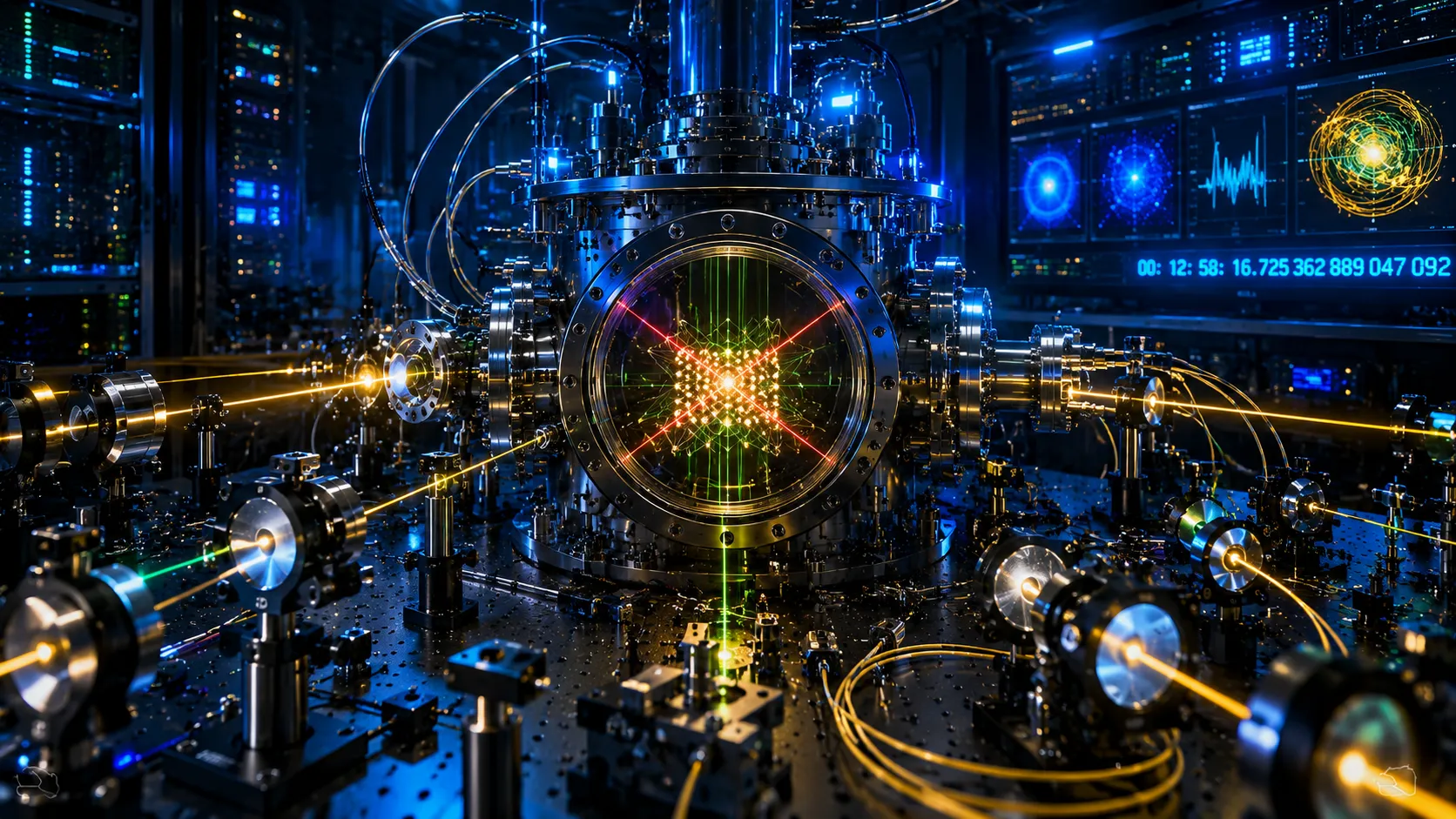
BOULDER, Colo. — May 26, 2026 — The clock lives in a room that does not exist on any public blueprint. It is housed in a windowless laboratory deep inside the National Institute of Standards and Technology, behind three layers of electromagnetic shielding and a steel door that weighs two tons. The room is kept at a temperature variation of less than one millionth of a degree Celsius. The floor is isolated from seismic vibrations by pneumatic legs that adjust themselves forty times per second. Inside, suspended in an ultra‑high vacuum chamber and chilled by lasers to a few billionths of a degree above absolute zero, a cloud of strontium atoms ticks back and forth between two quantum states at a rate of 430 trillion times per second. This is the optical lattice atomic clock, and it is the most precise measuring device ever built.
It is also the vanguard of a quiet revolution. For half a century, global navigation has been a satellite monopoly. GPS, Galileo, GLONASS—all rely on signals from space that can be jammed, spoofed, or simply lost in a tunnel or a canyon. A single hour of GPS outage costs the US economy an estimated $1 billion. A coordinated spoofing attack could ground airliners, halt container ships, and disconnect financial markets. The vulnerability is not theoretical: Russia has repeatedly jammed GPS signals over large areas of Ukraine. Commercial ships in the Black Sea have reported false positions by hundreds of kilometers. And every smartphone user knows the frustration of "GPS signal lost."
The solution, it turns out, is not better satellites. It is better clocks.
"GPS is essentially a timing system," said Dr. Holly Kettering, a physicist at NIST and the lead architect of the new strontium clock. "The satellites broadcast their time. Your receiver measures the delay. The difference tells you your distance from each satellite. The more precise the time, the more precise the position. Our clock is a million times more stable than the atomic clocks on GPS satellites. That means we can do navigation without the satellites at all."
The Vulnerability You Didn't Know to Fear
The Global Positioning System is a miracle of engineering. Thirty‑one satellites, each carrying four atomic clocks, broadcasting signals that allow any receiver on Earth to triangulate its position to within a few meters. It is free, ubiquitous, and so reliable that we have stopped thinking about it. We use it to find restaurants, to track packages, to land airplanes in fog, to synchronize power grids, to timestamp financial trades. GPS is the silent metronome of modern civilization.
But the metronome can be silenced. GPS signals are extremely weak—less power than a light bulb from 12,000 miles away. A $100 jammer can drown them out across a city block. More insidiously, a spoofer can broadcast fake GPS signals that look authentic, tricking a receiver into reporting a false position. In 2012, a researcher in Texas used a $2,000 spoofing device to hijack a $80 million yacht, steering it off course without the crew noticing. In 2024, a series of spoofing incidents near Moscow caused dozens of civilian aircraft to show false positions on their navigation displays; pilots reported seeing their own planes apparently teleporting across the sky.
"We have built a world that assumes GPS is always truthful," said Dr. Kettering. "That assumption is dangerously naive. We need a backup. And the best backup is a clock so good that you can navigate using it alone."
How a Clock Becomes a Compass
The principle is called autonomous navigation using inertial sensors. Traditional inertial navigation systems use gyroscopes and accelerometers to track movement from a known starting point. If you know where you started, and you measure every turn and every acceleration, you can calculate where you are. The problem is drift: even the best gyroscopes accumulate errors over time. After a few hours, a submarine's inertial system might be off by a kilometer. After a few days, by tens of kilometers.
The new generation of quantum sensors eliminates drift. The key is the atomic accelerometer, a device that uses ultra‑cold atoms to measure acceleration with exquisite precision. When atoms are cooled to near absolute zero, they behave like quantum waves. Passing laser pulses through these waves creates interference patterns that shift in response to acceleration. By measuring the shift, you can calculate your velocity and position with error rates as low as one meter per hour of operation—a thousand times better than classical inertial systems.
The strontium clock plays a supporting role. To know your position, you need to know your orientation and your acceleration. But you also need to know time with extraordinary precision to synchronize the measurements. The optical lattice clock provides a timebase so stable that the atomic accelerometers can operate at their theoretical maximum.
"We are essentially building a GPS receiver that does not need the S," said Dr. Kettering. "It is a Positioning System, full stop. You turn it on, you tell it your starting point (which could be as simple as 'the dock at 40.7°N, 74.0°W'), and then it tracks every move you make from there. It does not look at the sky. It does not listen for satellites. It just measures the passage of time and the feel of acceleration."
The Race to Miniaturize
The Boulder clock fills a laboratory. That is not useful for a ship, a plane, or a soldier. The challenge is miniaturization: taking a system that weighs two tons and reducing it to a few kilograms, small enough to fit in a shipping container, then a backpack, then a smartphone.
Progress is rapid. The Defense Advanced Research Projects Agency (DARPA) launched its Atomic Clock with Enhanced Stability (ACES) program in 2020, and the first prototype chip‑scale optical clocks are now being tested. These devices, about the size of a deck of cards, use a different atomic species (ytterbium) trapped on a photonic chip. They are a million times less accurate than the Boulder clock, but still ten times better than the rubidium clocks in current GPS satellites. And they can be manufactured using existing semiconductor fabs.
"Size, weight, and power are everything for real‑world deployment," said Colonel Mark Villanueva, who manages quantum navigation programs at the US Air Force Research Laboratory. "We have a roadmap to a 10‑cubic‑centimeter optical clock by 2030. That is small enough to put in a missile, a drone, or a soldier's helmet. When that happens, GPS becomes optional."
The commercial sector is also investing. A startup called Vector Atomic has raised $75 million to develop chip‑scale optical clocks for autonomous vehicles. "Self‑driving cars cannot rely on GPS in tunnels, under dense tree cover, or in urban canyons," said Vector's CEO. "Our clock gives them independent positioning. It is the difference between a car that needs clear skies and a car that can drive anywhere."

Beyond Earth: Navigating Without GPS
The deepest implications of quantum navigation are not on Earth. They are in space, and beyond.
The Moon has no GPS. Mars has no GPS. Any spacecraft traveling beyond Earth orbit must navigate using a combination of Earth‑based radio signals (with delays of minutes to hours) and onboard inertial systems (with accumulating drift). A chip‑scale optical clock, combined with an atomic accelerometer, would allow a spacecraft to know its position autonomously, in real time, anywhere in the solar system. Landings on Mars could be precise to meters rather than kilometers. Rendezvous with asteroids could be executed without waiting for instructions from Earth.
"This is how we become a multiplanetary species," said Dr. Kettering. "You cannot drive a rover on the Moon by joystick from Houston—the delay is too long. You need the rover to know where it is, by itself. That requires a clock that does not drift. That is what we are building."
The first test of quantum navigation in space is scheduled for 2028, aboard a small satellite funded by the European Space Agency. The satellite will carry an optical clock and an atomic accelerometer, and it will attempt to determine its orbit without any GPS or ground‑based ranging. If successful, every deep‑space mission after that will carry a quantum navigation package.
The Backup That Becomes the Primary
The irony of quantum navigation is that it was conceived as a backup for GPS. But as the technology matures, it may become the primary system for many applications. GPS is vulnerable to jamming, spoofing, and solar flares. It also requires a clear line of sight to four or more satellites—impossible indoors, underground, underwater, or under heavy foliage. Quantum navigation works anywhere, because it does not rely on external signals.
"I think we will look back on the GPS era as a strange historical interlude," said Dr. Kettering. "For a few decades, we outsourced our sense of position to satellites. Before that, we used maps and compasses. After this, we will use quantum clocks. It is a return to self‑reliance, but with the power of fundamental physics."
The clock in the Boulder laboratory continues to tick. The strontium atoms oscillate 430 trillion times per second, unaware that their dance is about to change the world. In a decade, every long‑haul truck, every container ship, every autonomous drone may carry a chip that contains their quantum ghost. GPS will still be there, a convenient convenience. But we will no longer be dependent on it. We will know where we are, because we will have built a clock that never loses a second.


