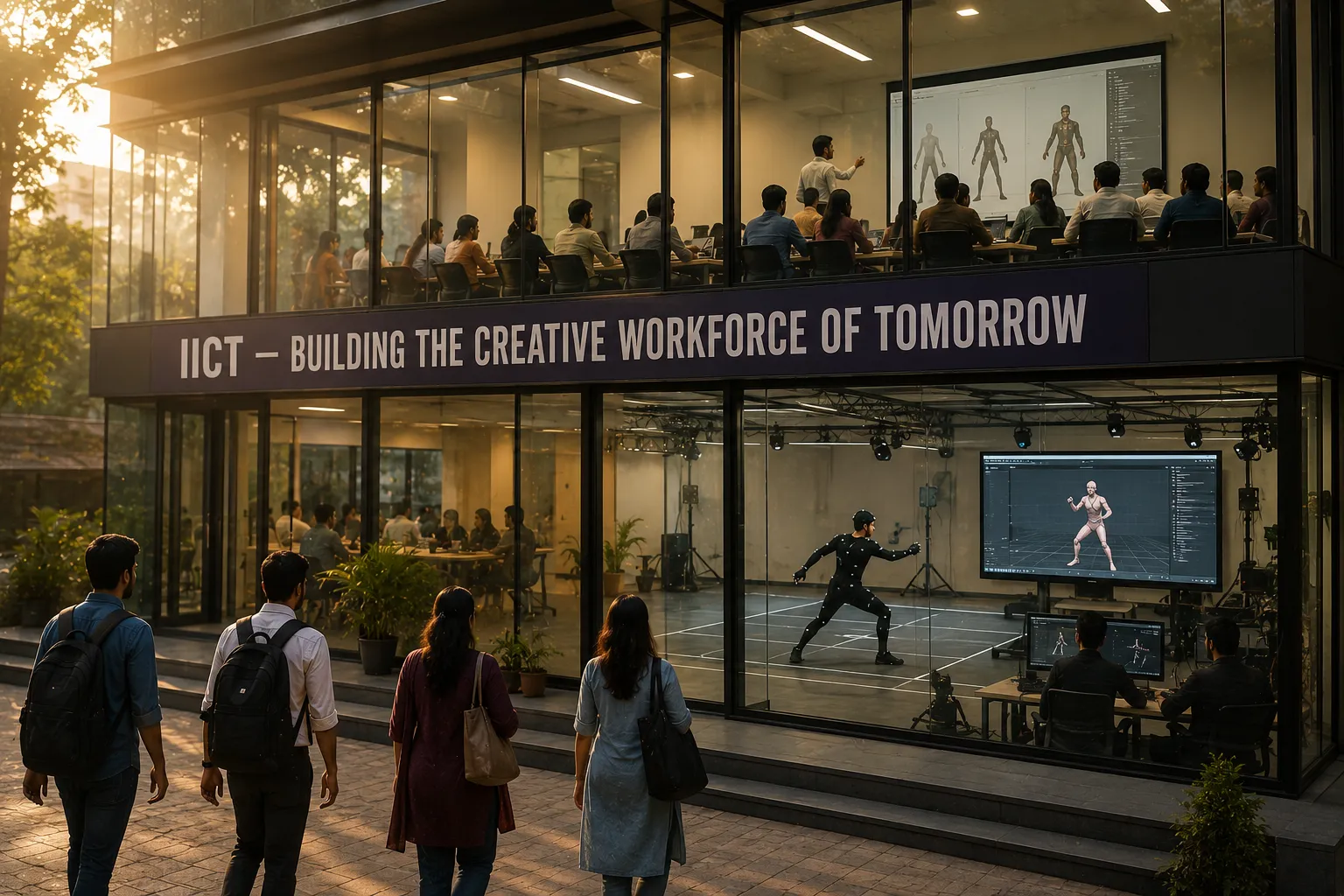
The Classroom-to-Studio Pipeline: Inside the 15,000 Content Creator Labs That Are Finally Training India's 2 Million AVGC Professionals—and Why Every Studio Is Watching
MUMBAI — May 30, 2026 — In a brightly lit classroom at a government secondary school in Nashik, a 14‑year‑old girl sits before a graphics tablet, her fingers tracing the contours of a character she is designing for a mobile game that does not yet exist. The software she is using—Blender, an open‑source 3D‑modelling tool—is the same software that professional animators use in the studios of Mumbai, Bengaluru, and Hyderabad. The curriculum she is following was developed by the Indian Institute of Creative Technologies, the national centre of excellence that was established in Mumbai in 2024 to anchor the government's AVGC‑XR talent strategy. Her teacher, a 26‑year‑old who was trained in a six‑month intensive programme at the IICT, is one of approximately 3,000 master trainers who have been deployed across the country since the Content Creator Labs programme became operational in January 2026. The girl's parents, a municipal clerk and a homemaker, have no idea what a "3D modeller" is. They know only that their daughter has been offered a paid internship at a gaming studio in Pune, starting next summer, and that the internship could lead to a job that pays more than either of them has ever earned.
She is one of approximately 1.2 million students who are currently enrolled in the Content Creator Labs programme, which has established AVGC training facilities in 15,000 secondary schools and 500 colleges across India. The programme, which was announced in the Union Budget of February 2026 and which has been funded with an initial allocation of ₹250 crore, is the centrepiece of the government's strategy to build a talent pipeline that can supply the 2 million professionals that the AVGC industry is projected to require by 2030. The labs are equipped with industry‑standard hardware and software, staffed by teachers who have been trained by the IICT, and connected to a network of industry partners who provide mentorship, internships, and, ultimately, jobs. The programme is ambitious, unprecedented in scale, and, according to the studios and platforms that are beginning to hire its graduates, beginning to work.
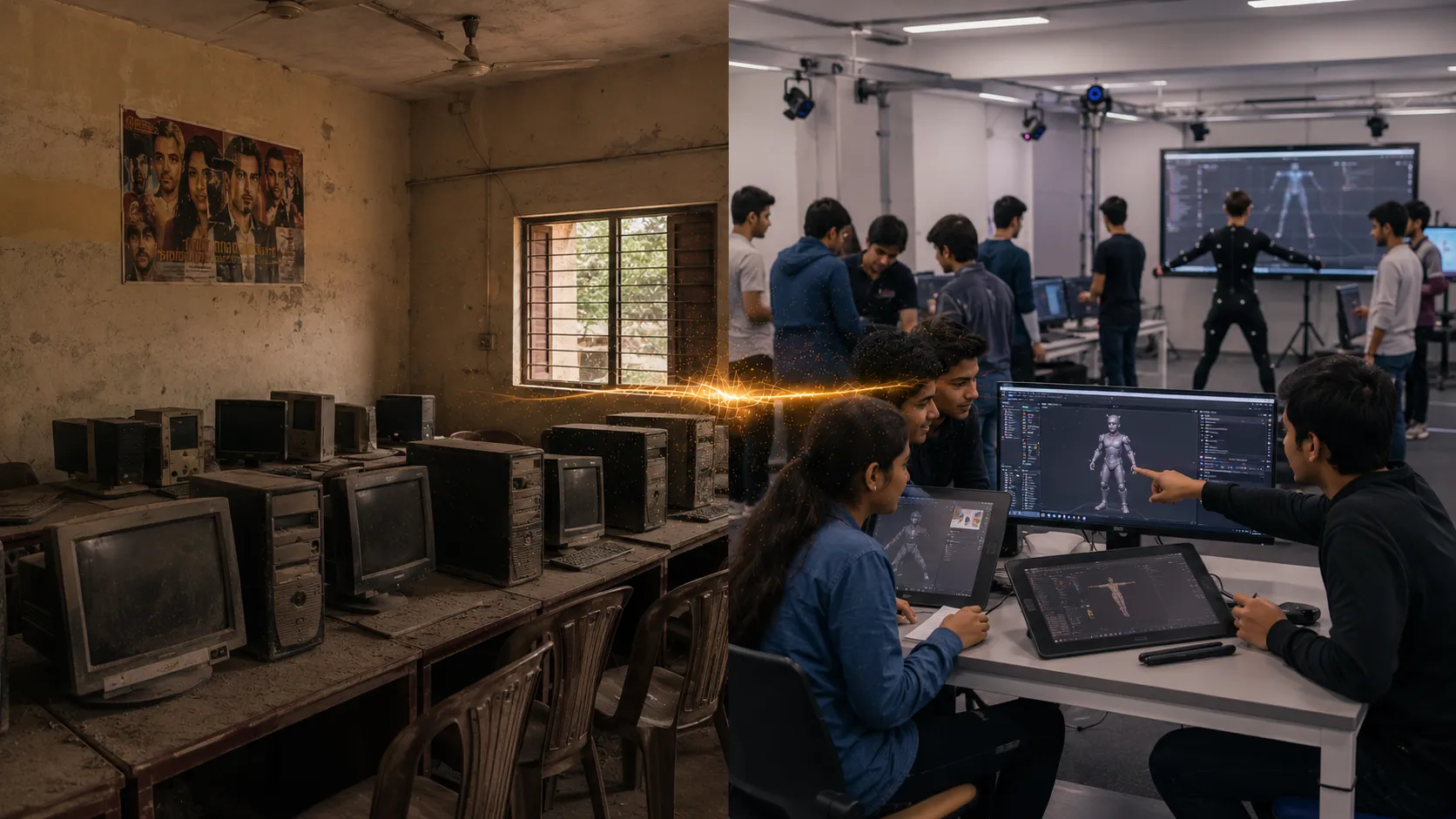
The Scale of the Gap
To understand the urgency of the Content Creator Labs programme, one must first understand the scale of the talent gap it is designed to fill. India's AVGC sector—animation, visual effects, gaming, and comics—is currently valued at approximately $6.8 billion, growing at a compound annual rate of nearly 30 percent. The gaming market alone is projected to reach $9.89 billion by 2031. The animation and VFX industry is expected to touch $2.2 billion in 2026, driven by surging demand from OTT platforms, Hollywood outsourcing, and the domestic film industry's growing appetite for visual spectacle. India is already the world's third‑largest hub for creative startups, and roughly 30 to 35 percent of the global VFX outsourcing market now flows through Indian studios.
The industry's single greatest constraint is people. The 2 million‑professional requirement is not a marketing figure. It is a structural estimate, derived from the growth trajectories of the animation, VFX, gaming, and comics sectors, and it reflects a fundamental reality of the creative economy: the industries that are growing fastest are the ones that require human creativity at scale. The Indian education system, for all its size and ambition, has historically produced almost none of the graduates that the AVGC industry needs. The schools that taught computer science taught coding, not character design. The schools that taught art taught traditional media, not digital sculpting. The schools that taught filmmaking taught live‑action production, not animation. The AVGC industry was forced to train its own workforce, absorbing the cost of developing talent that the education system had failed to develop, and the cost—measured in time, money, and lost productivity—was substantial.
The Content Creator Labs programme is designed to shift that cost from the industry to the state—to embed AVGC skills into the education system at the secondary and tertiary levels, so that the graduates who emerge from that system are already equipped with the foundational skills that the industry needs. The programme is not, in itself, sufficient to close the 2 million‑professional gap. The labs are reaching approximately 1.2 million students, but not all of those students will pursue AVGC careers, and the programme's curriculum is designed to provide foundational skills rather than advanced specialisation. The labs are the beginning of the pipeline, not the end. The students who pass through them will require further training—at the IICT, at the state‑level AVGC centres of excellence, at the private training institutes, and, most importantly, on the job—before they become fully productive professionals. The pipeline is a multi‑stage system, and the Content Creator Labs are the first stage—the stage that catches the talent before it is lost to the system, that gives it a direction, and that channels it toward the next stage.
The IICT and the Hub‑and‑Spoke Model
The Indian Institute of Creative Technologies is the apex institution of the AVGC talent pipeline—the "hub" in the hub‑and‑spoke model that connects the Content Creator Labs to the industry. The IICT, which was approved by the Union Cabinet in September 2024 and which began operations in 2025, is designed to function as the national centre for AVGC‑XR research, curriculum development, and master training. It is modelled, in its ambition and its institutional structure, on the IITs and the IIMs—a premier institution that sets the benchmark for quality, that develops the standards that the rest of the system follows, and that serves as the bridge between the education system and the industry.
The IICT's most important function, in the early years of its operation, has been the training of the master trainers who staff the Content Creator Labs. The 3,000 teachers who have been deployed across the 15,000 labs were not AVGC professionals before they entered the IICT's training programme. They were secondary‑school teachers—computer‑science teachers, art teachers, mathematics teachers—who had been selected by their state governments for retraining. The IICT's six‑month intensive programme gave them the foundational skills in animation, VFX, gaming, and comics that they would need to teach the Content Creator Lab curriculum, and it gave them the pedagogical training to deliver that curriculum effectively to students who had no prior exposure to the creative‑technology industries. The master‑trainer programme is the single most critical component of the Content Creator Labs infrastructure, and its success or failure will determine the success or failure of the entire pipeline.
The IICT is also responsible for developing the curriculum that the Content Creator Labs use. The curriculum, which was developed in consultation with the AVGC industry—the studios, the gaming companies, the streaming platforms—is designed to provide students with a foundational understanding of the creative‑technology disciplines, and to give them the practical skills that they can apply immediately in a studio environment. The curriculum is modular, allowing schools to adapt it to their specific resources and their specific student populations, and it is designed to be updated regularly as the technology evolves. The IICT's curriculum team, which includes both academic researchers and industry professionals, meets quarterly to review the curriculum and to incorporate the feedback from the master trainers, the students, and the industry partners who are hiring the students who complete the programme. The curriculum is not static. It is a living document, and its ability to keep pace with the industry's evolution is essential to the pipeline's long‑term viability.
The hub‑and‑spoke model also includes a network of state‑level AVGC centres of excellence, which are being established in partnership with the state governments. The centres of excellence function as regional hubs—providing advanced training for the students who have completed the Content Creator Lab curriculum, offering specialised courses in areas like virtual production, real‑time rendering, and AI‑driven content creation, and serving as the local interface between the education system and the industry. The centres of excellence are the second stage of the pipeline—the stage that takes the foundational skills that the Content Creator Labs provide and develops them into the specialised skills that the industry needs. The centres are being established at different speeds in different states, depending on the state governments' commitment and the availability of industry partners, but the model is designed to be replicated across the country over the next several years.
The Industry Response
The AVGC industry has responded to the Content Creator Labs programme with a mixture of enthusiasm and caution. The enthusiasm is driven by the recognition that the talent pipeline is the single most important constraint on the industry's growth, and that the government's investment in building that pipeline is a structural support that no private company could provide on its own. The studios, the gaming companies, and the streaming platforms that are hiring the programme's graduates are reporting that the students who emerge from the Content Creator Labs are better prepared, more motivated, and more familiar with the industry's tools and workflows than the graduates of the traditional education system. The programme is delivering on its promise—producing a new generation of AVGC talent that is larger, more diverse, and more industry‑ready than the talent that the previous system produced.
The caution is driven by the recognition that the programme is still in its early stages, and that the talent pipeline is only as strong as its weakest link. The master trainers who staff the labs are, in many cases, still learning the curriculum themselves. The equipment that the labs are equipped with—the graphics tablets, the workstations, the software licences—requires maintenance, upgrading, and replacement on a cycle that the government's procurement systems are not designed to support. The industry partnerships that are supposed to provide the mentorship, the internships, and the jobs are still being negotiated, and the students who complete the programme are not guaranteed employment—they are merely better positioned to compete for the jobs that the industry is creating. The pipeline is real, and it is flowing, but the flow is still a trickle rather than a flood, and the industry is watching to see whether the trickle can be scaled to the volumes that the market demands.
The most significant long‑term challenge facing the Content Creator Labs programme is the pace of technological change. The AVGC industry is being transformed by the same AI‑powered tools that are transforming every other creative industry, and the skills that the Content Creator Labs are teaching today may be obsolete within a few years. The AI‑powered animation tools that are currently in development—the generative AI for background art, the machine‑learning‑driven rotoscoping, the neural rendering for photorealistic environments—will, within the next several years, automate many of the tasks that the Content Creator Labs are teaching students to perform manually. The students who are being trained today will need to be retrained within a few years, and the curriculum that the IICT is developing today will need to be revised continuously as the technology evolves. The Content Creator Labs programme is not a one‑time investment. It is an ongoing commitment—a commitment to building a talent pipeline that can adapt to an industry that is changing faster than any educational institution can keep pace with. The commitment is necessary, and the investment is worthwhile, but the challenge is formidable, and the outcome is uncertain.
The broader context is an Indian education system that has, for decades, been criticised for its failure to prepare students for the economy of the future. The Content Creator Labs programme is, in this sense, an experiment—a test of whether the government can build a talent pipeline that connects the classroom to the creative economy, that reaches the students who have been excluded from the previous waves of economic growth, and that adapts to a technology landscape that is evolving faster than any curriculum can keep pace with. The experiment is being watched by every other sector of the Indian economy that is facing a similar talent gap—the semiconductor industry, the renewable‑energy sector, the healthcare‑technology industry—and its outcome will determine whether the Content Creator Labs model is replicated across the economy or abandoned as another well‑intentioned government programme that failed to deliver on its promise. The classroom in Nashik, the 14‑year‑old with the graphics tablet, the internship at the gaming studio in Pune—these are the data points that will determine the outcome. The data is still being collected. The experiment is still underway.
What This Signals
The Content Creator Labs programme is not primarily a story about education. It is a story about the structural transformation of the Indian creative economy—a shift from a model in which the AVGC industry was forced to train its own workforce, at its own expense, to a model in which the state has accepted the responsibility of building the talent pipeline that the industry needs, from a talent base that was concentrated in a handful of metropolitan cities to a talent base that is being cultivated in every state, in every district, and in every demographic, and from an industry that was constrained by the scarcity of skilled professionals to an industry that is being fuelled by the abundance of them. The 1.2 million students who are currently enrolled in the Content Creator Labs are the first cohort of a generation that will enter the workforce with the skills that the creative economy demands. The pipeline is being built, and the water is beginning to flow.


