The Cheese Mogul, His Cousin, and the AI That Saved a 113‑Year‑Old Creamery
PETALUMA, CALIF. — May 18, 2026 — Larry Peter is not the kind of founder who gives keynote speeches at technology conferences. He does not use the word "scalable" or "total addressable market" or "digital transformation." He uses words like "cow" and "butter" and, when the subject turns to the two years he nearly lost everything, words like "lost" and "sweating bullets" and "thank God."
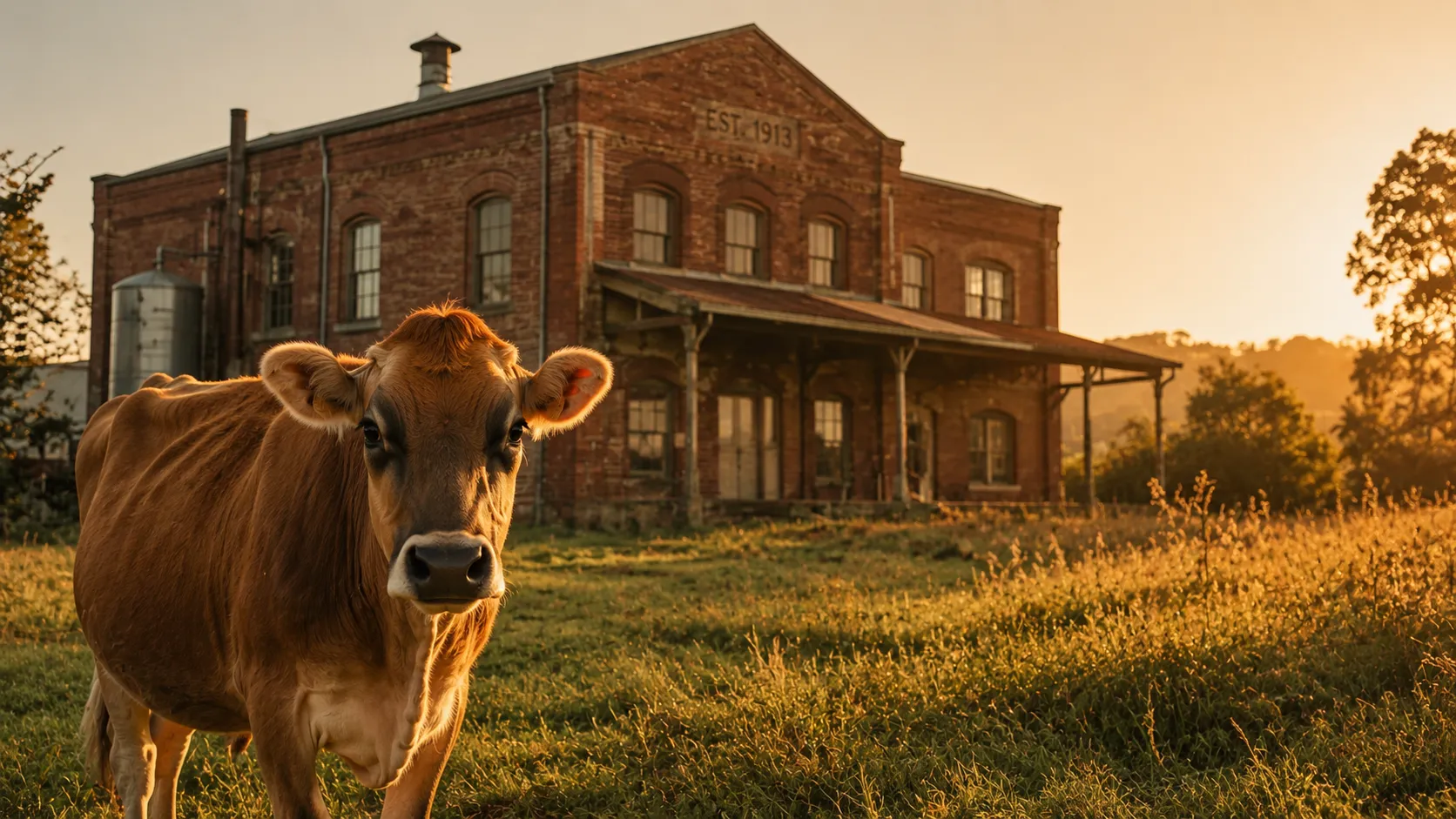
But sometime in the past eighteen months, without seeking it and without fully absorbing what it means, Larry Peter became the protagonist of the most improbable AI success story in American business. He owns Petaluma Creamery, a 113‑year‑old cheese‑making operation that sprawls across three city blocks in Sonoma County, California — a facility established in 1913 by a cooperative of dairy farmers, shuttered in 2004 when that cooperative dissolved, and then rescued by Larry when he came down to buy a cream separator and ended up buying the whole thing.
At its peak, the creamery was a $50‑million‑a‑year enterprise. Larry supplied cheese to 1,400 Chipotle locations. He appeared on Martha Stewart. Julia Child — Julia Child — sat at his tailgate at the Santa Barbara farmers' market every Saturday and told him his white cheddar was the best she had ever eaten. "She bought my butter every day," Larry told Fortune in a profile published this week. "She always had my butter because my butter is real yellow."
Then, in the space of roughly two years, it all collapsed.
The Fall
The sequence of events that brought Petaluma Creamery to its knees reads less like a business case study than like the Book of Job, set in a dairy.
It began with COVID‑19. The pandemic gutted the restaurant industry, which was the creamery's primary customer base. Employees stopped showing up to the production floor. The supply chain frayed. Then Larry's father died. A month later, Larry himself went under the knife for an open‑heart surgery that lasted eight hours. While he was recovering, a series of maintenance failures at the plant generated enormous repair bills. The Chipotle relationship ended. And then, exhausted and emotionally drained, Larry agreed to sell the facility to a buyer who proceeded to string him along for eighteen months — promising $50,000 a month in rent that never materialized, offering new excuses every time an escrow date came and went.
When the deal finally, definitively collapsed, Petaluma Creamery had thirteen active accounts. Not 1,300. Not 130. Thirteen.
Larry Peter, a first‑generation farmer who had paid cash for his first house at eighteen by selling his Corvette, who had built a dairy empire by riding a bicycle to work for a decade so he could save money, who once sold cheese out of a woodshed he built next to a schoolhouse he bought from Sonoma High School for a dollar — Larry Peter was done. He shut the creamery down in September of 2022. "I was lost," he said later. "I didn't know what I was going to do."
So he got in his car and drove south, toward Silicon Valley, to find his cousin Daniel.
The Cousin from Silicon Valley
Daniel Peter was not a dairy man. He was a technologist — a 36‑time certified Salesforce MVP Hall of Fame member, an applications engineer who had built manufacturing enterprise resource planning systems for Del Monte and run Salesforce consulting practices for seventeen years. For years, Daniel had visited Larry in the country and told him about his work, offering to help if he was ever needed. Larry's response was always the same: "I can't afford this guy. I know what he makes."
But when Larry finally came calling in late 2022, Daniel happened to be on sabbatical — a little burned out, a little open to something different. He agreed to become the chief technology officer of a bankrupt creamery. "I was sweating bullets," Larry said. "I didn't know if he was really going to come and help me, and I didn't have money to pay him. But thank God, he wanted a change in life."
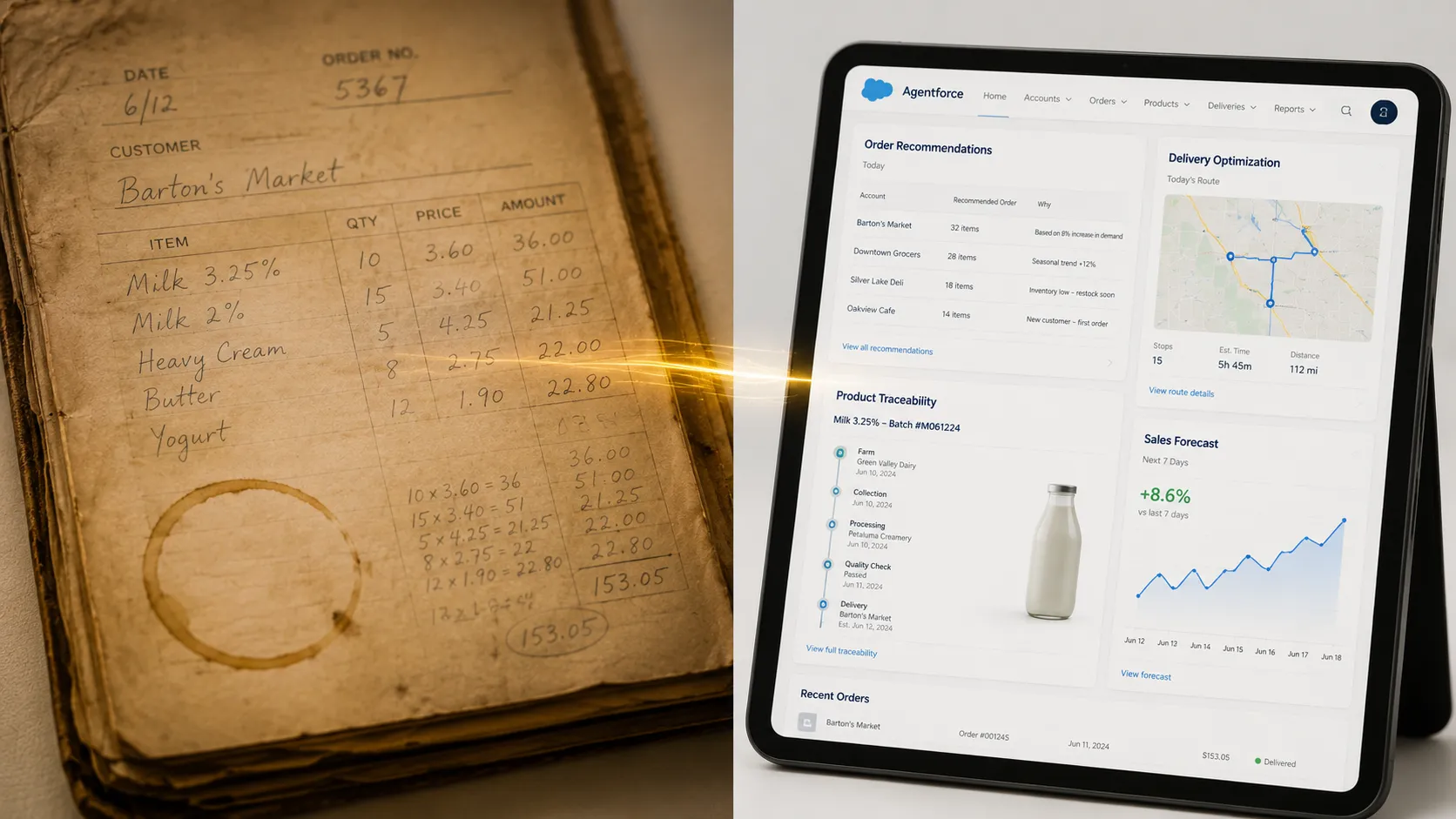
What Daniel found when he arrived in Petaluma was not a struggling business. It was a business that had essentially stopped existing. The creamery had no fiber internet — just T1 lines, the kind of connection that was ubiquitous in the 1990s and virtually extinct by the 2020s. Orders arrived on handwritten paper forms that could get lost or had to be physically walked around the plant. Invoices were entered in QuickBooks using a 150‑SKU code hierarchy that employees had to memorize — yellow cheddar was something like "C:CY," and every transaction required manual math because customers ordered in cases but the system tracked everything in pounds.
"Forget about AI," Daniel told Fortune. "It was like, how do we have a digital representation of an order?"
The first physical act of the turnaround was not deploying a model. It was running a fiber‑optic cable to a telephone pole.
What Daniel Built
The approach Daniel took was methodical: establish the data foundation first, then automate, then add intelligence. The creamery, it turned out, was sitting on a trove of unstructured data — twenty‑plus years of emails, invoices, and gigabytes of laboratory testing results covering every dairy product ever made in the facility. "We have a really rich foundation of data, which is one of the key pieces you need for AI," Daniel said.
He rebuilt the entire operating system on Salesforce and its Agentforce AI platform. The tools he deployed, in rough order, tell the story of a business being reconstructed from the digital ground up:
Order‑to‑cash. A new interface replaced the memorized 150‑SKU hierarchy with natural‑language search. An employee types "Firehouse" or "Jack" or "Pepper" and the correct product appears instantly. Quantities auto‑convert from cases to pounds. Orders that once required training and mental arithmetic now practically write themselves.
Predictive ordering. Agentforce ingests years of customer purchase history and anticipates reorders. If a grocery store has been buying two‑pound cheddar on a consistent cycle, the AI pre‑populates the order. A sales rep can review and confirm a predicted order in seconds. The system also surfaces items a customer usually buys but forgot to mention — catching the kind of leakage that happens when a store's shelf label goes missing.
AI‑powered delivery routing. Geographic routes and delivery constraints are now written in plain English prompts, not code. To update the routing algorithm, Daniel edits a sentence instead of spinning up a development cycle. "We just tweak the prompt," he said. "AI is sort of the black box that turns the prompt into the actual algorithm behind the scenes."
Milk traceability. Every gallon of milk is now tracked from the moment it arrives at the farm — logging temperature, amount, source farm, and driver name — through production batches all the way to lot numbers on store shelves. The creamery can trace a wedge of cheddar sold at retail back to the specific loads of milk that went into it, with full state compliance reporting built in. Agentforce helps make sense of that data stream.
Intelligent prospecting. Daniel used the Google Places API to load every grocery store, restaurant, and convenience store in California into Salesforce as a potential lead. When a delivery driver visits a store near Fort Ross, the system surfaces the ten nearest restaurants, delis, and cafes that are not yet customers — ranked by proximity, review rating, and price level. The driver can drop off samples on the same route.
The Results
The numbers tell the story of a business resurrected. When Daniel and Larry began the rebuild, Petaluma Creamery had 13 active accounts. Within eighteen months, that figure had grown to more than 300. Michelin‑starred restaurants including Benu in San Francisco signed on. The Sacramento Kings now stock Petaluma Creamery products in their concession stands, using the cheese in nachos, grilled ham‑and‑cheese sandwiches, and a triple‑double cheese dog.
The customer reclamation effort was driven by a single salesperson working with Agentforce. In the first six months, that employee worked through the top 1,000 of the 3,500 former customer records and successfully reactivated more than a third of them. The work continues on the remaining names while new accounts are added simultaneously. "The ROI is that we are building back our whole revenue pipeline with just one salesperson," Daniel said. "To do something like that manually, you would need a lot more people."
The financial targets are concrete: $10 million in annual revenue by the end of next year, with a longer‑term vision of $200 million to $300 million as the facility scales. Salesforce CEO Marc Benioff publicly highlighted the creamery's transformation as a flagship Agentforce case study, noting that the system "overhauled its ordering, routing, and farm‑to‑shelf traceability."
That last number — $200 million to $300 million — is not a fantasy. The Petaluma Creamery plant was originally built to process 140,000 pounds of commodity cheese per day. It is currently running at roughly 3% of that capacity. The upside is not incremental. It is structural.
What This Story Actually Says About AI
The dominant narrative about artificial intelligence and the American workforce is one of displacement — white‑collar jobs automated away, call centers replaced by chatbots, radiologists made redundant by algorithms. Petaluma Creamery tells a quieter, more complicated story.
"There's a good chance this place wouldn't exist anymore without it," Daniel said. "Yeah, the jobs are changing and we might not need as many people doing manual labor here, but having some jobs here are better than the place going away."
Larry's vision for the facility at scale is not a lights‑out, fully automated factory. It is a larger headcount producing higher‑value artisanal goods — cottage cheese, kefir, yogurt, A2 milk, grass‑fed butter. Products that require more human craft, not less, and that people will pay more for precisely because a person made them. He plans to deploy robots on the production floor to handle the brute‑force work — bagging powder, pulling 40‑pound blocks from the towers — but frames it as expansion, not subtraction.
"I want to produce product that don't have all this bad stuff in the cow," Larry said. "They want a cow. They want natural food. They want grass. They want clover. They want to know, Larry and Daniel made this and then their cows that are completely grass‑fed, normal cows." That is why he runs 400 Jersey cows on a farm eight miles up the road, even though Holsteins might make more industrial‑scale sense. "We're doing all Jersey, 100% Jersey, because that cow puts out more cream and more butter and it's a heartier cow." He paused. "Besides, I have the cows with the pretty eyes."
The story of Petaluma Creamery does not offer a tidy moral about AI. It does not prove that the technology will create more jobs than it destroys, or that every legacy business can be saved by a tech‑savvy cousin and a well‑configured CRM. What it proves is more specific and, for millions of small business owners staring down an uncertain future, more useful: that the same tools the giants use are now available to the people who make cheese in a converted woodshed, that a data‑rich business running on paper is not a lost cause but a latent one, and that the fastest way back from the brink sometimes runs through a telephone pole with a fiber‑optic cable tied to it.
Larry Peter does not talk like a technology convert. He talks like a man who almost lost everything and found it again, improbably, through the work of a cousin he could not afford and a platform he did not understand. "Salesforce makes me know that I'm going to own my pillow again," he said. "I'm going to have a good night's sleep."
It is not the slogan of a digital transformation. It is the testimony of a survivor.


