The Charging Gap: How India's EV Infrastructure Startups Are Racing to Plug In 100 Million Vehicles
The Hook: The Highway That Almost Broke an EV Driver
Picture this: It is a sweltering afternoon on the Delhi-Mumbai Expressway. You are driving an electric vehicle with 15 per cent battery remaining. The dashboard says the nearest charging station is 28 kilometres away. You reach it. The charger is out of service. The next one is 45 kilometres away. You start sweating. Not from the heat — from the math.
This scenario is not hypothetical. It plays out every day on India's expanding highway network. The good news is that it is becoming less common. The better news is that an entire ecosystem of startups, established players, and government schemes is racing to make it extinct.
India wants 80-100 million electric vehicles on its roads by 2030, targeting 30 per cent electrification of private cars, 70 per cent of commercial vehicles, 40 per cent of buses, and 80 per cent of two-wheelers and three-wheelers. According to a research firm, EVs could account for more than 40 per cent of India's automobile market and generate over $100 billion (₹8,57,500 crores) of revenue by 2030. But charging infrastructure remains the Achilles' heel of this electric dream. As of 2026, India has roughly 29,000 to 30,000 operational public charging stations, with the number crossing nearly 39,000 if semi-public chargers inside office parks, malls, and housing societies are included. That sounds impressive until you consider the ratio: India currently sits at roughly 235 EVs per charger, while more mature EV markets globally usually operate between 6:1 and 20:1. The gap becomes even more noticeable during peak travel seasons and on major intercity routes.
The charging infrastructure in India is currently quite under-developed with as many as 26 EVs per charger available in the country, compared to only 8 in China and 17 in the US. But this is changing faster than most realise. The India electric vehicle charging infrastructure market generated a revenue of USD 557.4 million in 2025 and is expected to reach USD 3,856.9 million by 2033, growing at a CAGR of 27.6%. Other estimates place the market at USD 1,114.23 million in 2024, expected to reach USD 3,681.17 million by 2030 with a CAGR of 22.04%.
The Number That Explains Everything: 100 Million Vehicles
Let us start with the raw scale of what India is attempting. India's EV sales have witnessed significant growth, with total sales crossing 2.55 million units in FY2026. All major vehicle segments have recorded double-digit growth rates, reflecting broad-based adoption.
But the government's ambition goes far beyond current numbers. India expects to have between 80 million and 100 million electric vehicles by 2030 as the government targets 30% electrification of private vehicles. This is expected to drive demand for charging infrastructure. The India electric vehicle charging infrastructure market generated a revenue of USD 557.4 million in 2025 and is expected to reach USD 3,856.9 million by 2033, growing at a CAGR of 27.6%. A primary growth driver stems from aggressive policy measures introduced to phase out fossil-fuel-based mobility.
The math is brutal but hopeful. India currently needs approximately 30 lakh (3 million) charging stations by 2030, requiring 4,00,000 installations yearly. The EV charging market in India, currently estimated at about ₹5,000 crore, is expected to grow to around ₹50,000 crore over the next six years. That is a tenfold increase in less than a decade.
The India EV Charging Station Market, valued at approximately USD 348.5 million in 2024, is projected to grow at a 27.67% CAGR to reach USD 1.65 billion by 2030. Public EV charging stations grew from 5,151 in December 2022 to approximately 29,000+ in August 2025 — nearly sixfold in under three years. The Ministry of Power issued guidelines for EV charging infrastructure in September 2024, establishing standards for connected and interoperable charging networks. The Bureau of Indian Standards has published related standards covering connectors, communication protocols, electric vehicle supply equipment and battery swapping systems.
The New Guard: Statiq's $18 Million Charge
The most significant funding story in India's EV charging space in 2026 belongs to Statiq. In February 2026, the Gurugram-based EV charging network startup raised approximately $18 million (around ₹150 crore) in a blended equity and debt round led by Tenacity Ventures, with key participation from Y Combinator, Shell Ventures, and RCD Holdings. This brought its total funding to over $25.7 million.
Founded in 2020 by Akshit Bansal (CEO) and Raghav Arora (CTO), Statiq operates a full-stack EV charging platform combining proprietary AC and DC fast chargers with software, and claims to have built one of the country's largest charging networks. Its network comprises over 8,000 chargers live across 70 cities. The startup is planning to install 20,000 charging points across the country by 2026, catering to the growing demand for daily charging services for e-vehicles.
What sets Statiq apart is its ambitious vision beyond Indian borders. The startup plans to utilise the funds toward scaling its charging infrastructure and expanding presence across Tier I and II cities, deploying DC fast chargers across key highways, upgrading its products to achieve "99.9 per cent uptime", and beginning to export its "Made in India" hardware to global markets, building on successful UAE pilots.
Raghav Arora, co-founder and CTO of Statiq, captured the moment: "With this capital, we'll harden our stack for scale; hardware lifecycle management, software-strengthening, telematics, and global systems that let partners build on our innovations". Users of its mobile app can avail charging services from Statiq's charging network along with other providers like E-Fill, Sunfuel and GLIDA. The startup has also tied up with government bodies, automakers and hospitality companies to expand its charging network coverage to about 100 cities where it has installed over 10,000+ chargers.
PULL QUOTE #2
"One of the biggest gaps in India's EV journey currently is not intent, but infrastructure. Consumers are ready to adopt electric mobility, but the lack of reliable, accessible charging continues to slow scale." — Mitesh Shah, Co-founder, Inflection Point Ventures, January 2026
The Challenger: RoadGrid's Universal Charger Bet
While Statiq captured headlines with its $18 million round, another player took a different approach. In January 2026, Indore-based RoadGrid raised ₹12 crore in a Pre-Series A funding round led by Inflection Point Ventures, with participation from Venture Catalysts, FAAD Network, LetsVenture, and several angel investors.
What makes RoadGrid distinct is its focus on "universal" chargers. The company is developing patented universal EV chargers designed to work across two-wheelers, three-wheelers and four-wheelers — a crucial feature in a market where vehicle segments vary dramatically. Founded by Deepesh Shrinath, RoadGrid operates across two verticals: manufacturing and supplying EV chargers to Original Equipment Manufacturers (OEMs), and deploying and operating public and commercial charging stations.
Its business model blends Charging as a Service (CaaS) with direct OEM sales. Under CaaS, the company establishes and manages EV charging stations, with active deployments underway in Indore and Navi Mumbai and engagements with utilities such as BSES, NPCL and IOCL. Its confirmed order book and pipeline exceed 1,000 chargers, with an additional 1,000+ chargers under order for OEM supply across two, three and four wheeler segments.
The company has executed over 100 installations across Madhya Pradesh, Rajasthan and Karnataka, serving marquee clients including IOCL, Amazon, BSES and NPCL. RoadGrid has also partnered with VinFast arm V-Green to develop EV charging networks at HPCL retail outlets and to support VinFast's aftersales charging network in India.
Mitesh Shah, Co-founder of Inflection Point Ventures, made a crucial observation: "One of the biggest gaps in India's EV journey currently is not intent, but infrastructure. Consumers are ready to adopt electric mobility, but the lack of reliable, accessible charging continues to slow scale. RoadGrid addresses this gap end-to-end, from charger manufacturing to on-ground charging operations".
The Incumbent Titan: Tata Power's Network of 6,700+ Points
While startups grab headlines, one company has built India's most extensive EV charging network without fanfare. Tata Power has expanded its EV Charging network under the brand name of EZ Charge to over 2 lakhs+ home chargers, 6,700+ public, semi-public, and fleet charging points, along with 1,200+ E-bus charging points across 690+ cities and towns. Overall, Tata Power EZ Charge has 5 lakhs+ registered customers, strategically deployed at diverse and accessible locations such as highways, hotels, malls, hospitals, offices, bus and commercial vehicle depots, and residential complexes.
The company has facilitated over 7.5 lakh charging sessions, supported approximately 414 million green miles, and helped avoid nearly 50,000 tonnes of CO₂ emissions from tailpipe pollution — underscoring its impact on sustainable mobility.
In May 2026, Tata Power expanded its ultra-fast EV charging network on the Delhi-Mumbai Expressway in collaboration with Indian Oil Corporation, inaugurating a 240 kW ultra-fast EV charging station with four charging guns. The stations are operational on both carriageways, enabling charging access for travellers commuting in both directions, catering to both personal and commercial EV users.
The Geographic Reality: Where the Chargers Are
Charging infrastructure in India is highly centralised right now. According to the JMK Research & Analytics report titled 'India EV Market FY26', Karnataka accounted for 6,096 of India's 29,151 public charging stations as of December 2025, giving it a 20.91 per cent share and placing it ahead of Maharashtra, which had 4,166 charging stations or a 14.29 per cent share. Tamil Nadu added another 1,780 charging stations, while Telangana had 1,062. Together, the three states command over 30 per cent of all public charging infrastructure in the country.
Bengaluru remains India's EV capital in 2026, largely due to early state-level EV policies, strong tech-sector adoption, and better charging penetration across residential and office areas. Delhi, Noida, and Gurugram now have significantly better fast-charging coverage than a few years ago, especially around commercial hubs and expressways. Under the FAME-II scheme, Tamil Nadu leads all states with 957 chargers installed, followed by Karnataka with 751 and Maharashtra with 670.
India had 6,645 operational electric vehicle public charging stations as of 1 March 2026, out of 9,332 sanctioned under the FAME-II scheme, according to data presented in the Rajya Sabha by the Ministry of Heavy Industries. The government has made an allocation of more than 912 crore rupees under the FAME-2 scheme, and 2,000 crore rupees under the PM E-DRIVE schemes for the deployment of adequate public EV charging infrastructure.
The Fast Charger Gap: Why Speed Matters
India's charging network is still dominated by slower AC chargers. AC chargers are cheaper to install and work well for overnight charging, particularly for city users. However, they are less practical for intercity travel because charging times can stretch to several hours. DC fast chargers remain the most in-demand part of the network because they can recharge many modern EVs from 20% to 80% in under an hour. The problem is availability. Fast chargers are still concentrated mainly in Tier-1 cities.
According to Wood Mackenzie's EV Charging Infrastructure Forecast, India's DC fast chargers are projected to grow from 14,000 at present to 1.1 million by 2040. The fast charger segment is the largest and fastest-growing charger type, with the fast charger segment registering the fastest growth during the forecast period.
Routes like Mumbai-Pune, Delhi-Jaipur, Chennai-Bengaluru, and Ahmedabad-Vadodara now have noticeably better DC fast-charging coverage. Still, charger reliability and downtime continue to remain common complaints during long-distance EV travel.
The Policy Engine: FAME, PM E-DRIVE, and What Comes Next
The Indian government has not been a passive observer in this transformation. The Ministry of Power's updated guidelines on public EV charging infrastructure, strengthened through 2024 and implemented across states through 2025 and 2026, have provided a structured framework for deployment. These guidelines emphasise charging density norms in urban areas, mandatory intervals along highways, interoperability standards, and integration with distribution utilities. Charging infrastructure has been classified as a de-licensed activity to encourage private sector participation.
Under the PM E-DRIVE Scheme, the Ministry issued operational guidelines for the deployment of EV Public Charging Stations in 2025, which provide the framework for the implementation of charging infrastructure projects. The Bureau of Indian Standards has published standards covering connectors, communication protocols, electric vehicle supply equipment and battery swapping systems.
Initiatives like FAME (Faster Adoption and Manufacturing of Hybrid and Electric Vehicles) and mandates on charging infrastructure in urban planning have created a foundation for rapid deployment. State EV policies are customising support according to city density and energy demand, further diversifying the opportunity. By reducing investment risk and enhancing profit potential for infrastructure developers, these policy frameworks are creating an enabling environment for rapid market growth.
The Global Indian Takeaway
For the Indian diaspora, the EV charging infrastructure boom offers three clear pathways.
First, invest via emerging funds. Statiq and RoadGrid are just the beginning. With the EV charging market projected to grow from ₹5,000 crore to ₹50,000 crore, follow-on rounds and new entrants offer compelling entry points for accredited investors.
Second, build cross-border technology partnerships. Indian EV charging startups need access to global best practices in grid management, battery swapping, and fast-charging hardware. Diaspora professionals with experience in European or North American EV ecosystems can serve as technical advisors, joint venture partners, or distributors.
Third, participate in public-private initiatives. The government has allocated significant funds under PM E-DRIVE and FAME-II. Diaspora professionals with project management or infrastructure expertise can partner with state governments to implement charging corridors.
The Final Word
India's EV charging story is a race against time. The country has the ambition — 80-100 million EVs by 2030. It has the policy support — FAME-II, PM E-DRIVE, state EV policies. It has the capital — Statiq's $18 million, RoadGrid's ₹12 crore, Tata Power's expanding network. And it has the startups building everything from universal chargers to intelligent software platforms. What it needs now is speed. The gap between 29,000 public chargers today and the 3 million needed by 2030 is immense. But so is the opportunity.
The EV charging gap is becoming the charging gold rush. And for the Global Indian watching from afar, the question is not whether to participate — but how fast to plug in.
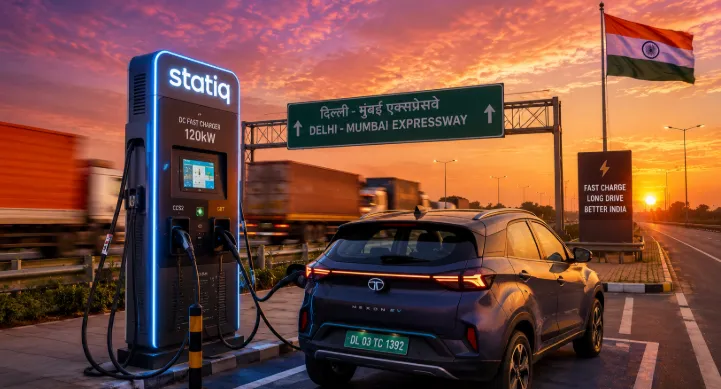
CHART: "India's EV Charging Infrastructure Race – At a Glance (2026)"
Metric | Data | Source |
|---|---|---|
EVs on road target by 2030 | 80-100 million | Government estimates |
EV sales (FY2026) | 2.55 million units (+double-digit growth) | Tata Power report |
Public charging stations (May 2026) | ~29,000-30,000 (39,000 incl. semi-public) | Car&Bike, May 2026 |
EV-to-charger ratio | ~235:1 (vs global 6:1 to 20:1) | Car&Bike, May 2026 |
India EV charging market (2025) | USD 557.4 million | Grand View Research |
Projected market (2033) | USD 3,856.9 million (27.6% CAGR) | Grand View Research |
Alternative market projection (2024→2030) | USD 1,114M → USD 3,681M (22.04% CAGR) | TechSci Research |
EV charging market value (India, ₹) | ₹5,000 crore today → ₹50,000 crore (6 years) | Economic Times |
DC fast chargers (present → 2040) | 14,000 → 1.1 million | Wood Mackenzie |
Statiq funding (Feb 2026) | $18 million (led by Tenacity Ventures) | Inc42 |
Statiq total funding | $25.7 million+ | Inc42 |
Statiq network (current → target) | 8,000 chargers in 70 cities → 20,000 by 2026 | Mercom India |
RoadGrid Pre-Series A funding | ₹12 crore (~$1.44 million), Jan 2026 | Energetica India |
Tata Power EZ Charge network | 2 lakh+ home chargers, 6,700+ public points, 1,200+ E-bus points across 690+ cities | Economic Times, May 2026 |
Tata Power charging sessions | 7.5 lakh+ sessions, 414M green miles, 50,000 tonnes CO₂ avoided | The Battery Magazine |
FAME-II operational chargers | 6,645 out of 9,332 sanctioned | Automotive World |
PM E-DRIVE allocation | ₹2,000 crore for EV charging | PIB (February 2026) |


