The Carbon‑Hungry Microbe: How Engineered Algae Are Sucking CO₂ Out of the Sky and Turning It Into Fuel
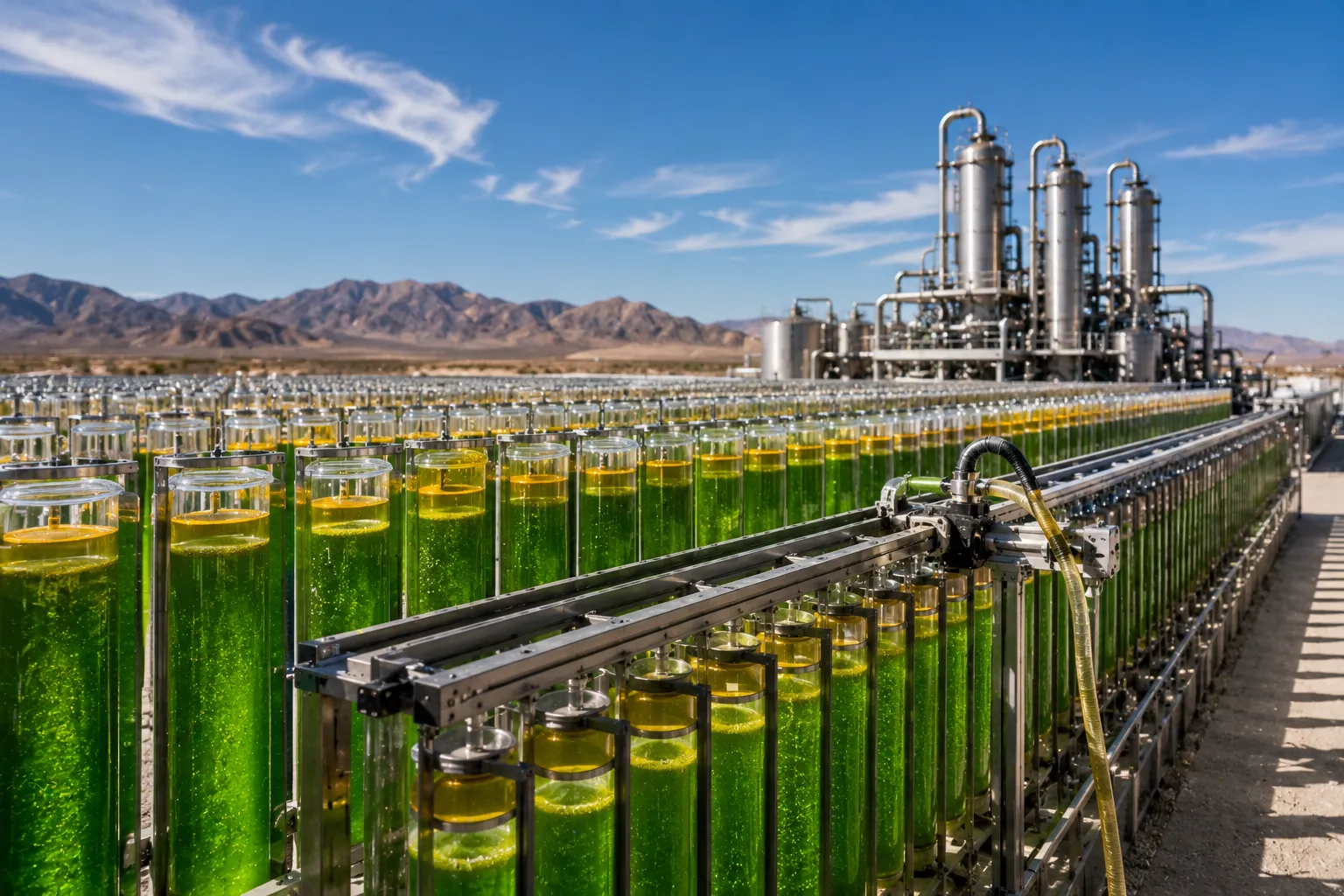
THE CHIHUAHUAN DESERT, Mexico — May 26, 2026 — The rows of photobioreactors stretch to the horizon, each a vertical glass tube twelve feet tall, filled with a vivid emerald liquid. The liquid is alive—dense with Chlamydomonas reinhardtii, a single‑celled green alga that has been genetically engineered to do something no natural plant can manage: absorb carbon dioxide from ambient air at a rate one hundred times faster than a tropical rainforest, then excrete long‑chain hydrocarbons that can be refined directly into gasoline, diesel, and jet fuel. The facility, operated by a startup called Algix, covers 200 acres of sun‑baked desert. It consumes no arable land, no fresh water (the algae grow in brackish groundwater), and no fertilizer (the nitrogen comes from the air). Its only inputs are sunlight, salt water, and the open air. Its outputs are fuel and oxygen.
"This is photosynthesis on steroids," said Dr. Elena Vasquez‑Rios, Algix's chief scientific officer, walking between the rows of reactors. A handheld meter shows the CO₂ concentration inside the tubes: 220 parts per million, a full 100 ppm lower than the ambient air outside. The algae are literally scrubbing the desert sky. "People think of algae as pond scum. We think of them as the most efficient solar panels on the planet. Plants are only about 3 percent efficient at converting sunlight into biomass. Algae can reach 15 percent. And we have engineered them to put that energy into making fuel, not just more algae."
"Plants are only about 3 percent efficient at converting sunlight into biomass. Algae can reach 15 percent. And we have engineered them to put that energy into making fuel, not just more algae." — Dr. Elena Vasquez‑Rios, Algix
The Problem with Trees and Machines
The world needs to remove billions of tons of CO₂ from the atmosphere to avoid catastrophic warming. The two leading approaches have serious flaws.
Tree planting is beloved, cheap, and natural. But a mature forest absorbs about 2.5 tons of CO₂ per acre per year. To remove 10 billion tons annually (roughly one‑quarter of current emissions), you would need 4 billion acres—an area larger than Russia. Trees also take decades to mature, are vulnerable to fire and drought, and compete with agriculture for land.
Direct air capture (DAC) machines are faster but expensive. The leading technology, from companies like Climeworks and Carbon Engineering, uses fans to blow air over chemical sorbents that bind CO₂. The captured gas is then heated to release it. The cost is $500–$800 per ton of CO₂, and the energy required is substantial. Scaling to billions of tons would require thousands of massive facilities and trillions of dollars.
Algae offer a third path. They are biological machines that self‑replicate, self‑repair, and run on sunlight. They can be grown in deserts, on rooftops, on degraded land that cannot support crops. And they do not need to be heated or pressurized; they grow at ambient temperatures. The Algix system costs roughly $150 per ton of CO₂ removed—already competitive with the most optimistic projections for DAC, and falling.
The Genetic Toolkit: Turning Pond Scum into Oil Refineries
The natural algae that bloom in ponds are not good fuel producers. They store energy as starch or lipids, but the lipids are a mixture of short‑ and long‑chain fatty acids that are difficult to upgrade to transportation fuel. The Algix team spent seven years engineering a strain of Chlamydomonas that solves both problems.
First, they inserted genes from coconut and palm trees that code for a special enzyme, acyl‑ACP thioesterase, which stops fat synthesis at the medium‑chain length (C8 to C14)—exactly the range that yields gasoline and diesel after simple hydrotreating. Second, they knocked out the gene that diverts carbon into starch, forcing the algae to put all their photosynthetic output into fat. Third, they added a sulfate‑controlled promoter: when the algae run low on sulfur (which Algix withholds from the growth medium), they stop dividing and start accumulating fat, reaching up to 70 percent of their dry weight as hydrocarbons. Fourth, they engineered a secretion pathway: instead of storing the oil inside their cells (which requires harvesting and breaking the algae open), the engineered algae excrete the hydrocarbons directly into the surrounding water. The oil floats to the surface, where it can be skimmed off continuously, while the algae remain in the reactor, still alive, still producing.
"We have turned algae into living oil wells," said Dr. Vasquez‑Rios. "They pump out crude continuously. We skim the oil, refine it on site, and send the algae back to work. The same population can run for months with only top‑ups of water and nutrients."
The System: Desert to Fuel Tank
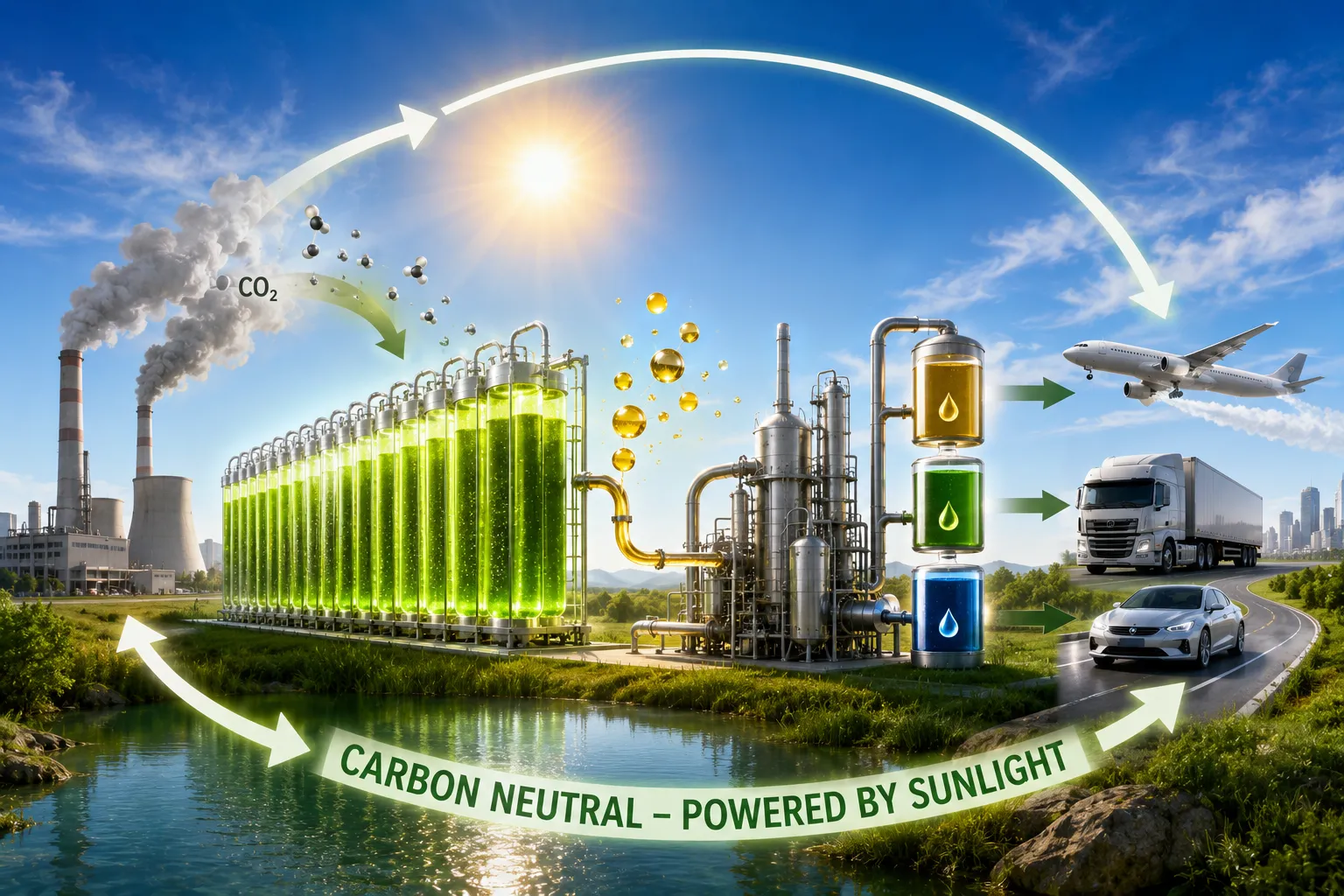
The Algix facility in Mexico is a pilot plant, but it is designed to scale. Each photobioreactor is a transparent tube with a central baffle that creates a swirling flow, keeping the algae suspended and exposed to light. A small pump circulates the culture. At the top, a skimmer collects the floating oil layer. The oil flows by gravity to a small hydrotreater that removes oxygen and sulfur, producing a mixture of alkanes—chemically identical to standard gasoline and diesel. The fuel is then blended with conventional fuel and sold to local distributors. The facility produces 50 barrels per day (about 2,000 gallons) of drop‑in fuel from 10 tons of captured CO₂.
The water is recycled. The algae consume CO₂ from the air; a small fan blows ambient air through the tubes, and the algae strip out the carbon. The oxygen they release is vented. The only waste is a small amount of dead algae biomass, which is dried and sold as protein‑rich animal feed.
"We are carbon negative," said Dr. Vasquez‑Rios. "Every barrel of fuel we produce represents CO₂ that was in the atmosphere a few days ago. When you burn that fuel in your car, you release the CO₂ back, but the net is zero. And because we are powered by sunlight, not fossil energy, the whole cycle is carbon neutral. Compare that to conventional gasoline, which takes carbon that was underground for 100 million years and puts it into the air. We are doing the opposite."
The Economics: Already Cheaper Than You Think
The Algix system costs about $150 per ton of CO₂ removed, including capital amortization, operation, and maintenance. The resulting fuel sells for $3.50 per gallon—competitive with gasoline in markets with carbon pricing or renewable fuel standards. Without subsidies, it is about $1.00 per gallon more expensive than fossil gasoline. But the gap is closing. Algix projects that by 2030, with larger reactors and optimized strains, the cost will drop to $2.50 per gallon, cheaper than fossil gasoline at current oil prices.
"We do not need a carbon tax to be viable," said Algix CEO Mark Torres. "We need scale. The first facility cost $50 million for 50 barrels a day. The next one will be 500 barrels a day for $200 million—four times the output for four times the cost, but half the capital intensity per barrel. The one after that will be 5,000 barrels a day. This is the same learning curve that solar and wind have already ridden. We are just starting."
The company has already secured offtake agreements with two major airlines (for sustainable aviation fuel) and a shipping line (for marine diesel). The US Department of Energy has awarded Algix a $75 million loan guarantee for a 500‑barrel‑per‑day facility in West Texas, scheduled to break ground in 2027.
Beyond Fuel: The Multibillion‑Ton Potential
If algae can capture CO₂ at $150 per ton and produce a valuable fuel, why not scale it to planetary dimensions? The answer is land and water. Even with high productivity, removing 1 billion tons of CO₂ per year would require about 10 million acres of photobioreactors—an area the size of Massachusetts. That is large, but not impossible. The world has plenty of desert land with abundant sunlight and brackish groundwater. The United States alone has 100 million acres of desert.
Water is the tighter constraint. Each ton of CO₂ removed requires roughly 1,000 gallons of water (lost to evaporation and incorporation into biomass). One billion tons would require 1 trillion gallons per year—about 1 percent of the flow of the Colorado River. That is not trivial, but it is manageable, especially if the facilities are located near coastlines (seawater is fine) or use closed‑loop cooling.
"We are not proposing to solve climate change with algae alone," said Dr. Vasquez‑Rios. "We are proposing to solve the hard part: aviation, shipping, long‑distance trucking, industrial heat. Those sectors are hard to electrify. They need liquid fuels. Our algae produce those fuels from air and sunlight. It is the only scalable, carbon‑negative path to decarbonizing transportation that exists today."
"Our algae produce liquid fuels from air and sunlight. It is the only scalable, carbon‑negative path to decarbonizing transportation that exists today." — Dr. Elena Vasquez‑Rios
The Critics and the Challenges
Not everyone is convinced. Critics point to the long history of failed algae‑fuel startups. In the 2000s, dozens of companies promised algae diesel; almost all went bankrupt. The problem was that they tried to grow algae in open ponds, which are vulnerable to contamination by wild algae and predators. Algix uses closed photobioreactors, which are more expensive but eliminate contamination. Still, the capital cost is high, and the energy required to circulate the algae and blow air through the tubes is not trivial.
There are also concerns about genetic containment. The engineered algae are designed to be less fit than wild strains in natural environments—they have been optimized for high‑light, high‑salt, low‑sulfur conditions that do not occur outside the reactors. But a spill could still cause ecological disruption. Algix uses multiple containment layers (filters, UV treatment, and chlorine disinfection) for all waste streams, and the facility is located in a remote desert region with no natural water bodies.
"Every technology has risks," said Dr. Vasquez‑Rios. "The risk of doing nothing is far greater. Climate change is already killing people. We need every tool in the box. Algae fuel is not the only tool. But it is a very sharp one."
The Future: Algae Refineries Everywhere
The Algix pilot is just the beginning. Other companies are pursuing different approaches. Viridos (a spin‑out from Synthetic Genomics) is engineering algae that produce high‑value oils for cosmetics and nutrition, with fuel as a secondary product. Algenol grows blue‑green algae (cyanobacteria) that excrete ethanol directly. ExxonMobil (yes, the oil giant) has a long‑standing algae research program, though it has not yet commercialized.
The long‑term vision is a network of algae refineries located near the equator, where sunlight is abundant, on land that is too poor for farming. They would consume CO₂ from the air, produce fuel for local use or export, and generate oxygen as a byproduct. The fuel would be carbon‑neutral, and the process would be carbon‑negative if the algae are also used for bioplastic or soil carbon after their productive life.
The facility in Mexico runs silently through the night, the algae in their tubes resting in the dark, the skimmer arms still. At dawn, the sun will hit the first tubes, and the emerald liquid will begin to churn, the engineered microbes waking to their work: drinking carbon, excreting fuel, breathing oxygen. It is not a silver bullet. But it is a green one. And in a world desperate for solutions, green is the color of hope.


