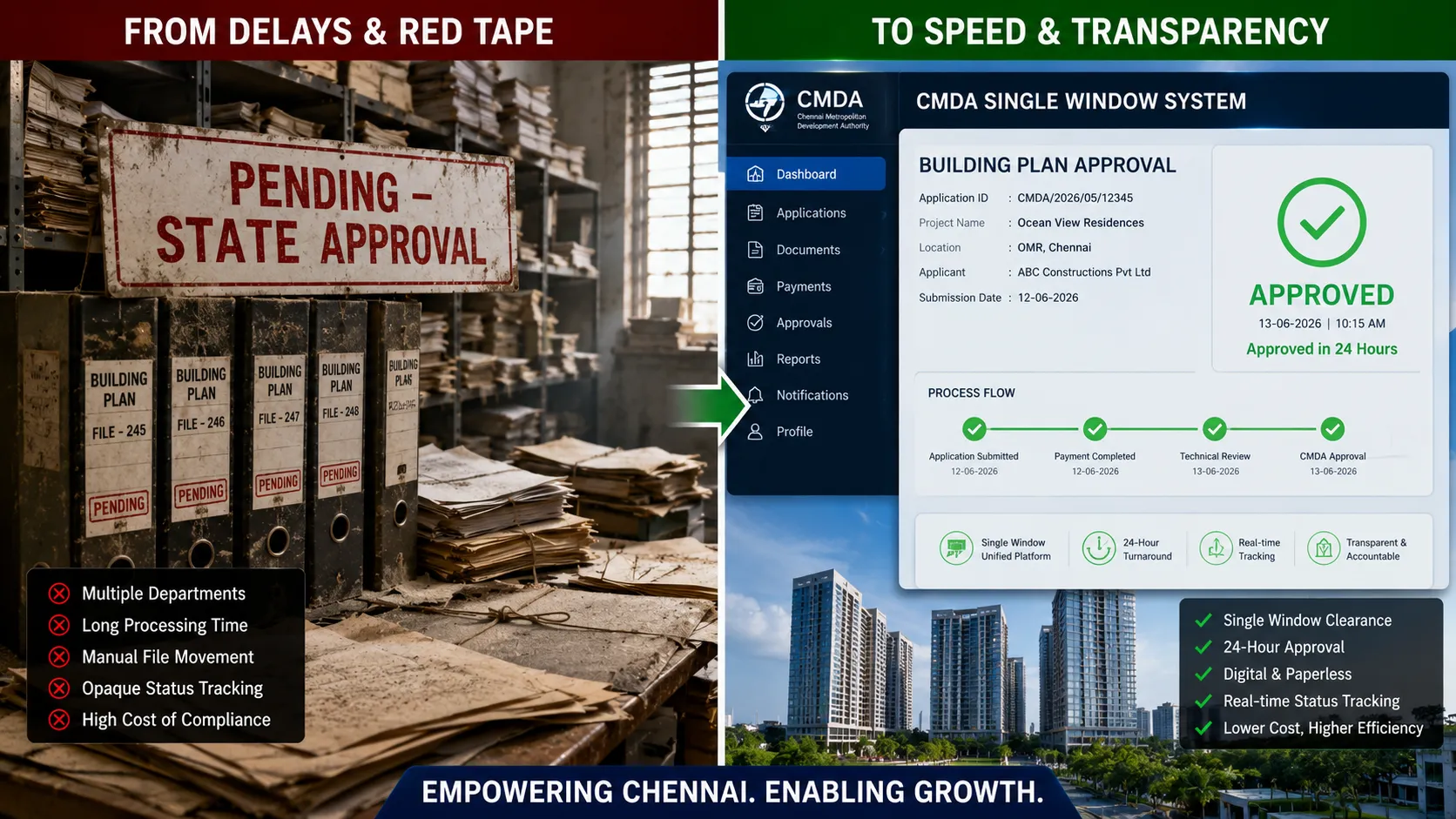
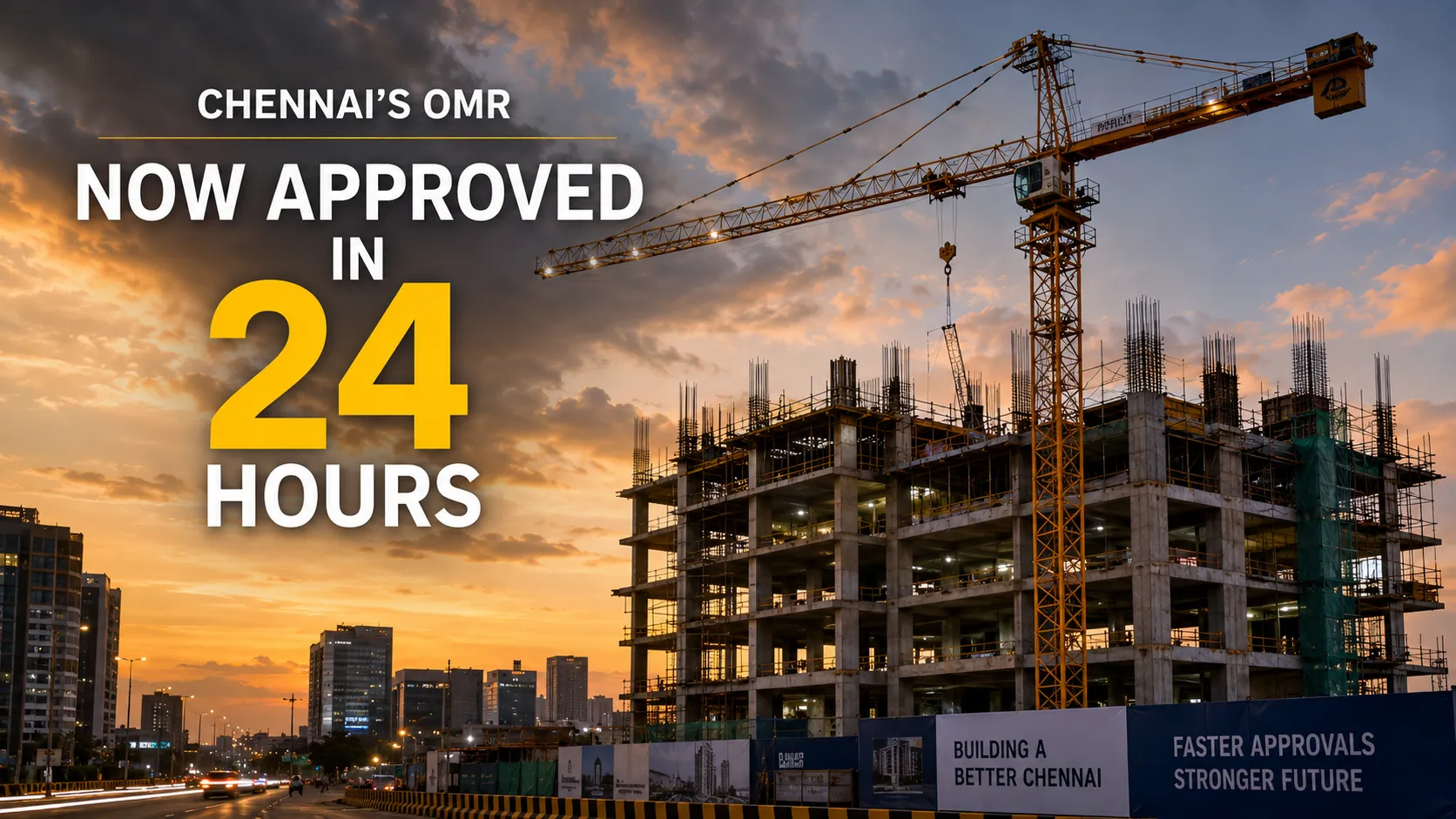
A government order dated June 13, 2026, stripped away years of red tape. Now high‑rises can rise without waiting for a minister's signature. Chennai is about to get a whole lot taller.
The file had been sitting on the same desk for eleven months. A proposed 32‑storey residential tower in OMR, Chennai's IT corridor. The builder had every approval from the Chennai Metropolitan Development Authority (CMDA). The structural plans were stamped. The environmental clearance was in place. But one more signature was needed — from the State Government's Housing and Urban Development Department. The file moved from desk to desk, from secretary to joint secretary, from "under consideration" to "further scrutiny" and back again. Eleven months. Then, on June 13, 2026, the government issued a new order. That signature was no longer required. The file was approved within 24 hours.
The government order, signed by Chief Minister C. Joseph Vijay, empowered the CMDA to directly approve high‑rise building projects. No more layer of state government approval. No more files sitting on secretariat desks for months. No more builders waiting for a politician's nod while their capital costs ballooned. The CMDA, already the primary planning authority for the Chennai metropolitan area, was now the final authority for buildings above 18 metres — essentially any structure of four storeys or more.
The change sounds technical. It is anything but. High‑rise construction in Chennai has been bottlenecked for years by a dual‑approval system. The CMDA would do the technical review — checking structural safety, fire compliance, floor space index, parking, and environmental impact. But the final permit required concurrence from the State Government's Housing Department. That concurrence was supposed to be a formality. In practice, it became a chokepoint. Files would sit for months. Some would get lost. Others would be returned with arbitrary queries. A few would be held up by political considerations — a local legislator wanting a favour, a rival builder objecting to competition, a minister's relative with a stake in the land market.
"Builders told us that the average time from CMDA recommendation to state approval was eight to ten months," said a senior official in the CMDA. "In some cases, it was over two years. During that time, construction costs would rise, interest on loans would accrue, and projects would become unviable. Many builders simply abandoned the high‑rise approval process altogether and built within the limits of lower height categories, even when the density justified a tower."
The economic cost of this delay was not trivial. Chennai is one of India's most land‑constrained major cities, bounded by the Bay of Bengal on one side and protected wetlands on the other. The only way to accommodate growth is to build upward, not outward. But the slow approval process discouraged vertical development, pushing residential and commercial demand into peripheral areas — further from jobs, further from transit, and often on environmentally sensitive land.
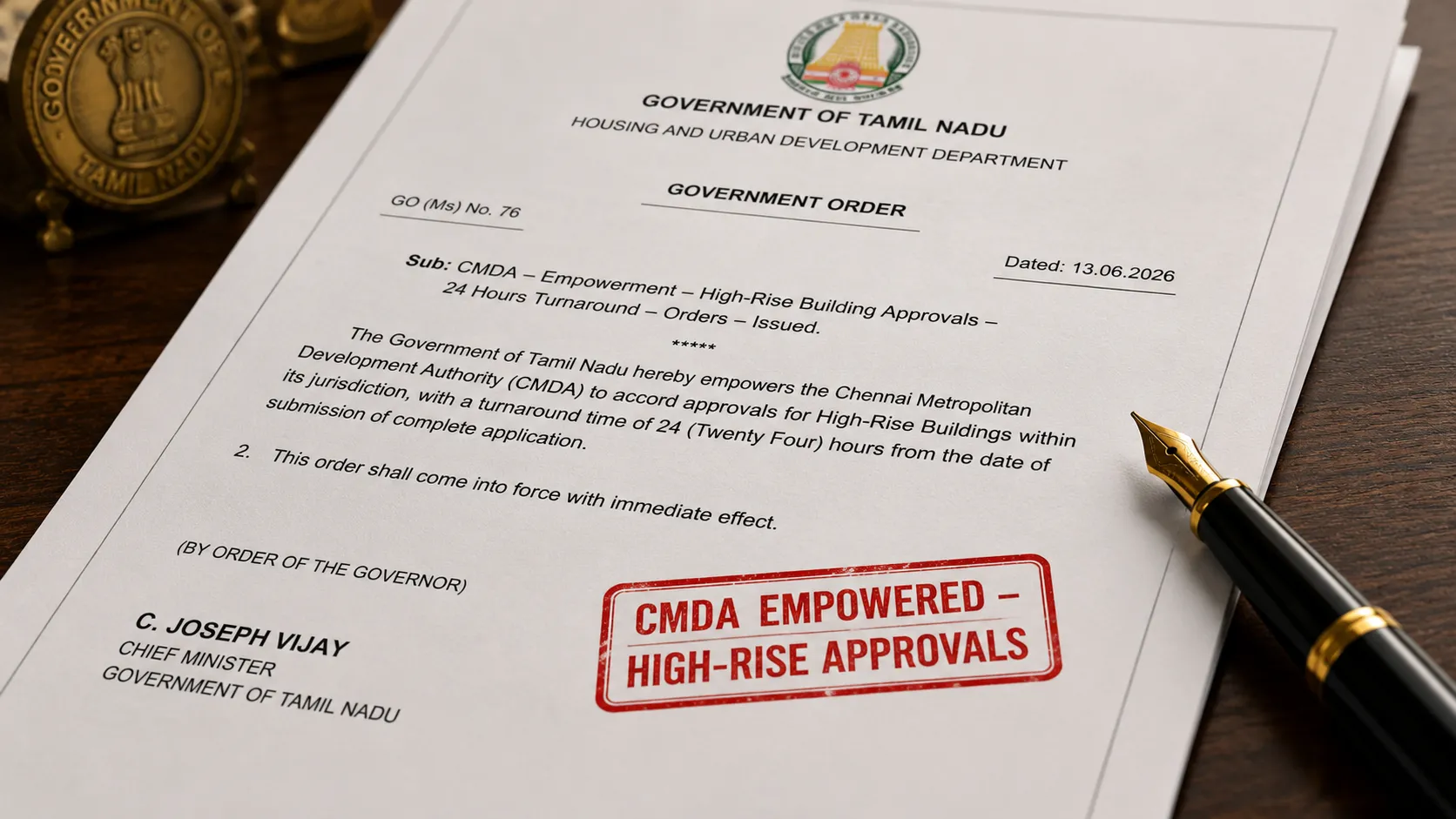
Chief Minister Vijay's government order on June 13 changed that overnight. The CMDA is now the sole approving authority for high‑rise buildings in the Chennai Metropolitan Area, which spans 1,189 square kilometres and includes parts of Chengalpattu, Kanchipuram, and Tiruvallur districts. The state government retains an appellate role — builders can appeal CMDA decisions to the Housing Department — but the routine approval process is now entirely within the CMDA's purview.
The impact will be felt almost immediately. According to CMDA data, there are currently 147 high‑rise building proposals pending at various stages of the approval process. Of these, 68 were awaiting state government concurrence after having already received CMDA technical clearance. Those 68 files were reopened on June 14, and the CMDA expects to issue approvals for all of them within 60 days.
"The market will react very quickly," said a Chennai‑based real estate consultant. "Builders who were sitting on land banks because they couldn't get approvals will now move. The supply of high‑rise residential and commercial space will increase, which should moderate prices. And the construction industry — cement, steel, glass, elevators — will see a surge in demand."
The CMDA itself has been preparing for this moment. Over the past year, the authority has digitised its approval process, launched an online portal for applications, and hired additional technical staff. The goal is to issue building permits within 45 days of application submission, provided the project meets all technical requirements. That would put Chennai on par with the fastest approval systems in the country — and far ahead of cities where builders still wait months or years.
The reform is part of a larger pattern. Under Chief Minister Vijay, Tamil Nadu has been systematically removing bureaucratic bottlenecks. The single‑window clearance for industrial investments, the streamlined land acquisition process, and now the CMDA empowerment — each reform is a brick in the wall of a state that wants to be known for ease of doing business.
Critics have raised concerns. Removing the state government's oversight role, they argue, could increase the risk of corruption or lax enforcement. The CMDA is not immune to political pressure, and developers with deep pockets might find ways to influence approvals. The government's response is that the technical standards are clear, the approval process is now fully digital and auditable, and the appellate mechanism provides a check.
"We are not eliminating scrutiny," the CMDA official said. "We are eliminating delay. Every high‑rise will still be checked for structural safety, fire compliance, and environmental impact. The difference is that now a single agency does the checking and issues the permit, without a second agency duplicating the work."
For Chennai's skyline, the change will be visible within a few years. Builders who had been waiting for approvals will break ground. New projects that were previously deemed too slow to pursue will be launched. The city's density will increase, but with better planning — the CMDA's approval process includes requirements for parking, open space, and infrastructure that will, in theory, prevent the chaos that has accompanied unplanned growth in other Indian cities.
For the file that sat on the desk for eleven months — the 32‑storey tower in OMR — the builder is already mobilising contractors. "We should have our foundation laid by the end of this year," he said. "Two years ago, I thought this project would never happen. Now I'm thinking about the next one."
That is the power of a single government order. Not just a signature. A signal. An unlocking. And a city that finally learned to grow upward.