The Boy from the Coffee Hills Who Is Building India's Eye in the Sky — and Its First AI Data Center in Orbit
BENGALURU — May 20, 2026 — Awais Ahmed grew up in Chikmagalur, a quiet town in the Western Ghats of Karnataka famous for its rolling coffee plantations and not much else. Five hours from Bengaluru, five hours from the nearest venture capitalist, five hours from any plausible future in technology. His early world was defined by agriculture, weather patterns, and the steady rhythm of nature — the kind of childhood that produces farmers, not founders. Years later, when Ahmed walked through the doors of SpaceX headquarters in Hawthorne, California, carrying India's first Hyperloop pod under his arm, he had no way of knowing that the moment would reroute his life. But it did. Standing inside that building, surrounded by the physical manifestations of modern aerospace ambition, Ahmed realized his calling. He would build something in space. And not just anything — he would build a company that could see what no one else could see.
Seven years later, Pixxel is no longer a promising startup. It is the architect of India's first private satellite constellation, a fleet of hyperspectral Firefly satellites that capture 135 spectral bands at 5-meter resolution, detecting crop infestations, pipeline leaks, and environmental crises invisible to standard cameras. It is a defense contractor with formal contracts from the Indian Ministry of Defence to build dedicated satellites for the Indian Air Force. It is Google-backed, Lightspeed-backed, Radical Ventures-backed, with $95 million in total funding and a Series C in the works that could swell to $100 million. And as of May 2026, it is the company that, in partnership with foundational AI developer Sarvam AI, is building India's first orbital AI data center — a 200-kilogram satellite called Pathfinder that will carry data-center-class GPUs into orbit and run sovereign AI models directly in space.
Ahmed is 29. The coffee hills are still there. The satellites are already in the sky.

The Invisible Crisis
The problem Pixxel was built to solve is, in retrospect, so obvious that it is remarkable no one had solved it before. For decades, Earth observation satellites have captured what the human eye can see: standard red-green-blue imagery, useful for mapping cities, tracking deforestation, and monitoring weather. But the most catastrophic environmental and industrial crises — early-stage crop infestations, underground pipeline leaks, marine oil spills, methane emissions from thawing permafrost — remain invisible to standard RGB cameras. They emit or reflect light in wavelengths beyond human vision, in the narrow spectral bands that only hyperspectral sensors can detect.
"When you look at a forest with RGB imagery, you see green," Ahmed told India Today Tech. "But with hyperspectral, you can tell whether those trees are stressed, diseased, or healthy, because the spectral signature of chlorophyll changes before the leaves turn brown." The difference is not academic. A crop infestation detected at its earliest, pre-visual stage can be treated before it spreads. A methane leak identified from orbit can be capped before it becomes a climate disaster. A pipeline anomaly caught weeks before a rupture can save millions in cleanup costs and environmental damage.
The global incumbents — Planet Labs, Maxar, Airbus Defence and Space — had built successful businesses on optical imagery. But they had left the hyperspectral market largely unaddressed, in part because the sensors were difficult to miniaturize, in part because the data processing challenge was immense, and in part because the commercial case had not yet been proven. Ahmed and his co-founders — Kshitij Khandelwal, the company's CTO, and a small team of engineers who had cut their teeth on university satellite projects and Hyperloop competitions — believed they could build a hyperspectral constellation that was smaller, cheaper, and more capable than anything the incumbents had attempted.
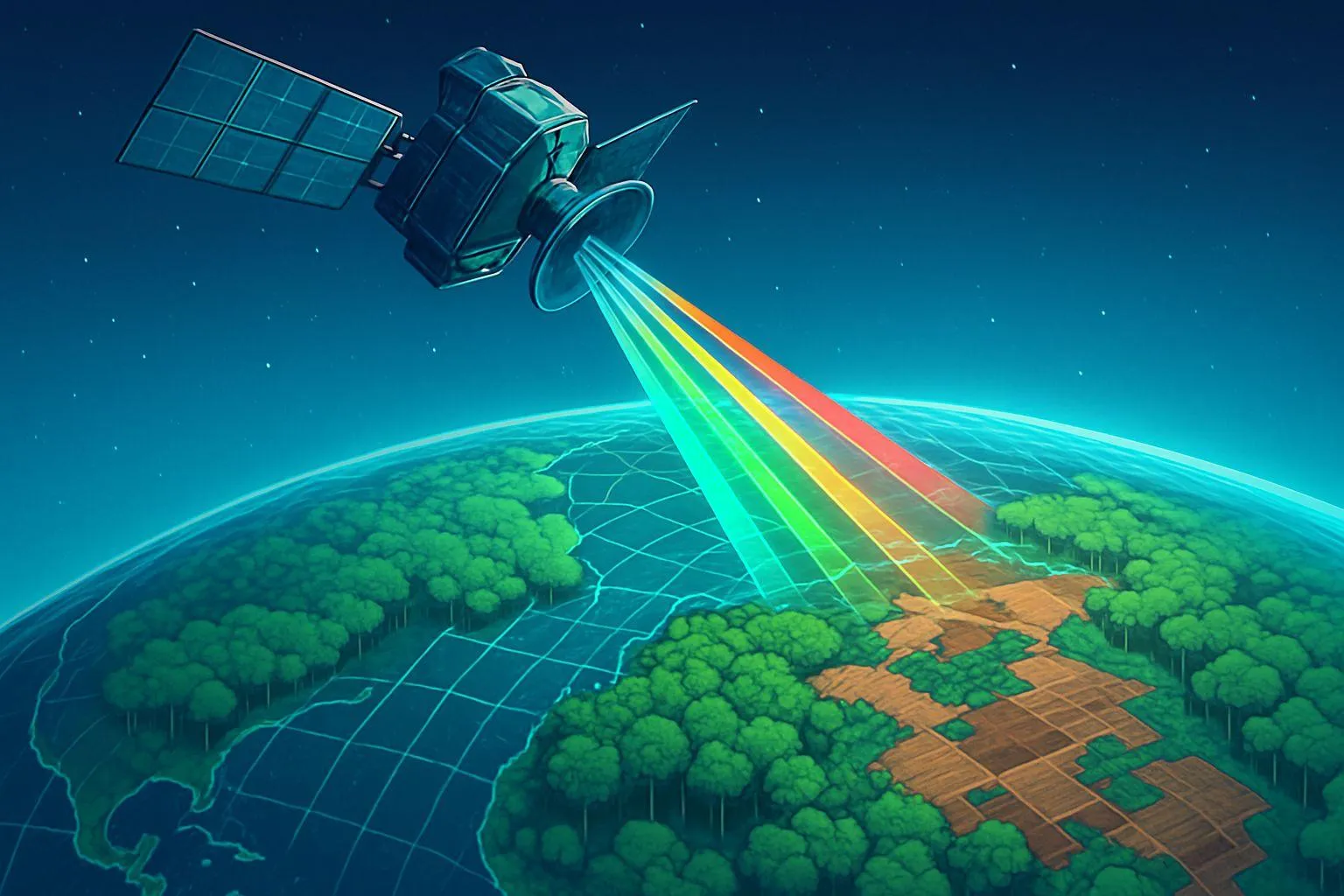
They were right. The Firefly constellation — India's first private satellite network operating independently of the state-run ISRO — now delivers commercial datasets to international clients at scale, capturing 135 spectral bands at 5-meter resolution with daily revisit capability over any point on Earth. A second constellation, Honeybee, is scheduled for launch in 2026, extending coverage into the shortwave infrared range with 260 spectral bands. The company designs, builds, and operates its hardware entirely in-house, from the sensor optics to the satellite bus to the Aurora analytics platform that turns raw spectral data into actionable intelligence. "We own the sensors, the satellites, the data, and we analyse it through Aurora for a health monitor of our planet," Ahmed told BW Businessworld. "That's the planetary intelligence piece."
From ISRO to SpaceX and Back
Pixxel's relationship with ISRO is one of the more instructive examples of how India's private space sector has evolved from adversarial to symbiotic in less than a decade. When Ahmed and his team began building satellites in the late 2010s, India's space sector was a government monopoly. There was no regulatory framework for private launches, no venture capital ecosystem for space tech, and no cultural template for a startup that built satellites. The founders navigated a chaotic landscape of unclear regulations and cautious government gatekeepers who had never been asked to accommodate a private satellite operator.
The introduction of the formal Indian Space Policy and the establishment of IN-SPACe — the Indian National Space Promotion and Authorization Centre — as a single-window regulatory clearinghouse transformed the environment. Today, Pixxel relies on ISRO's world-class testing infrastructure and uses the iconic Polar Satellite Launch Vehicle to ride into orbit. ISRO veterans populate Pixxel's advisory board and engineering teams. The startup that once operated in regulatory limbo now uses the government agency as a launchpad — and Ahmed frames the relationship not as dependency but as division of labor.
"ISRO excels deeply at core research and development," he said. "However, over the last two decades, they also had to take on commercial execution burdens. Their primary mandate should be long-term space exploration — sending missions to the Moon, Mars, and Venus, or managing human spaceflight programs like Gaganyaan. Private companies like Pixxel are stepping up to handle the commercial market, allowing ISRO to focus heavily on pure R&D."
The company has also attracted investment from some of the most significant names in Indian technology. Zomato founder Deepinder Goyal is in advanced talks to invest in Pixxel's latest fundraise, joining existing backers Alphabet (Google), Lightspeed Venture Partners, Radical Ventures, Glade Brook Capital Partners, and M&G Investments. The $55–60 million round is expected to expand to $80–100 million as additional investors are brought in. The cap table reflects a conviction that the company's ambitions extend well beyond Earth observation.
The Pathfinder and the Orbital Compute Race
The Pathfinder satellite, announced in early May 2026 and scheduled for launch as early as the fourth quarter of this year, is the most audacious piece of Pixxel's roadmap — and the project that has drawn the most attention from the global space and AI communities. Under the partnership with Sarvam AI, Pixxel will design, build, launch, and operate the satellite. Sarvam will provide the sovereign AI models — foundational language and computer vision systems trained on Indian data, running on Indian-built infrastructure. The satellite will carry data-center-class GPUs into orbit, allowing AI inference to be performed directly in space, on the data the satellite collects, without the latency and bandwidth constraints of downlinking to a terrestrial ground station.
The logic is both technical and geopolitical. Terrestrial data centers are hitting severe bottlenecks: energy constraints, regulatory delays, community pushback, and physical land limitations are slowing the buildout of AI compute capacity in major markets. Space-based data centers, by contrast, offer continuous solar power, passive radiative cooling, and the ability to process data at the point of collection — reducing the need for high-bandwidth downlinks. The same hyperspectral data that Pixxel's Firefly satellites collect can be analyzed in orbit by Sarvam's models, with only the insights — not the raw terabytes — transmitted to Earth.
The geopolitical dimension is even more urgent. "Countries that want to maintain a serious geopolitical stance in the coming decades must own indigenous space infrastructure," Ahmed said. "If global powers are developing orbital data centres, India must establish its own footprint to maintain data sovereignty." The Pathfinder is a direct response to the orbital compute race that has seen SpaceX file to launch up to one million compute-capable satellites, Lumen Orbit raise $175 million for space-based data centers, and China advance its own orbital AI infrastructure programs. India, through Pixxel and Sarvam, is now a participant.
The Defense Dimension
Pixxel's commercial Earth observation business and its orbital data center ambitions are the most visible parts of the company's story. But a quieter, equally significant piece of the puzzle is the company's deepening integration into India's national security apparatus.
Under a formal contract with the Ministry of Defence, Pixxel is constructing a dedicated, specialized satellite for the Indian Air Force — a miniaturized platform capable of carrying electro-optical, infrared, synthetic aperture radar, and hyperspectral payloads. The contract, awarded under the Innovations for Defence Excellence (iDEX) program, marks one of the first instances of an Indian private startup building a bespoke satellite for a specific military customer. Pixxel also signed an iDEX SPARK grant agreement in mid-2025 to develop hyperspectral and mid-wave infrared payloads tailored for the IAF, focusing on border surveillance, tracking illegal infrastructure developments, and monitoring maritime activities across critical sea lanes.
"India absolutely possesses the foundational ingredients to be a leader here," Ahmed told India Today. "We are learning that we must develop sovereign capabilities across the board. We have to collaborate domestically to bridge the gaps." The statement is diplomatic but the strategic logic is unmistakable: Pixxel is positioning itself as the space-technology backbone of India's defense modernization, building not just commercial satellites but the reconnaissance and surveillance infrastructure that the country's military has historically sourced from foreign suppliers.
The First Pixxel for the World
Ahmed is frequently asked whether he is building the "SpaceX of India." It is a natural question. His Hyperloop team presented to Elon Musk. His satellites ride Falcon 9 rockets. His company's ambition — to build a vertically integrated space technology company that designs, manufactures, and operates its own hardware — echoes the SpaceX playbook at a smaller scale. And his industry is one where SpaceX is the unavoidable reference point for every commercial space startup on Earth.
Ahmed's answer is characteristically nuanced. "For anyone who went through engineering school around 2014 or 2015, what Musk has accomplished with SpaceX and Tesla from a first-principles engineering perspective is undeniable," he said. "But my inspiration is less about the individual public persona and far more about emulating the relentless velocity, operational culture, and scale of the organisation they built." And then, with the quiet confidence of a founder who has already launched a constellation and is planning his next one, he adds: "We want to build the first Pixxel for the world. They are a great benchmark for civilisational-scale ambition, but we are taking a fundamentally different technological approach to solve critical planetary data gaps that haven't been addressed yet."
The planetary data gaps are real. The satellites are already in the sky. The orbital AI data center is scheduled to launch before the end of 2026. The defense contracts are signed. The Series C is coming. The boy from the coffee hills who walked into SpaceX headquarters with a Hyperloop pod under his arm and walked out with a conviction that he would build something in space has, in seven years, built exactly that — not a SpaceX clone, but something more specific, more local, and more ambitious in its own way: a company that can see the invisible, process the unprocessable, and give India a sovereign presence in the orbital compute race that will define the next decade of global technology competition.


