The Billion‑Dollar Burger: Why Cultivated Meat Finally Works—And Why It Took So Long
BERKELEY, Calif. — May 26, 2026 — The patty sizzles on a stainless‑steel griddle. It smells like beef—that rich, Maillard‑reaction perfume that has drawn humans to fire and flesh for two million years. It looks like beef: brown on the outside, pink within, with glistening fat marbling through the protein. A chef flips it. A photographer leans in. And then the tasting: a bite, a chew, a pause. "It's beef," says the taster, a little surprised. "I mean, it's really, really good beef."
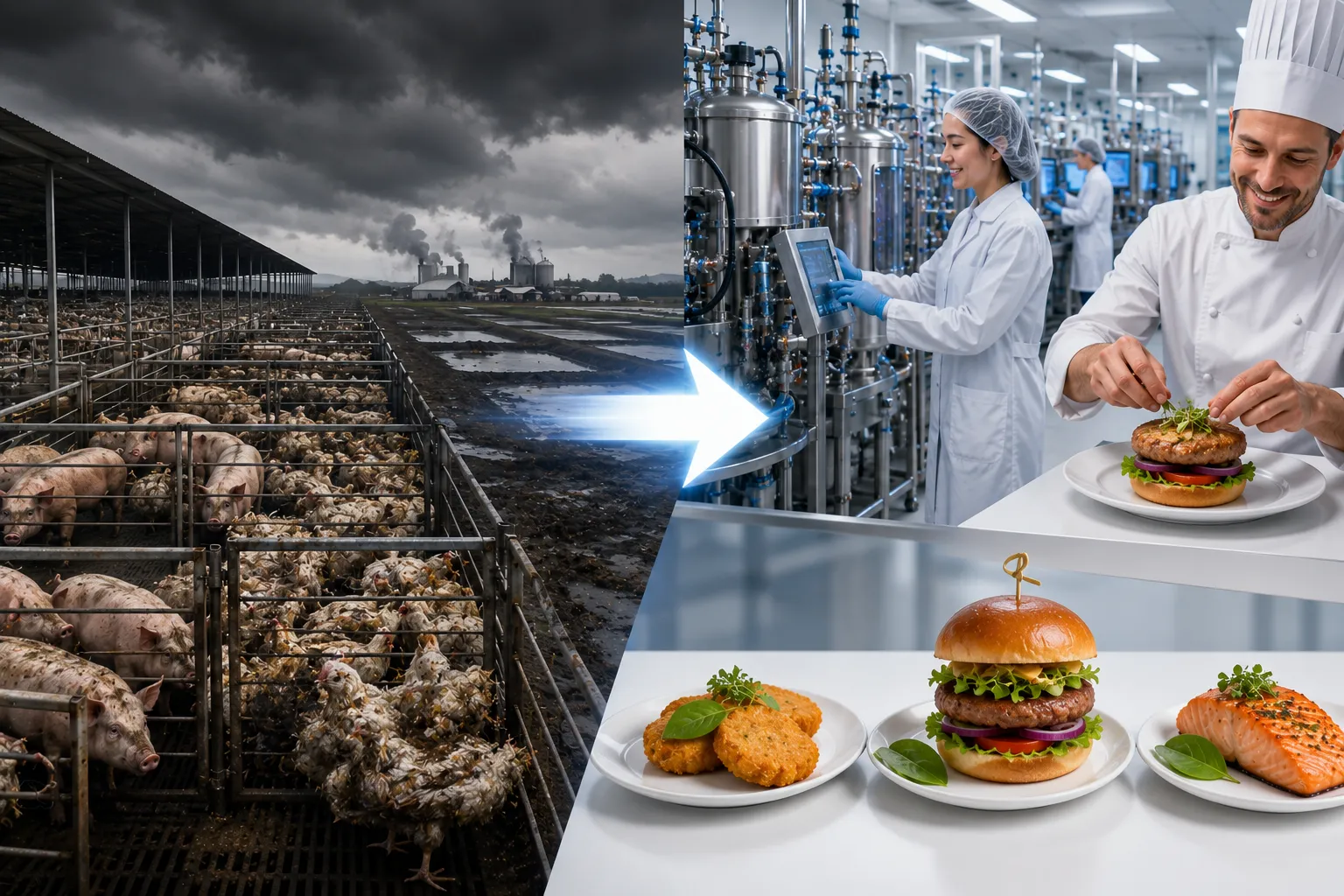
This patty cost $330,000 to make. That was 2013, in Maastricht, the Netherlands, when Mark Post unveiled the first cultivated hamburger. The price was a punchline—a symbol of a technology that was theoretically possible but practically absurd. Today, less than 300 yards from the University of California, Berkeley, a startup called Upside Foods is producing the same patty for less than $6. Their production facility, a converted warehouse near the Oakland estuary, contains 2,000‑liter bioreactors—the same stainless‑steel vessels used to brew beer—growing chicken, beef, and pork cells by the ton. The facility can produce 50,000 pounds of cultivated meat per month. It is operating at 40 percent capacity. The only bottleneck, for now, is demand.
"Cultivated meat has crossed the chasm," said Dr. Uma Valeti, a cardiologist turned CEO of Upside Foods. "The science is solved. The scaling is happening. The regulatory pathway is clear. What remains is cultural—convincing people that meat grown in a bioreactor is not 'fake' or 'Frankenfood.' It is real meat. The cells are from animals. The growth process is the same. The only difference is where the animal lives: in a pasture, or in a vial."
The Long, Expensive Road
The dream of growing meat without animals is older than most people realize. Winston Churchill predicted it in 1931: "We shall escape the absurdity of growing a whole chicken in order to eat the breast or wing, by growing these parts separately under a suitable medium." But the technology lagged the vision by nearly a century.
The first hurdle was cell sourcing. You cannot just throw any animal cells into a vat and expect them to multiply into a steak. You need a cell line that is immortal—able to divide indefinitely without aging—or at least that remains viable through many generations. The breakthrough came from the meat industry itself. Scientists discovered that stem cells from the muscle tissue of cattle, chickens, and pigs could be coaxed into indefinite proliferation using specific growth factors.
The second hurdle was media. Animal cells do not grow in water. They need a rich broth of amino acids, sugars, vitamins, and growth factors. The traditional medium for cell culture—fetal bovine serum (FBS)—is harvested from the blood of slaughtered calves. It is expensive, variable, and ethically problematic (using animal products to make animal‑free meat defeats the purpose). Finding a serum‑free, animal‑free medium took years. The breakthrough came from plant hydrolysates—yeast extracts, soy peptones, and recombinant proteins produced by fermentation. Today, the cost of growth medium has fallen from $1,000 per liter to less than $10 per liter.
The third hurdle was scaffolding. Muscle cells grown in a vat tend to form a shapeless slurry, not a steak. To create texture—the bite, the chew, the mouthfeel—cells need a scaffold to attach to and align along. Early scaffolds were made of collagen or gelatin (again, animal‑derived). Newer scaffolds use plant proteins (soy, pea, wheat) or even 3D‑printed edible polymers that mimic the extracellular matrix of animal muscle. The scaffold dissolves during cooking or is soft enough to eat without detection.
The fourth hurdle was scale. A petri dish is easy. A 2,000‑liter bioreactor is not. Cells need oxygen, nutrients, and waste removal. They need to be stirred gently enough not to damage them but vigorously enough to keep them suspended. They are sensitive to temperature, pH, and shear stress. The engineering challenges took years to solve. Now, continuous perfusion bioreactors—cells are constantly fed and waste is constantly removed—can maintain high densities for months.
"We went from making a single patty in a lab to making tons of meat in a factory in ten years," said Dr. Valeti. "That is an astonishing acceleration. It took the semiconductor industry twenty years to go from the first transistor to the first microprocessor. We are moving faster."
The Regulatory Tipping Point
The single most important event in the history of cultivated meat was not a scientific breakthrough. It was a regulatory decision. In June 2023, the U.S. Department of Agriculture and the Food and Drug Administration jointly approved the sale of cultivated chicken from Upside Foods and GOOD Meat (a subsidiary of Eat Just). The approval came after a rigorous safety review: the cells were tested for pathogens, the media ingredients were vetted, the bioreactor materials were inspected. The conclusion: cultivated meat is as safe as conventional meat.
That approval opened the floodgates. Within 18 months, four more companies received approval: Believer Meats (cultivated lamb), Wildtype (cultivated salmon), Mosa Meat (cultivated beef), and Integriculture (cultivated foie gras, using quail cells). As of May 2026, cultivated meat is legally available in the United States, Singapore (the first adopter, in 2020), Israel, the European Union (under novel food regulations), and China, which has made cultivated meat a strategic priority to reduce its dependence on imported soy and grain.
"The regulatory approval was the signal the industry needed," said Bruce Friedrich, president of the Good Food Institute, a nonprofit that supports alternative proteins. "Venture capital had been cooling on cultivated meat because the exit path was unclear. After the USDA approval, funding rebounded. In 2024 alone, cultivated meat startups raised $2.3 billion—more than the previous five years combined."
The Price Cliff
The most dramatic story in cultivated meat is the collapse of production costs. In 2013, the first burger cost $330,000. By 2018, a San Francisco startup, Memphis Meats (now Upside), had reduced the cost to $2,400 per pound. By 2022, it was $50 per pound. By 2025, Upside achieved $6 per pound for ground chicken—roughly comparable to organic, free‑range chicken at Whole Foods.
The cost curve is still falling. Industry analysts project that by 2028, cultivated ground meat will reach price parity with conventional commodity meat ($2–$3 per pound). Cultivated steak, which requires complex scaffolding and longer growth times, will remain expensive ($15–$20 per pound) for the foreseeable future. But ground meat—burgers, nuggets, sausages, meatballs—accounts for the majority of meat consumption.
"We are seeing a classic learning curve," said Dr. Liz Specht, a chemical engineer and food technology analyst. "Every time cumulative production doubles, costs fall by about 20 percent. We have only just started scaling. Once we have dozens of large‑scale facilities, costs will fall further. There is no fundamental reason why cultivated meat should be more expensive than conventional meat. Both require energy, labor, and inputs. Conventional meat requires a whole animal—feed, water, land, waste management, slaughter. Cultivated meat requires only the cells that become meat. In theory, it should be cheaper."
The Demand Problem
The biggest obstacle today is not production or price. It is consumer acceptance. Polling consistently shows that a majority of Americans are willing to try cultivated meat, but a substantial minority (30–40 percent) are skeptical or opposed. The opposition is not political in a simple way: some conservatives reject cultivated meat as "fake" or "government overreach," while some progressives reject it as "too processed" or "unnatural."
"There is no single messaging strategy that works for everyone," said Friedrich. "Some people care about animal welfare. Some care about the environment. Some care about food safety (cultivated meat has no risk of fecal contamination or antibiotics). Some care about cost. The industry is learning to segment its messaging."
The early adopters are young, urban, and educated. The first cultivated meat products—chicken nuggets at a high‑end San Francisco restaurant, lamb meatballs at a Tel Aviv food stall—sold out within hours. The challenge is moving from novelty to staple. That requires distribution: getting cultivated meat into grocery stores at scale. The first major retail deal was announced in March 2026: Upside Foods will supply cultivated chicken to 100 Costco locations in California and the Pacific Northwest, beginning in September.
"We are not trying to replace the family farm or the grass‑fed rancher. We are trying to replace the factory farm—the system that produces 99 percent of meat in America. That system is cruel, unsustainable, and fragile. Cultivated meat is a better way." — Dr. Uma Valeti
The Environmental Math
The environmental case for cultivated meat is strong but nuanced. A 2024 life‑cycle assessment commissioned by the Good Food Institute found that, compared with conventional beef, cultivated beef produces 92 percent less greenhouse gas emissions, uses 95 percent less land, and consumes 78 percent less water. However, the energy intensity of bioreactors is high; if the electricity comes from fossil fuels, the climate benefits shrink. The analysis assumed a decarbonized grid, which is the direction the US is moving (though slowly).
"Cultivated meat is not a magic bullet for climate change," said Dr. Specht. "But it is a powerful tool. Animal agriculture is responsible for about 15 percent of global emissions—more than all transportation combined. Replacing even a fraction of that with cultivated meat would make a significant dent. And the land freed up from grazing and feed crops could be rewilded, sequestering even more carbon."
Critics argue that the environmental benefits are overstated. They point to the energy cost of producing growth factors, the plastic waste from single‑use bioreactor bags, and the fact that many life‑cycle assessments are funded by the industry itself. Defenders counter that conventional meat's environmental footprint is similarly understated because it excludes the cost of manure management, antibiotic resistance, and public health impacts.
The Taste Test
In the end, the success of cultivated meat will come down to one thing: taste. If it tastes good and costs the same or less, people will eat it. If it does not, they will not.
The tasting at Upside's Berkeley facility is promising. The chicken is moist, tender, and savory—indistinguishable from conventional poultry in a blind test. The beef has a clean, slightly sweet flavor, with a texture that is less chewy than conventional beef (because it has less connective tissue). The salmon flakes and has a mild, oceanic taste, though it lacks the briny complexity of wild fish.
"We are still iterating," said Valeti. "We are adding fat cells to improve mouthfeel. We are experimenting with different scaffold materials to replicate the grain of steak. We are a long way from perfect. But we are already good enough. And we will only get better."
The Future of Meat
The cultivated meat industry is still tiny. In 2025, global production was approximately 5 million pounds—equivalent to the output of a single mid‑sized chicken farm. By 2030, projections range from 500 million to 2 billion pounds, or about 1–4 percent of US meat consumption. That is not a revolution. It is a beachhead.
But beachheads grow. The first automobiles were expensive, unreliable, and mocked as "horseless carriages." The first cell phones were bricks. The first cultivated meat patty was a $330,000 publicity stunt. Today, a burger costs $6. In five years, it may cost $2. In ten years, it may be the default, not the exception.
The animal in the vat does not suffer. It does not produce waste. It does not consume antibiotics that breed resistant bacteria. It does not emit methane. It is, in every sense that matters, a better way to make meat. The only question is whether we—the eaters, the shoppers, the voters—will embrace it. The billion‑dollar burger is now a six‑dollar burger. The next stop is your plate.


