The Bengaluru Robots That Want to Run Every Warehouse on Earth: Inside the $5.4 Million Bet on Machines That Understand Context—Not Just Commands
BENGALURU — May 24, 2026 — Ribin Mathew was not supposed to be a roboticist. He was a software engineer, the kind who could have spent a comfortable career building enterprise applications for companies that paid well and asked few questions. But somewhere in the early years of his working life, he stumbled on a statistic that lodged in his brain and refused to leave. Nearly 80 percent of the world's warehouses operate with little or no automation. Not 8 percent. Not 18 percent. Eighty percent. Hundreds of thousands of facilities—the distribution centres that feed the e‑commerce pipelines, the factory floors that build everything from smartphones to car parts, the logistics hubs that move the global economy—are still run largely by humans pushing carts, carrying boxes, and walking miles of concrete every shift. The world had spent a decade building artificial intelligence that could write poetry and generate images. It had spent almost no time building robots that could move a pallet from one end of a warehouse to the other without human supervision.
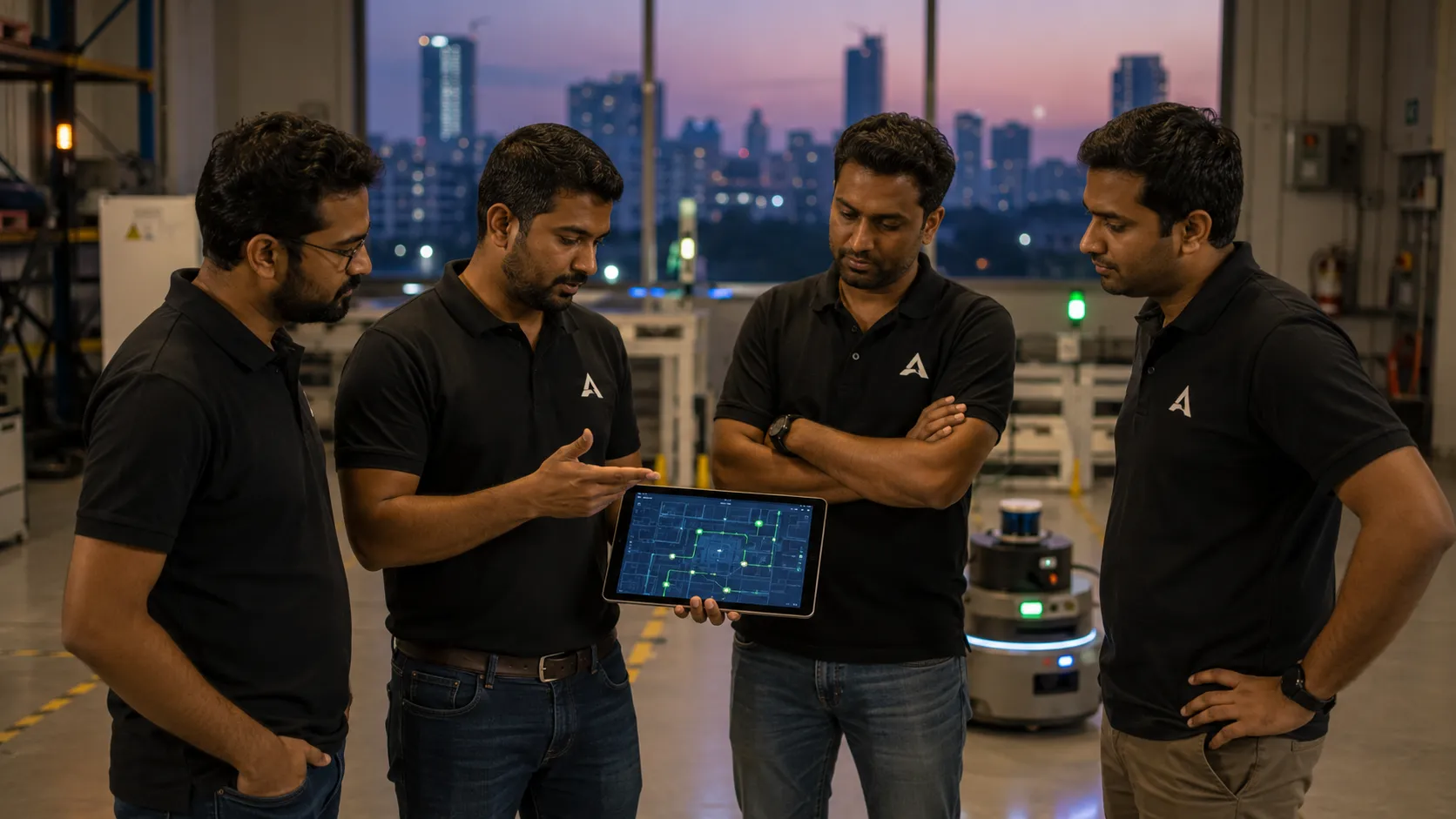
In 2020, Mathew quit his job. He recruited three friends—Ebin Sunny, Raghu Venkatesh, and Raj Mohan—and together they launched ANSCER Robotics, a Bengaluru-based industrial robotics startup with a thesis that was either visionary or delusional, depending on whom you asked. They would build autonomous mobile robots, or AMRs, that could navigate the chaotic, unpredictable environments of real factories and warehouses—not the sterile, controlled labs where most robotics startups test their prototypes. They would build them in India, where labour costs were low enough that the economic case for automation was harder to make than in the United States or Europe. They would sell them to a global market that had spent decades treating industrial automation as a luxury for the largest corporations. And they would do all of this while competing against companies with deeper pockets, longer track records, and manufacturing bases in the countries that had dominated industrial robotics for a century.
On May 21, 2026, that thesis was validated. ANSCER Robotics announced a $5.4 million (approximately ₹45 crore) Series A funding round led by IAN Alpha Fund, with participation from Info Edge Ventures and a syndicate of angel investors. The round, which follows a $2 million seed round in 2023, will fund the company's push into the United States—the world's largest and most competitive industrial automation market—and the expansion of its Bengaluru manufacturing facility, which already has the capacity to produce more than 1,000 robots per year. The company has onboarded Mark Messina, a former Amazon Robotics and Kiva Systems executive, as Managing Director and CEO of its U.S. operations. And it has done something that few Indian deeptech startups have managed: it has built a product that global enterprises are willing to buy, not because it is cheaper than the alternative, but because it is smarter.
The Engineers Who Chose Hardware
The founding story of ANSCER Robotics is not the story of a brilliant PhD dissertation or a government research grant. It is the story of four engineers who looked at the industrial automation market and concluded, with the clarity of people who had spent years building software, that the hardware was stuck in the past.
Mathew, the CEO, had been a software engineer before the company's founding, and his journey—from writing code to building physical machines—mirrors the broader shift in Indian deeptech. For decades, India's technology industry was defined by services: IT outsourcing, business process management, the arbitrage between Indian talent and Western demand. The country produced brilliant software engineers. It did not produce companies that built physical products—robots, chips, satellites—that could compete globally. The infrastructure required to design, prototype, and manufacture hardware was expensive, complex, and concentrated in a handful of countries. India was not one of them.
That is changing. The Indian government's production-linked incentive schemes, the expansion of domestic manufacturing capacity, and the growing availability of venture capital for deeptech startups have created an environment in which a hardware company can be founded in Bengaluru and scaled globally. ANSCER is part of a wave of Indian robotics startups—alongside Addverb, Ati Motors, and Hi-Tech Robotic Systemz—that are building autonomous systems for factories and warehouses. The difference, Mathew argues, is in the intelligence layer.
"The first era of automation was about machines following instructions," he said at the funding announcement. "The next era will be about machines understanding context, learning from operations, and working alongside enterprise intelligence." The statement captures the central distinction between ANSCER's approach and the legacy automation industry. Traditional industrial robots—the kind that have welded car frames and moved pallets for decades—are programmable but not intelligent. They follow pre-set routes and repeat the same motions thousands of times, blind to variation. If a forklift blocks their path, they stop and wait for a human to clear it. If the layout of the warehouse changes, they must be reprogrammed. They are reliable but rigid, capable of brute-force repetition but incapable of adaptation.
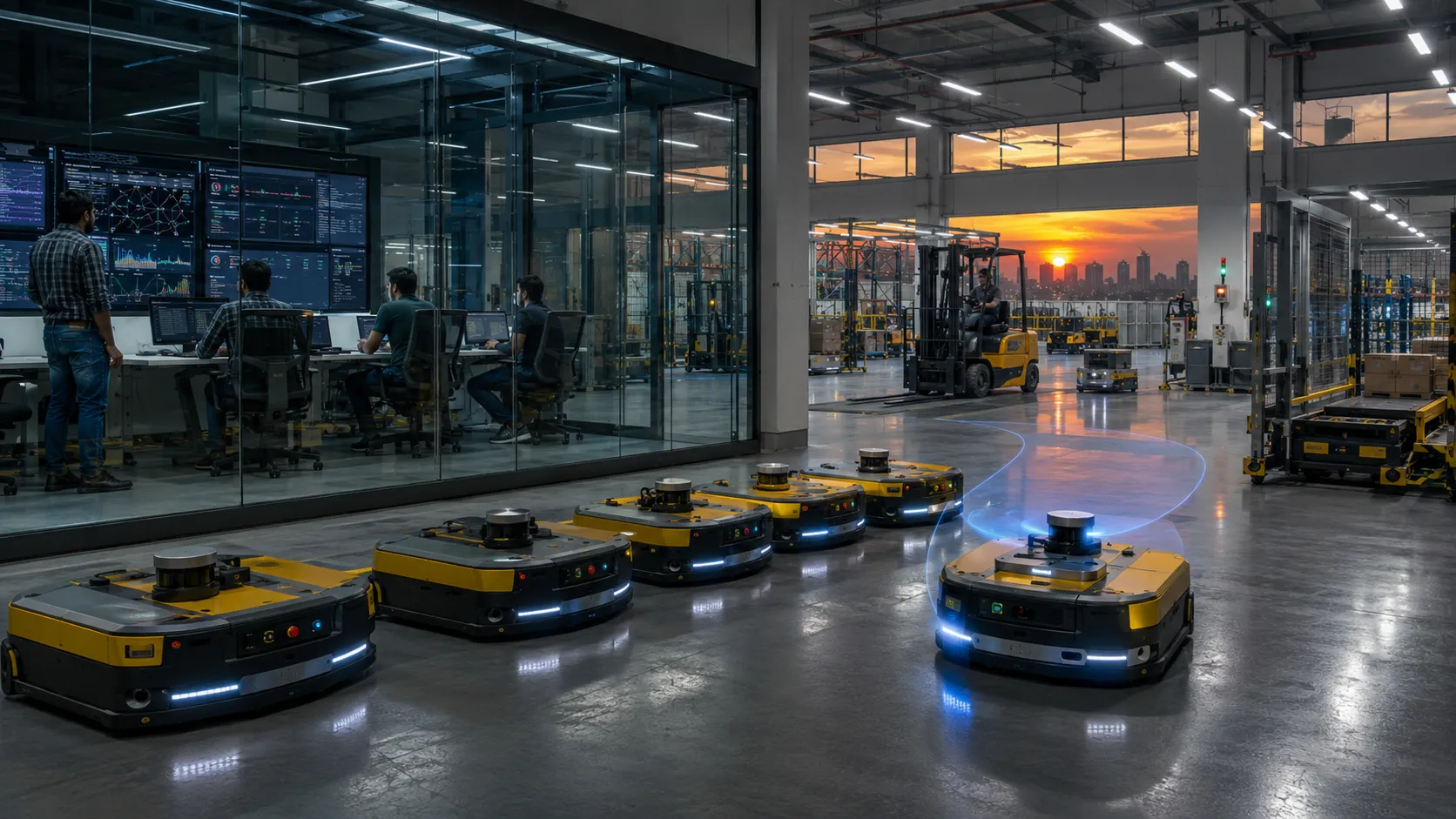
ANSCER's platform is built on a different philosophy. The company's autonomous mobile robots are equipped with advanced vision systems, Vision-Language Model capabilities, and enterprise-grade software that allows them to perceive their environment, understand context, and make decisions in real time. The architecture is designed to be interoperable with enterprise AI tools, built on principles aligned with the Model Context Protocol, or MCP—an open standard that allows AI agents and large language models to connect with external systems. In practice, this means that an ANSCER robot can be controlled not just by a pre-programmed route, but by an AI agent that understands the broader operational context—the day's order volume, the location of congestion points on the warehouse floor, the availability of human workers to handle exceptions. The robot is not just following instructions. It is participating in an intelligent system.
The technical ambition is matched by the commercial pragmatism. ANSCER's manufacturing facility in Bengaluru is designed for scale, with the capacity to produce more than 1,000 robots per year and a dedicated 20,000-square-foot testing area where each robot undergoes rigorous performance, endurance, and application testing before deployment. The company designs its robots for the demanding conditions of real-world manufacturing and warehouse environments—places where robots need to operate safely alongside people, forklifts, production lines, and high-throughput industrial processes. The modular hardware and software stack is designed for faster deployment, easier servicing, and scalable adoption across both domestic and international markets.
The Amazon Connection
The single most strategically significant hire ANSCER has made is not an engineer. It is the person who will lead the company's expansion into the United States.
Mark Messina spent years inside Amazon Robotics and Kiva Systems, the company that pioneered the autonomous mobile robot category before it was acquired by Amazon in 2012. Kiva's robots transformed Amazon's fulfilment centres, turning chaotic warehouses into tightly orchestrated systems in which robots brought shelves to workers rather than workers walking to shelves. The model reduced picking times, increased storage density, and became the gold standard for warehouse automation globally. Messina was there for much of that journey, and his decision to join ANSCER as Managing Director and CEO of U.S. operations is a signal—not just about the company's technology, but about its ambition.
The U.S. market is the largest and most competitive industrial automation market in the world. It is home to the biggest warehouse operators—Amazon, Walmart, Home Depot, Target—and the most sophisticated automation customers. It is also the market where the labour shortage driving automation adoption is most acute. American warehouses are struggling to hire and retain workers, particularly for the physically demanding, repetitive tasks that AMRs are designed to handle. The economic case for automation in the U.S. is clearer than in India, where labour costs are lower and the payback period for a robot investment is longer. ANSCER's expansion into the American market is not a diversification play. It is the company's primary growth vector.
Messina's role will be to build the partnerships, the distribution channels, and the customer relationships required to compete in a market that is dominated by established players—AGILOX, Mobile Industrial Robots (MiR), and a growing roster of well-funded startups. The competitive landscape is intense, but the addressable market is enormous. McKinsey & Company estimates that nearly 80 percent of warehouses globally still operate with limited or no automation. The warehouse automation market in India alone was valued at approximately $822 million in 2025 and is projected to reach $2.8 billion by 2034, growing at nearly 15 percent annually. The global market is measured in the tens of billions, and the share of it that is AI-native—powered by robots that learn, adapt, and integrate with enterprise intelligence—is only beginning to be defined.
The Open Robotics Bet
The most technically significant decision ANSCER has made is not a hardware choice. It is an architectural one. The company is building its platform on principles aligned with the Model Context Protocol, or MCP, an open standard that allows AI agents to connect with external tools and data sources. In practice, this means that ANSCER's robots are designed to be interoperable with the broader AI ecosystem—not a closed, proprietary system that only works with ANSCER's own software, but a platform that can be integrated into an enterprise's existing AI infrastructure.
The strategic logic is clear. The industrial automation market is fragmented, with dozens of hardware vendors, software platforms, and integration partners. A warehouse operator who buys robots from ANSCER also buys warehouse management software from SAP, inventory tracking systems from Zebra, and enterprise AI tools from a growing roster of startups. If ANSCER's robots can only communicate with ANSCER's own software, the operator must manage a parallel system that increases complexity and reduces the value of the automation investment. If ANSCER's robots can integrate with the operator's existing AI infrastructure—if the same AI agent that optimises inventory can also route robots—the value of the entire system compounds.
The MCP approach also positions ANSCER for a future in which the boundary between physical automation and digital intelligence dissolves. A warehouse in 2036 will not be managed by a human supervisor staring at a dashboard. It will be managed by an AI agent that optimises the entire operation—inventory, labour, robotics, shipping—as a single, integrated system. The robots in that warehouse will be the limbs of the AI agent, executing its decisions in physical space. ANSCER's bet is that the companies that build robots designed for that future—open, interoperable, AI-native—will capture a disproportionate share of the value as the market consolidates around intelligent automation platforms.
The Deeptech Moment
The ANSCER story is not occurring in isolation. It is part of a broader structural shift in Indian venture capital—a migration of serious, institutional money from consumer internet plays toward sectors that require patience, technical expertise, and a tolerance for long gestation periods.
The same week that ANSCER announced its Series A, the Technology Development Board approved 22 deeptech projects under the Research Development and Innovation Fund, or RDIF. A report by Campus Fund revealed that deep tech had become the single largest category among student-led startups in India for the first time. Shastra VC announced a $100 million fund targeting early-stage deeptech startups. The alignment of policy, capital, and talent is unmistakable: India's startup ecosystem is pivoting from the shallow end of consumer internet to the deep end of hard technology.
Rajnish Kapur, Managing Partner at IAN Alpha Fund, framed the ANSCER investment in explicitly structural terms. "We believe that industrial automation technology has reached a critical point globally," he said. "Today, companies view automation as a key resource for resilience, intelligence, and competitive advantage, not just efficiency. It was the team's vision for the development not only of robotic hardware but also of an intelligent, interoperable automation solution that could evolve with the adoption of enterprise artificial intelligence that impressed us the most."
The investment thesis is not merely about ANSCER's current product. It is about the company's position in a market that is expected to experience rapid growth globally in the coming years. The Indian automated material handling market alone was estimated at $1.87 billion in 2026, growing at 12.45 percent annually toward a projected $3.36 billion by 2031. The global warehouse robotics market is far larger, and the share of it that is AI-native—powered by machines that understand context, learn from operations, and integrate with enterprise intelligence—is only beginning to be addressed.
The Road Ahead
ANSCER is still a young company. It has raised a total of approximately $7.4 million across two rounds—a modest sum by the standards of Silicon Valley robotics startups, some of which have raised hundreds of millions before shipping a single product. It competes against established players with deeper pockets and longer track records. Its expansion into the U.S. market, led by a former Amazon Robotics executive, will test whether a robotics platform developed in Bengaluru can compete in the most demanding automation market in the world.
But the tailwinds are powerful. Global labour shortages are intensifying, particularly in the physically demanding, repetitive tasks that AMRs are designed to handle. The e‑commerce boom has created demand for faster, more efficient warehouse operations that cannot be met by human labour alone. The rise of quick commerce—a category that barely existed five years ago—has created a new class of warehouse operator that needs automation today, not in five years. And the broader AI revolution has made it possible to build robots that are not just programmable but intelligent—machines that understand context, learn from operations, and work alongside the digital infrastructure that enterprises are already deploying.
Ribin Mathew is no longer the software engineer who quit his job with a conviction that the world's warehouses deserved better robots. He is the founder of a company that has built a manufacturing facility capable of producing 1,000 robots a year, hired a former Amazon Robotics executive to lead its U.S. expansion, and secured backing from investors who believe that the next era of industrial automation will be built not by the companies that make machines follow instructions, but by the companies that make machines understand context. The Bengaluru robots are ready. The 80 percent of warehouses that are still unautomated are waiting. The AI-native factory is not a distant vision. It is being built, one robot at a time, in a facility on the outskirts of Bengaluru.


