The Bengaluru Brain Rush: Why Google AI's Fund Chief Says the Next GenAI Unicorn Will Come From India
A Prediction That Caught Silicon Valley Off Guard
It was a quiet Tuesday at a Bengaluru hotel when Jonathan Silber, the soft‑spoken cofounder of Google's AI Futures Fund, made a statement that rippled through global venture capital. "The next unicorn founder in generative AI will come from India," he told a room of founders and investors. "Not from Silicon Valley, not from Beijing — from here."
Three months later, his words have begun to look less like a prediction and more like a spoiler.
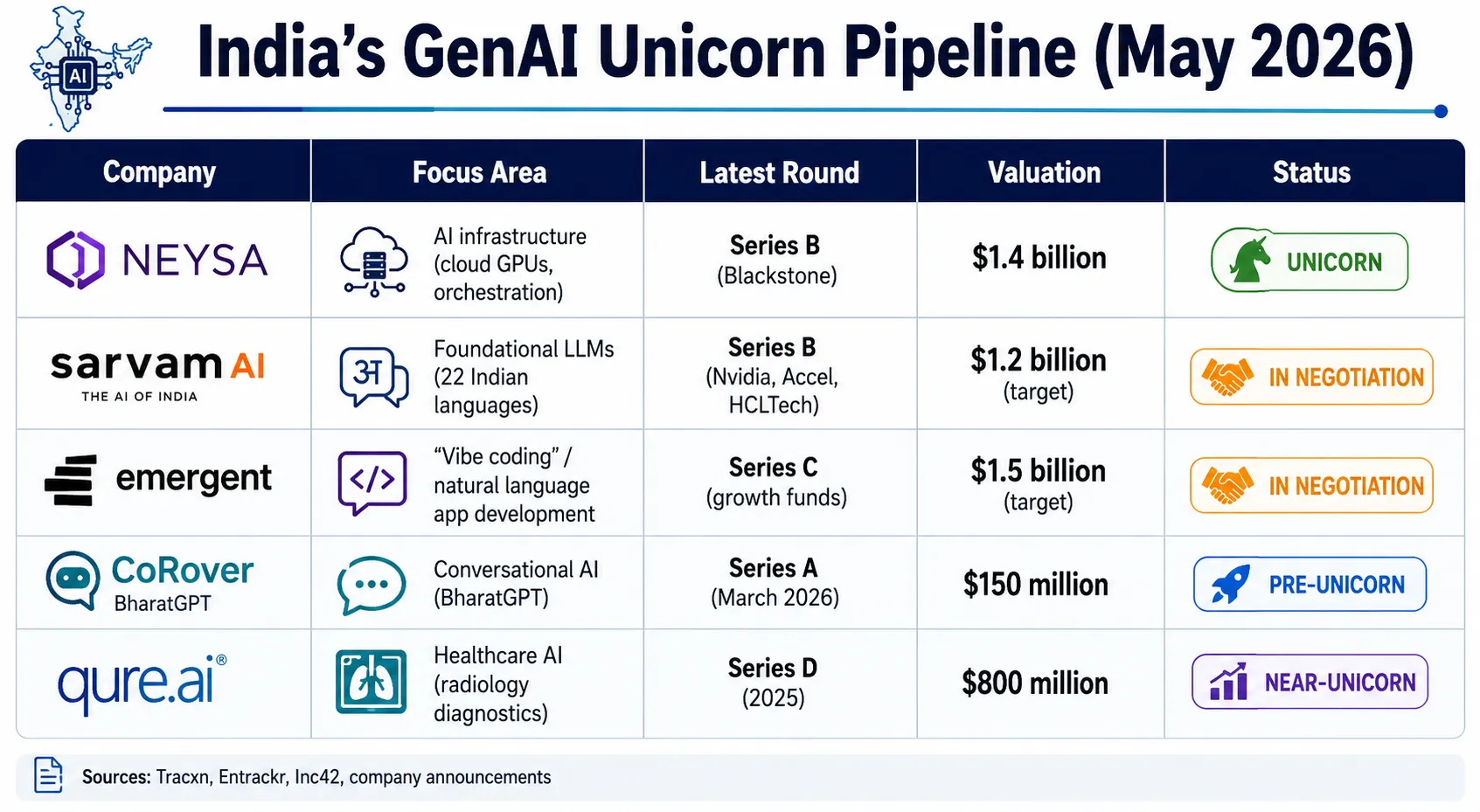
In May 2026, Neysa, a cloud‑based AI infrastructure platform, quietly became India's second unicorn of the year, raising a round led by Blackstone that pushed its valuation past $1.4 billion. Just weeks before, Sarvam AI — a startup building indigenous foundation AI models — entered final negotiations to raise $250 million at a $1.2 billion valuation, with Nvidia, Accel, and HCLTech reportedly at the table. Simultaneously, Emergent, the "vibe coding" platform that crossed $100 million ARR in just eight months, began raising $200–250 million at a $1.5 billion valuation.
India's generative AI moment has arrived. And it is rewriting the rules of who builds the world's artificial intelligence.
The Numbers That Changed Everything
To understand the scale of India's GenAI pivot, look at the funding data.
In the first five months of 2026, Indian GenAI startups raised over $600 million — a figure that already surpasses the total for all of 2025. According to Tracxn, the number of active GenAI startups in India crossed 200 in April 2026, up from just 40 two years earlier. More than a dozen are now in late‑stage funding discussions.
The sectors attracting the most capital are:
Foundation models (Sarvam AI, CoRover, KissanAI)
Code generation and developer tools (Emergent, Neysa)
Enterprise AI infrastructure (Neysa, TrueFoundry)
Vertical AI for healthcare, finance, and legal (Qure.ai, Niramai, LegalMind)
What makes Indian GenAI startups distinct from their global peers is their cost efficiency. The average Indian GenAI startup burns 60–70% less capital to reach product‑market fit than a US equivalent. The reasons: lower developer salaries, abundant STEM talent, and a regulatory environment that has been deliberately permissive for AI experimentation.
The Unicorn Three: Neysa, Sarvam, Emergent
Neysa: The Infrastructure Bet That Paid Off
Founded in 2023 by Sharad Sanghi and Anindya Das, Neysa provides a cloud‑native AI infrastructure platform that helps enterprises deploy, scale, and manage GenAI models. Unlike consumer‑facing AI startups, Neysa built the picks and shovels — the GPUs, the orchestration layers, the security wrappers — that every AI company needs.
In May 2026, Blackstone led a round that valued Neysa at $1.4 billion, making it India's 14th unicorn of the year and the country's first pure‑play AI infrastructure unicorn. The company claims to have over 200 enterprise customers, including three of India's largest banks and two global automotive manufacturers.
Sarvam AI: The Foundation Model Contender
Sarvam AI, founded by Vivek Raghavan and Pratyush Kumar (both former Google AI researchers), is building what India has long lacked: a large language model trained on Indian data, in Indian languages, for Indian use cases. The startup has raised approximately $50 million to date from investors including Lightspeed, Peak XV, and Khosla Ventures.
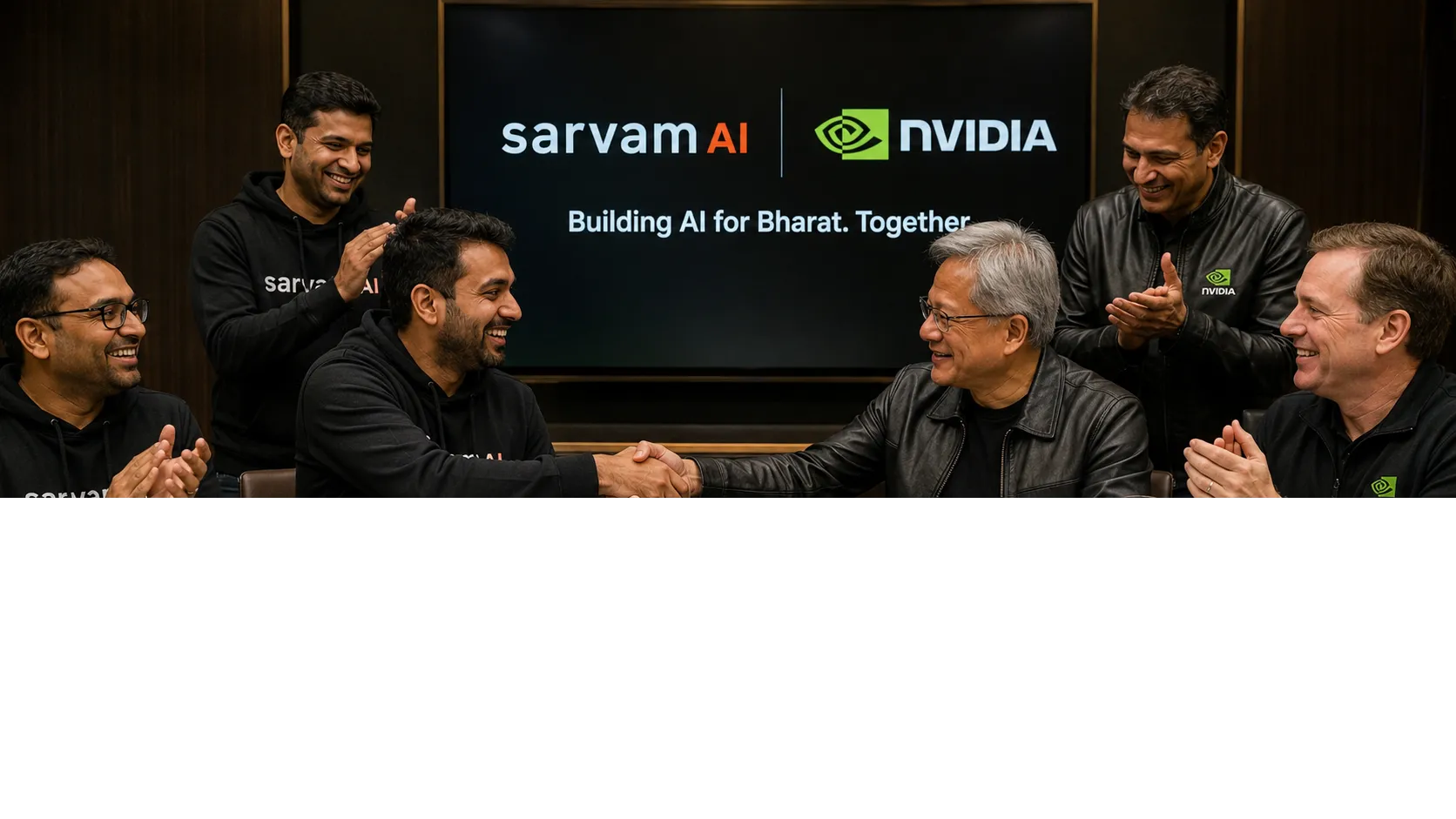
In April 2026, reports emerged that Sarvam was in advanced talks to raise a $250 million Series B at a $1.2 billion valuation. Nvidia is said to be leading the round, with Accel and HCLTech also participating. The funding would be used to train Sarvam's next‑generation model, rumored to have over 200 billion parameters and fluent in 22 Indian languages.
If the deal closes, Sarvam will become India's first foundational AI unicorn — a milestone that would put it in the same league as OpenAI, Anthropic, and Cohere.
Emergent: The Fastest $100 Million in SaaS History
Emergent, the Bengaluru‑based "vibe coding" platform that allows non‑technical users to build full‑stack apps using natural language prompts, made headlines in February 2026 when it crossed $100 million ARR in eight months — the fastest in SaaS history.
Now, the company is raising a $200–250 million round at a $1.5 billion valuation, according to sources familiar with the matter. The round is expected to be led by a mix of US and Asian growth funds. Emergent's CEO, Mukund Jha, has publicly stated that the company's mission is to "democratize software creation for the next billion users" — a mission that resonates deeply in India, where English is not the first language for the majority of the population.
The Google AI Futures Fund: A Strategic Bet
The Google AI Futures Fund, launched in India in November 2025 with an initial commitment of $20 million, has been one of the earliest institutional backers of Indian GenAI. The fund focuses on early‑stage startups using AI to solve problems in healthcare, education, agriculture, and climate.
In March 2026, Jonathan Silber revealed that the fund had already deployed $12 million across 15 Indian startups, including two that are now in late‑stage unicorn discussions. "India has the world's most diverse language data, the most price‑sensitive consumers, and the most creative engineers," Silber said. "Those three ingredients are rocket fuel for GenAI."
The Policy Tailwind: IndiaAI Mission
The Indian government has not been a passive observer. The IndiaAI Mission, approved in 2024 with a budget outlay of ₹10,372 crore (approximately $1.25 billion) , has five pillars:
Compute Capacity: Building a scalable AI computing infrastructure with over 10,000 GPUs
Innovation Centre: Establishing a premier AI research institution
Datasets Platform: Creating a unified platform for anonymized, non‑personal datasets
Application Development: Promoting AI solutions for critical sectors
Future Skills: Expanding AI education and upskilling
In March 2026, the government announced that the first phase of compute capacity — 3,000 GPUs — had been deployed and was available to startups at subsidised rates. This direct intervention has dramatically lowered the cost of training large models for Indian founders.
The Global Indian Takeaway
For the Indian diaspora, the GenAI unicorn wave presents three immediate opportunities.
First, angel investing. Many Indian GenAI startups are still at seed and Series A stages, with valuations that are a fraction of their US counterparts. A $50,000 check today could become $500,000 in 18 months.
Second, talent arbitrage. Indian GenAI engineers are world‑class and charge 60% less than Bay Area equivalents. Diaspora‑led enterprises can outsource AI development to Indian startups or freelance talent pools.
Third, market entry partnerships. If you run a business in the US or Europe that could benefit from multilingual AI (customer support, content creation, translation), Indian GenAI startups are hungry for reference customers. A pilot project today could become an equity partnership tomorrow.
The Final Word
The era of India as a back‑office for global AI is over. The era of India as a builder of global AI has begun.
With Neysa already a unicorn, Sarvam and Emergent on the brink, and the IndiaAI Mission providing infrastructure and compute, the foundation is laid. The next five years will see dozens of Indian GenAI companies cross the billion‑dollar mark — not by copying Western models, but by building for the world's most diverse, price‑sensitive, and data‑rich market.
The next unicorn founder in GenAI will indeed come from India. The only question is whether you will invest, partner, or watch


