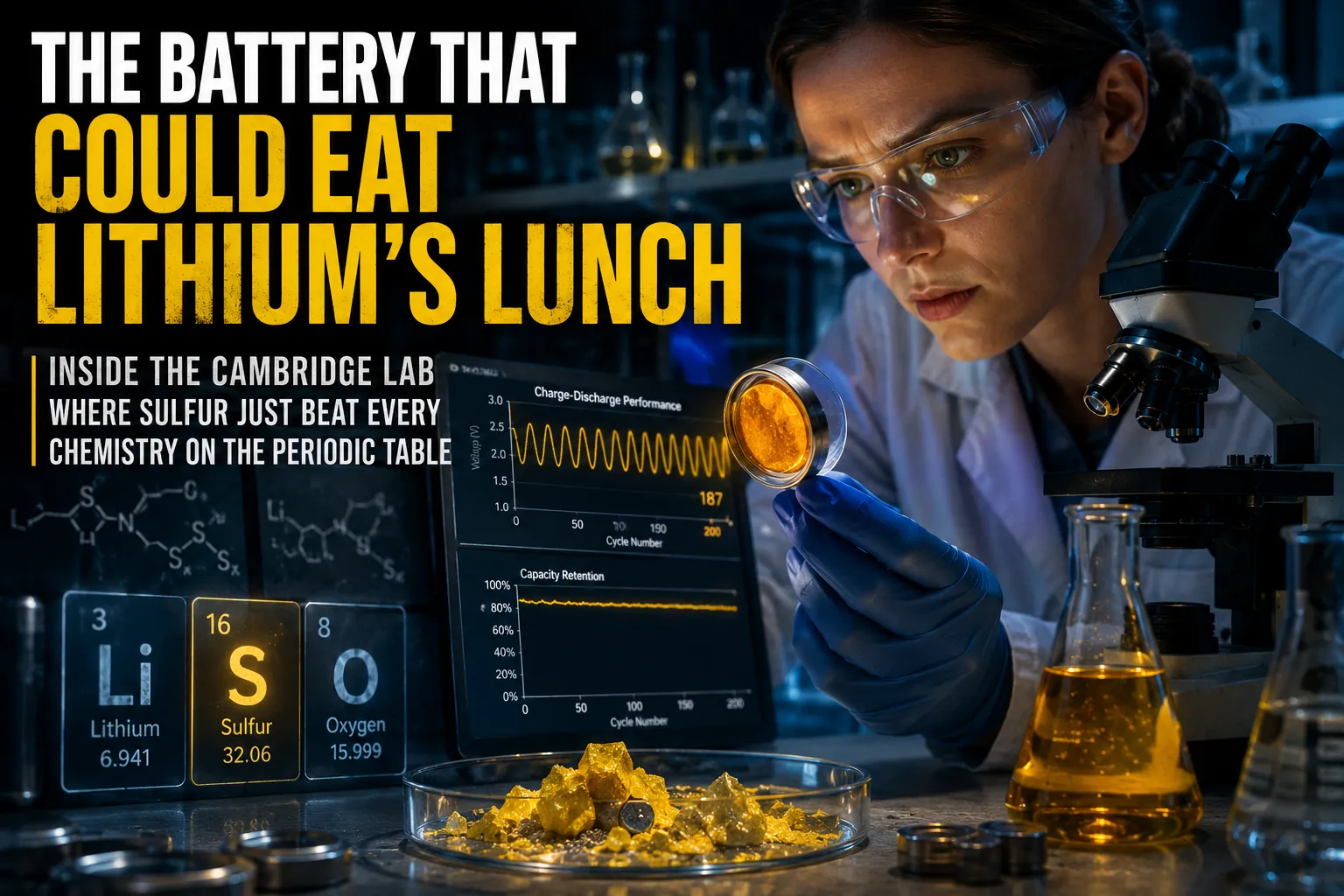
The Battery That Could Eat Lithium's Lunch: Inside the Cambridge Lab Where Sulfur Just Beat Every Chemistry on the Periodic Table
CAMBRIDGE, ENGLAND — May 21, 2026 — The quest for a better battery has consumed more capital, more scientific talent, and more failed promises than almost any other technology in the modern era. Solid-state lithium-metal batteries. Lithium-air batteries. Sodium-ion batteries. Graphene supercapacitors. Flow batteries. Each has arrived with breathless claims and departed with quiet disappointment, unable to match the relentless, incremental improvement of the lithium-ion cells that power everything from smartphones to electric vehicles to the grid storage facilities that are beginning to replace natural gas peaker plants.
In a laboratory at the University of Cambridge, a team led by Professor Clare Grey—one of the world's most respected battery researchers—has built something that may finally break that pattern. It is a lithium-sulfur battery, a chemistry that has been promising extraordinary energy density for decades but has been plagued by a fatal flaw: the sulfur cathode dissolves into the electrolyte, destroying the battery from the inside within a few dozen charge-discharge cycles. The Cambridge team's innovation is a new electrolyte—a liquid that does not merely slow the dissolution but prevents it entirely, stabilizing the sulfur cathode and allowing the battery to survive more than 200 cycles with minimal degradation. The energy density, measured in watt-hours per kilogram, is extraordinary: 800 Wh/kg. The best lithium-ion cells on the market today max out at roughly 300 Wh/kg. The theoretical limit for lithium-ion—the ceiling beyond which no amount of optimization can push it—is around 400 Wh/kg. A lithium-sulfur battery that delivers 800 Wh/kg and survives 200 cycles is not an improvement. It is a category break.
The results, published in Nature Energy on May 14, 2026, have drawn comparisons to the moment in 1991 when Sony commercialized the first lithium-ion battery—a technology that, in the three decades since, has reshaped the global economy and earned its inventors the Nobel Prize. The comparison may be premature. Two hundred cycles is not enough for an electric vehicle, which requires at least a thousand. The sulfur cathode still expands and contracts during cycling, creating mechanical stresses that will need to be managed. The battery has not been tested outside a laboratory. The road from a bench-scale breakthrough to a factory-floor product is long, expensive, and littered with the wreckage of promising chemistries that could not survive the transition.
But the chemistry is real. The energy density is real. And the implications—if the Cambridge team or one of its competitors can solve the remaining engineering challenges—are difficult to overstate.
The Sulfur Problem
To understand why the Cambridge breakthrough matters, it helps to understand the periodic table—and the fundamental limits of lithium-ion chemistry.
Lithium-ion batteries work by shuttling lithium ions between a metal oxide cathode and a graphite anode. The cathode is typically made of cobalt, nickel, and manganese—metals that are expensive, environmentally destructive to mine, and concentrated in a handful of countries, notably the Democratic Republic of Congo. The energy density of a lithium-ion cell is limited by the amount of lithium that can be stored in the cathode, which is in turn limited by the crystal structure of the metal oxide. You can optimize the manufacturing, improve the packaging, and tweak the chemistry at the margins. You cannot change the fundamental physics. The ceiling is around 400 Wh/kg, and the best commercial cells are already approaching it.
Sulfur is different. Sulfur is the tenth most abundant element in the universe, a byproduct of oil refining that costs pennies per ton. It can store far more lithium than any metal oxide—theoretically up to 2,500 Wh/kg, though practical cells will never approach that figure. The problem is that sulfur dissolves. When a lithium-sulfur battery charges and discharges, the sulfur cathode produces intermediate compounds called polysulfides that are soluble in the electrolyte. They diffuse through the liquid, react with the lithium anode, and deposit as a passivating layer that strangles the battery's performance. Within a few dozen cycles, the capacity fades to nothing. The battery dies.
The Cambridge team's innovation is an electrolyte that prevents polysulfide dissolution. The exact composition is proprietary, but the published paper describes it as a "highly concentrated, sparingly solvating electrolyte" that forms a stable interface with the sulfur cathode, preventing the polysulfides from leaving. The result is a lithium-sulfur battery that retains 80 percent of its capacity after 200 cycles—not yet competitive with lithium-ion, which routinely achieves 1,000 to 2,000 cycles, but far beyond anything that lithium-sulfur has previously achieved.
The Path to Commercialization
The Cambridge team is not alone in the lithium-sulfur race. At least a dozen startups and corporate research labs are pursuing similar chemistries, each with its own approach to the polysulfide problem. Sion Power, based in Arizona, has been developing lithium-sulfur batteries for more than a decade and has partnered with Airbus on a high-altitude pseudo-satellite application. Oxis Energy, in the UK, was working on lithium-sulfur before entering administration in 2021; its assets were acquired by Johnson Matthey. LG Chem, Samsung SDI, and Panasonic all have lithium-sulfur programs, though none has announced a commercial product.
The Cambridge electrolyte is the most promising solution to the polysulfide problem yet published in the peer-reviewed literature. But it is not a product. The 200-cycle lifetime is a laboratory result, achieved in small coin cells under carefully controlled conditions. Scaling the electrolyte to full-size pouch cells—the format used in electric vehicles—will require solving a new set of engineering problems. The sulfur cathode expands and contracts by as much as 80 percent during cycling, creating mechanical stresses that can crack the electrode and degrade performance. The lithium metal anode, which is required to achieve the full energy density advantage, is prone to forming dendrites—needle-like growths that can pierce the separator and cause a short circuit. These are hard problems. They are not unsolvable.
The economic case for solving them is compelling. Lithium-sulfur batteries, if they can be commercialized, would be dramatically cheaper than lithium-ion on a per-kilowatt-hour basis. Sulfur is essentially free. Cobalt costs roughly $30,000 per ton and has been labeled a conflict mineral by human rights organizations. Replacing cobalt with sulfur would slash the materials cost of a battery and eliminate the ethical and geopolitical baggage that comes with the current supply chain. The result would be an electric vehicle battery that costs less than $50 per kilowatt-hour—the threshold at which EVs become cheaper than internal combustion vehicles without subsidies—and a grid storage battery that makes intermittent renewables economically competitive with fossil fuels in every market on Earth.
The Geopolitics of Sulfur
The shift from cobalt to sulfur would also redraw the geopolitical map of the battery industry. The current supply chain is concentrated in a handful of countries: the Democratic Republic of Congo for cobalt, China for refining and cathode production, Australia and Chile for lithium. The United States, Europe, and Japan are heavily dependent on imports for their battery materials, a vulnerability that has driven billions of dollars in government investment in domestic battery supply chains.
Sulfur changes the equation. It is produced in vast quantities by oil refineries as a byproduct of removing sulfur from crude oil. The United States alone produces more than 8 million tons of elemental sulfur per year, most of which is stockpiled or used in low-value applications like fertilizer. If even a fraction of that sulfur were diverted to battery production, it could supply the entire global electric vehicle market. The geopolitical leverage held by cobalt-producing countries would evaporate. The battery supply chain would diversify from a handful of choke points to a genuinely global network of producers.
The environmental case is equally compelling. Cobalt mining, particularly in the Democratic Republic of Congo, is associated with child labor, unsafe working conditions, and severe environmental degradation. Sulfur production from oil refining is an existing industrial process with well-understood environmental impacts. Replacing cobalt cathodes with sulfur cathodes would not only reduce the cost of batteries; it would eliminate the most ethically troubling component of the supply chain.
What This Signals
The Cambridge lithium-sulfur battery is not a product. It is a proof of concept—a demonstration that the fundamental chemistry problem that has defeated lithium-sulfur for thirty years can be solved. The polysulfide dissolution that killed every previous lithium-sulfur battery has been tamed, at least in the laboratory, by an electrolyte that prevents sulfur from escaping. The energy density is extraordinary. The cycle life is promising, if not yet competitive. The next steps—scaling to pouch cells, extending cycle life to 1,000 cycles, solving the lithium metal anode problem—are engineering challenges, not fundamental science challenges.
The battery industry has learned, through decades of disappointment, to be skeptical of laboratory breakthroughs. The gap between a coin cell in Cambridge and a factory in Nevada is measured in years and billions of dollars. But the trajectory is clear. Lithium-ion is approaching its limits. The periodic table offers only a handful of alternative chemistries with the theoretical energy density to replace it, and lithium-sulfur is the most promising of them. The Cambridge electrolyte has solved the hardest problem in the hardest chemistry. The rest is engineering.
The battery that could eat lithium's lunch is not ready for the table. But it is no longer a dream. It is a device, sitting in a laboratory in England, holding a charge that would double the range of an electric vehicle or halve the cost of a grid storage installation. The next thirty years of battery technology will be built on the chemistry that works. Lithium-sulfur just got a lot closer to working.


