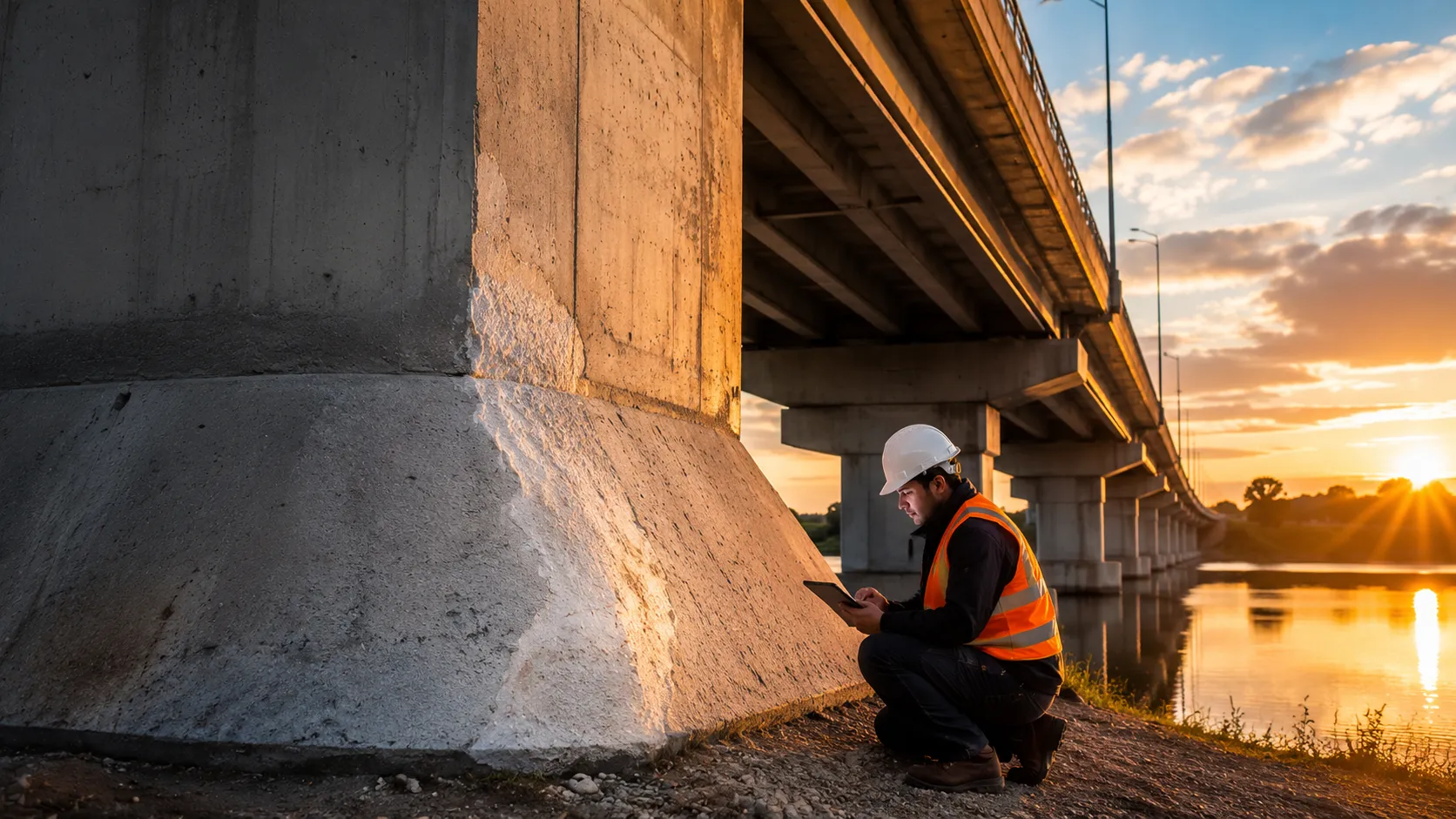
The Bacteria That Build Buildings: How a Concrete Pill That Heals Cracks Could Double the Life of Every Bridge in America
CAMBRIDGE, MASS. — May 22, 2026 — On a test platform at MIT's Civil and Environmental Engineering laboratory, a block of concrete has been sitting under a drip-feed of salt water for eight months. The block is cracked—intentionally, with a hydraulic press that opened a fissure half a millimeter wide and three centimeters deep. In ordinary concrete, that crack would be a death sentence. Water would seep in, reach the steel reinforcement bars inside, and begin the slow, inexorable process of rust that causes concrete to spall, crumble, and eventually fail. The bridge would need repair. The building would need reinforcement. The bill would arrive, eventually, in the millions.
This block is different. Inside the concrete, embedded in tiny capsules scattered throughout the mix, are millions of dormant bacterial spores—microorganisms that have been freeze-dried, packaged in a nutrient-rich shell, and placed into the concrete like seeds waiting for rain. When the crack formed and water entered, the capsules broke open. The bacteria woke up. They began feeding on the nutrients, multiplying, and producing calcium carbonate—limestone, the same material that makes up seashells and coral reefs. Within eight weeks, the crack was gone. The concrete had healed itself.
The research, published in Science Advances on May 3, 2026, by a team led by Professor Admir Masic, represents the most successful demonstration yet of self-healing concrete technology—a field that has been advancing for two decades but has never before achieved the combination of speed, reliability, and cost-effectiveness required for real-world deployment. The MIT team's innovation is not the bacteria themselves—researchers have been embedding bacteria in concrete for years—but the encapsulation system that keeps them alive for decades and the nutrient formulation that triggers rapid, robust healing when cracks appear. The result is a concrete that can repair its own damage before it becomes structural, potentially doubling the lifespan of bridges, tunnels, and buildings.
The Problem with the World's Most Popular Material
Concrete is, by volume, the most widely used man-made material on Earth. The global construction industry pours approximately 30 billion tons of it every year—more than four tons for every human being alive. It is the foundation of modern civilization: the bridges that span rivers, the dams that hold back lakes, the buildings that define city skylines, the roads and sidewalks and airport runways that connect the world.
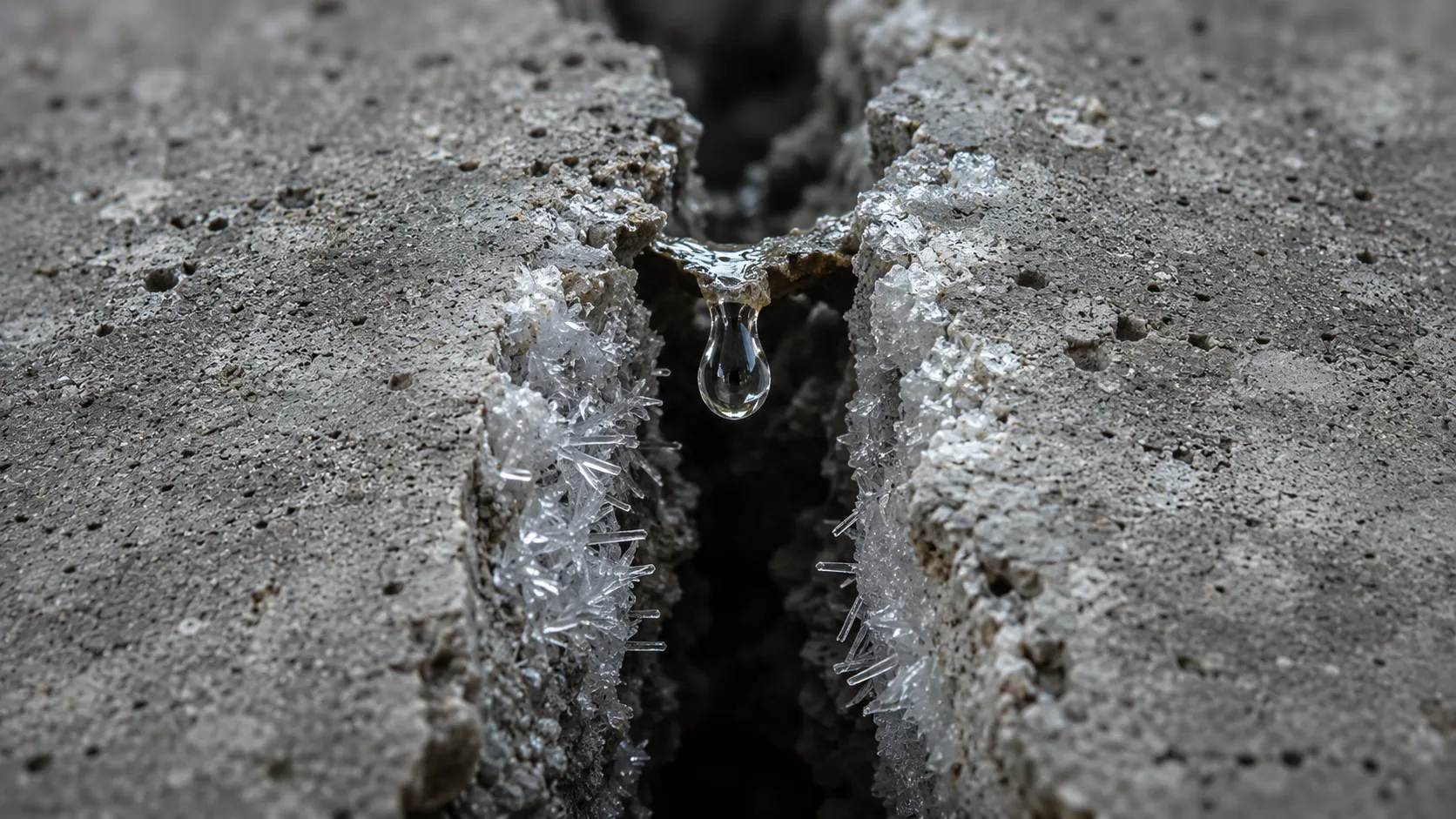
And it cracks. Concrete is extraordinarily strong in compression—it can bear enormous weights without failing—but it is weak in tension. When the ground shifts, when temperatures fluctuate, when traffic pounds across a bridge deck for decades, the concrete develops hairline fractures. Those fractures allow water to seep in, which corrodes the steel reinforcement bars embedded within. The rust expands, cracking the concrete further, and the cycle accelerates until the structure fails.
The cost of this failure is staggering. The American Society of Civil Engineers estimates that the United States alone faces a $786 billion backlog of bridge and road repairs. The Federal Highway Administration spends roughly $70 billion annually on maintenance. Globally, the cost of concrete repair and replacement runs into the trillions. A technology that could extend the life of concrete structures by even 50 percent would generate savings measured in the hundreds of billions of dollars—and that is before accounting for the reduction in carbon emissions from manufacturing replacement concrete, which is itself one of the largest industrial sources of greenhouse gases on Earth.
The Bacteria That Build
The bacteria at the heart of the MIT system are a species of Bacillus, a genus of rod-shaped microorganisms known for their ability to form tough, dormant spores that can survive extreme conditions—heat, cold, dryness, and the high alkalinity of fresh concrete. The spores are mixed into the concrete along with the cement, sand, and aggregate, and they remain dormant indefinitely, protected by a shell of nutrients and minerals.
When a crack forms and water enters, the shell dissolves. The bacteria wake up. They begin consuming the nutrients and multiplying. As a byproduct of their metabolism, they produce calcium carbonate—limestone—which precipitates out of solution and fills the crack. The process is identical, in principle, to the way seashells form or coral reefs grow, but accelerated by the high concentration of bacteria and nutrients in the crack environment.
The MIT team's innovation was in the encapsulation. Previous attempts at self-healing concrete used bacteria embedded directly in the concrete matrix, but the organisms tended to die during mixing or remain inactive when cracks appeared. Masic's team developed a multi-layer capsule that protects the spores during mixing, releases them when cracks form, and provides the precise nutrient balance required for rapid growth and mineral production. In laboratory tests, cracks up to 0.6 millimeters wide healed completely within eight weeks. The healed concrete recovered up to 90 percent of its original strength.
The economic case is compelling. The capsules add roughly 5 to 10 percent to the cost of the concrete mix, depending on the application. But if the concrete lasts twice as long before requiring repair or replacement, the lifecycle savings are enormous. A bridge that costs $100 million to build and $50 million to maintain over 50 years might cost $110 million to build with self-healing concrete but only $20 million to maintain—a net saving of $20 million, plus decades of reduced disruption from repair work.
From Lab to Infrastructure
The MIT team is now working with the Massachusetts Department of Transportation on a pilot project—a small bridge deck in western Massachusetts that will be poured with self-healing concrete later this year. The project will be the first real-world test of the technology in a North American infrastructure application, and its results will be closely watched by transportation agencies across the country.
The path to widespread adoption is not short. Infrastructure agencies are conservative by nature, and new materials must prove themselves over years or decades before they are trusted with public safety. The bacterial capsules must be manufactured at scale, and the concrete must be mixed and poured using standard equipment and procedures. The regulatory framework for biologically active construction materials is still in its infancy.
But the momentum is building. The European Union has funded multiple self-healing concrete research projects. The Netherlands has tested bacteria-based concrete in canal linings. South Korean researchers have demonstrated a similar system using different bacterial strains. The MIT study is the most comprehensive demonstration to date that the technology works under realistic conditions, and it arrives at a moment when governments around the world are facing an infrastructure crisis that traditional materials and budgets cannot solve.
What This Signals
The self-healing concrete developed at MIT is not just a construction material. It is a philosophical shift in how we think about infrastructure—from inert, passive structures that degrade over time to living, responsive systems that maintain themselves.
The 20th century was built on the assumption that concrete was permanent. It is not. It cracks, corrodes, and crumbles, and the cost of repairing it consumes a growing share of public budgets. The 21st century will be built on the recognition that infrastructure, like the organisms that build it, must be capable of self-repair. The bacteria sleeping in the concrete are not a gimmick. They are a glimpse of a future in which the built environment behaves more like the natural one—resilient, adaptive, and quietly self-sustaining.
The bridge in western Massachusetts will be the first test. If it works, the bacteria that heals cracks will move from the laboratory to the construction site, from the construction site to the building code, and from the building code to the foundations of every structure that humanity builds. The bacteria are not architects. They are not engineers. They are not construction workers. They are something simpler and more profound: a reminder that the oldest builders on Earth are still among the best.


