The Atomic Engine That Never Stops: Inside China's 10-Newton Thruster That Could Cut the Mars Trip in Half
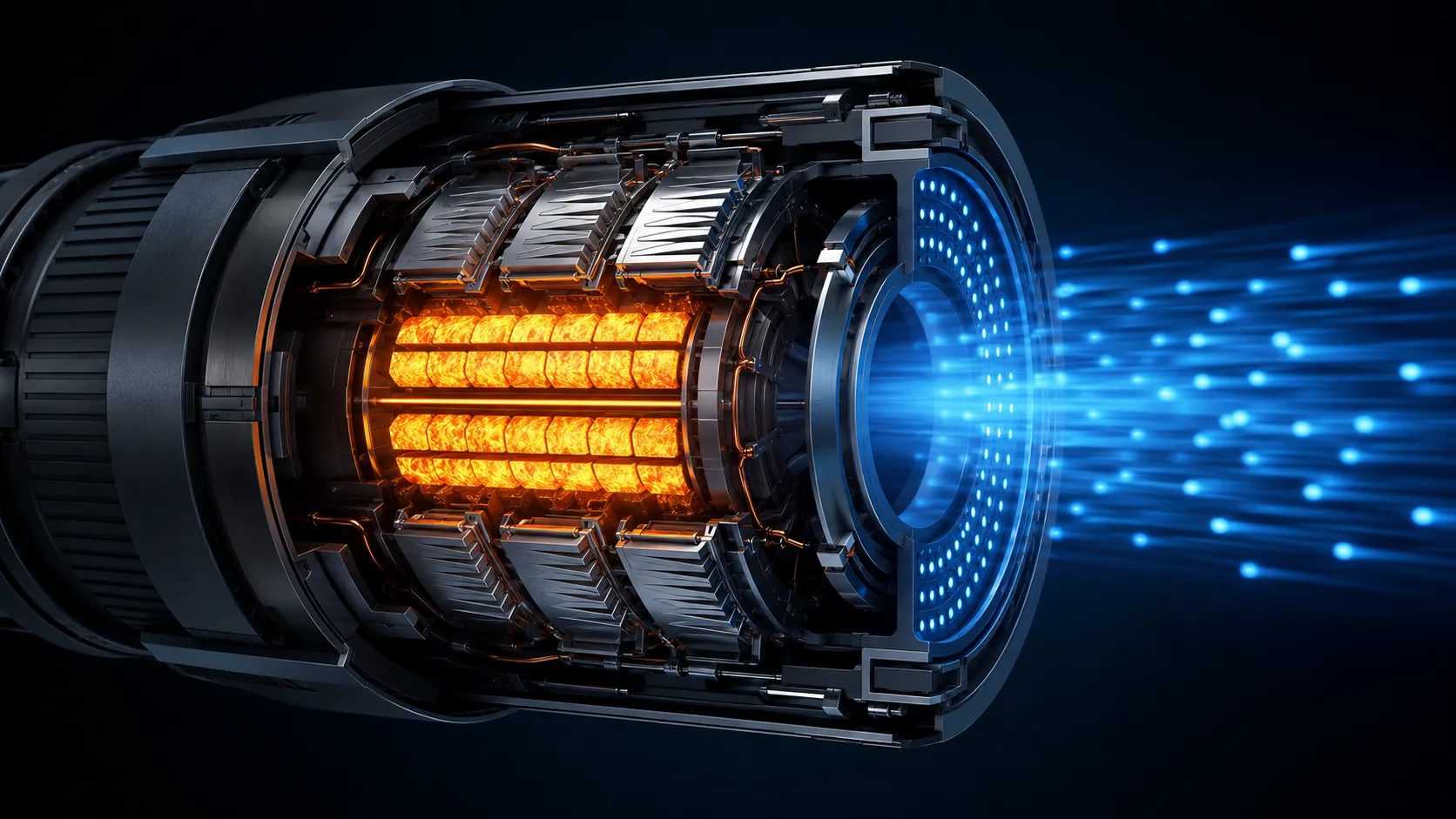
BEIJING — May 22, 2026 — In the vacuum of space, a small metal cylinder has been firing continuously for eleven months. It produces no flame, no roar, no dramatic plume of exhaust. It emits a faint blue glow—the Cherenkov radiation of particles moving faster than light through water—and it pushes forward with a force equivalent to the weight of a single apple resting on a table. Ten newtons. That is the thrust. That is the entire thrust.
And yet, in the frictionless void of space, ten newtons applied continuously for months can push a spacecraft faster than any chemical rocket ever built. The China National Space Administration confirmed in mid-May 2026 that its experimental radioisotope thermoelectric generator (RTG) thruster had completed its orbital test campaign and demonstrated stable, continuous propulsion for 11 months without degradation. The thruster is not designed for launch. It is designed for the deep, dark, years-long cruise between planets. And its successful test marks a milestone that could reshape the timeline for human exploration of the solar system.
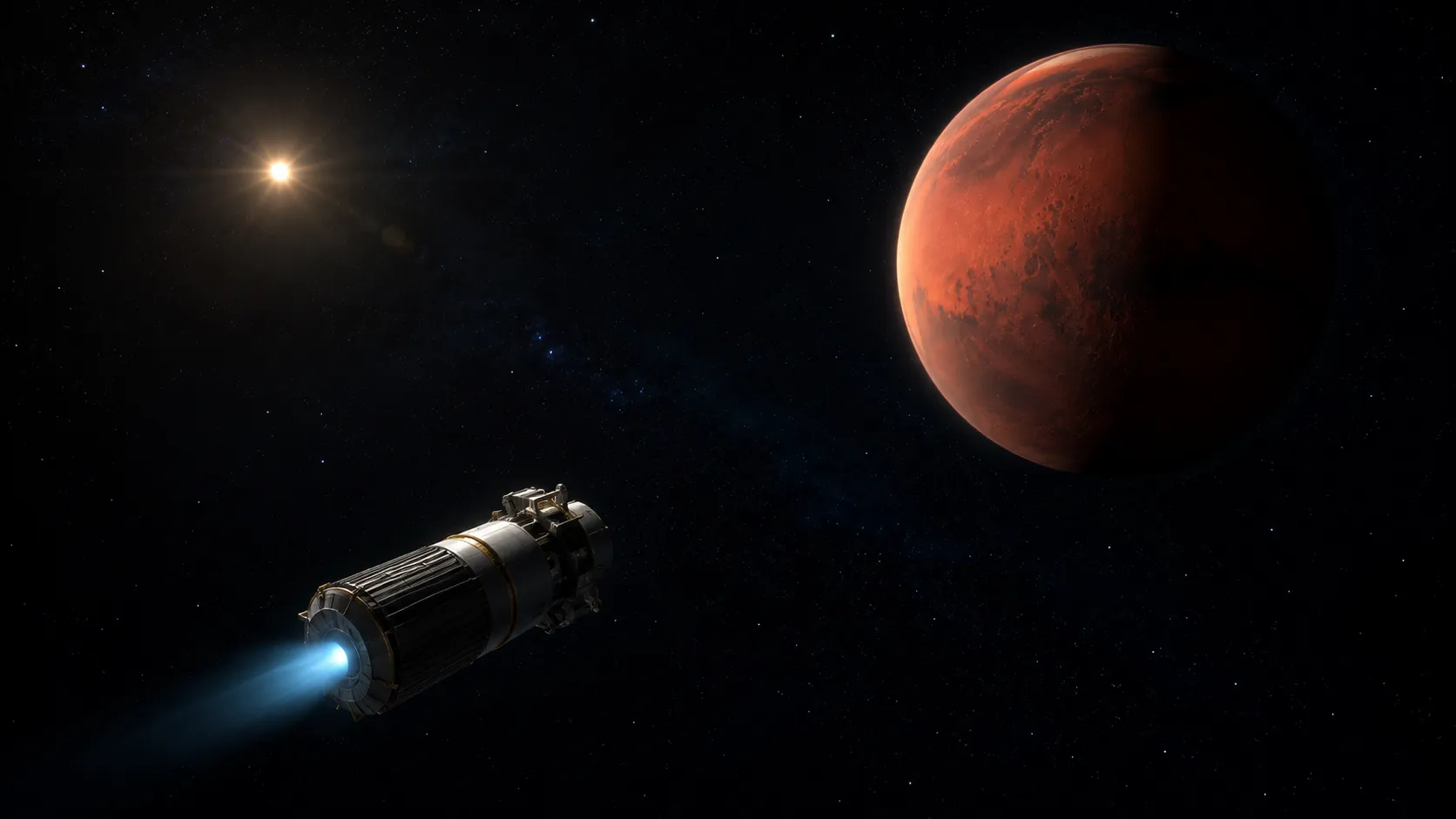
Chemical rockets—the kind that launch spacecraft from Earth—are sprinters. They burn furiously for minutes, produce enormous thrust, and then fall silent, their fuel spent. The RTG thruster is a marathoner. It uses the heat from decaying plutonium-238 to generate electricity, which powers an ion engine that expels charged particles at enormous velocities. The thrust is minuscule, but it never stops. Over months and years, the velocity accumulates. A spacecraft equipped with an RTG thruster could reach Mars in roughly four months instead of seven, or carry twice the payload for the same transit time. The implications for crewed missions—where every day in space exposes astronauts to radiation and microgravity degradation—are profound.
The Physics of Patience
To understand why the RTG thruster matters, it helps to understand the fundamental limitation of chemical rockets. A rocket moves by throwing mass out the back. The faster it throws that mass, the more efficient it is. Chemical rockets produce enormous thrust by burning fuel and oxidizer at high temperatures, but the exhaust velocity is limited by the energy content of the chemical bonds. The best chemical rockets achieve exhaust velocities of about 4.5 kilometers per second. That sounds fast, and it is, but it is not fast enough for efficient interplanetary travel. A Mars mission using chemical propulsion must carry enormous quantities of fuel, which limits the payload, extends the transit time, and exposes the crew to more radiation.
Ion thrusters work differently. They use electricity to strip electrons from atoms of a propellant—typically xenon—and then accelerate the resulting ions through an electric field. The exhaust velocity can exceed 40 kilometers per second, nearly ten times faster than a chemical rocket. The catch is that ion thrusters require electricity, and in deep space, far from the Sun, solar panels produce diminishing returns. An RTG solves this by generating electricity from the heat of radioactive decay—no sunlight required. The plutonium-238 in the RTG decays with a half-life of 87.7 years, producing steady heat for decades. The electricity powers the ion thruster. The thruster pushes the spacecraft. And the spacecraft, slowly, patiently, builds up speed.
The Chinese thruster tested in orbit is rated at 10 newtons. That is roughly the force required to hold an apple against Earth's gravity. It is not impressive on a spec sheet. But in space, where there is no air resistance and no gravity to fight, 10 newtons applied continuously for a year can accelerate a 5,000-kilogram spacecraft by more than 60 meters per second every month. Over a three-month transit, the velocity change would exceed 180 meters per second. Over a year, more than 700 meters per second. That is not enough to launch from Earth, but it is more than enough to reshape the trajectory between Earth and Mars.
The Deep-Space Implications
The RTG thruster is not a replacement for chemical rockets. It cannot launch a payload from Earth's surface. Its thrust is too low to escape a planet's gravity well. But once a spacecraft is in orbit, the RTG thruster can take over, pushing it from low Earth orbit to lunar orbit, from lunar orbit to interplanetary space, from Earth to Mars, and eventually—if the mission planners are ambitious enough—to Jupiter, Saturn, and beyond.
The most immediate application is Mars. A crewed mission to Mars using chemical propulsion requires a transit time of six to nine months each way, depending on the alignment of the planets. During that time, astronauts are exposed to galactic cosmic radiation and solar particle events that increase their lifetime cancer risk. Microgravity degrades their bones, muscles, and cardiovascular systems. Every day spent in transit is a day of accumulated risk. An RTG-powered spacecraft could cut the transit time to four months, reducing radiation exposure by a third and sparing the crew months of physiological degradation.
The Chinese test campaign is not the only deep-space propulsion program in development. NASA's Advanced Electric Propulsion System has been working on high-power electric thrusters for years. Russia's Roscosmos has investigated nuclear thermal propulsion. The European Space Agency has funded research into radioisotope electric propulsion. But the Chinese test is the most advanced orbital demonstration of an RTG thruster to date, and it puts China in a leading position for the next phase of deep-space exploration.
The geopolitical dimension is unavoidable. China has announced plans for a crewed lunar base by the 2030s and a Mars mission by the 2040s. The RTG thruster is a key enabling technology for both. The United States, through NASA's Artemis program, is racing to return astronauts to the Moon and eventually send them to Mars. The country that develops reliable, long-duration deep-space propulsion first will have an advantage in every phase of the competition—from lunar logistics to Mars transit to asteroid mining.
The Plutonium Problem
The limiting factor for RTG technology is not engineering. It is plutonium-238. The isotope is not found in nature. It must be produced in nuclear reactors, and the United States stopped producing it in the 1980s. For decades, NASA relied on aging stockpiles, supplemented by purchases from Russia. When those purchases ended, the agency had enough plutonium-238 for a handful of missions and no clear path to replenishing its supply.
In recent years, the United States has restarted plutonium-238 production at Oak Ridge National Laboratory in Tennessee, but the output is measured in hundreds of grams per year—enough for small science missions, not for crewed Mars vehicles. China, by contrast, has been ramping up its plutonium-238 production capacity, and the orbital test of the RTG thruster suggests that the supply chain is mature enough to support operational missions.
The plutonium bottleneck is a strategic vulnerability for the United States and a strategic advantage for China. The country that controls the supply of plutonium-238 controls the pace of deep-space exploration. The RTG thruster test is not just a technological milestone. It is a signal that China has secured the fuel supply to sustain a long-term deep-space program.
What This Signals
The RTG thruster is not a headline-grabbing technology. It will never produce the fire and thunder of a Starship launch or the drama of a Falcon Heavy booster return. It is, instead, a technology of patience—a machine that pushes gently but never stops, accumulating velocity over months and years until it reaches speeds that chemical rockets can only dream of.
The successful orbital test is a milestone on the path to crewed Mars missions. It demonstrates that continuous low-thrust propulsion works in space, that the engineering challenges of integrating an RTG with an ion thruster have been solved, and that China has the plutonium-238 supply chain to sustain the technology. The next step is a longer-duration test—perhaps powering a spacecraft to lunar orbit and back—and then, eventually, integration into a Mars-class vehicle.
The atomic engine that never stops is not a weapon. It is not a spectacle. It is a tool, and in the hands of the nation that masters it, it is a tool that can open the solar system. Ten newtons. The weight of an apple. Pushing continuously for years. That is the force that will carry humans to Mars.


