A Number That Stops Families Mid-Sentence
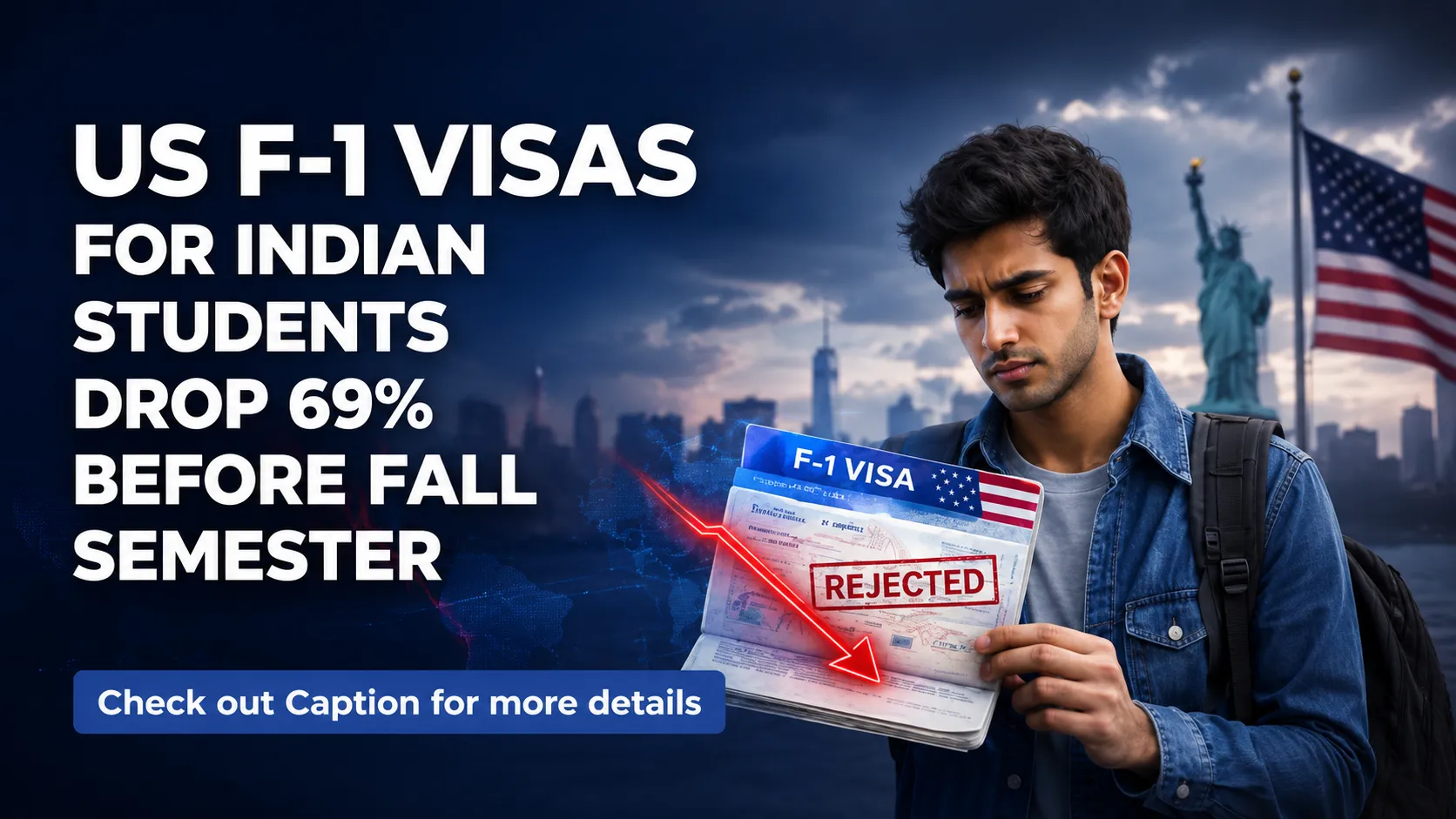
For an entire generation of Indian households, the arithmetic of upward mobility has long included a specific, almost ritualized calculation: years of coaching classes, a strong entrance exam score, a hard-won admission letter from an American university, and finally, the F-1 visa stamp that turned an acceptance letter into an actual plane ticket. That calculation is now colliding with a number stark enough to stop conversations mid-sentence at kitchen tables across India: F-1 visas issued to Indian nationals fell 69 percent, from 41,336 during June and July of 2024 down to just 12,776 during the same two-month window in 2025, according to data reported by Outlook India as part of its coverage of sweeping new Trump administration visa rules. It is one of the steepest single-year declines the India-to-US student pipeline has ever recorded, and it lands as the leading edge of a broader reshaping of how, and whether, international students are admitted to the United States at all.
The Policy Behind the Number
The collapse in visa issuance did not happen in isolation. It followed a State Department decision, early in the current administration's term, to pause all student visa interviews worldwide while officials developed expanded social media screening and vetting procedures for F, M, and J visa applicants — a pause that created a substantial processing backlog and directly suppressed issuance numbers across the entire 2025 visa season. That disruption has now been compounded by the Department of Homeland Security's decision to eliminate 'Duration of Status' for F-1 and J-1 visa holders entirely, replacing open-ended study permission with a fixed four-year admission period effective September 15, 2026. DHS has stated there were over 1.8 million student visa admissions in 2024, an increase of more than 11 percent from the previous year — a volume officials argue poses genuine monitoring challenges that justify tighter, more structured oversight going forward.
What an American Degree Has Always Represented
To understand why this data point resonates so deeply within Indian families, it helps to understand what an American degree has represented for decades: not simply an education, but a comprehensive, multi-generational strategy for economic mobility. For families who often took on significant debt or liquidated savings to fund the journey, a US degree offered a package deal — rigorous coursework at globally recognized institutions, Optional Practical Training work authorization that provided real-world American job experience, a credible shot at an H-1B visa and eventual employer sponsorship, and for a fortunate subset, a pathway toward permanent residency and citizenship that could reshape the trajectory of an entire extended family across generations. Indian students have consistently ranked among the largest international student populations in the United States, accounting for close to 30 percent of the country's total international enrollment during the 2023-24 academic year, according to the Open Doors Report on International Educational Exchange, which recorded over 1.126 million foreign students enrolled in the US that year.
A Dream Under Compounding Pressure
The 69 percent visa collapse does not exist as a single, isolated data point — it sits at the intersection of several simultaneous pressures bearing down on the same population. Beyond the interview pause and the new Duration of Status rule, the Trump administration has separately pursued an aggressive fraud investigation into the Optional Practical Training program, with then-acting ICE Director Todd Lyons announcing in May 2026 that authorities had identified roughly 10,000 foreign students employed at businesses flagged as suspect, describing OPT as having 'become a magnet for fraud.' The administration has also threatened to freeze federal funding for elite universities over student protest activity, and has pursued broader efforts to narrow what officials describe as an unchecked pipeline funneling global talent, and billions of dollars in tuition revenue, toward American higher education. Each of these measures, taken individually, might register as a manageable disruption. Taken together, they represent a systemic tightening that Indian families are increasingly forced to weigh against the traditional promise of the American pathway.
How the Numbers Compare Across a Longer Timeline
Placed against a longer historical backdrop, the current decline looks even more dramatic. As recently as the summer of 2023, the United States Mission in India was publicly celebrating having issued a record-breaking 90,000 student visas to Indian applicants across a single summer season, describing the milestone as proof that one in every four student visas issued globally that year had gone to an Indian applicant. That record-setting trajectory has been essentially inverted within the space of roughly two years, transforming what was being celebrated as a growth story into a case study in how quickly a favorable visa environment can reverse when broader immigration policy priorities shift.
The Emotional Weight Carried by a Single Number
For Indian families who have spent years, and often significant portions of household savings, preparing a child for the specific goal of American higher education, a statistic like a 69 percent visa decline is never experienced as an abstract policy data point. It is experienced as a direct, personal threat to a plan that may have been years in the making — coaching classes for standardized tests, careful selection of undergraduate coursework designed to maximize graduate school competitiveness, and in many cases, the deferral of other family financial priorities in favor of funding an American education. Education consultants describe fielding an increasing volume of consultations from families explicitly asking whether the traditional American pathway still represents a rational investment given the compounding visa risk, a question that would have seemed almost unthinkable within the Indian aspirational education community just five years ago.
Global Sentiment Still Tilts Toward America — For Now
Despite the mounting friction, broader survey data suggests America's underlying appeal has not collapsed as sharply as the visa numbers might imply. A Pew Research Center survey referenced in recent Indian media coverage found that China has overtaken the United States in certain measures of global favorability, even as India continues to favor America more consistently than many other nations surveyed. That distinction matters: it suggests the current decline in Indian student visa numbers may reflect a rational, calculated response to specific, quantifiable policy risk — visa denial rates, processing delays, and post-graduation uncertainty — rather than a wholesale loss of faith in the value of an American education itself. In other words, many Indian families appear to still want the American dream; they are simply recalculating, with much sharper numbers than before, exactly how risky and expensive achieving it has become.
The Families Recalculating in Real Time
Education consultants and immigration attorneys describe a population of prospective applicants engaged in an increasingly sophisticated risk assessment that would have seemed unnecessary just a few years ago. Where a family might once have treated a US acceptance letter as close to a guaranteed multi-year outcome, many now build contingency plans directly into their decision-making: backup applications to Canadian, Australian, German, or Singaporean institutions that have expanded post-study work rights specifically to attract students deterred by American volatility; closer scrutiny of a chosen program's typical completion timeline against the new four-year fixed admission cap; and, in a growing number of cases, a willingness to walk away from an American offer entirely in favor of a destination perceived as more predictable, even if less prestigious on paper.
What Universities Stand to Lose
The consequences of this recalculation extend well beyond individual families to the American universities that have come to depend heavily on international tuition revenue, particularly as domestic enrollment growth slows nationally. International students, who typically pay full, unsubsidized tuition rates, have functioned for many institutions as an essential cross-subsidy supporting research funding, financial aid for domestic students, and overall institutional budgets. A sustained decline in Indian enrollment specifically — given India's position among the very largest source countries for international students — would represent a meaningful and difficult-to-replace loss of revenue for exactly the kind of research-intensive graduate programs that have long depended on a steady pipeline of highly motivated, well-prepared Indian applicants.
A Generational Inflection Point
What makes this moment feel different from previous periods of US visa friction, according to those tracking Indian student sentiment closely, is the sense that the current wave of restrictions is not a temporary, cyclical tightening but potentially a durable, structural recalibration of how the United States relates to international students as a category. Earlier generations of Indian strivers navigated individual visa denials, occasional processing delays, and periodic political rhetoric around immigration, but largely operated within a system whose fundamental architecture — open-ended study status, a reliable OPT pathway, a credible route to H-1B sponsorship — remained stable across administrations. The current combination of a shredded interview pipeline, a newly fixed four-year admission clock, and an aggressive OPT fraud crackdown represents something closer to a wholesale redesign of that architecture, arriving all at once, for a generation of Indian students who never had reason to expect it.
The Dream, Reweighed Rather Than Abandoned
None of this suggests Indian demand for American higher education is disappearing. It suggests something more specific and, in its own way, more consequential: an entire generation of Indian families is now weighing the American dream with a level of quantitative, risk-adjusted scrutiny that simply did not exist a decade ago. The 69 percent visa collapse is not, on its own, proof that the dream is dead. It is proof that the price of pursuing it — measured now in processing delays, fixed admission clocks, extension filing fees, and OPT uncertainty — has risen sharply enough that even the most determined Indian strivers are being forced to ask, for perhaps the first time in a generation, whether the ladder still reaches as high as it once did.
The Long View: Will This Generation's Children Tell a Different Story
Perhaps the most consequential question raised by the current visa collapse is not whether this specific generation of Indian applicants adjusts its plans, but whether the children of that generation will grow up hearing an entirely different family narrative about America than the one their parents and grandparents told. For decades, the story passed down within countless Indian households involved a relative, often an uncle or family friend, who went to America on a student visa and built an extraordinary life — the exact narrative arc Ramesh Kapur himself has publicly described from his own 1967 arrival. Whether that same narrative remains plausible and attractive for a new generation, given the sharply increased visa risk and administrative burden now baked into the process, may not become fully clear for another decade, when today's prospective applicants either look back on a US degree as having been worth the trouble, or caution their own children toward a different path entirely.
A Dream Still Worth Pursuing, According to Most Surveyed Families
Despite the sharp decline in actual visa issuance, survey data continues to suggest that outright abandonment of American aspirations remains the exception rather than the rule among prospective Indian applicants. Education consultants report that most families continue submitting applications to American institutions even while simultaneously hedging with backup applications elsewhere, suggesting a strategy of risk diversification rather than wholesale redirection away from the United States. This pattern indicates that, for now at least, the fundamental value proposition of an American degree remains intact in the minds of most Indian families, even as the path to actually realizing that value has grown measurably more uncertain, expensive, and administratively demanding than at any point in recent memory. Whatever the ultimate verdict, the current moment will likely be remembered as the point at which an entire generation of Indian applicants first learned to treat the American dream not as a fixed destination, but as a moving, actively negotiated target requiring constant recalculation.
What Economists Say About the Long-Term Fiscal Stakes
Economists who study international education's contribution to the American economy have pointed out that the stakes of this decline extend well beyond individual student outcomes to the broader US fiscal and innovation picture. International students collectively contribute tens of billions of dollars annually to the American economy through tuition, housing, and consumer spending, with Indian students representing one of the largest single national contributions to that total given their sheer enrollment numbers. A sustained, multi-year decline in Indian enrollment specifically would represent a measurable, quantifiable loss to university budgets, local economies surrounding major research campuses, and eventually the American technology sector's talent pipeline, which has long depended heavily on international STEM graduates transitioning into the domestic workforce through OPT and subsequent H-1B sponsorship. For a generation raised on stories of relatives who simply boarded a plane and built a life, the new, more calculated version of that same dream may look less romantic, but it is, by every available measure, the version today's applicants must now learn to navigate.


