The AI Scientists Are Here: Inside the Lab Where Machines Debate, Argue, and Design Life‑Saving Drugs in Days
STANFORD, CALIF. — May 20, 2026 — James Zou had run out of time. The Stanford professor of biomedical data science runs a physical lab filled with brilliant graduate students and postdoctoral researchers, and yet, like every academic scientist, he was haunted by the gap between what his team could theoretically accomplish and what they could actually do in the finite hours of a working day. The problem was not intelligence. It was bandwidth. There were always more promising targets than there were people to investigate them, always more experiments worth running than hours in which to run them.
That frustration birthed an idea that has since shaken the foundations of how scientific discovery happens. "Wouldn't it be great," Zou asked, "if we actually have a team of AI agents that can emulate my physical lab so that they can tackle some of these problems in a more autonomous way?" It was a simple question, the kind scientists ask themselves at the end of a long week. What made it different was that Zou and his graduate student Kyle Swanson decided to answer it.
The result, published in Nature in late 2025 and now reverberating through the biomedical research community, is the Virtual Lab — a system in which multiple AI agents, each assigned a distinct scientific identity, work together as a collaborative research team. They debate. They critique each other's ideas. They write code, design experiments, and produce actionable protocols that can be handed directly to wet‑lab scientists. When Zou and Swanson gave the Virtual Lab a concrete biological task — design molecules that could bind to the latest, fastest‑evolving COVID‑19 variants — the AI agents did something unexpected. Rather than following the conventional path of designing full antibodies, which are large and complex, they independently concluded that nanobodies — smaller, simpler antibody fragments originally derived from camels — would be easier to computationally design and optimize. It was a strategic pivot that many human research teams might take weeks to reach. The agents reached it in hours.
The Team That Wasn't There
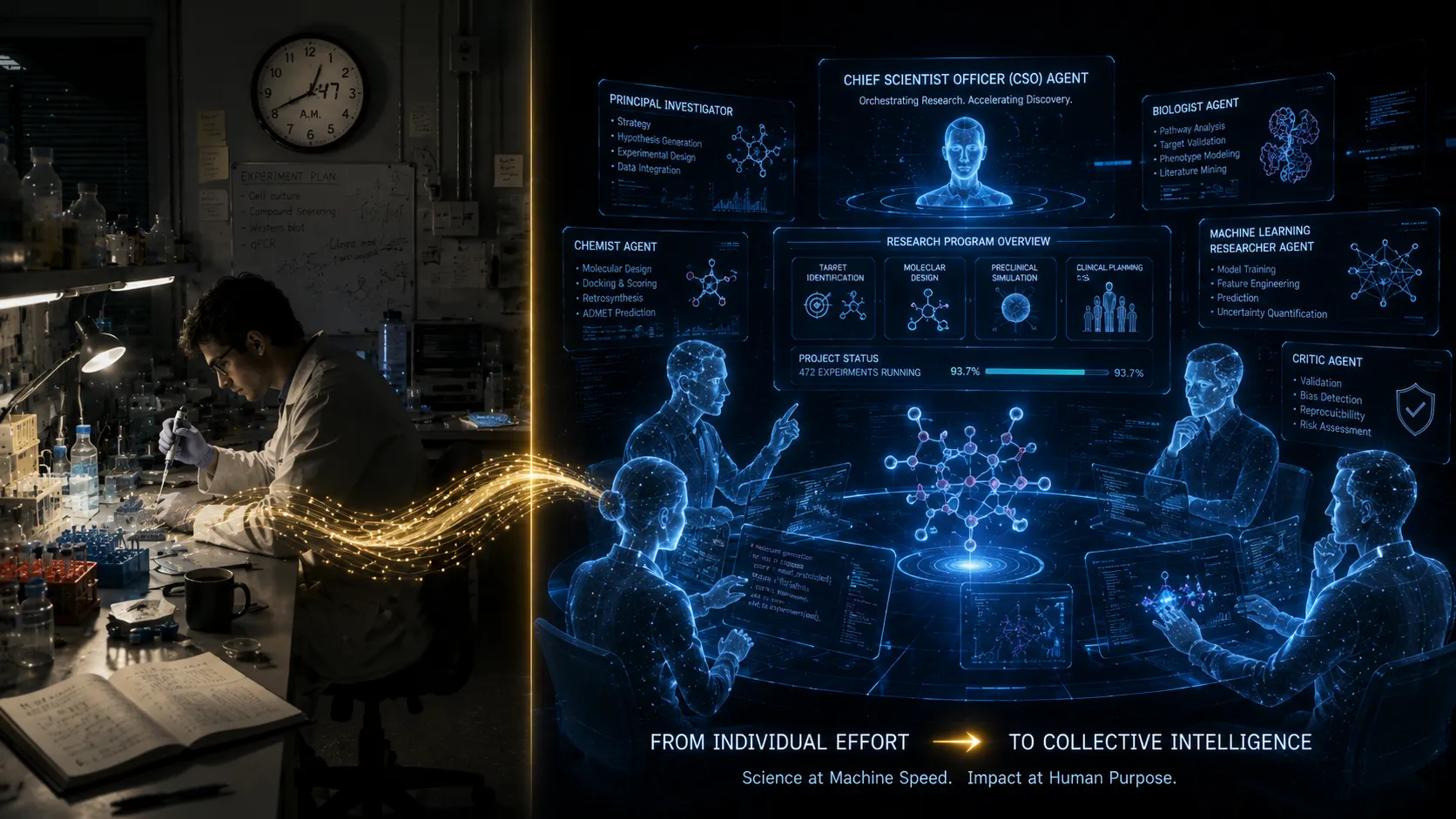
The architecture of the Virtual Lab is deceptively simple, and that simplicity is part of what makes it so powerful. One AI agent plays the role of a principal investigator — the lab head who sets the agenda, organizes discussions, and makes final calls on research direction. Other agents take on more specialized, domain‑specific roles: a biologist, a chemist, a machine learning researcher, and, critically, a "critic" agent whose entire job is to challenge assumptions and find flaws in the team's reasoning.
These agents hold structured research meetings, debating hypotheses, refining methods, and proposing experiments through a process that Swanson says was designed to mimic the interdisciplinary collaboration that drives real‑world discovery. "When we've worked on problems in drug discovery, it is a very interdisciplinary process," Swanson told the Stanford Daily. "We have biologists, chemists, computer scientists — we always made the most progress by having all those different perspectives in the room." The Virtual Lab forces the AI to think from multiple angles simultaneously, generating what Swanson calls "more and better information" than any single model could produce alone.
When given the COVID‑19 nanobody challenge, the agents did not simply execute a pre‑programmed pipeline. They debated the task, selected computational tools from the vast landscape of available protein‑modeling software, wrote code to integrate those tools into a coherent design pipeline, and produced 92 candidate nanobody sequences — all in a matter of days. The core planning, Swanson said, was compressed into one to two hours of agent discussion. A human team tackling the same problem would typically require weeks or months.
The candidates were then handed off to the Chan Zuckerberg Biohub, a nonprofit research institute, for experimental validation. More than 90 percent of the computationally designed molecules expressed and folded properly when synthesized in the lab — an extraordinarily high hit rate by the standards of protein engineering. Two of the nanobodies showed genuine, promising binding to the most recent viral variants while still recognizing the original strain. That cross‑reactivity, the ability to work across multiple versions of the virus, is exactly what makes a therapeutic candidate worth pursuing. The machines had not just generated ideas. They had generated good ideas — ideas that survived contact with the wet‑lab reality of pipettes, cell cultures, and binding assays.
The Virtual Biotech
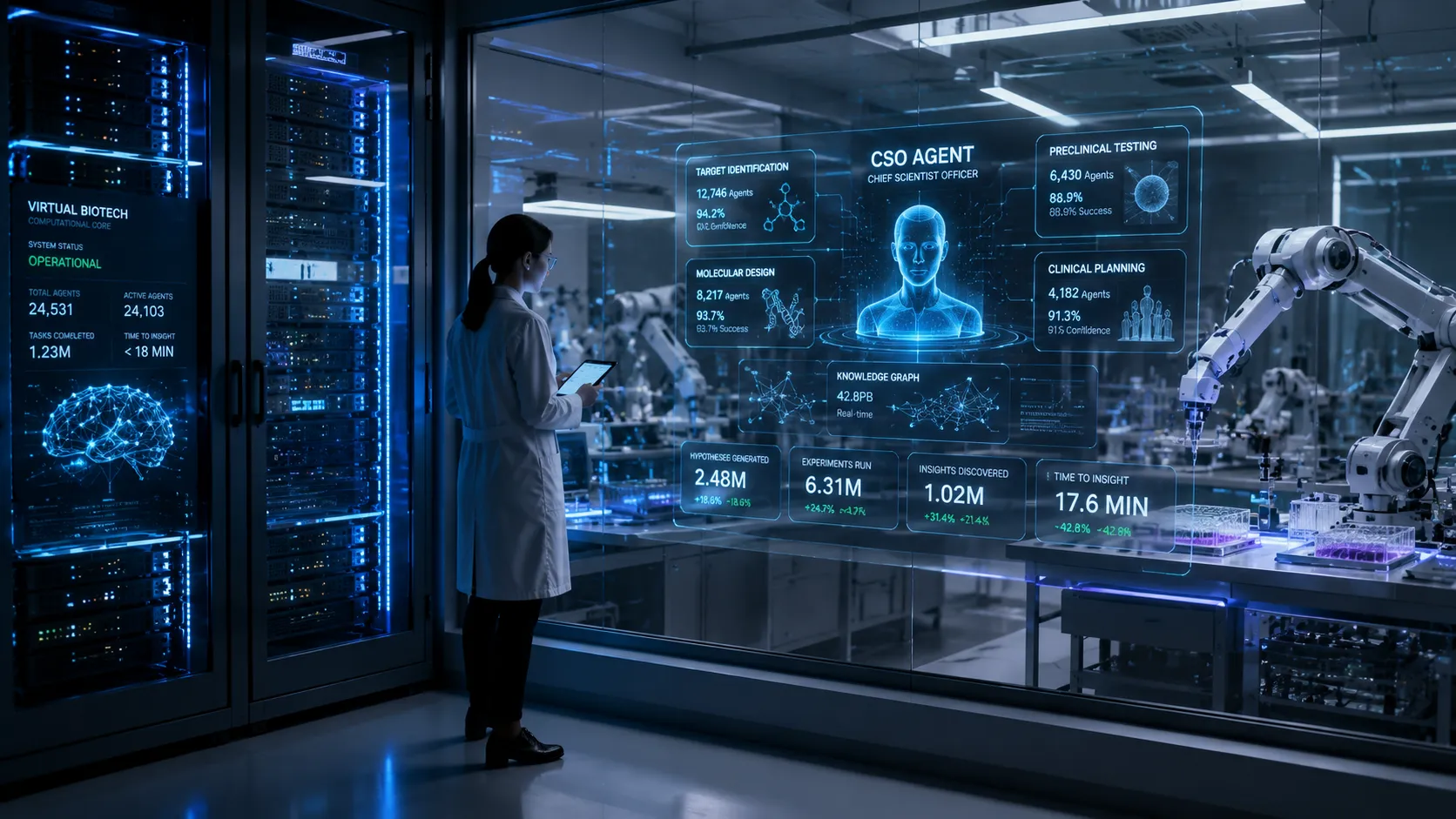
If the Virtual Lab is a research group, the Virtual Biotech is a research enterprise. After demonstrating that a small team of AI agents could collaboratively design molecules, Zou scaled the concept into a much larger system designed to simulate an entire drug discovery organization. Instead of a handful of agents, the Virtual Biotech uses thousands, organized under a "Chief Scientist Officer" agent that coordinates specialized teams — one for target identification, one for molecular design, one for clinical study planning, and so on.
The ambition is not merely to accelerate one step of the drug discovery pipeline. It is to reimagine the entire pipeline — from the initial mining of clinical trial databases for promising targets to the retrospective analysis of failed trials for clues about what went wrong. The system, described in a bioRxiv preprint in February 2026, can autonomously complete the full analysis chain: large‑scale clinical data mining, target evaluation, and the generation of precision‑medicine strategies. It has replicated and extended the findings of human expert teams, and in at least one case, it proposed a novel insight — linking single‑cell genomic features to clinical trial outcomes — that had not been identified by the original researchers.
The most striking validation came not from the system's own metrics but from an independent, real‑world confirmation. The Virtual Biotech proposed a design for an antibody‑drug conjugate targeting B7‑H3, a protein associated with lung cancer. Months later, the pharmaceutical giant Merck independently arrived at the same discovery, filing for breakthrough‑therapy designation from the FDA for a B7‑H3‑targeted drug. The AI had converged on an idea that a major pharmaceutical company's research division had also identified — not by copying, but by reasoning from the same biological data toward the same conclusion.
The Limits and the Lessons
For all its promise, the Virtual Lab is not a replacement for human scientists. It is a tool, and like any tool, it is limited by the hands that wield it.
The AI agents, built on large language models, can hallucinate facts. They are bound by their training data. They lack awareness of real‑world constraints — what equipment a particular lab has, what experiments are practical within a given budget and timeline, what scientific questions are worth asking in the first place. "They don't really know what we're capable of, what sort of equipment we have, what interests us," John Pak of the Biohub said. "So there is a lot of interpretation on the hands of the wet‑lab scientists to pick out what they find interesting amongst the agent's recommendations."
Swanson identified additional weaknesses. The agents can miss context. They can suggest experiments that are technically possible but pragmatically absurd — requiring reagents that take months to synthesize or equipment that exists in only three labs on Earth. They can fail to challenge each other's assumptions with sufficient rigor. "They were too agreeable with each other," Swanson said — a politeness problem that the team is now working to address by tuning the critic agent to be more adversarial.
The most fundamental limitation is physical. AI agents can propose designs, analyze data, and write code. They cannot yet run the wet‑lab experiments required to test their own hypotheses. The human researcher in the loop is not decorative. They are essential — providing context, catching errors, making judgment calls that the agents cannot. The Stanford team is now exploring ways to connect the Virtual Lab to automated robotic laboratories that can execute experiments and feed results back into the system, creating a closed loop of hypothesis generation and experimental validation. That vision — AI agents designing experiments that robots run, with results flowing back into the AI for the next round of design — is the ultimate destination. It is not here yet.
What This Signals
The Virtual Lab's significance extends well beyond a single nanobody design project. It represents the emergence of a new paradigm in scientific research — one in which AI agents do not merely assist individual scientists but function as collaborative team members with distinct expertise, capable of tackling open‑ended, interdisciplinary research problems that have historically required large, well‑funded, geographically concentrated human teams.
For the global scientific community, the implications are profound. Most research institutions in the world — including many excellent ones in Asia, Africa, and Latin America — do not have the concentrated expertise under one roof to field interdisciplinary teams covering biology, chemistry, machine learning, and clinical science simultaneously. The Virtual Lab model suggests a future where that gap narrows, where a smaller team with access to the right AI infrastructure can compete with much larger, better‑funded institutions.
The pharmaceutical industry is watching closely. Drug discovery is among the most expensive and failure‑prone endeavors in all of science, with the average new drug costing more than a billion dollars and taking more than a decade to reach the market. Any technology that can compress the discovery timeline — reducing the months or years spent on early‑stage target identification and molecular design — has an economic value that is measured in the billions. The Virtual Biotech's Merck‑validated B7‑H3 proposal is an early signal that AI‑driven discovery can converge on ideas that the pharmaceutical industry independently identifies as worth pursuing.
For the broader AI industry, the Virtual Lab represents a validation of the multi‑agent approach at a moment when "agentic AI" has become the technology sector's most heavily funded obsession. While much of the industry is focused on building AI agents that can book meetings, write code, or manage customer relationships, the Stanford team is demonstrating that agents can do something more consequential: they can reason together about problems at the frontier of human knowledge, generate novel hypotheses, and produce actionable protocols that lead to real experimental results. The architecture is not merely a research curiosity. It is a template for how AI systems might collaborate with humans — and with each other — across every domain where complex, interdisciplinary reasoning is required.
The Virtual Lab will not replace the human scientist. But it has already demonstrated that a team of AI agents, properly structured and guided by human expertise, can compress weeks of scientific work into days — and, in doing so, expand the frontier of what a single research group can achieve. The lab never sleeps anymore. What we do with that fact — the questions we choose to ask, the oversight we insist on, the access we fight for — is still entirely in human hands.


