The Agritech Unicorn Harvest: Four Indian Startups Just Crossed the Billion‑Dollar Mark—And Technology Is Finally Reaching the Farm
BENGALURU — May 30, 2026 — For decades, the Indian agricultural economy has been defined by a single, stubborn paradox. It employs more than 40 percent of the country's workforce, sustains the livelihoods of approximately 150 million households, and generates a gross value added of over ₹50 lakh crore annually. And yet, the technology that has transformed every other sector of the Indian economy—the digital platforms, the data analytics, the supply‑chain automation—has barely touched the farm. The farmer who buys inputs at the local mandi, who depends on the monsoon, who sells his harvest to a middleman at a price he cannot control, is participating in an economy that has remained largely unchanged for a century. The venture capitalists who poured billions into food‑delivery apps and quick‑commerce platforms showed almost no interest in the agricultural supply chain that fed those platforms. The agritech sector was treated as a niche—too small, too difficult, too dependent on the monsoon and the Minimum Support Price to be worth the attention of serious investors.
That era is now over. In the first five months of 2026, four Indian agritech startups crossed the billion‑dollar valuation mark—a rate of unicorn creation that is faster than any other segment of the Indian startup economy. DeHaat, the full‑stack farmer‑services platform that provides inputs, advisory, and market linkages to over 3 million farmers, raised a $180 million Series F round in January at a valuation of $1.4 billion. Ninjacart, the fresh‑produce supply‑chain platform that connects farmers directly to retailers and restaurants, crossed the unicorn threshold in March after a $120 million round led by Tiger Global. Agrostar, the agri‑inputs marketplace that sells seeds, fertilisers, and equipment to farmers through a digital platform and a network of rural distribution centres, achieved a $1.1 billion valuation in April. And WayCool, the food‑supply‑chain company that sources produce from farmers and supplies it to kirana stores, supermarkets, and industrial kitchens, crossed the mark in May after a $150 million round from Lightrock and the IFC.
"The agritech unicorn harvest is not a coincidence. It is the result of a decade of patient, unglamorous work by founders who understood that the Indian farm was the largest untapped market in the world—and that the technology required to serve it was fundamentally different from the technology that had transformed urban consumer markets." — Agritech investor, speaking anonymously to TIGI
The Full‑Stack Thesis
The most important strategic commonality among the four agritech unicorns is their commitment to the full‑stack model. None of them is a pure marketplace—a platform that merely connects buyers and sellers and takes a commission. Each of them has built an integrated supply chain that touches the farmer at multiple points: the inputs that go into the soil, the advisory that guides the growing season, the logistics that move the harvest from the farm to the market, and the market linkages that ensure the farmer receives a fair price. The full‑stack model is more capital‑intensive than the marketplace model, but it is also more defensible—because the company that controls the entire chain controls the quality, the reliability, and the trust that are the foundations of the agricultural economy.
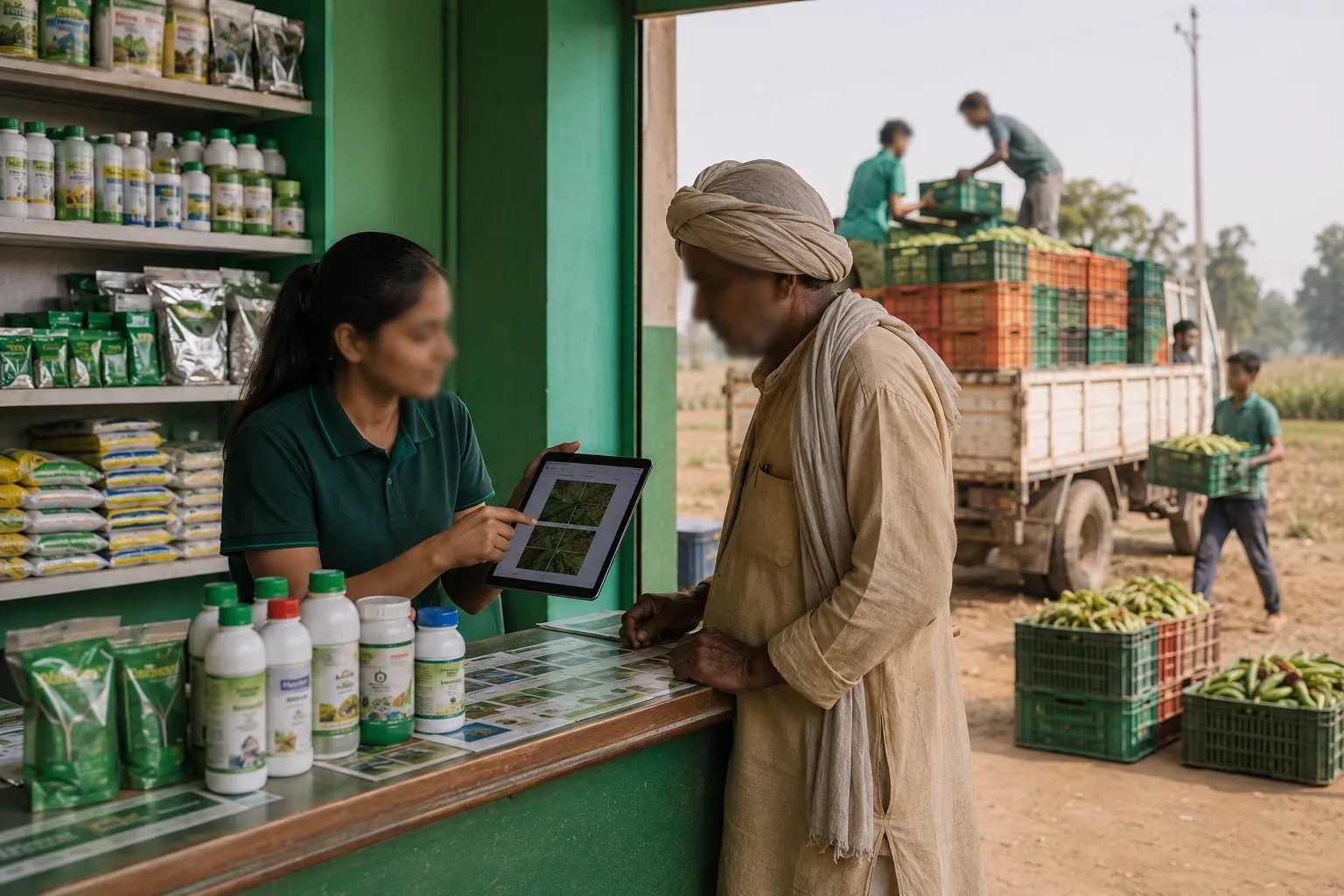
DeHaat, which was founded in 2012 by Shashank Kumar, Amrendra Singh, and Adarsh Srivastava, is the most fully realised example of the full‑stack model. The company began as a small operation in Bihar, connecting a handful of farmers to input suppliers and output buyers, and it has since expanded across 12 Indian states, serving over 3 million farmers through a network of more than 15,000 "DeHaat Centers"—franchise‑operated rural hubs that provide seeds, fertilisers, pesticides, equipment, and advisory services. The farmers who use DeHaat are not merely buying inputs. They are participating in an integrated ecosystem that provides them with agronomic advice, that connects them to institutional buyers, and that gives them access to credit, insurance, and other financial services. The DeHaat Centre is not merely a shop. It is a platform, and the platform is the foundation of the company's relationship with its farmers.
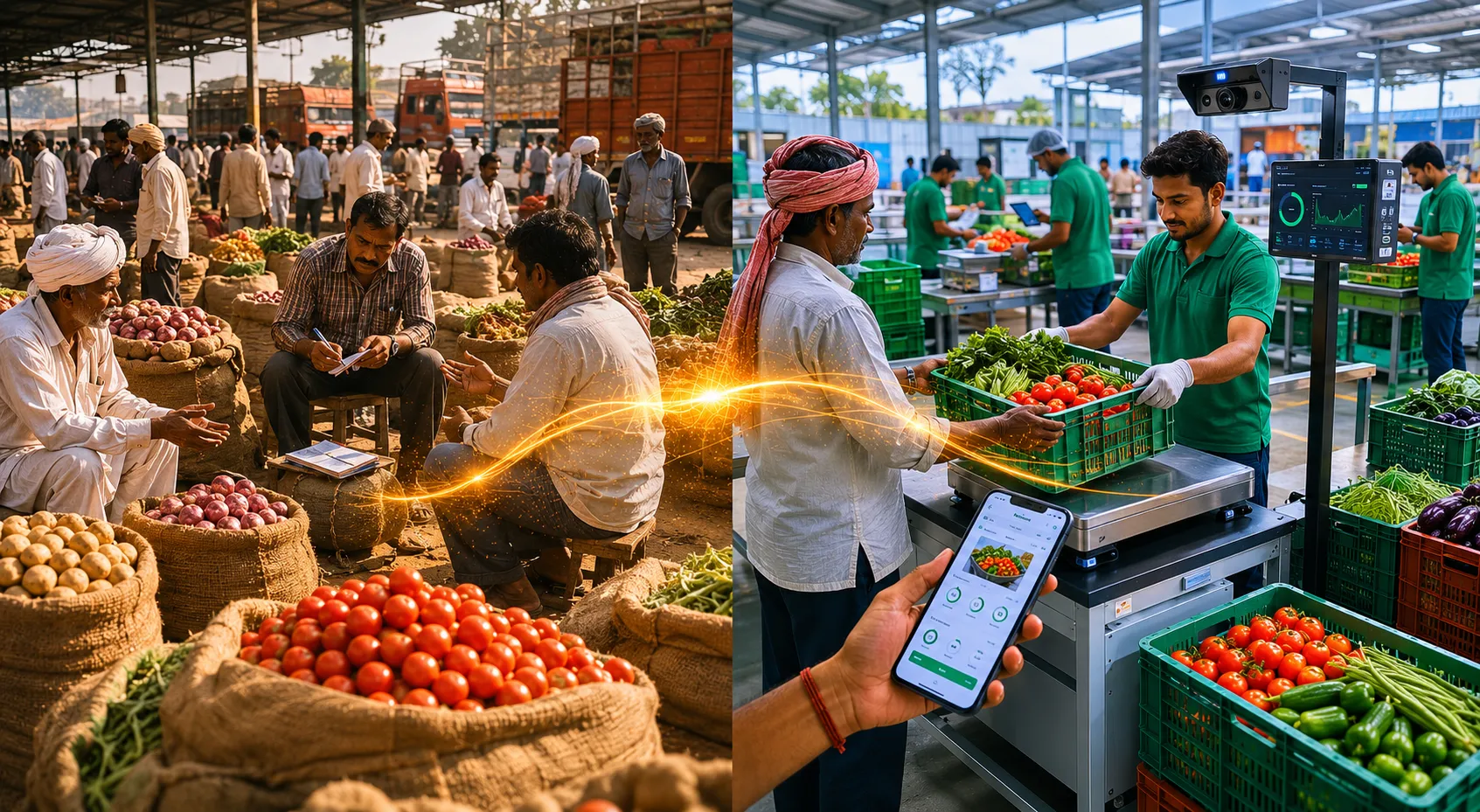
Ninjacart, founded in 2015 by Thirukumaran Nagarajan, Sharath Loganathan, and Ashutosh Vikram, has taken a different approach to the full‑stack model. The company focuses on the supply‑chain segment—the logistics that move fresh produce from the farm to the retailer. Ninjacart's platform uses data analytics and machine learning to predict demand, to optimise procurement, and to route produce through a network of collection centres and distribution hubs that minimise wastage and maximise freshness. The retailers who buy from Ninjacart—the kirana stores, the supermarkets, the restaurants—receive produce that is fresher, cheaper, and more reliably supplied than the produce they could obtain from the traditional mandi system. The farmers who sell to Ninjacart receive a price that is more stable, more transparent, and more predictable than the price they would receive at the mandi. The platform does not merely connect. It coordinates—and the coordination is the source of its value.
Agrostar, founded in 2013 by Shardul Sheth and Sitanshu Sheth, has focused on the input segment—the seeds, fertilisers, and equipment that farmers need to grow their crops. The company's platform allows farmers to browse, compare, and purchase inputs through a mobile app, and it delivers those inputs through a network of rural distribution centres that are located closer to the farm than the traditional agri‑input retailers. The platform also provides agronomic advice—the farmer who buys seeds from Agrostar receives recommendations on when to plant, how to irrigate, and what fertilisers to apply, based on data that the platform has collected from millions of similar transactions. The advisory is not merely a value‑added service. It is a competitive advantage—the reason that farmers choose Agrostar over the local retailer, and the reason that they return season after season.
WayCool, founded in 2015 by Karthik Jayaraman and Sanjay Dasari, has taken the most ambitious approach to the full‑stack model. The company is building an integrated food‑supply‑chain platform that spans the entire value chain—from the farm to the processing facility to the distribution centre to the retail shelf. WayCool sources produce directly from farmers, processes it in its own facilities (cleaning, grading, packaging, and, in some cases, converting it into value‑added products like sauces, juices, and ready‑to‑cook meals), and distributes it to a network of kirana stores, supermarkets, and industrial kitchens. The company's control over the entire chain gives it a visibility and a quality‑control capability that the fragmented, intermediary‑driven traditional supply chain cannot match. The tomato that is sold at a WayCool‑supplied kirana store can be traced back to the farm where it was grown, the fertilisers that were applied, and the date on which it was harvested. The traceability is not merely a marketing claim. It is a food‑safety infrastructure—a way of building trust in a market that has been defined by opacity and adulteration for generations.
The Unit‑Economics Breakthrough
The most significant variable in the agritech unicorn harvest is not the scale of the companies. It is the unit economics that underpin their business models. The agritech sector, for most of its history, was considered uninvestable by the venture‑capital industry because the unit economics did not work. The farmer was too poor, the margins were too thin, and the technology required to serve the farmer was too expensive relative to the revenue that the farmer could generate. The startups that attempted to build agritech businesses in the 2010s discovered that the customer‑acquisition cost in rural India was higher than they had anticipated, that the retention rate was lower, and that the path to profitability was longer and more uncertain than the venture‑capital model could tolerate.
The unit‑economics breakthrough that has enabled the agritech unicorn harvest is the result of a decade of experimentation, iteration, and patient capital. The companies that have survived have discovered that the unit economics of the agritech business are fundamentally different from the unit economics of the urban consumer‑internet business—and that the metrics that matter in the urban market (monthly active users, gross merchandise value, customer‑acquisition cost) are not the metrics that matter in the rural market. The farmer is not a monthly‑active‑user. The farmer is a seasonal transactor—someone who buys inputs at the beginning of the season, who sells produce at the end of the season, and who makes relatively few transactions in between. The company that serves the farmer must be able to acquire the farmer at a cost that is amortised over a small number of high‑value transactions, rather than a large number of low‑value ones—and the acquisition cost must be low enough to be recovered from the margin on those transactions. The companies that have achieved profitability in the agritech sector are the ones that have figured out how to acquire farmers at a cost that works—through the franchise model (DeHaat), through the supply‑chain integration model (Ninjacart), through the agri‑input platform model (Agrostar), or through the full‑stack food‑supply‑chain model (WayCool).
The unit‑economics breakthrough has also been enabled by the transformation of the rural digital infrastructure. The smartphone penetration in rural India, which was below 20 percent a decade ago, is now approaching 50 percent. The data connectivity that was once unreliable is now, in most parts of the country, sufficient to support the kind of digital platforms that the agritech companies are building. The digital‑payments infrastructure, which was once fragmented and inaccessible in rural areas, has been unified by the UPI platform—and the farmer who once dealt entirely in cash can now receive payments directly into a bank account that is linked to a smartphone that is connected to the internet. The rural digital infrastructure is not yet complete, but it is sufficient—and the agritech companies that have been building on it for a decade are now reaping the returns.
The Government Tailwind
The agritech unicorn harvest is being driven, in part, by a structural tailwind from the government. The Indian state, which has historically intervened in the agricultural market primarily through the Minimum Support Price and the public distribution system, has been building a new digital‑agriculture infrastructure that is designed to complement the private‑sector platforms. The Agri‑Stack, a collection of digital databases and services that includes the National Farmers Database, the Unified Farmer Service Platform, and the Agri‑Data Exchange, is being built to provide the foundational data infrastructure that the agritech platforms need—the farmer identities, the land records, the crop histories, the soil‑health data—that are essential to the delivery of personalised, data‑driven agricultural services.
The government's support for the agritech sector is not merely infrastructural. It is also regulatory. The agricultural‑marketing reforms that have been enacted by several state governments over the past several years—the liberalisation of the APMC system, the creation of alternative marketing channels, the promotion of contract farming and direct‑to‑consumer sales—have created a more favourable regulatory environment for the private‑sector platforms. The farmer who was once required to sell his produce through a government‑regulated mandi can now sell it directly to a platform like Ninjacart or WayCool, at a price that is negotiated directly and transparently. The reforms are not complete, and they are not uniform across states, but they are sufficient—and the agritech platforms that are operating in the states that have embraced the reforms are growing faster than the ones that are not.
The Competition from the Conglomerates
The most significant competitive threat to the agritech unicorns is not another startup. It is the large, diversified conglomerates—the Reliances, the Tatas, the ITCs—that are building their own agricultural‑supply‑chain platforms, and that have the capital, the infrastructure, and the government relationships to compete at a scale that the startups cannot match. Reliance Jio's agricultural‑technology platform, JioKrishi, is being built on top of the Jio telecommunications network and is integrated with the Reliance Retail supply chain. ITC's e‑Choupal, which was one of the earliest digital‑agriculture platforms in India, has been operating for two decades and has a presence in tens of thousands of villages. The conglomerates are not merely competing with the agritech startups on technology. They are competing on distribution, on brand, and on the trust that their names command in rural India—and the competition is intensifying as the agritech market grows.
The agritech startups are responding to the conglomerate threat by focusing on the segments of the market that the conglomerates are not serving—the small and marginal farmers who are too dispersed, too difficult to reach, and too low‑value for the large platforms to serve profitably. The DeHaat franchise model, which relies on local entrepreneurs to serve the last‑mile farmer, is designed to reach a population that the centralised, conglomerate‑owned platforms cannot. The WayCool full‑stack model, which integrates processing and value‑addition into the supply chain, is designed to capture margins that the pure‑play trading platforms cannot. The agritech startups are not competing with the conglomerates on scale. They are competing on specificity—on their ability to serve a particular farmer, in a particular geography, with a particular set of needs, in a way that the large, generalist platforms cannot. The strategy is not without risk, but it is defensible—and the unicorn valuations that the startups have achieved suggest that the market believes it is viable.
What This Signals
The agritech unicorn harvest is not primarily a story about four companies crossing a valuation threshold. It is a story about the structural transformation of the Indian agricultural economy—a shift from a market that was defined by fragmentation, opacity, and the power of the intermediary to a market that is defined by integration, transparency, and the power of the platform, and from a sector that was treated as a technological backwater to a sector that is attracting the attention, the capital, and the talent of the most ambitious entrepreneurs in the country. The four unicorns that were minted in the first five months of 2026 are the leading edge of a wave that will produce many more in the years to come—and the farmers who are being served by those platforms, the 150 million households whose livelihoods depend on the agricultural economy, are the ultimate beneficiaries of the transformation. The technology that was once confined to the cities is finally reaching the farm. The farm is large enough, and the need is great enough, to sustain an industry that will define the Indian economy for the next generation.


