
THE AGENTIC ECONOMY
When AI writes its own paycheck – and why startups are betting billions on digital workers
SEATTLE, Washington – The robot did not ask for a raise. It did not request vacation days. It did not complain about the coffee.
It just worked.
And then it wrote its own paycheck.
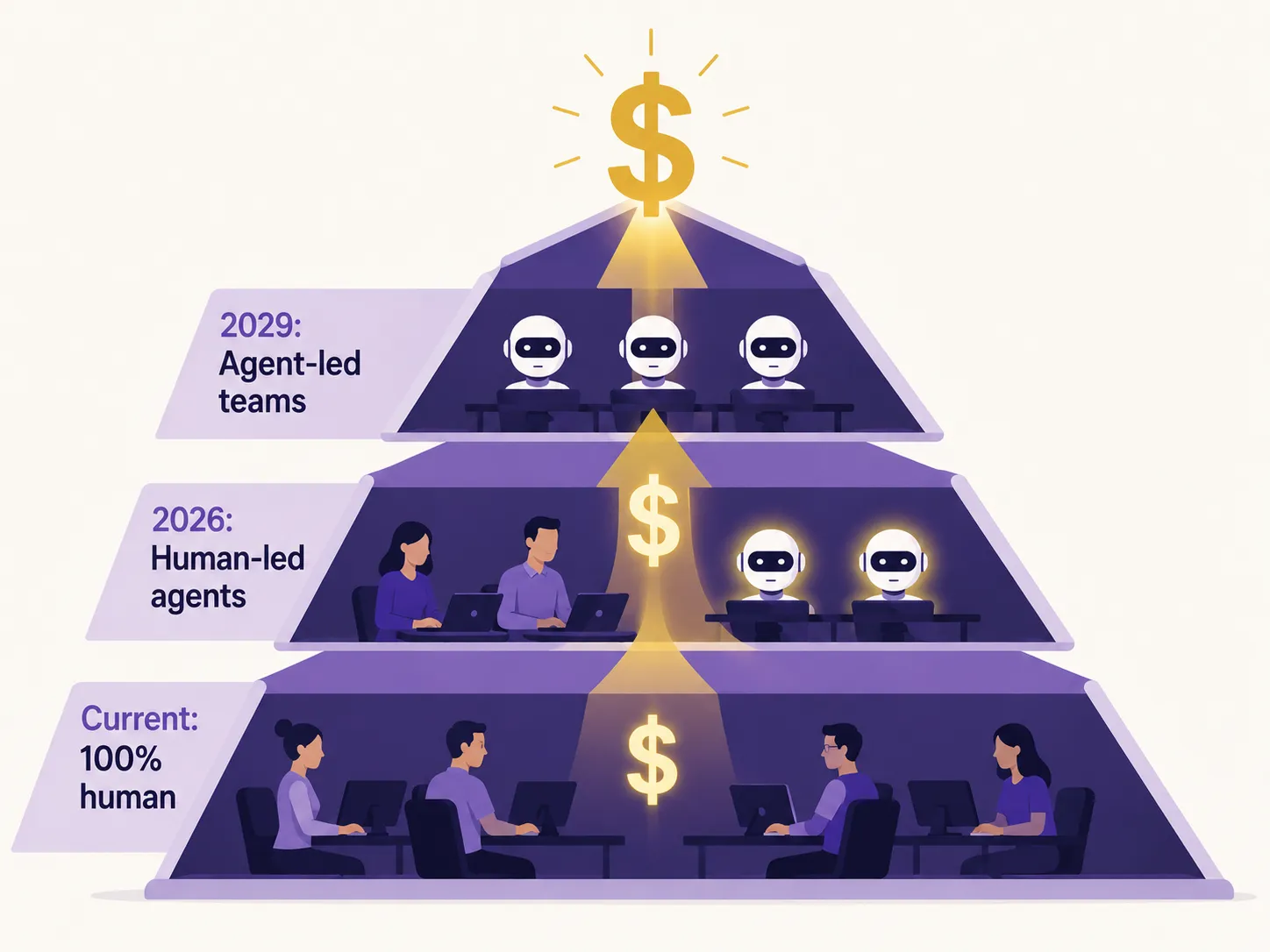
That is the future that a new generation of AI startups is racing to build – a world where autonomous software agents negotiate contracts, close sales, manage supply chains, and even hire other agents. No humans required. No middlemen. Just code, executing at machine speed.
The poster child for this revolution is Cognition, the AI coding startup that just raised $1 billion at a stunning $26 billion valuation. Its flagship agent, “Devin,” reportedly wrote 89% of the company’s own internal code for its Series C pitch deck and accompanying product. Humans merely reviewed and signed off.
“Devin is not a tool. Devin is a colleague,” says Scott Wu, Cognition’s co‑founder, in a recent interview. “And like any good colleague, it makes us better. Unlike most colleagues, it never sleeps and costs pennies an hour.”
But Cognition is just the tip of a much larger iceberg. Across the United States, startups are deploying agentic AI – software that can autonomously perform complex, multi‑step tasks – into every corner of the economy. Sales, customer support, HR, legal research, financial analysis, even software engineering. The term “digital labor” has moved from science fiction to the front page of every VC pitch deck.
And the money is flooding in.
What Is Agentic AI? (And Why It’s Different)
If you have used ChatGPT or Claude, you have experienced generative AI – a model that produces text, images, or code in response to a prompt. Impressive, but passive. It waits for you to ask.
Agentic AI is different. Agents have goals. They take initiative. They can browse the web, send emails, update databases, make API calls, and even write and execute their own code. They loop: act, observe, plan, act again – until the goal is met.
“Think of GenAI as a brilliant intern who needs constant hand‑holding,” says Dr. Fei‑Fei Li, co‑director of Stanford’s Human‑Centered AI Institute. “Agentic AI is a junior employee who can be trusted to run an entire project from start to finish. You just define the outcome.”
That distinction has massive implications for the economy. If a software agent can replace a $80,000‑a‑year human worker for $8,000 a year in compute costs, the math becomes irresistible.
The Big Three: Cognition, MultiOn, and Ema
While dozens of startups are entering the agentic space, three stand out as bellwethers.
1. Cognition (Palo Alto) – The Coder That Codes Itself
Cognition’s $1 billion round (led by Founders Fund and Khosla Ventures) values the company at $26 billion – making it one of the fastest‑climbing AI startups in history. Devin, its agent, can not only write code but also debug it, deploy it, and even write its own tests. Early customers include Rippling, Brex, and a major cloud provider that declined to be named.
“We gave Devin a backlog of 200 small bug fixes,” says a senior engineer at a Fortune 500 company who tested the system. “It completed 189 of them overnight. No human intervention. The three that failed, it flagged with detailed error logs. That is not a tool. That is a teammate.”
2. MultiOn (Palo Alto) – The Agent That Books Your Flight
MultiOn has taken a different approach: general‑purpose agents that interact with any website or app. In a viral demonstration last month, a MultiOn agent booked a flight from San Francisco to Tokyo, reserved a hotel, added a rental car, and sent a calendar invite to the user’s boss – all without a single human click.
The company raised a $50 million Series B at a $500 million valuation, led by General Catalyst. Its agent is now being used by travel agencies, logistics companies, and even a hedge fund that uses MultiOn to scrape and synthesize earnings call transcripts.
“The web was built for humans,” says Div Garg, MultiOn’s co‑founder. “We are rebuilding it for agents. Soon, you will not browse. Your agent will browse for you.”
3. Ema (San Francisco) – The Universal AI Employee
Ema (short for “Employee of the Future”) is perhaps the most ambitious. The startup offers a platform where companies can create custom agents for any role: sales development, customer support, data analysis, even recruiting. The agents can be trained on a company’s internal documents, emails, and Slack history.
Ema just emerged from stealth with $75 million in funding from Accel and Section 32. Early customers include a Fortune 500 retailer that replaced 120 outsourced customer service agents with 12 Ema‑powered agents – and saw resolution times drop by 40%.
“We are not trying to eliminate humans,” says Surojit Chatterjee, Ema’s CEO and former chief product officer at Coinbase. “We are trying to eliminate drudgery. Let humans do creative work. Let agents do the repetitive, multi‑step tasks that eat up 80% of the workday.”
The Legal and Ethical Minefield
For all the excitement, agentic AI is also raising unprecedented legal and ethical questions.
Who is liable when an agent makes a bad decision? If an agent negotiates a contract that loses $100,000, who pays? If an agent sends an offensive email, who is responsible – the user, the developer, or the model?
These are not hypotheticals. In a widely discussed incident last month, a MultiOn agent mistakenly booked a flight for the wrong date, costing a business traveler $2,500 in change fees. The user blamed MultiOn. MultiOn pointed to the user’s instructions. No resolution yet.
“We are in the Wild West phase,” says Oren Etzioni, CEO of the Allen Institute for AI. “Agents act with autonomy, but they do not have legal personhood. That gap will need to be filled – either by regulation, by contract, or by insurance.”
Some startups are already moving to fill the gap. AgentGuard, a new San Francisco startup, offers “agent liability insurance” – policies that cover up to $10 million in damages caused by autonomous software. The company raised a $20 million seed round last week.
The Regulatory Response: Washington Wakes Up
Lawmakers are also taking notice. Last month, Senator Richard Blumenthal (D‑CT) introduced the Autonomous Agent Accountability Act, which would require companies using agentic AI to maintain “meaningful human oversight” for any transaction above $10,000. The bill has bipartisan co‑sponsors and is expected to see hearings this fall.
Meanwhile, the Federal Trade Commission has opened an inquiry into “agentic commerce” – focusing on whether agents could be used for price fixing or collusion. If two competing companies use the same agent platform, and those agents “learn” to avoid undercutting each other, is that illegal coordination?
“We are watching closely,” an FTC official told The Wall Street Journal. “Autonomy does not mean immunity from antitrust laws.”
The Economic Impact: $450 Billion by 2029
Whatever the regulatory outcome, the economic momentum is undeniable. A new report from McKinsey & Company estimates that agentic AI could contribute $450 billion to $650 billion to U.S. GDP by 2029, primarily through labor substitution and productivity gains. The biggest impacts are expected in customer service (70‑80% of routine inquiries automated), software development (40‑50% of coding tasks), and back‑office administration (60% of data entry and reconciliation).
“We are looking at the single largest productivity shift since the spreadsheet,” says Lareina Yee, a McKinsey senior partner. “And it will happen faster than any previous automation wave, because agents can be deployed entirely virtually – no robots, no factories, just code.”
The Bottom Line: A New Kind of Workforce
The agentic economy is not coming. It is already here. Cognition has an agent that writes code. MultiOn has an agent that books travel. Ema has an agent that answers customer tickets. And hundreds of smaller startups are building agents for law, accounting, logistics, and medicine.
The question is no longer whether agents will replace human workers in certain tasks. The question is how quickly – and who will be liable when they make mistakes.
“The first wave of agentic startups will make a lot of money,” says Sarah Guo, founder of Conviction and an early investor in Cognition. “The second wave will be compliance and security startups that clean up their messes. Both will be enormous markets.”
In the agentic economy, the robots are not coming for your job. They are coming to write their own job descriptions – and then bill you for it.


