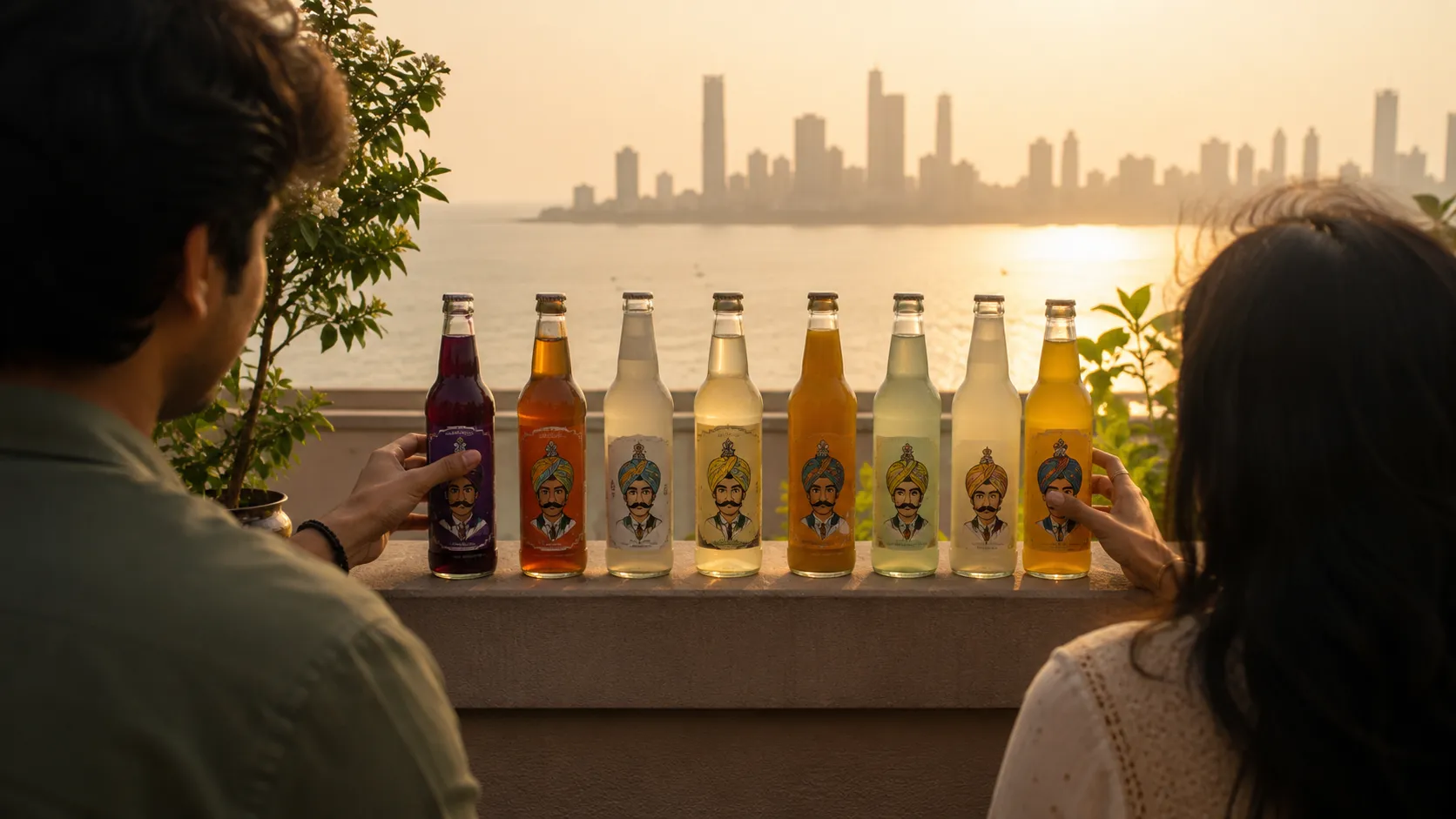
The ₹8 Crore Bet That Kala Khatta Can Beat Coke: How a Husband-Wife Duo Is Turning India's Street-Side Nostalgia Into a Premium Beverage Empire
MUMBAI — May 24, 2026 — Akkshita Malhotra was not supposed to be a beverage entrepreneur. She was a marketing professional with a stable career, a comfortable salary, and a perfectly respectable trajectory. Her husband, Meet Singh Malhotra, was an operations specialist with experience in scaling consumer businesses. They were the kind of couple who could have spent their thirties climbing corporate ladders, accumulating promotions, and settling into the comfortable rhythms of urban professional life.
Instead, in 2021, they quit their jobs, pooled their savings, and launched a beverage brand built around a thesis that was either visionary or delusional, depending on whom you asked: that the flavours Indians had been drinking from street-side carts for generations—Kala Khatta, Masala Cola, Jeera Soda, Nimbu Shikanji—deserved the same premium branding, world-class packaging, and global ambition as the products sold by Coca-Cola and Pepsi. They called the company Bombay Banta, a nod to the marble-stoppered glass bottles—"banta"—that have been the vessel for India's street-side soda economy for more than a century.
Five years later, the thesis is holding. On May 13, 2026, Bombay Banta announced a ₹8 crore Pre-Series A funding round led by DSG Consumer Partners, the early backer of SaladStop, Veeba, and Raw Pressery. The round values the company at ₹80 crore. The brand now offers eight distinctive variants across carbonated and non-carbonated categories, is served across hundreds of hotels and restaurants nationwide, sits on the shelves of every major quick-commerce platform in India, and first gained national visibility as the featured beverage onboard Vistara Airlines—introducing the brand to premium urban consumers at 35,000 feet. The company recorded nearly 50 percent growth in sales during the course of investor discussions and is targeting a doubling of revenues over the next six months. The Diet Vanilla Cola, its first entry into the zero-sugar, zero-calorie segment, launched this month. The banta bottle has been reinvented. The street cart has gone premium. And the couple who walked away from their corporate careers are building what they believe can be the first globally relevant Indian beverage brand.
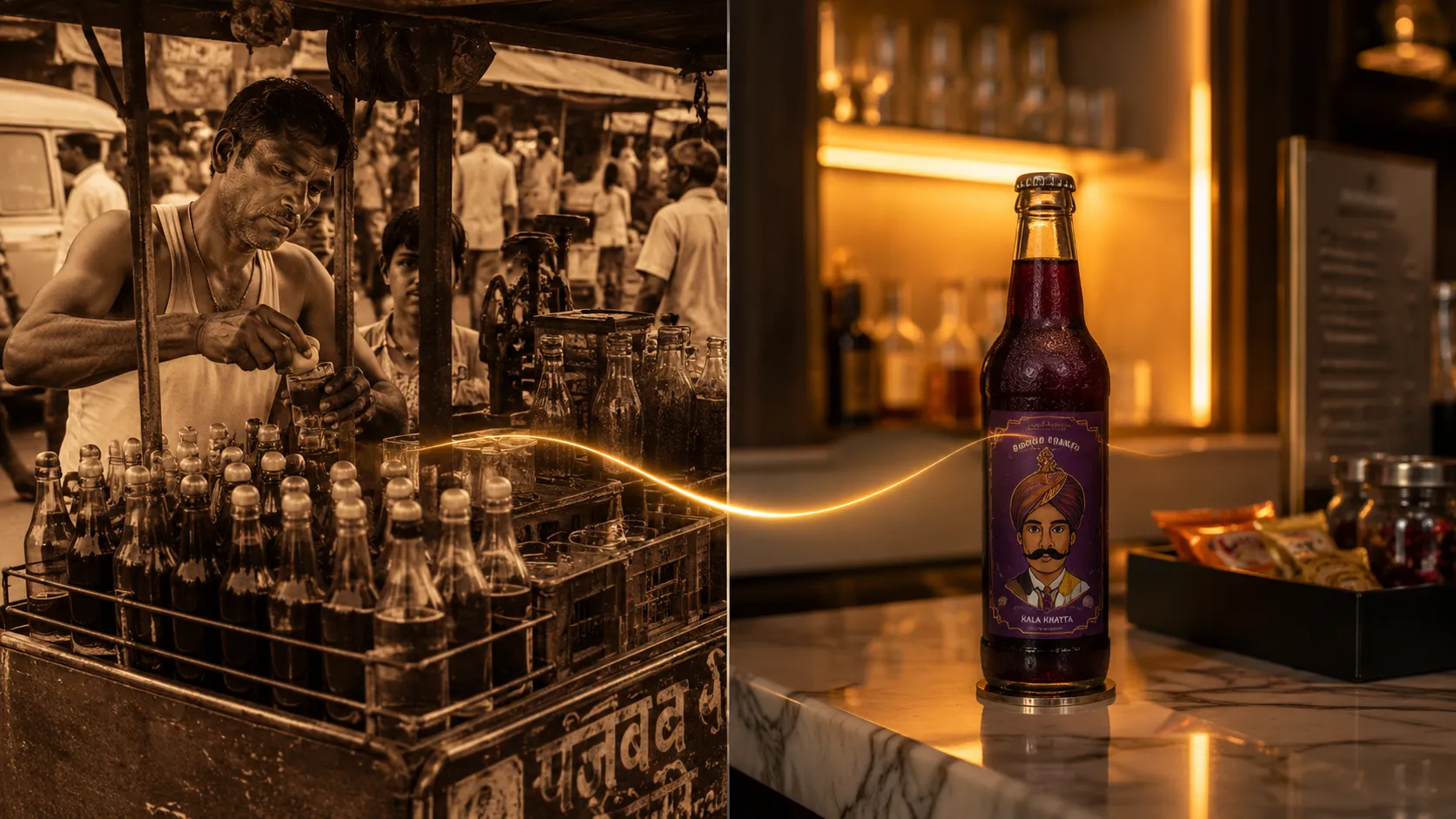
The Flavour Memories That Coke Cannot Replicate
The most strategically significant decision the Malhotras made when building Bombay Banta was not about pricing, distribution, or packaging. It was about the product portfolio. They chose flavours that no multinational could credibly replicate.
The global soft drink industry is built on a handful of universal flavours—cola, lemon-lime, orange, ginger ale—that have been standardised across markets for a century. Coca-Cola and Pepsi dominate the Indian market with the same products they sell in Atlanta and Purchase. The "Indian" flavours that exist in the organised market—Thums Up, Limca, Maaza—are, with the exception of Thums Up's spiced cola, relatively generic. The vast and sophisticated universe of Indian regional beverage flavours—Kala Khatta, the sweet-tart-savoury syrup made from black jamun and spices; Masala Cola, cola spiked with cumin, black pepper, and rock salt; Jeera Soda, the cooling, digestive cumin-infused sparkling water; Nimbu Shikanji, the vitamin-rich, spiced lemonade that every Indian grandmother has served on summer afternoons—remained almost entirely the province of street vendors, home kitchens, and unorganised local bottlers.
The Malhotras' insight was that these flavours were not niche. They were the flavours that hundreds of millions of Indians had grown up with—the flavours of childhood summers, of railway platform stops, of cricket matches and beach holidays. What they lacked was not demand. It was branding. No one had ever put Kala Khatta in a premium bottle and sold it in a five-star hotel minibar. No one had ever formulated a low-sugar Masala Shikanji that a health-conscious millennial could order on Blinkit. No one had ever treated the Indian street-side beverage tradition as the foundation for a modern consumer brand.
"We want to build a brand that reinterprets flavour memories generations have grown up with, while offering modern consumers better ingredients, premium branding, and world-class packaging," the Malhotras said at the funding announcement. The statement captures the central tension of the brand: it is selling nostalgia, but it is selling it to a generation that has never actually bought Kala Khatta from a street cart—and that expects every product it consumes to look, feel, and taste like it belongs in 2026, not 1986.
The Vistara Moment
The single most important commercial milestone in Bombay Banta's journey was not a funding round or a product launch. It was an airline.
In the brand's early days, the Malhotras secured a partnership with Vistara, the full-service carrier that was a joint venture between Tata Sons and Singapore Airlines. Bombay Banta became the featured non-alcoholic beverage onboard Vistara flights—served to business-class passengers at 35,000 feet, presented on trays alongside premium meals, experienced by the kind of high-income, urban, brand-conscious consumer who had never bought a street-side banta in their life.
The Vistara partnership was strategically brilliant for reasons that extend well beyond the immediate revenue. An airline is a confined environment where consumers are a captive audience, where brand exposure is guaranteed for the duration of the flight, and where the implicit endorsement of a premium carrier transfers a portion of its credibility to the brands it serves. When Vistara chose Bombay Banta over Coke or Pepsi as its featured beverage, it was telling its customers, in effect, that this small, homegrown brand deserved to be taken seriously.
"Bombay Banta first gained widespread visibility after becoming the featured beverage onboard Vistara Airlines, introducing the brand to premium urban consumers across India," the company's press release noted, with the careful understatement of a brand that knows exactly how significant that moment was. Since then, the brand has expanded into multiple airlines, hundreds of hotels and restaurants, cafés, delivery-first food brands, and hospitality groups. Its products are stocked across minibars, in-room dining, and restaurant menus at premium and luxury hospitality brands. The Vistara partnership was the door. The rest of the HoReCa (Hotel/Restaurant/Café) expansion was the room.
The Quick-Commerce Acceleration
The second structural tailwind behind Bombay Banta's growth has been the rise of quick commerce. Platforms like Blinkit, Zepto, and Swiggy Instamart have transformed how urban Indians purchase everyday essentials—and beverages are increasingly part of that basket.
Bombay Banta's products are now available across "all leading quick commerce and e-commerce platforms including Blinkit, Zepto, Swiggy Instamart, Flipkart Minutes, and Amazon," according to the company. The quick-commerce channel is particularly valuable for a beverage brand because it solves the impulse-purchase problem. A customer browsing Blinkit for dinner groceries at 7 p.m. can add a six-pack of Bombay Banta to their cart and receive it at their doorstep in under 15 minutes—a distribution capability that would have required years of retail partnerships and thousands of physical touchpoints to achieve even five years ago.
The quick-commerce channel also provides data that traditional retail distribution cannot. Every transaction is digital, every customer is identifiable, and every purchase pattern can be analysed. The Malhotras know which flavours are most popular in which neighbourhoods, at which times of day, and among which demographic segments. That data feeds back into product development, inventory planning, and marketing strategy—a feedback loop that the traditional beverage giants, with their dependence on wholesale distribution and third-party retail, cannot match.
The capital from the Pre-Series A round is explicitly targeted at deepening the company's quick-commerce penetration. "The fresh capital will be used to expand distribution, strengthen quick commerce presence, and widen the product portfolio," the company stated. The fact that quick-commerce expansion is listed alongside distribution and product development—the traditional priorities of any consumer brand—reflects how central the channel has become to Bombay Banta's growth strategy.
The ₹80 Crore Valuation and the Diet Vanilla Cola Bet
The Pre-Series A round valued Bombay Banta at ₹80 crore—a figure that, in the overheated world of Indian startup valuations, might seem modest. But the valuation reflects the company's stage, its revenue base, and its capital efficiency rather than any lack of ambition. The Malhotras have built a brand with eight product variants, national distribution across multiple channels, and nearly 50 percent sales growth—all with seed-stage capital. They have not burned through venture money chasing growth at any cost. They have built a business that generates real revenue from real customers who come back for more.
The next phase of growth will test whether the model can scale. The company is targeting a doubling of revenues over the next six months, driven by strong summer demand and new product launches. The most significant of those launches is Diet Vanilla Cola, the company's first entry into the zero-sugar, zero-calorie segment—a category that has grown rapidly in India as health-conscious consumers shift away from traditional sugary soft drinks. The diet cola launch signals that Bombay Banta is not content to be a niche nostalgia brand. It wants to compete in the same categories that define the global soft drink industry.
The competitive landscape is formidable. Coca-Cola and PepsiCo together control the vast majority of India's organised soft drink market, with distribution networks that reach every village, every kirana store, and every restaurant in the country. Reliance Consumer Products launched Campa, the resurrected Indian cola brand, in 2023 and has deployed the full force of Reliance's distribution and pricing power behind it. A growing roster of D2C beverage startups—including Paper Boat, Lahori, and Bira 91's non-alcoholic range—are competing for overlapping consumer segments. The barriers to entry in the beverage industry are low; the barriers to scale are enormous.
The Malhotras' response is to focus on what the giants cannot replicate: the authenticity of flavour memories. A multinational can launch a masala soda. It cannot launch the masala soda that tastes like the one Indians grew up drinking at roadside stalls. A multinational can hire the best branding agency in the world. It cannot replicate the emotional connection that consumers feel to a brand that is unapologetically, distinctively Indian. "Bombay Banta is building a highly differentiated Indian beverage brand at the intersection of nostalgia, flavour and modern consumer relevance," said Hari Premkumar, Partner at DSG Consumer Partners. "Meet and Akkshita have demonstrated exceptional product instinct and brand-building capability in a highly competitive market."
The Global Ambition
The most intriguing sentence in Bombay Banta's funding announcement was not about India. It was about the world.
"With ambitions to build a modern Indian beverage brand for the world," the company's press release stated, positioning the Pre-Series A round as a stepping stone toward international expansion. The global ambition is not as far-fetched as it might sound. The Indian diaspora is one of the largest and most affluent in the world, with approximately 32 million people of Indian origin living outside India. For decades, these consumers have had access to Indian food—restaurants, groceries, spices—but almost no Indian beverage brands. The soft drinks available in Indian restaurants in London, New York, or Dubai are the same Coke and Pepsi available everywhere else.
Bombay Banta's thesis is that the diaspora represents a natural beachhead for international expansion. A first-generation Indian immigrant in California who grew up drinking Kala Khatta at street stalls in Mumbai is a consumer with a pre-existing emotional connection to the product. A second-generation Indian-American who has never been to India but who is curious about the flavours their parents describe is a consumer waiting to be introduced. The international ethnic food market is valued at billions of dollars globally, and the beverage segment within it is almost entirely unoccupied by Indian brands.
The global ambition is likely years away from realisation. The Pre-Series A round funds distribution in India, not overseas expansion. The infrastructure required to export beverages—manufacturing capacity, international logistics, regulatory compliance across multiple jurisdictions—is expensive and complex. But the ambition itself is significant because it reflects a shift in how Indian consumer brands think about their addressable market. For decades, Indian brands were content to serve Indian consumers in India. The new generation of founders—whether in tea, spices, or soft drinks—believes that the Indian brand can be a global brand. Bombay Banta is positioning itself to test that belief.
What This Signals
The Bombay Banta story is not primarily about beverages. It is about the collision of two massive structural shifts—the premiumisation of Indian consumption and the nostalgia-driven rediscovery of regional flavours—and about the entrepreneurs who are building at the intersection of the two.
For decades, the Indian consumer market was defined by aspiration for foreign brands. The consumer who could afford it drank Coke, not Kala Khatta. The consumer who wanted to signal sophistication chose Pepsi, not Jeera Soda. The hierarchy was clear, and it was reinforced by decades of advertising, by the cultural prestige of everything Western, and by the simple fact that Indian flavours were not available in premium formats. The street cart was not a brand. The home kitchen was not a product. The flavours of Indian childhood were memories, not merchandise.
That hierarchy is collapsing. A generation of Indian consumers who have grown up in a more confident, more prosperous, more globalised India is rediscovering the flavours that their parents and grandparents consumed—not as cheap alternatives to Western products, but as premium experiences in their own right. The same consumer who buys single-origin coffee, craft beer, and artisanal cheese is now buying Kala Khatta in a premium glass bottle from a five-star hotel minibar. The flavour is the same. The context is different. And the brand that connects the two is building a category that did not exist five years ago.
Akkshita Malhotra and Meet Singh Malhotra are not competing with Coca-Cola on scale. They are competing on meaning. The multinational giants can outspend them on distribution, marketing, and pricing. But they cannot outspend them on authenticity—on the deep, emotional connection that consumers have to flavours that taste like childhood, like home, like a specific street corner on a specific summer afternoon. The ₹8 crore Pre-Series A round is not a threat to Coke. But the thesis it validates—that Indian flavour memories, properly branded and packaged, can support a premium consumer business—is a threat to the assumption that the Indian beverage market belongs, permanently and inevitably, to the multinationals. The banta bottle has been reinvented. The street cart has gone premium. The world, if the Malhotras are right, is next.


