The ₹70,000 Crore Question: How a Delhi Dropout Built India's Biggest Eyewear Empire, Survived a Shark Tank Valuation Meme-Storm—and Just Posted a ₹530 Crore Profit That Silenced Everyone
GURUGRAM — May 25, 2026 — In October 2025, the internet made fun of Peyush Bansal. Lenskart, the company he had spent fifteen years building from a small Delhi shop into India's largest eyewear retailer, was about to go public. The valuation was approximately ₹70,000 crore—roughly $8 billion at the upper end of the price band. The price-to-earnings ratio, calculated on trailing earnings, was approximately 230. The memes arrived within hours. "Glasses Or Diamonds?" read one viral post, comparing the per-share price of Lenskart to a pair of gold earrings. Shark Tank India viewers—who knew Bansal as the measured, thoughtful investor on the show's judging panel—pointed out the apparent hypocrisy: the same person who grilled founders about their valuations was now asking public-market investors to pay one of the highest multiples in Indian consumer internet history.
Bansal did not respond to the memes. He did not post a defence on LinkedIn. He did not give interviews explaining why the multiple was justified. He waited. And last week, he let the numbers speak.
On May 20, 2026, Lenskart reported its Q4 and full-year FY26 results. Revenue from operations for the quarter surged 46 percent year-on-year to ₹2,516 crore. For the full financial year, revenue increased 32 percent to ₹9,002 crore. EBITDA climbed 55.3 percent to ₹1,789 crore. And adjusted profit after tax—the number that had been held up as evidence of the company's overvaluation—surged 148 percent year-on-year to ₹530 crore. The company conducted 23.8 million eye tests during the year, up 48 percent, with nearly half being first-time examinations in India. India recorded same-store sales growth of 24.2 percent in Q4. The company entered 157 new cities, primarily across Tier‑2 and smaller markets. International revenue grew 35 percent year-on-year, with EBITDA margins in overseas markets improving sharply. Premiumisation accelerated: orders above ₹10,000 accounted for 20.5 percent of India revenue in FY26.
The stock rose 2 to 3 percent on Thursday and Friday. The memes went quiet. The question that now hangs over Lenskart is no longer whether its valuation is a joke. It is whether the company can sustain the growth trajectory that, so far, has justified the multiple.
The Dropout Who Saw What No One Else Saw
Peyush Bansal was not supposed to be a retailer. He was an engineer—a Delhi College of Engineering graduate who had studied computer science and then gone to McGill University in Montreal for an MBA. He worked at Microsoft in the United States as a programme manager, a job that paid well and looked good on a resume. He could have stayed. He could have climbed the corporate ladder, accumulated stock options, and settled into the comfortable life of an Indian-American technology professional.
He quit. He returned to India in 2007 with a conviction that he could build an online eyewear brand—a business model that had been pioneered in the United States by Warby Parker but that had no equivalent in India. He launched an online contact lens store called Flyrr. It failed. He pivoted to prescription glasses, which also struggled. He pivoted again, to sunglasses, which sold in the thousands. He kept pivoting, kept iterating, kept surviving. In 2010, he launched Lenskart.com with a simple, almost naive thesis: that Indians would buy spectacles online, without trying them on, if the price was right and the return policy was generous.
The thesis was partly wrong. Indians did want to try on glasses before buying them—a behaviour that Warby Parker had also encountered in the United States. Bansal's response was to build what Warby Parker built: an omnichannel model. Lenskart opened its first physical store in 2012. It now operates roughly 2,500 stores across India and is expanding internationally into Southeast Asia and the Middle East. The company that began as an online-first D2C brand has become, quietly and methodically, one of India's largest physical retailers. It sells a pair of glasses every few seconds. It has its own manufacturing facilities, its own supply chain, its own eye-testing infrastructure, and its own in-house brands. It is, in the fullest sense, a vertically integrated eyewear company—and it was built, from the ground up, by a founder who had never worked in retail before he started.
Bansal's obsession with vertical integration is the thread that connects every phase of Lenskart's evolution. In 2017, the company opened a robotic manufacturing facility in Delhi that could produce a pair of glasses in a single day—from grinding the lens to fitting the frame—at a cost that undercut every competitor. In 2022, it announced a partnership with the Government of Rajasthan to set up India's largest eyewear manufacturing facility in Bhiwadi, with a capacity of 50 million pairs per year. The factory was designed not just for the Indian market, but for export to Europe, the United States, and the Middle East. "We don't want to be an Indian eyewear company," Bansal told a business magazine. "We want to be a global eyewear company that happens to be based in India."
The Shark Tank Effect
No profile of Peyush Bansal is complete without acknowledging the platform that made him a household name. Shark Tank India, the Indian adaptation of the global franchise, launched in 2021 with Bansal as one of the original judges. He was not the most famous shark—that distinction belonged to BharatPe's Ashneer Grover and Shaadi.com's Anupam Mittal—but he was, by general consensus, the most empathetic. He listened carefully. He asked thoughtful questions. He invested in founders whose businesses he believed in, and he did so with a gentleness that contrasted sharply with the aggressive, theatrical style that defined the show's early seasons.
The show transformed Bansal from a relatively obscure entrepreneur into a national figure. It also transformed Lenskart. The brand awareness that came from Bansal's weekly television appearances was impossible to quantify but unmistakable in its effect. Lenskart's store expansion accelerated. Its customer acquisition costs declined. Its brand became synonymous with "buy glasses online"—a positioning that had taken Warby Parker a decade of venture-funded marketing to achieve in the United States. "Shark Tank gave us something that no amount of advertising could have bought," Bansal told an interviewer. "It gave people permission to trust us."
But the same visibility that had elevated Lenskart's brand also exposed Bansal to the internet's most unforgiving scrutiny. In October 2025, as Lenskart's IPO approached, the same social media platforms that had celebrated Bansal as the kindest shark began circulating memes about the company's valuation. The P/E ratio of 230 was held up as evidence of a market gone mad. "On Shark Tank, Bansal lectures founders about reasonable valuations," read one widely shared post. "Now he's asking 230x for his own company." The irony was not lost on anyone. The shark had become the prey.
Bansal's response was characteristically understated. He did not engage. He did not tweet. He let the roadshow play out—and watched as the IPO was oversubscribed, the stock listed at a premium, and the company's post-listing performance began, quarter by quarter, to narrow the gap between the valuation and the fundamentals. The P/E ratio that had been 230 at listing is now substantially lower, driven not by a correction in the stock price but by a surge in earnings. The company that was mocked as overvalued has grown its profit by 148 percent in a single year. The memes have not been deleted. But they have stopped being funny.
The Eye Test That Is Also a Growth Engine
The single most underappreciated strategic asset in Lenskart's business model is not the stores, the brands, or the manufacturing. It is the eye test.
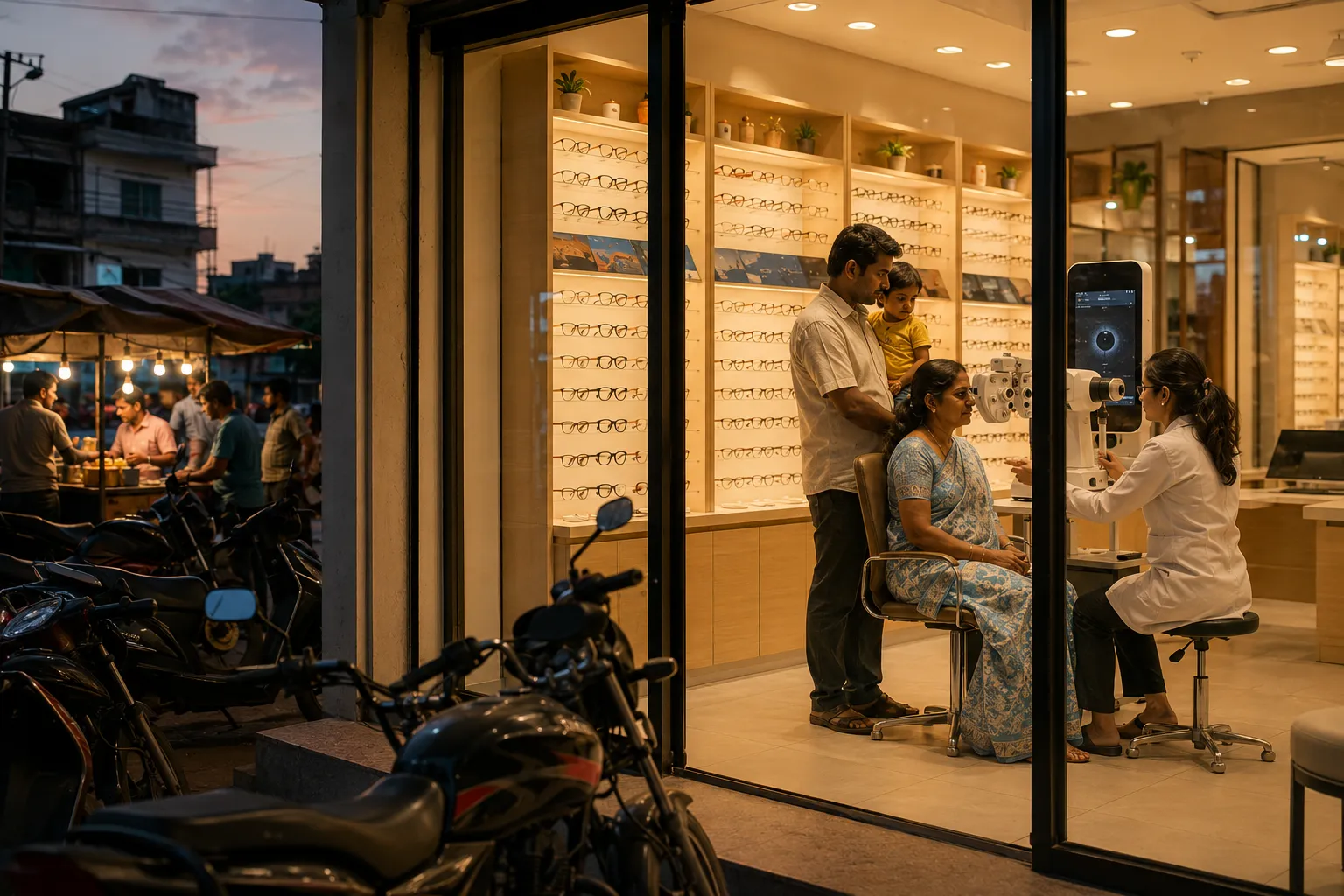
The company conducted 23.8 million eye tests in FY26—a 48 percent increase over the previous year. Nearly half of those were first-time examinations. Each eye test is a customer-acquisition event disguised as a health check. The customer walks into a Lenskart store for a free eye test. The optometrist identifies a vision problem—often one the customer did not know they had. The customer buys glasses. The glasses break or the prescription changes, and the customer returns. The relationship compounds. The eye test, in Bansal's framing, is not a cost centre. It is the engine of customer acquisition, and it runs on a logic that no online-only competitor can replicate.
The optical retail market in India is uniquely suited to this model. India has an estimated 550 million people who require vision correction—more than the entire population of the United States and Europe combined. The organised eyewear market, dominated by Lenskart and a handful of regional chains, accounts for roughly 35 percent of sales. The remaining 65 percent is served by the country's approximately 5 lakh independent opticians—small, often single-person shops that sell unbranded frames and lenses with no quality guarantees and no after-sales service. The market is enormous, fragmented, and waiting to be consolidated. The eye test is the mechanism by which Lenskart intends to consolidate it.
The expansion into Tier‑2 and smaller cities is central to this thesis. In FY26, Lenskart entered 157 new cities, primarily in markets where organised eyewear retail has been virtually nonexistent. The customer in a Tier‑2 city who walks into a Lenskart store for an eye test is often getting their first pair of prescription glasses ever—a life-changing intervention that creates a customer for life. The economics of these markets are different from metro cities: store rents are lower, competition is thinner, and the addressable population—once affordable eyewear is available—is larger than the population that currently wears glasses. "Lenskart added 604 net new stores in FY26 compared with 334 in the previous year," NDTV Profit reported. "Bulls argue that Tier‑2 and smaller Indian cities remain significantly underpenetrated, leaving room for years of expansion."
The Bull Case and the Bear Case
The argument over Lenskart's valuation is not settled. It has merely become more nuanced.
The bull case is built on the trajectory. Revenue grew 32 percent to ₹9,002 crore in FY26. EBITDA surged 55.3 percent, expanding margins as the cost base leveraged against a growing store footprint. Adjusted PAT rose 148 percent. The company added 604 net new stores in a single year, entered 157 new cities, and saw same-store sales growth of 20.8 percent—a figure that suggests new stores are not cannibalising existing ones. International operations are scaling fast, with revenue up 35 percent in Q4 and EBITDA margins improving 335 basis points for the full year. Premiumisation is accelerating: 20.5 percent of India revenue now comes from orders above ₹10,000. The addressable market—550 million Indians who need vision correction, the vast majority of whom have never set foot in an organised optical store—is among the largest untapped retail opportunities in the world.
The bear case is built on the multiple. Lenskart trades at approximately 104 times estimated FY27 earnings and roughly 75 times FY28 earnings—levels that imply a decade of flawless execution. The company's capital expenditure has nearly doubled alongside its expansion push, raising concerns about cash-flow pressure and returns on invested capital. Projected return on equity for FY28 is estimated at approximately 11 percent, while return on capital employed is projected near 8 percent—figures that suggest profitability metrics may lag the valuation premium investors are paying. The aggressive store expansion creates operational complexity: managing quality, staffing, and brand consistency across 157 new cities in a single year is extraordinarily difficult. And the broader macro environment—geopolitical uncertainty, sustained foreign selling from Indian equities, and the risk of an economic slowdown—could compress the multiples that growth stocks command.
The question that divides bulls and bears is not whether Lenskart is a good business. It is. The question is whether the business is good enough to justify a valuation that prices in several years of sustained growth, margin expansion, and international success. The answer will be determined, quarter by quarter, by the same numbers that silenced the memes. Bansal, for his part, seems content to let those numbers do the talking. He has been through worse. In the early years of Lenskart, the company almost ran out of cash. The online-only model failed. The pivot to physical retail was expensive, risky, and widely doubted. The IPO valuation was mocked. Each time, Bansal's response was the same: stop talking, start building, and let the results arrive.
What This Signals
The Lenskart story is not primarily about spectacles. It is about the structural transformation of Indian retail—and about the founder who has spent fifteen years building the infrastructure to serve a market that most retailers ignored.
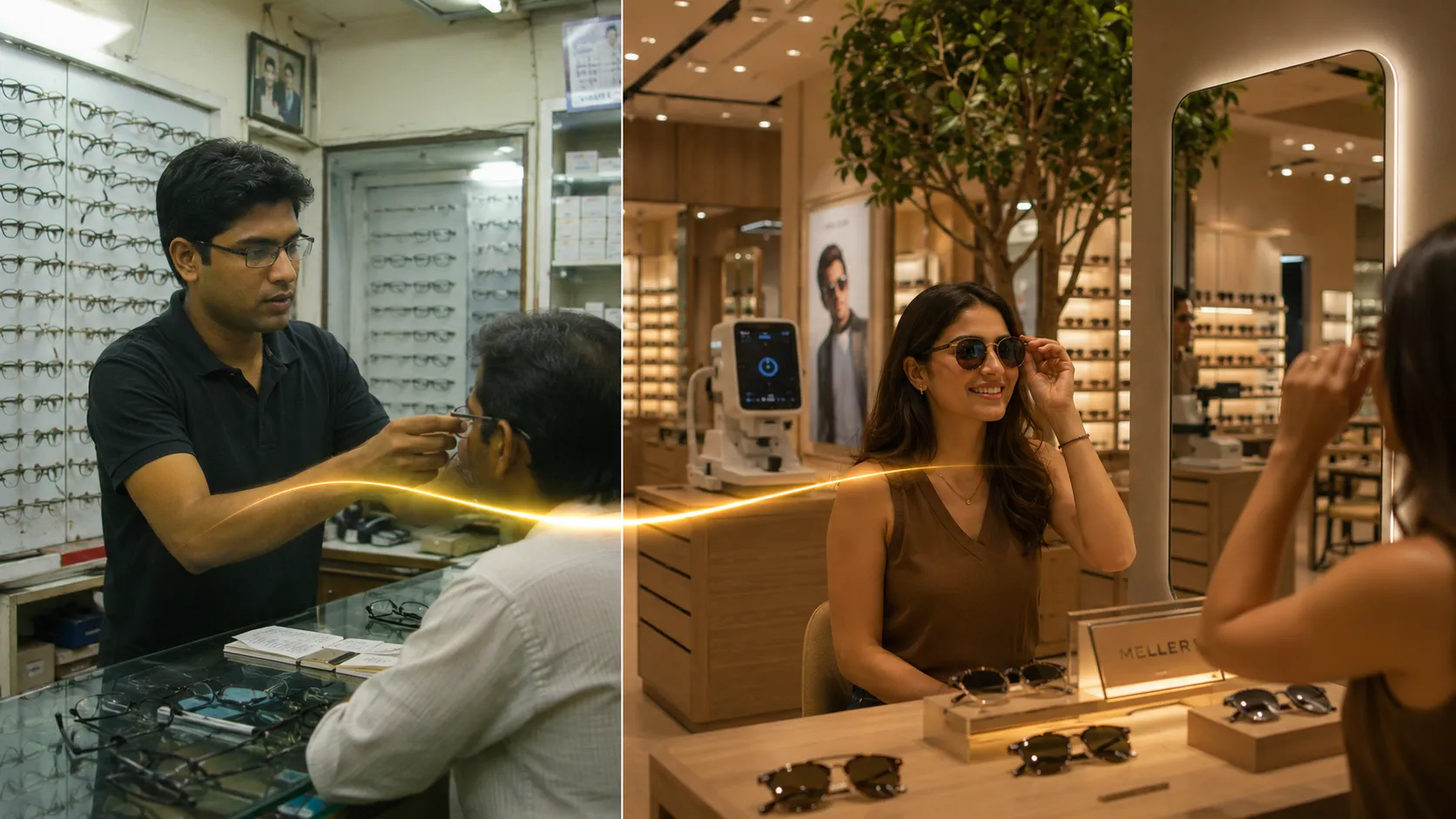
For decades, the Indian eyewear market was defined by the neighbourhood optician—a small, independent shop where the frames were overpriced, the lenses were unbranded, and the eye test was conducted with equipment that had not been calibrated in years. The optician was not a villain. He was a product of a supply chain that was fragmented, inefficient, and resistant to scale. The customer who bought glasses from him had no alternative—until Lenskart built one.
Bansal's achievement is not that he built a large eyewear company. It is that he built a company that forced the entire industry to improve. Independent opticians who once sold unbranded frames for ₹1,500 now compete with Lenskart's ₹699 entry-level glasses. The quality of eye testing, the range of frames, and the transparency of pricing have all improved—not because of regulation, but because of competition. Lenskart did for spectacles what Reliance Jio did for mobile data: it made the service so affordable and accessible that the entire market was forced to respond.
The ₹70,000 crore question—whether the valuation is justified—will be answered by the next several quarters of execution. But the question that has already been answered is whether an Indian D2C brand can become a publicly listed, vertically integrated, omnichannel retailer with a ₹9,000 crore revenue base and a credible path to global expansion. Lenskart has answered that question. The stores are multiplying. The eye tests are compounding. The memes are quiet. And the founder who was told, fifteen years ago, that Indians would never buy glasses online has built the largest eyewear company in the country—and one of the most valuable retail brands in Indian history.


