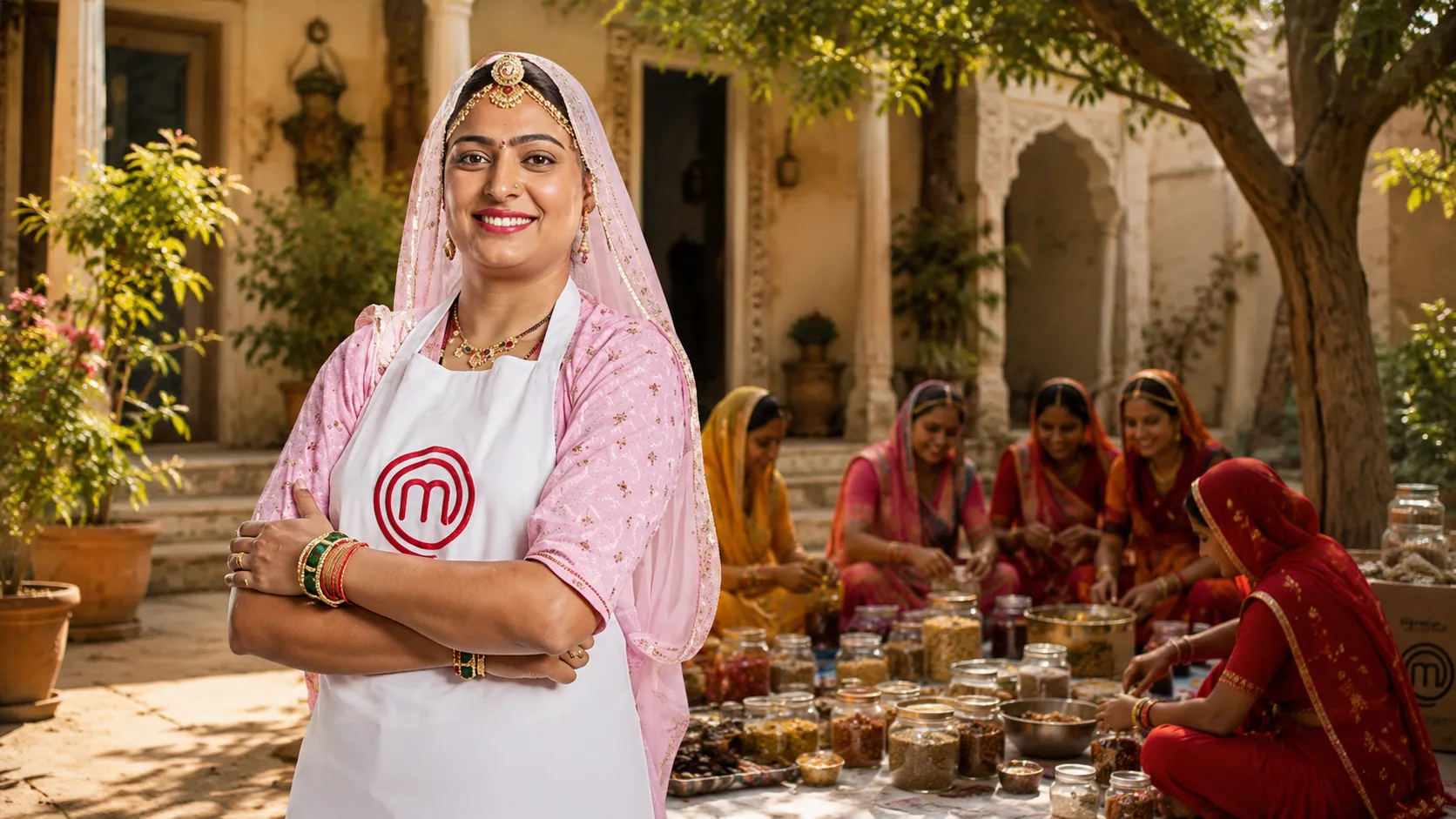
The ₹7,500 Phone That Built a Spice Empire: How a Rajasthan Homemaker Turned Her Village Kitchen Into a Crore-Turnover Brand—and a MasterChef Finalist Spot
JAIPUR — May 24, 2026 — Kaushalya Chaudhary did not set out to become an entrepreneur. She did not set out to become a YouTube star, a MasterChef India finalist, or the founder of a spice and cold-pressed oil brand with outlets across India and customers overseas. She set out to do what millions of Indian women in her position have done for generations: cook for her family, run her household, and live within the quiet, invisible boundaries that rural Rajasthan drew around a woman's ambition.
In 2019, her husband brought home a ₹7,500 smartphone. It was not a gift. It was a tool. Kaushalya had been cooking traditional Marwari food since she was a child, learning recipes from her mother and grandmother that had been passed down through centuries of desert kitchens—recipes that used pure spices, cold-pressed oils, and the slow, patient techniques of village cooking. Her husband thought she should share them. He suggested she start a YouTube channel. Kaushalya laughed. She had never spoken into a camera. She had never used a smartphone. She had never imagined that anyone outside her family would care what she cooked.
Six years later, Kaushalya Chaudhary is the founder of Sidhi Marwari, a spice and cold-pressed oil brand with over 50 outlets across India, crore-level annual turnover, and customers in multiple countries. Her YouTube channel, "Kaushalya Ki Rasoi," has over 1.6 million subscribers—more than many professional media companies. She was a finalist on MasterChef India in 2025, where her traditional Marwari cooking stunned professional chefs. She now employs around 35 women from her village, most of whom had never earned a rupee of their own before she hired them. And it all began with a ₹7,500 smartphone, a tripod made from a broken fan stand, and a woman who decided that her kitchen was not a cage. It was a launchpad.
The Accidental YouTube Star
Kaushalya Chaudhary was born in a small village in Rajasthan's Nagaur district, a region of arid farmland, camel carts, and deep-rooted social conservatism. She was married at a young age, as was customary, and moved to her husband's home in another village, where her life followed the familiar rhythms of rural womanhood: cooking, cleaning, raising children, managing the household. She was good at it. She was also, by her own later admission, restless in ways she could not articulate.
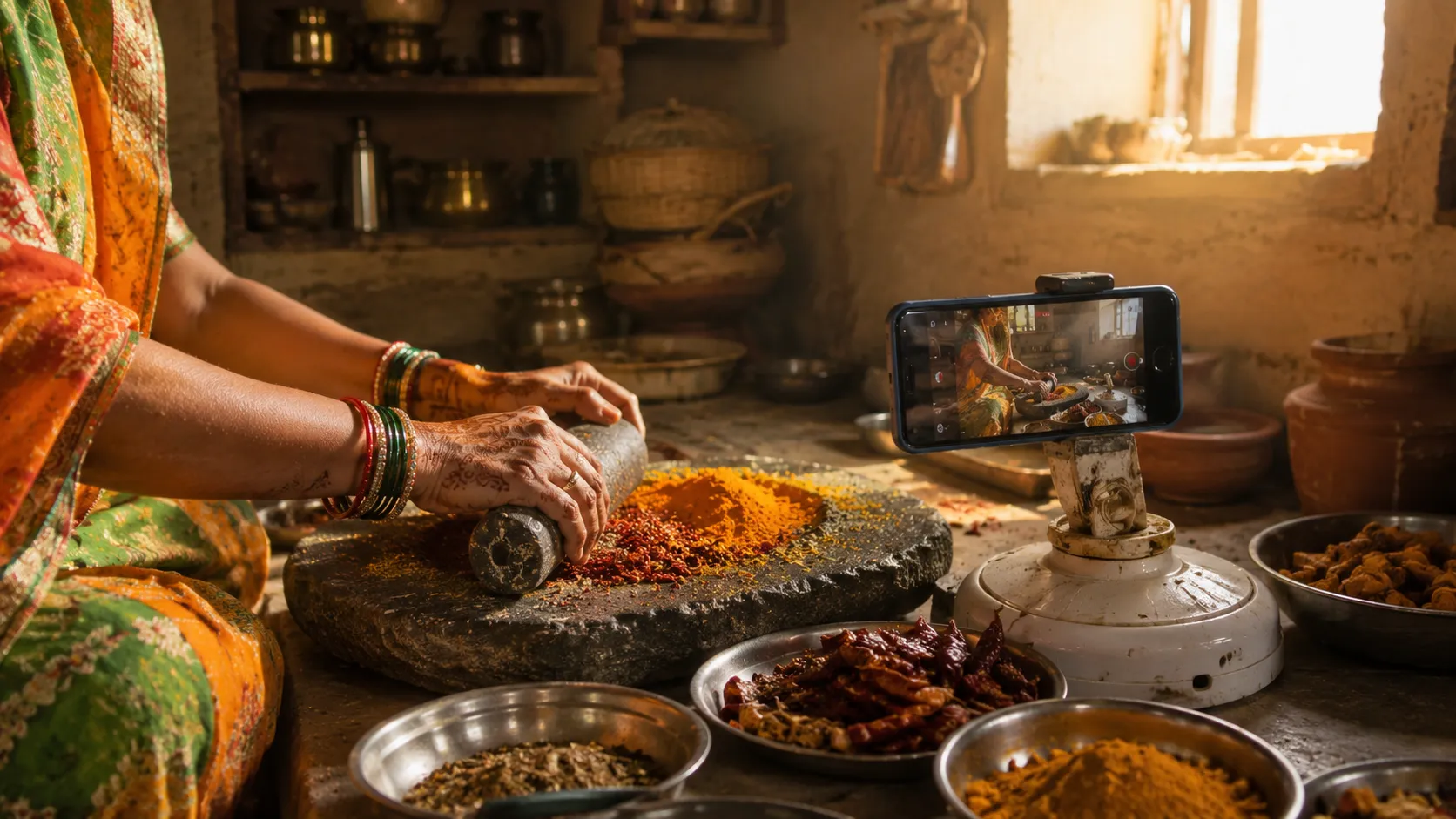
The smartphone arrived in 2019. Her husband, a farmer who had watched his wife cook extraordinary food for years, suggested she film her recipes and put them online. Kaushalya was terrified. "I had never spoken into a camera," she recalled. "I didn't even know how to use the phone properly. The first time I tried to record, I forgot what I was cooking. I just stood there, frozen." She persisted. She propped the phone on a broken fan stand—her first tripod—and began filming simple Marwari dishes: bajre ki roti, ker sangri, gatte ki sabzi, lahsun ki chutney, traditional sweets made from jaggery and sesame.
The early videos were raw. The lighting was poor. The audio was uneven. Kaushalya spoke in a mix of Hindi and Marwari, stumbling over her words, unsure of herself. And yet, something connected. Viewers began finding her channel—not from Jaipur or Delhi, but from the vast, underserved audience of rural and small-town Indians who had never seen their own food traditions reflected back at them with dignity. Kaushalya was not a chef. She was a home cook, using the same ingredients and techniques they used, speaking in the same dialect they spoke at home. The authenticity was undeniable.
The turning point came when viewers began commenting that she should stop speaking Hindi and switch entirely to Rajasthani. They said her Hindi felt forced, that she was trying to be something she was not. "They told me I was losing my soul," she said. She listened. She switched to pure Rajasthani—the language of her village, her grandmother, her childhood—and the channel exploded. Subscribers poured in. Comments flooded with gratitude. Viewers wrote that they had never heard their own language spoken on a cooking show, that they felt seen, that they had started cooking their grandmothers' recipes again because Kaushalya had reminded them what they had lost.
By 2025, "Kaushalya Ki Rasoi" had crossed 1.6 million subscribers. She was invited to participate in MasterChef India, where she advanced to the finals, competing against professionally trained chefs with a repertoire of traditional Marwari dishes that the judges described as revelatory. The woman who had once frozen in front of a smartphone camera was now cooking before millions on national television, her hands steady, her voice calm, her food speaking for itself.
The Brand That the Audience Built
The transition from YouTube channel to consumer brand was not a business school exercise. It was a response to demand. Viewers began writing to Kaushalya, asking where they could buy the spices and oils she used in her videos. They wanted the same cold-pressed mustard oil she drizzled over her bajre ki roti. They wanted the same stone-ground red chili powder she used in her lahsun ki chutney. They wanted the same purity, the same village authenticity, the same connection to a food tradition that the industrial supply chain had largely erased.
Kaushalya and her husband launched Sidhi Marwari—the name means "Straight Marwari" or "Pure Marwari"—with a simple thesis: source spices and oils directly from farmers and village cooperatives, process them using traditional methods like stone-grinding and cold-pressing, and sell them directly to consumers through the brand's website and a growing network of physical outlets. No middlemen. No artificial colours or preservatives. No dilution of quality.
The brand now operates over 50 outlets across India, serves customers in multiple countries, and generates annual turnover in the crore range—figures that Kaushalya, who never finished high school, tracks with the same careful attention she once applied to household budgets. The product range includes cold-pressed oils (mustard, sesame, groundnut, coconut), stone-ground spices (turmeric, red chili, coriander, cumin), traditional pickles, papads, and ready-to-cook mixes for Marwari dishes like ker sangri and gatte ki sabzi.
The women's empowerment dimension of the business is as significant as the commercial one. Kaushalya employs around 35 women from her village and surrounding areas—women who had never worked outside their homes, who had no formal education, who had been told their entire lives that their place was in the kitchen. She pays them fair wages. She trains them in food processing, packaging, and quality control. She has created a supply chain that runs on female labour, female expertise, and female ambition. "Many of these women were previously restricted to homes due to social or personal constraints," she said. "Now, they are working and financially contributing to the family needs."
The MasterChef Moment
In 2025, Kaushalya Chaudhary walked onto the set of MasterChef India as a contestant. She was the oldest woman in the competition, the least formally educated, the least professionally trained. She was also, by the end of the season, one of the most respected.
The judges—professional chefs with international training—were repeatedly stunned by the sophistication of her traditional Marwari cooking. She prepared dishes that had never been seen on Indian television: ker sangri, a desert bean and berry dish that grows wild in the Thar and is preserved using ancient techniques; gatte ki sabzi, gram-flour dumplings simmered in a yoghurt-based gravy that requires precise control of temperature and acidity; traditional lahsun ki chutney, a garlic chutney made with stone-ground spices and cold-pressed mustard oil that one judge described as "the best thing I have tasted on this show."
Kaushalya did not win MasterChef India. But she did something more valuable than winning. She demonstrated, to a national audience of millions, that the food traditions of rural Rajasthan—the recipes that had been passed down through generations of women, without written records, without professional training, without recognition—were as sophisticated, as delicious, and as deserving of respect as any cuisine in the world. She did not cook to impress the judges. She cooked the food she had been cooking her entire life, the food her grandmother had cooked, the food that millions of Rajasthani women cook every day in kitchens that the world has never seen.
The MasterChef appearance transformed her brand. Orders surged. Media attention followed. She was profiled in national newspapers, invited to food festivals, celebrated as a symbol of what rural Indian women could achieve when given a platform. "MasterChef gave me something I never had before," she said. "It gave me the confidence to believe that my food—my village food—was worth something. That I was worth something."
The Philosophy of Purity
The core value proposition of Sidhi Marwari is not branding or distribution. It is purity—a concept that Kaushalya understands not as a marketing slogan but as a lived reality.
In the village economy of rural Rajasthan, food adulteration is not an abstract concern. It is a daily threat. Industrial food companies routinely cut spices with sawdust, brick powder, and artificial colours. Cold-pressed oils are replaced with chemically extracted, solvent-treated alternatives that are cheaper to produce but carry none of the nutritional value of traditional oils. The supply chain that connects the farmer to the consumer is riddled with middlemen who dilute, adulterate, and repackage, capturing the margin while destroying the product.
Kaushalya's supply chain is designed to eliminate that threat. She sources turmeric, chili, coriander, and cumin directly from farmers she knows. The spices are stone-ground in small batches—a slower, more expensive process than industrial grinding, but one that preserves the volatile oils and flavours that give fresh spices their potency. The oils are cold-pressed in traditional wooden ghanis, a process that extracts oil through mechanical pressure rather than chemical solvents, retaining the nutrients and flavour that industrial extraction destroys.
"This is how my grandmother made oil," Kaushalya said. "This is how my mother made oil. Why would I change it?" The question is rhetorical, but the answer is instructive. Industrial food companies changed it because cold-pressing is slower, yields less oil per kilogram of seed, and cannot be scaled to the volumes that supermarkets demand. Kaushalya's counterargument is that quality, not volume, is the point. Her customers—the growing number of Indians who are rejecting industrially processed food in favour of traditional alternatives—agree.
The Road Ahead
Sidhi Marwari is not a venture-backed startup. It has not raised institutional capital. It does not have a growth-at-all-costs mandate, a board of directors, or a target valuation. It is, in the truest sense, a family business—run by Kaushalya and her husband, staffed by village women, built on the rhythms of a rural household.
And yet, the business is growing at a pace that would impress any venture capitalist. The 50 outlets are just the beginning. Kaushalya plans to expand the retail footprint across Rajasthan, Gujarat, and Maharashtra—states with large Marwari populations and a cultural affinity for the food traditions she represents. The website ships nationally. International orders come from the Indian diaspora in the United States, the United Kingdom, Canada, and the Gulf, where customers pay a premium for spices and oils that taste like home.
The larger ambition is to build Sidhi Marwari into a nationally recognised brand—a household name that stands for purity, tradition, and the dignity of village-produced food. It is an ambition that would be laughable if it were not already partly achieved. A woman who had never used a smartphone six years ago now runs a brand with 50 outlets, a seven-figure annual turnover, and a customer base that spans continents. The ₹7,500 phone has been replaced. The broken fan-stand tripod is a memory. The kitchen where it all began is still there, in the village, where Kaushalya still cooks, still films, and still answers comments from viewers who call her "didi"—older sister—and tell her that her videos make them feel closer to home.
"I can run a business while staying in my village," she said, in Rajasthani, in a recent interview. The statement is simple. The meaning is not. It is a declaration of independence—from the cities that have historically monopolised economic opportunity, from the middlemen who have historically captured the value of agricultural produce, from the social norms that have historically confined village women to domestic labour. Kaushalya Chaudhary did not leave her village to build a brand. She built the brand without leaving her village—and in doing so, she built a template for millions of rural women who have the skills, the knowledge, and the ambition, but have never had the platform. The smartphone changed that. The rest was her.


