The ₹67 Crore Bet That India Can Design Its Own Appliances—Not Just Assemble Them
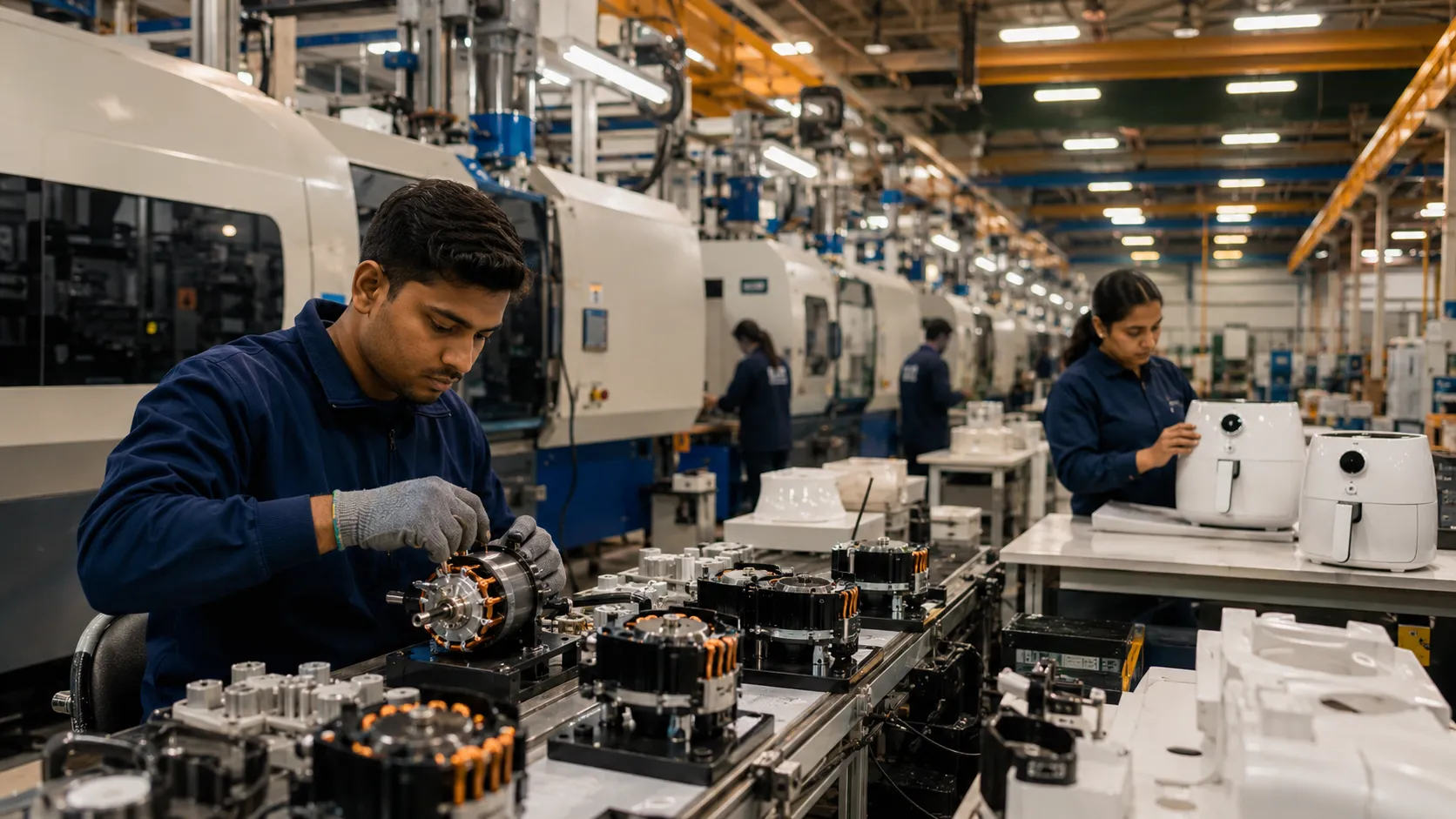
DELHI — May 21, 2026 — For decades, the Indian consumer electronics industry has operated on a simple, humbling premise: design overseas, assemble in India. The air fryer in your kitchen, the juicer on your counter, the car vacuum in your trunk—the outer shell may carry an Indian brand, but the motors, the precision gears, the heating elements, and the load cells that make it work were almost certainly designed and manufactured somewhere else. India's ₹40,000-crore small-appliance market runs largely on imported components, and the companies that sell to Indian consumers have accepted this as the cost of doing business.
Anand Yadav and Gaurang Kuchhal did not accept it. In 2022, the two founders launched Mekr Technologies, a Delhi-based Original Design Manufacturer that builds consumer appliances from the circuit board up—designing the motors, engineering the gear mechanisms, developing the tooling, and managing the full product lifecycle from concept to mass production. This month, Mekr closed a ₹67 crore Series A funding round led by Avaana Capital, with participation from the Titan Capital Winners Fund. The round is a bet—not just on a company, but on the idea that India can move from assembling other people's designs to creating its own. It is a bet on the manufacturing backbone that the country has never fully built.
Mekr's platform integrates the entire product development chain: initial concept, prototyping, proprietary tooling, certification, and mass manufacturing. The company uses modular architecture and shared core technologies—brushless DC motor systems, precision gear mechanisms, heating systems, load cells, and in-house mold design—to reduce production timelines for brands that want to launch Indian-made appliances without building their own factories. To date, Mekr has developed more than 100 SKUs and partnered with over 40 brands, including Croma, Wipro, Amazon Basics, and Flipkart.
The Full-Stack Manufacturing Platform
What distinguishes Mekr from the thousands of contract manufacturers across India's industrial belts is its ambition to be a full-stack platform, not a production shop. The company does not simply execute designs handed to it by brand partners. It creates the designs. Its engineering teams develop the core technologies that make appliances work—the motors, the sensors, the heating systems—and then integrate those technologies into products that carry their partners' brand names.
The modular architecture is key. By developing shared core technologies that can be adapted across multiple product categories, Mekr reduces the cost and time required to bring a new appliance from concept to market. A brushless DC motor designed for a high-end blender can be adapted for a food processor or a personal fan. A precision gear mechanism developed for a kitchen appliance can be reconfigured for a car accessory. The approach turns manufacturing from a one-off, project-by-project business into a platform play.
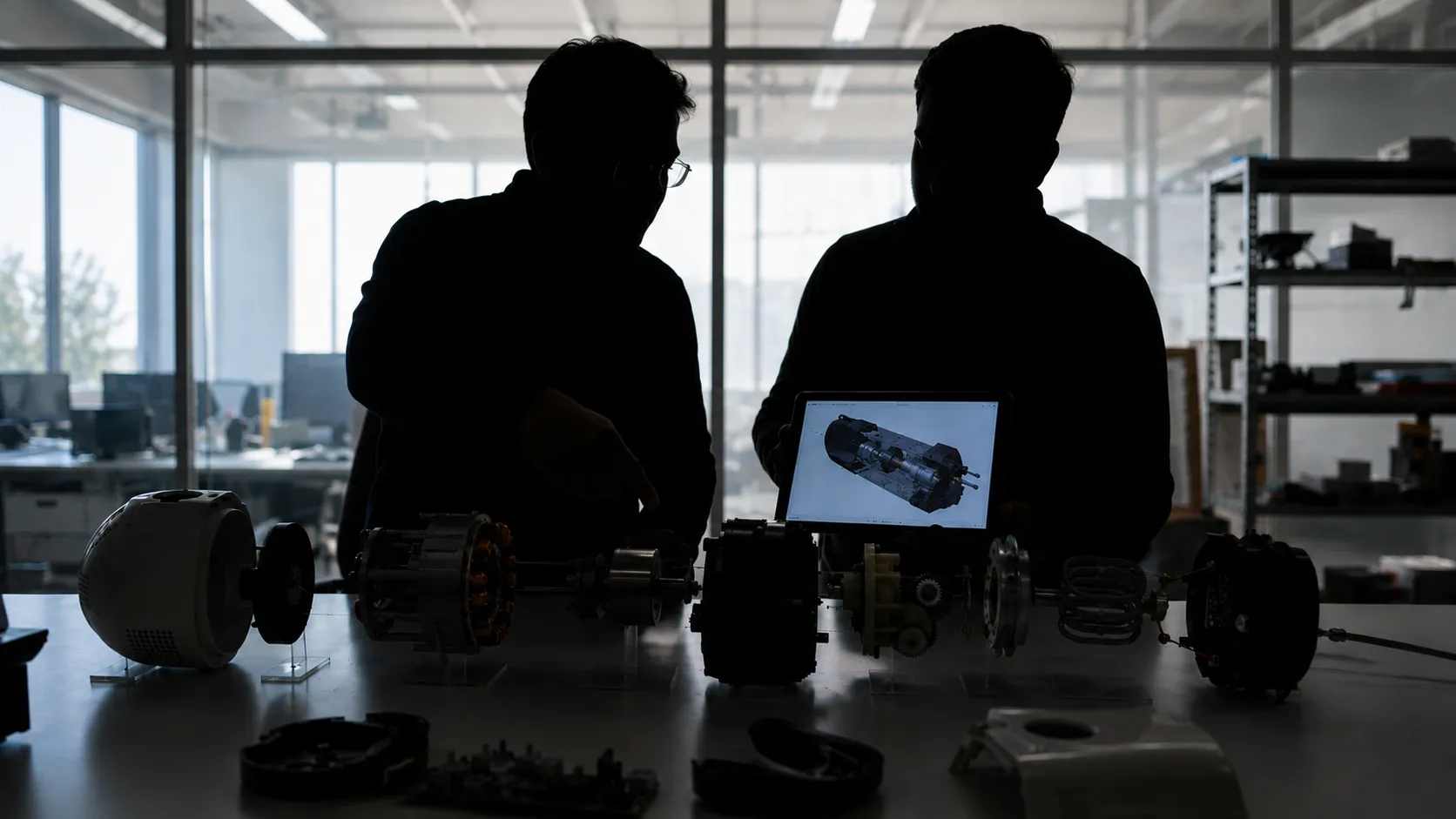
"Vikas Verma, a partner at Avaana Capital, noted that Mekr's design-led approach addresses India's structural reliance on imported components for domestic appliances." The structural reliance is not a minor inconvenience. It means that Indian appliance brands are price-takers on components designed overseas, with limited ability to customize products for Indian conditions—voltage fluctuations, dust, heat, hard water—that foreign-designed motors and electronics were never built to handle.
The ₹67 crore infusion will deepen Mekr's investments in research and development, product engineering, and proprietary tooling. The company also plans to allocate funds toward supplier localization, manufacturing automation, quality systems, and export readiness. The export dimension is significant: Mekr is not building only for the Indian market. It intends to compete globally, shipping Indian-designed appliances to markets where the "designed in India" label is still a rarity.
The Foundry Model Comes to Appliances
Mekr's business model draws on a concept that transformed the semiconductor industry four decades ago: the foundry. In the 1980s, chip companies realized that they did not need to own their own fabrication plants. They could design the chip and outsource manufacturing to a dedicated foundry—TSMC, in Taiwan, became the most famous example—that would build it for them at scale. The model separated design from production and unlocked a wave of innovation by lowering the capital barriers to entry.
Mekr is attempting the same move for consumer appliances. A brand that wants to launch a new kitchen appliance does not need to build a factory, develop a supply chain, or hire an engineering team. It partners with Mekr, which handles the design, the tooling, the certification, and the manufacturing. The brand focuses on marketing, distribution, and customer relationships. The model has already attracted more than 40 brand partners, from established retailers like Croma and Wipro to e-commerce platforms like Amazon and Flipkart that are building their own private-label appliance lines.
The economics are compelling. India's small home appliances market is growing at 7 to 9 percent annually, driven by rising disposable incomes, urbanization, and a generation of consumers who want modern kitchens and connected homes. But the manufacturing base to serve that demand has not kept pace. Imports fill the gap, particularly from China, which dominates the global supply chain for the motors, sensors, and heating elements that go into everyday appliances. Every rupee that goes to an imported component is a rupee that could have gone to an Indian engineer, an Indian factory worker, and an Indian supply chain. Mekr's bet is that the economics of localization will improve as the platform scales—and that the brands will follow.
The Road to Export
Mekr's ambitions extend beyond India's borders. The company is investing in export readiness—certifications, quality systems, packaging standards—with the goal of shipping Indian-designed appliances to global markets. The path is not easy. Global appliance markets are dominated by established brands with decades of consumer trust and supply chains optimized over generations. An Indian ODM entering those markets must compete on design quality, manufacturing precision, and reliability—not just price.
But the tailwinds are real. Global brands are diversifying their supply chains away from China, driven by geopolitical risk and tariff volatility. India is positioning itself as a beneficiary of that diversification, and companies like Mekr that can offer full-stack design and manufacturing services—not just assembly—are well placed to capture contracts that might previously have gone to Chinese ODMs. The "China Plus One" strategy that has reshaped electronics supply chains over the past five years is beginning to reach the appliance sector.
For India, the stakes are larger than a single startup's success. The country's manufacturing sector has lagged behind its services industry for decades. The government's Production Linked Incentive schemes have tried to close the gap, offering subsidies for domestic manufacturing across sectors. But subsidies alone cannot build an industrial ecosystem. Ecosystems are built by companies like Mekr—companies that do not just assemble, but design; that do not just manufacture, but engineer; that do not just serve the domestic market, but compete globally. The ₹67 crore round is not just a bet on Mekr. It is a bet that India can finally build the manufacturing backbone it has never quite managed to construct.


