The ₹65 Crore Gamble That Milk Can Beat Maggi: How Two IIM Graduates Built a ₹1,380 Crore Dairy Empire—and Are Now Taking On Zepto and Blinkit at Their Own Game
GURUGRAM — May 24, 2026 — Chakradhar Gade was not supposed to be a dairy farmer. He was a software engineer at Infosys, then a consultant, then an IIM Indore graduate with the kind of resume that leads to corner offices and comfortable salaries. Nitin Kaushal was not supposed to be a milkman. He was a vice president at HSBC, rising through the ranks of one of the world's largest banks, on a trajectory that would have made his parents proud and his peers envious. Both had done everything right. Both were, by their own later admission, restless in ways they could not articulate.
The idea arrived in 2013, during a conversation about a problem so ubiquitous that most Indians had stopped noticing it. The milk supply chain was broken. Not the demand—India is the world's largest producer and consumer of milk, a $70 billion-plus market that touches nearly every household in the country. The break was in the chain between the cow and the kitchen. Farmers sold milk to middlemen who pooled it, transported it without refrigeration, and sold it to retailers who had no incentive to guarantee quality. The result was a product that was frequently adulterated—diluted with water, laced with detergent to maintain froth, stripped of its nutritional value—and a consumer who had no way to know whether the milk they were feeding their children was pure or poison.
"On the one hand we have a highly unorganised sector, where quality is unreliable, and on the other hand, we have a highly organised sector, where the essence and naturalness of food is completely lost," Gade said at the company's Series D funding announcement in 2022. "At Country Delight, we have taken a tech-driven and consumer-centric approach to solve this problem by delivering natural, fresh and minimally processed food essentials, sourced directly from farmers and delivered to the doorstep of consumers every single day."
Thirteen years later, Country Delight is no longer a startup experiment. The company posted revenue of approximately ₹1,380 crore in FY24, a 50 percent surge from ₹917 crore in FY23, and is tracking toward the ₹1,800 to ₹2,000 crore range. It serves roughly 1.5 million customers across more than 25 cities. It has raised approximately $220 million in cumulative funding across equity and debt, with Temasek—the Singaporean sovereign wealth fund—holding a 13.63 percent stake as its largest external shareholder. Its valuation stood at approximately $820 million as of its March 2025 Series E round. And this month, the company raised ₹65 crore in fresh debt from Alteria Capital—not to fund its core dairy business, but to finance an aggressive, capital-intensive pivot into quick commerce that pits it directly against Zepto, Blinkit, Swiggy Instamart, Flipkart Minutes, and Amazon Now.
The Purity Gap
To understand Country Delight, one must first understand the structural rot at the heart of India's dairy supply chain—a rot that Gade and Kaushal encountered, studied, and eventually built a company to eliminate.
India is the world's largest milk producer, generating more than 230 million tonnes annually. The dairy industry is estimated at more than $70 billion, and milk is not just a commodity—it is a cultural staple, consumed daily in the vast majority of Indian households, fed to children as their first source of nutrition beyond breast milk, used in religious rituals, and central to the preparation of chai, the beverage that functions as India's social lubricant. And yet, for most of the country's history, the supply chain that connected the cow to the kitchen was a patchwork of informal intermediaries—village-level aggregators, unrefrigerated transporters, wholesale traders, and local milkmen—each of whom diluted, adulterated, or degraded the product in ways that were invisible to the consumer.
The adulteration problem is not a marginal concern. Studies by the Food Safety and Standards Authority of India have repeatedly found that a significant percentage of milk sold in the open market is adulterated with water, detergent, urea, starch, and synthetic whiteners—substances that can cause gastrointestinal illness in the short term and organ damage over years of cumulative exposure. The consumer had no way to verify purity. The milkman was a figure of trust, but the trust was unverifiable. The "purity gap," as Country Delight's marketing would later frame it, was the single largest unmet need in Indian dairy.
Gade and Kaushal's insight was that the purity gap could be closed—not by regulation, not by consumer activism, but by supply-chain innovation. If they could build a company that sourced milk directly from farmers, tested it rigorously for quality at every stage, transported it through a fully owned cold chain, and delivered it to customers' doorsteps within 24 to 36 hours of milking, they could offer something that neither the unorganised milkman nor the organised cooperative could match: verifiable purity, delivered daily, at a price that reflected the quality rather than the middleman's margin.
The insight was simple. The execution was anything but.
The Full-Stack Machine
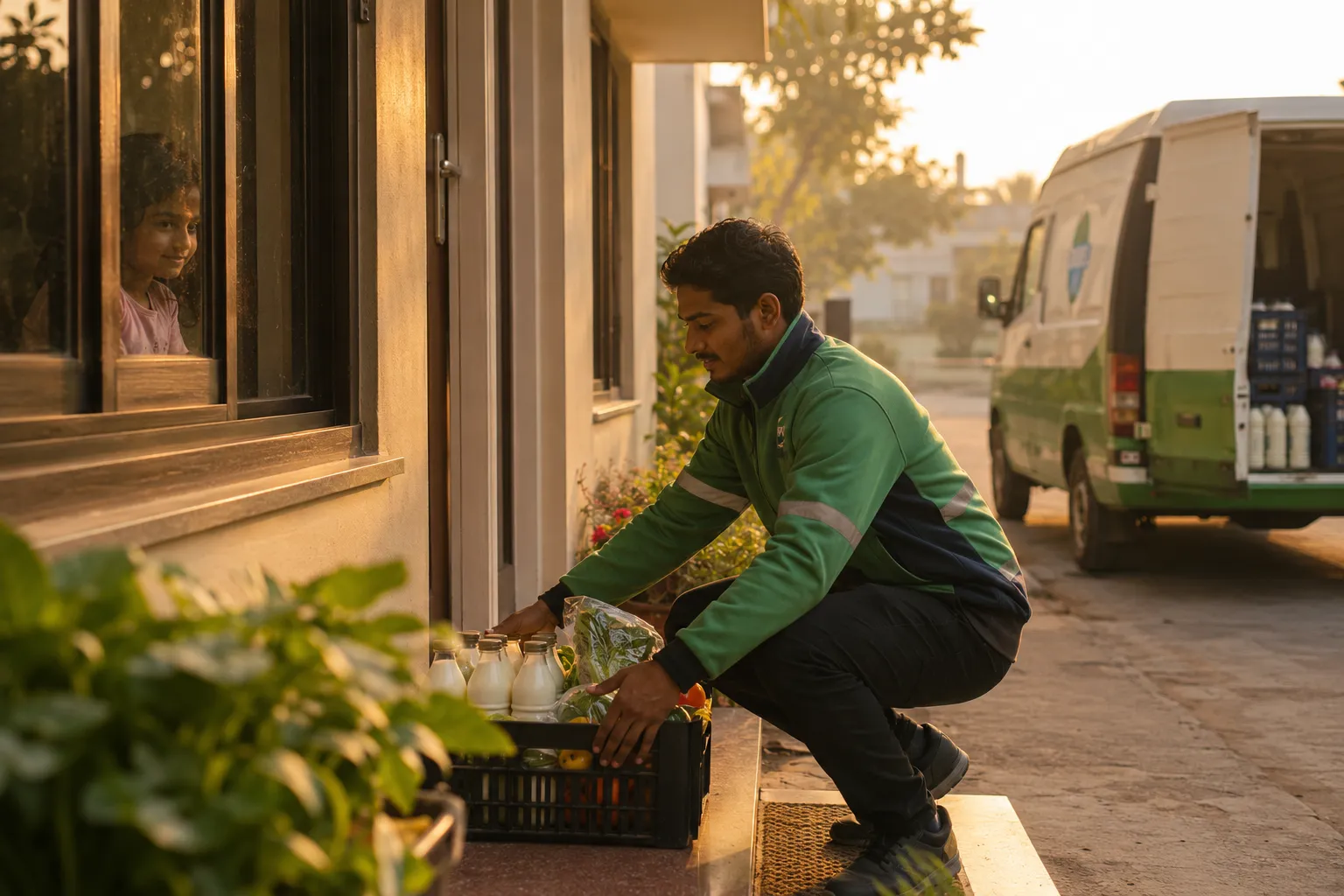
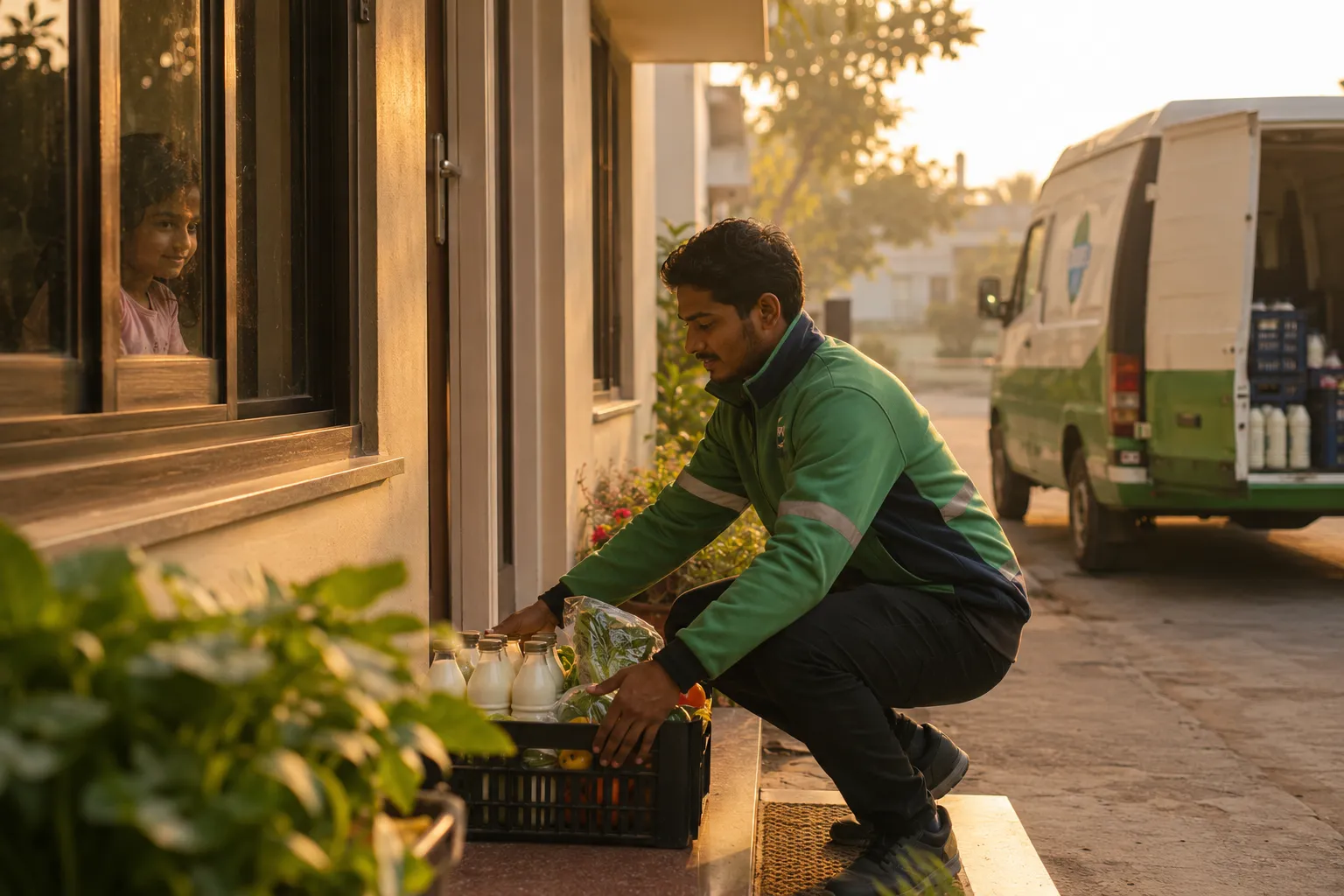
The single most important strategic decision Country Delight made was to own the entire supply chain. The company does not source milk from wholesale markets. It does not outsource logistics to third-party cold-chain providers. It does not sell through kirana stores or modern trade. It controls every link in the chain—from the farmer who produces the milk to the delivery executive who places it on the customer's doorstep.
The model works as follows. Country Delight partners directly with dairy farmers, providing them with training, veterinary support, and guaranteed purchase prices. The milk is collected at village-level chilling centres, where it is immediately cooled to preserve freshness and tested for adulteration, antibiotics, and bacterial contamination. It is transported in refrigerated trucks to the company's processing facilities, where it is pasteurised, packaged, and prepared for delivery. It is then dispatched through a last-mile network of delivery centres that operate on a precise, overnight schedule: procurement and testing happen during the afternoon and evening, processing happens overnight, and the milk arrives at the customer's doorstep by 7 a.m. the following morning.
The cold chain is the moat. Milk is among the most perishable of consumer products—it spoils within hours if not refrigerated—and the infrastructure required to maintain temperature control from farm to doorstep is capital-intensive and operationally complex. Most competitors in the Indian dairy market do not own their cold chains. They rely on third-party logistics providers, which introduces variability, cost, and quality risk. Country Delight's ownership of its cold chain gives it control over quality that no asset-light model can match. It also creates a barrier to entry that deters competition: building a full-stack cold chain across 25 cities takes years and significant capital.
The result is a brand that has built its entire identity around a single, powerful promise: purity, proven by science, delivered daily. Each bottle of Country Delight milk carries a QR code that customers can scan to see the results of the quality tests performed on that specific batch—fat content, protein content, bacterial count, adulteration screening. The transparency is not marketing. It is the product. "At Country Delight, we are solving two fundamental problems," Gade has said. "Adulteration and freshness. The consumer deserves to know exactly what they are consuming."
The Economics of Daily Habit
The strategic genius of Country Delight's business model is not the supply chain. It is the subscription. Milk is the ultimate habit-forming product—consumed daily by the vast majority of Indian households, purchased on a predictable schedule, and resistant to the kind of price-shopping that characterises discretionary categories. A customer who signs up for daily milk delivery is not a one-time buyer. She is a recurring revenue stream, generating predictable cash flows that compound over months and years.
Country Delight built its model around this insight. The company operates on a subscription basis: customers sign up for daily, alternate-day, or weekly delivery of milk and other essentials. The subscription model generates several structural advantages that a transaction-based model cannot match. It creates predictable demand, which allows the company to plan procurement and logistics with precision, reducing wastage and improving asset utilisation. It builds habit, which reduces churn and increases lifetime value. It generates data—on consumption patterns, seasonal variations, product preferences—that feeds back into product development, inventory planning, and marketing.
The milk subscription is also a Trojan horse for selling other products. Once a customer trusts Country Delight to deliver pure milk every morning, she is far more likely to add bread, eggs, fruits, vegetables, paneer, ghee, and other daily essentials to her order. The company has steadily expanded its product portfolio beyond dairy into bakery items, poultry, farm-fresh produce, and grocery staples. The non-dairy categories now contribute a significant and growing share of revenue, and they carry higher margins than milk, which is a relatively low-margin product by design. The milk is the hook. The rest of the basket is the profit.
The financial trajectory reflects the model's compounding power. Revenue surged approximately 50 percent year-on-year to ₹1,380 crore in FY24, driven by growth in both subscribers and non-dairy product sales. The company is tracking toward ₹1,800 to ₹2,000 crore in FY25. While the bottom line has historically been under pressure—the company registered a net loss of ₹260 crore in FY23—the core milk subscription business has been transitioning toward EBITDA positivity, and the economics improve with scale.
The Quick-Commerce Pivot
The most strategically significant—and most controversial—move Country Delight has made in 2026 is a direct assault on the quick-commerce giants.
The company is currently piloting a 10- to 15-minute delivery service in Gurugram, a satellite city of Delhi that is home to a dense concentration of affluent, digital-native consumers. The pilot represents a structural departure from Country Delight's legacy model. For a decade, the company built its reputation on a predictable, cold-chain-optimised morning subscription: milk was procured, tested, and routed overnight for doorstep fulfilment by 7 a.m. The quick-commerce pilot inverts that model. Instead of a scheduled delivery that customers plan around, the company is now offering on-demand, instant fulfilment—the same model that Zepto, Blinkit, and Swiggy Instamart have used to capture hundreds of millions of dollars in monthly grocery spend.
The ₹65 crore debt infusion from Alteria Capital, announced this month, is explicitly earmarked to fund this transition. The capital will finance micro-fulfilment centres (dark stores), advanced spot-delivery logistics, and localised inventory buffers required to sustain hyper-local, instant fulfilment. By using structured debt rather than equity for the quick-commerce expansion, Country Delight is preserving shareholder value and avoiding dilution at a moment when its valuation—approximately $820 million—may not yet reflect the full potential of the new business line.
The logic of the pivot is both offensive and defensive. Offensively, quick commerce represents a new channel for growth—a way to reach customers who want dairy and fresh essentials instantly, not tomorrow morning. Defensively, the move acknowledges that the quick-commerce platforms themselves are increasingly encroaching on Country Delight's territory. Blinkit, Zepto, and Instamart all sell milk, bread, eggs, and fresh produce on their platforms. If Country Delight does not offer instant delivery, it risks losing the customer who wants milk at 8 p.m., not 7 a.m.
But the quick-commerce pivot also introduces significant risk. Instant delivery is among the most capital-intensive, lowest-margin segments of digital retail. The unit economics are brutal: dark stores are expensive to rent and operate, delivery riders must be paid regardless of order volume, and customer acquisition costs in a market with multiple well-funded competitors are punishingly high. Country Delight's ₹65 crore debt buffer will be tested quickly. "The structural question is whether a premium, vertically integrated dairy supply chain can successfully anchor an on-demand quick-commerce network," the dairy-industry publication Dairy Dimension noted in its analysis of the debt raise. "If the Gurugram pilot demonstrates capital efficiency, it will prove that fresh dairy can serve as a high-frequency anchor product."
The Amul Factor
No discussion of Country Delight is complete without acknowledging the elephant in the Indian dairy aisle. Amul, the Gujarat Cooperative Milk Marketing Federation, is not merely a competitor. It is the largest dairy brand in the world's largest dairy market—a ₹72,000 crore behemoth with a distribution network that reaches every corner of India, a brand that has been built over more than seven decades, and a cooperative structure that gives it political and cultural legitimacy that no private company can match.
Country Delight does not compete with Amul on price or scale. It competes on purity, convenience, and the direct relationship with the consumer. Amul's milk is sold through retail outlets—kirana stores, supermarkets, Amul parlours. The consumer who buys Amul milk does not know when it was produced, how far it travelled, or what testing it underwent. Country Delight's milk arrives at the doorstep within 24 to 36 hours of milking, with a QR code that reveals the results of every quality test. The value proposition is not "cheaper than Amul." It is "more transparent than Amul."
The competitive landscape extends beyond Amul. Mother Dairy, the National Dairy Development Board's retail arm, competes in the organised sector. A growing number of D2C dairy startups—Milkbasket, Supr Daily, Doodhvale—are pursuing overlapping models with varying degrees of success. The local milkman, the original doorstep-delivery service, remains a formidable competitor in many neighbourhoods, particularly in smaller cities where trust is built on personal relationships rather than QR codes.
Country Delight's response to the competitive intensity is to double down on what none of the competitors can easily replicate: the full-stack supply chain. Amul does not deliver to doorsteps. The local milkman does not test for adulteration. The D2C startups do not own their cold chains. Country Delight does all three—and the combination, while expensive to build, is genuinely differentiated in a market where trust is the scarcest commodity of all.
The Temasek Endorsement
The single most important external validation of Country Delight's model arrived not from a venture capital firm but from a sovereign wealth fund. Temasek, the Singaporean state-owned investment company that manages a portfolio exceeding $300 billion, first invested in Country Delight in 2022 through its $108 million Series D round. It has since increased its stake through subsequent rounds, including the ₹212.5 crore Series E in March 2025. Temasek now holds a 13.63 percent stake, making it the company's largest external shareholder.
Sovereign wealth funds do not invest in startups on a whim. Temasek's continued commitment to Country Delight—through multiple rounds, across a period when the Indian startup funding environment has tightened significantly—is a signal that the company's thesis is being validated at the operational level. The fund has a multi-decade investment horizon and a tolerance for the long gestation periods that infrastructure-heavy business models require. Its presence on the cap table is both a source of patient capital and an implicit endorsement that Country Delight's full-stack model is built on durable competitive advantages rather than short-term growth hacks.
The other investors on the cap table—Venturi Partners, Elevation Capital, Orios Venture Partners, Matrix Partners, IIFL Asset Management, SWC Global, Trifecta Capital—represent a cross-section of Indian and international growth-stage capital. Alteria Capital, the debt provider behind the recent ₹65 crore NCD issuance, has been Country Delight's primary structured-finance partner, providing the operational liquidity that the company has used to bridge equity rounds and fund capital-intensive initiatives like the quick-commerce pilot. The balanced mix of equity and debt in Country Delight's capital structure—roughly $220 million total, split between the two—reflects a disciplined approach to funding that is unusual in the Indian startup ecosystem, where equity dilution has historically been the default.
The Road Ahead
Country Delight is at an inflection point. The core dairy subscription business is large, growing, and approaching EBITDA positivity. The quick-commerce pilot in Gurugram could either open a massive new growth channel or consume capital that would have been better deployed elsewhere. The path to an initial public offering—which the company has signalled as a medium-term objective—depends on demonstrating that the economics of the full-stack model can support sustained profitability at scale.
The broader context is a structural transformation in how Indian households buy daily essentials. For decades, the morning routine was defined by the milkman's knock and the kirana store around the corner. The milkman is not disappearing—personal relationships built over decades do not dissolve overnight—but the share of milk purchased through branded, digitally enabled, quality-verified channels is growing steadily. Country Delight is positioned at the centre of that shift. Its 1.5 million customers, its 25-city footprint, and its full-stack supply chain represent a bet that the future of Indian dairy belongs not to the unorganised milkman or the legacy cooperative, but to the company that can prove, with science, that its milk is purer than the alternative.
The ₹65 crore debt raise is a bridge to that future. The quick-commerce pilot is a test of whether the future can arrive faster than the market expects. Chakradhar Gade and Nitin Kaushal are no longer the two IIM graduates who quit their corporate jobs with a conviction that India deserved better milk. They are the founders of a company generating nearly ₹1,400 crore in revenue, backed by one of the world's largest sovereign wealth funds, and now taking on the most aggressive quick-commerce platforms in the world at their own game. The morning delivery is still happening—the milk arrives by 7 a.m., cold and tested, with a QR code that tells the customer what is in the bottle. The rest of the day is up for grabs.


