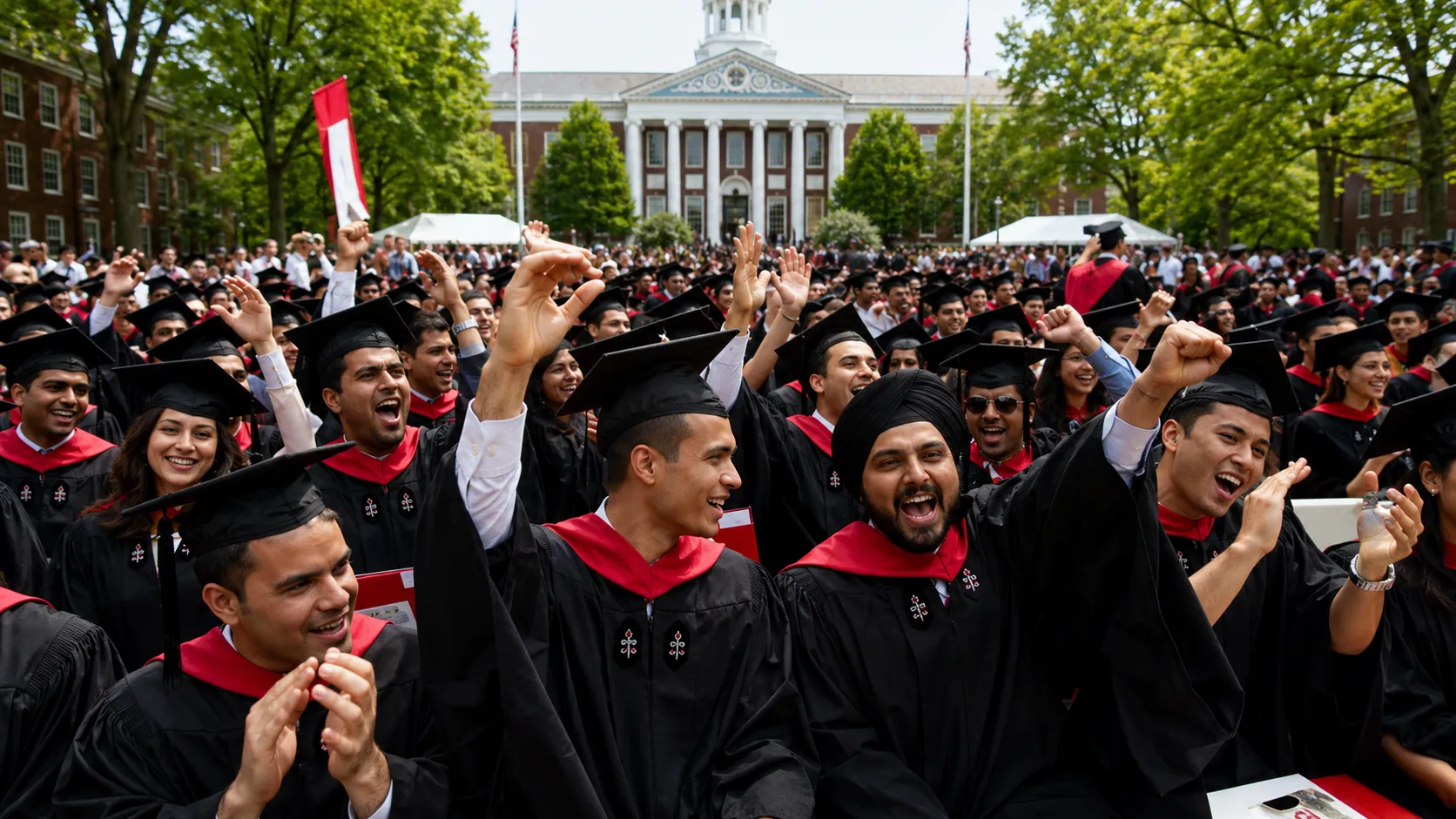
The Number That Changed Everything
Somewhere in the dense enrollment records of the Institute of International Education's annual Open Doors report, a number appeared in November 2025 that would have seemed almost impossible just a decade ago: 363,019.
That is how many Indian students were enrolled in U.S. colleges and universities in the 2024-25 academic year — a 10% increase from the year before, and enough to make India the #1 source of international students in America for the second consecutive year, surpassing China for the first time in 15 years. India's students now represent 30.8% of all 1.177 million international students in the United States. Three in ten international students you would pass on any American campus are Indian.
This is not a minor demographic footnote. It is the story of one of the most consequential mass educational migrations in modern history — a migration driven by a uniquely Indian combination of economic ambition, family sacrifice, and strategic long-term thinking. For millions of Indian families, sending a child to study in America is not just an education decision. It is, simultaneously, a financial investment, a visa strategy, a career plan, and a generational bet.
And in 2025 and 2026, the returns on that bet are far from guaranteed.
363,019 Indian students enrolled in the U.S. in 2024-25 — #1 internationally
30.8% of all international students in America are Indian
$55B contributed to the U.S. economy annually by international students
17% decline in new international student enrollments in Fall 2025
57% of international students in the U.S. pursue STEM fields
Why America? The Calculus Behind the Commitment
To understand why 363,000 Indian students — most of them paying tuition fees that would be unthinkable at home — are enrolled in U.S. universities right now, you have to understand how Indian families make this decision. It is not romantic. It is not impulsive. It is, almost always, rigorously calculated.
The typical Indian family financing a U.S. master's degree is not wealthy. They are middle-class, aspirational, and heavily leveraged. They borrow between $50,000 and $100,000 — often from Indian banks at interest rates of 10 to 12.5 percent — to fund a degree they expect to produce a return that justifies every rupee. The university is not chosen primarily for its ranking or its history. It is chosen for its STEM OPT eligibility, its placement rates, its location relative to tech employers, and its total cost-to-expected-outcome ratio.
This is, in the words of one admissions industry analyst, 'not about prestige branding — it's about OPT and high-salaried jobs.' Indian families filter universities by price before prestige. They will pay $60,000 or more for certain data science or computer science programs, but only when those degrees come with proven placement pipelines and the 36-month STEM OPT work extension that makes the financial math work.
And the math, when it works, is compelling. STEM OPT graduates in technology fields earn between $70,000 and $140,000 per year. Even after repaying substantial education loans, most STEM graduates who secure employment in their field recover their investment within two to three years. In a country where the average annual salary for a software engineer might be $18,000, the appeal of that trajectory is overwhelming.
The United States, beyond salary, offers something no other country currently matches for Indian STEM students: the 36-month OPT framework that gives graduates three separate opportunities to enter the H-1B lottery, the visa pathway to long-term career and residency. Three chances, across three years of post-study work authorization, to win a lottery that opens the door to permanent professional life in America's economy. That is not just a job opportunity. For many families, it is the entire plan.

The Visa Wall: When the Dream Meets Immigration Reality
But the plan is hitting a wall — and for many Indian students in 2025 and 2026, that wall is the U.S. consulate.
F-1 student visa issuances to Indian nationals fell sharply by 33.2% between fiscal year 2023 and fiscal year 2024, according to the Open Doors report. In peak summer 2025, the drop was even more dramatic: a 69% decline in June and July compared to the same period the previous year. Only 12,776 visas were issued to Indian students during those peak months — down from 41,336 in 2024. This, critically, occurred in the exact period when students needed visas to arrive for Fall semester enrollment.
The causes are multiple and compounding. A temporary pause in visa interviews during May and June 2025 disrupted the peak application window. Processing times at major consulates in Delhi, Hyderabad, and Chennai stretched to 45-90 days beyond normal timelines, with thousands of cases stacking up. And policy changes meant visa officers were increasingly interpreting post-study work plans — the very OPT pathway that defines the entire ROI calculation — as evidence of 'immigrant intent,' turning what had been a standard part of every strong application into a liability.
The result was a 61% F-1 refusal rate for Indian applicants in certain 2025-2026 windows, according to one admissions consultancy tracking over 1,200 applicant profiles. Students with perfect academic credentials — high GPAs, strong funding documentation, clear family ties to India — were refused within minutes of their consulate interviews.
The new fall 2025 snapshot in the Open Doors report tells the downstream story: new international student enrollments dropped 17% across U.S. institutions, with 96% of universities citing visa application concerns as a contributing factor. Indian students, who had driven the international enrollment boom, were now among the first to feel the cooling.
"Without OPT, U.S. universities become overpriced diplomas without job prospects. Why would anyone pay $100,000 for a degree that ends in deportation?"
The OPT Question: The Linchpin of the Entire Value Proposition
If the F-1 visa is the door into American education, Optional Practical Training — OPT — is the bridge that makes the investment make sense. And in 2025 and 2026, that bridge is under unprecedented political pressure.
OPT has existed since 1992, surviving administrations of both parties without serious challenge. It allows international students to work in the U.S. in their field of study for up to 12 months after graduation, with STEM graduates eligible for a 24-month extension bringing total authorized work time to 36 months. As of 2024-25, more than half of all international students in the U.S. were pursuing STEM degrees — and nearly three-quarters of international graduates use their OPT work benefit.
What is at stake if OPT is restricted or eliminated is almost impossible to overstate. The ICEF Monitor noted the arithmetic with brutal clarity: 'The average Indian student spends $60,000 to $100,000 on a U.S. STEM degree. Without OPT, the ROI vanishes.' For 1.43 lakh Indian students currently relying on OPT to bridge their F-1 visa to H-1B sponsorship, the stakes are existential.
A Congressional bill introduced in April 2026 aims to eliminate OPT entirely, and separately, a DHS rulemaking process is underway that could fundamentally reshape post-study work authorization. No changes have been formalized as of mid-2026, but the threat — arriving simultaneously from multiple directions — has already changed how Indian families are calculating the risk. OPT delays in 2026 have created cascading problems: missed employer start dates, payroll compliance issues, and complications in the H-1B lottery timeline that can set a graduate's career trajectory back by an entire year.
For STEM OPT to remain viable, it requires political protection that, as of this writing, is not guaranteed. This uncertainty is itself a kind of cost — a psychological and financial risk premium that Indian families must now price into every decision about whether, where, and what to study in America.
The Cost vs. ROI Reckoning: What the Numbers Actually Say
The financial reality of studying in the U.S. in 2025 and 2026 is more complex and more uneven than either the promotional materials of American universities or the cautionary Reddit posts of disillusioned graduates would suggest.
Total costs for a two-year U.S. master's program — tuition plus living expenses — typically range from $80,000 to $150,000 depending on institution, location, and field. For private universities, annual costs can reach $75,000 or more. With the rupee at approximately 92 to the dollar and unsecured education loan interest rates in India running at 10 to 12.5 percent, the debt burden at repayment can be enormous.
The break-even timeline — the point at which a graduate's cumulative earnings exceed the total cost of education including interest — is now estimated at seven years for many programs, up from what was once achievable in three to four. This is driven by flat entry-level salaries in tech and consulting, rising cost of living in American cities, and the ongoing uncertainty around post-study work authorization.
But the picture is deeply bifurcated. For STEM graduates from well-regarded programs who successfully navigate OPT and H-1B sponsorship, the long-term ROI remains substantial. Starting salaries for STEM OPT graduates in technology typically range from $70,000 to $140,000. U.S. MBA graduates from top-10 schools earn median starting salaries of $125,000 to $155,000, with M7 MBA graduates who land in U.S. tech or consulting earning $175,000 to $220,000 in base compensation.
The problem is that those outcomes are not evenly distributed. They concentrate heavily at the top of the program quality spectrum, in STEM-designated fields, in specific employer pipelines. The Indian student who borrows $60,000 to attend a second-tier master's program in a non-STEM field, at a university with limited employer relationships, is making a fundamentally different bet than the one who secures a funded teaching assistantship at a public research university in computer science or data science.
Indian families are, increasingly, learning to distinguish these two bets. Admissions data shows that the enrollment surge is concentrated in STEM-designated programs at mid-tier public universities with strong employer adjacency — not in the prestigious-sounding programs at expensive private institutions whose placement rates don't justify the cost. This is sophisticated, data-driven decision-making at the family level, shaped by thousands of community conversations, Reddit threads, and hard lessons learned by earlier cohorts.
STEM vs. Non-STEM: Two Radically Different Journeys
Nowhere is the disparity in Indian student outcomes in America more visible than in the gap between STEM and non-STEM graduates.
For the STEM student — particularly in computer science, data science, electrical engineering, AI, or health informatics — the U.S. degree pathway remains, despite its obstacles, the most powerful career launchpad available anywhere in the world. The 36-month OPT extension provides three H-1B lottery chances. The employer pipelines at public research universities are deep and active. The starting salaries are high enough to accelerate loan repayment significantly. And the professional network built during a STEM master's in an American tech hub is genuinely irreplaceable — relationships with classmates, professors, and employers that span the global technology industry.
The profile of the STEM path is also evolving rapidly. AI-integrated programs have grown dramatically: master's programs in AI increased 2.7 times between 2022 and 2026, jumping from 116 to 310 programs. MBA programs with AI specializations have risen 1,260 percent since 2022. Indian students are tracking these shifts with precision, pivoting from traditional computer science or software engineering into AI/ML, cloud architecture, and data engineering — the fields where the salary premium for specialized skills is widest and growing.
The non-STEM path is, in the current environment, far more fraught. A two-year U.S. master's in a non-STEM field can cost ₹50 to ₹80 lakhs all-in. Without the STEM OPT extension, the graduate has just 12 months to land a job before the visa clock runs out — a punishingly short window in a competitive job market. The MBA, once the gold standard of the non-STEM American degree, has also come under pressure: Harvard Business School's Class of 2024 had 15% of graduates without job offers three months after graduation, up significantly from just 4% in 2021.
This does not mean non-STEM is closed. For Indian students who can access funded programs — the Fulbright-Nehru fellowship, the Knight-Hennessy scholarship at Stanford, need-blind financial aid at elite universities — the non-STEM path can still produce exceptional outcomes. And the rise of STEM-designated MBA programs has created a hybrid pathway that gives business school graduates access to the 36-month work extension. But for the majority of Indian students paying full international tuition for non-technical master's degrees, the calculus has shifted meaningfully against them.
Post-Study Struggles and the Triumph of Resilience
The stories are everywhere now, circulating through Indian student WhatsApp groups, Reddit threads, and alumni networks with a frequency that has begun to reshape family decision-making in real time.
A 25-year-old posted under the title "Regretting Masters in USA… Jobless, Huge Debt." He had been a cloud engineer in India with a major global technology company, earning $18,000 a year. He gave up the job and borrowed $50,000 at 12.5% interest to pursue a U.S. degree. "Right now," he wrote, "I'm regretting my decision of moving to the US considering the financial stress and uncertainty I am facing."
This is not an isolated story. Several hundred thousand students have returned to India in recent years after failing to secure employment in the United States — burdened with large education loans and, in some cases, unable to find equivalent work in India. Indian news outlets and social media are full of these accounts, and they are beginning to do what no government advisory or admissions consultancy ever could: change the risk calculation at the source.
And yet — the stories of transformation are equally real, equally documented, and in many ways, more instructive.
Girish Mathrubootham, who arrived from India and turned personal frustration with customer service software into Freshworks, which became the first Indian SaaS company listed on NASDAQ. Abhinav Asthana, who built a simple internal tool called Postman that now powers 20 million developers globally. The thousands of Indian professionals who used their U.S. master's degrees not as an endpoint but as a launching pad — building careers, founding companies, and creating economic ripples that span both countries.
The difference between the success stories and the debt stories is rarely talent. It is almost always strategy. The students who thrive in America are, overwhelmingly, those who treated the degree as one element of a larger career architecture — who chose programs with precise alignment to employer demand, who leveraged campus networks aggressively, who diversified their options rather than betting everything on a single immigration pathway.

The Global Alternative: When America Is Not the Answer
The emergence of credible alternatives to the United States has, for the first time in decades, given Indian students genuine leverage in the study abroad decision.
Germany has been the surprise breakout destination of the past two years. Indian student interest in Germany more than doubled, from 13.2% of outbound applicants in 2022 to over 32% in 2024-25. The combination of low or zero tuition at public universities, an 18-month job-seeker visa after graduation, and a clear pathway to the EU Blue Card and permanent residency within approximately 21 months for STEM graduates is, as one analysis put it, 'unbeatable for STEM applicants' on pure ROI terms.
Canada, long the preferred alternative for family-friendly immigration pathways, has tightened its own access — intake caps, reduced approval rates, housing shortages — but remains attractive for its Express Entry and Provincial Nominee routes to genuine permanent residency on timelines measured in years rather than the decade-plus waits of the U.S. employment-based green card system.
Australia, Ireland, the UAE, and Singapore each offer distinct combinations of education quality, post-study work rights, and immigration pathways that may suit specific student profiles better than the American route. The rise of these alternatives is not a threat to U.S. universities — it is a forcing function, pressuring American institutions to improve their value proposition or lose market share to competitors that have made the path to post-study employment simpler and more secure.
The lesson for Indian students and their families is not that America is no longer the best option. It is that America is no longer the only option — and making that comparison clearly, with up-to-date data on visa reality, post-study work rights, and career outcomes, is now an essential part of the decision-making process.
The Verdict: A Conditional Yes — With Conditions That Matter
Is studying in the United States still worth it for Indian students? The honest answer, in 2026, is: yes — but only under specific conditions, and with clear eyes about the risks.
For the Indian student who is pursuing a STEM-designated program at a university with strong employer pipelines, who is doing so with a clear plan for OPT and H-1B, who has compared the total cost against realistic salary outcomes in their specific field, and who has built contingency plans in case the immigration pathway narrows further — the U.S. remains the most powerful educational launchpad in the world. The research universities are genuinely world-class. The employer networks are unrivaled. The salary potential, for those who navigate the system successfully, is unmatched.
For the Indian student pursuing a non-STEM degree at a mid-tier institution with limited placement support, financing the degree through high-interest loans, and relying on a single immigration pathway that is under active political threat — the calculation is far more precarious. The debt can outlast the career advantage.
The deeper truth is that the American dream for Indian students has always been conditional. It was conditional on getting the visa. On getting the grades. On networking strategically. On finding the employer who would sponsor the H-1B. On waiting, sometimes decades, for the green card. Those conditions have multiplied, and the risks have grown. But the reward, for those who navigate the conditions successfully, remains extraordinary.
An American degree is no longer a ticket. It is a gamble.
The odds are still good. But only if you know exactly which table you are sitting at.
For the 363,000 Indian students currently enrolled in American universities — and the millions of families weighing that decision right now — the most important investment they can make is not the tuition payment. It is the research, the planning, and the clarity of thought that turns a gamble into a strategy.


