The ₹60 Crore Bet That India's Water Crisis Can Be Solved by IoT: How a Pune Engineer Built the World's Largest Smart Water Meter Network—and Is Taking It to 40 Countries
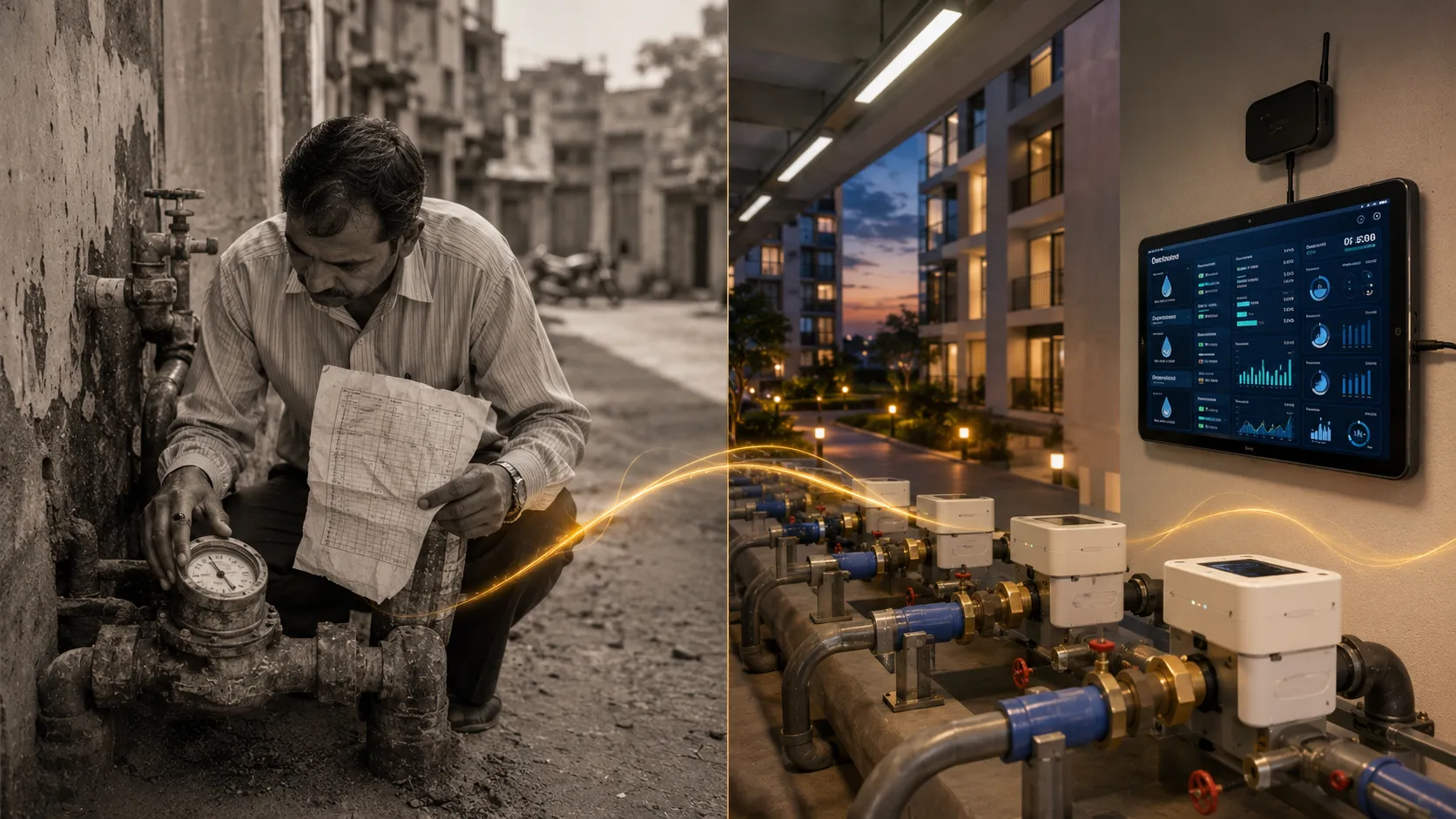
PUNE — May 24, 2026 — Sometime in 2014, Vivek Shukla was sitting in a government office in Maharashtra, watching a junior engineer manually transcribe water meter readings from a crumpled paper ledger into a desktop computer. The meter reader had visited roughly 40 households that morning, squinting at analogue dials, scribbling numbers on a clipboard, and moving on. By the time the data reached the central database — assuming it ever did — it would be weeks out of date, riddled with errors, and functionally useless for the one thing it was supposed to enable: billing people for the water they actually used. Shukla, an instrumentation engineer who had spent years building industrial sensors for factories, looked at the ledger and saw something different. He saw a market failure.
Today, Shukla's company, SmarterHomes Technologies, is the world's largest provider of smart water meters by installed base. Its flagship product, WaterOn, has been deployed in more than 800,000 apartments across 40 countries, from India to the Middle East to Australia. The meters use ultrasonic technology — no moving parts, nothing to wear out — and a proprietary IoT protocol that transmits consumption data to a central platform without requiring WiFi or cellular connectivity in every apartment. The platform generates accurate bills, detects leaks in real time, and has saved an estimated 7 billion litres of water that would otherwise have been wasted. The company has raised approximately $7.2 million (₹60 crore) in total funding, is profitable, and is now scaling its technology from apartment complexes to entire cities — a market that India's water infrastructure has been waiting for someone to address for decades.
The Ultrasonic Advantage
The core technological insight behind WaterOn is that measuring water flow accurately is harder than it looks — and that the mechanical meters used in most of the world's buildings are fundamentally unsuited to the task.
A conventional mechanical water meter works by spinning a small turbine or rotating a piston as water flows through it. Over time, the moving parts wear out. Mineral deposits from hard water clog the mechanism. Small leaks — the kind that drip steadily for weeks before anyone notices — do not generate enough flow to turn the turbine at all, so they go unmeasured and undetected. The meter's accuracy degrades with age, and by the time it is replaced — typically after five to seven years — it may be under-reporting consumption by 10 to 20 percent. The apartment resident pays less than they should; the building owner absorbs the loss; the water utility records consumption data that bears no relationship to reality.
Ultrasonic metering solves these problems by eliminating moving parts entirely. Two ultrasonic transducers are placed at opposite ends of a precisely engineered flow tube. One sends a sound pulse downstream; the other sends a pulse upstream. The difference in transit time — the downstream pulse travels slightly faster than the upstream one — is proportional to the flow rate. The measurement is accurate to within 1 to 2 percent, even at very low flows. There is nothing to wear out. There is nothing to clog. The meter can detect a leak as small as a few litres per hour — the equivalent of a dripping tap — and flag it long before it becomes a burst pipe.
The challenge that had defeated previous attempts at ultrasonic water metering for residential use was cost. Industrial ultrasonic flow meters have existed for decades, but they are expensive — typically $500 to $1,500 per unit — and require skilled installation. Bringing the technology down to a price point that made sense for apartment buildings — where a single complex might need hundreds of meters, each one serving a single flat — required redesigning the sensor architecture from scratch. Shukla's team spent two years on that redesign, eventually developing a proprietary ultrasonic transducer that could be manufactured at a fraction of the cost of industrial equivalents, using materials and processes adapted from the automotive sensor industry. The result was a meter that could be sold for roughly $50 to $80 per unit — a price that made the business case for retrofitting existing buildings viable.
The IoT protocol was the second piece of the puzzle. Individual apartment meters are often installed in basement utility rooms, underground parking garages, or other locations where WiFi and cellular connectivity are unreliable. SmarterHomes developed a proprietary mesh networking protocol — called SmarterHomes IoT — that allows meters to communicate with each other over distances of up to 500 metres, relaying data from meter to meter until it reaches a central gateway connected to the internet. The protocol uses very little power — the meters run on batteries that last up to ten years — and is designed to be resilient to the interference and physical obstructions that plague conventional wireless networks in dense urban environments. Each meter functions as a node in a self-healing mesh: if one meter loses connectivity, the data routes through a different path. The system is designed to be installed by plumbers, not network engineers.
The 40-Country Footprint
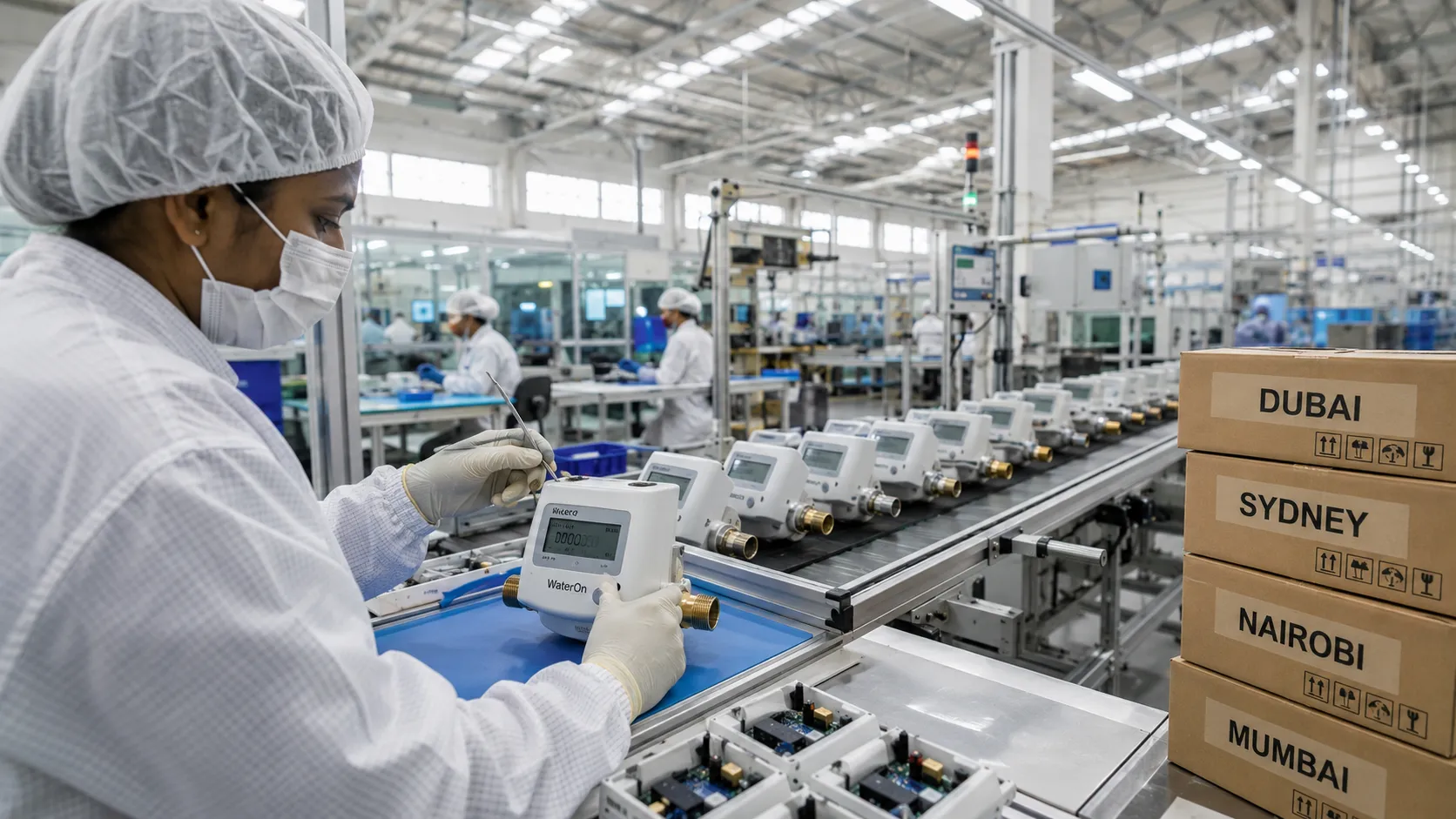
The most remarkable thing about SmarterHomes is not the technology. It is the geography. The company has deployed its meters in more than 40 countries — a footprint that is almost unheard of for an Indian hardware startup. The list includes the UAE, Australia, Saudi Arabia, Kenya, South Africa, the United Kingdom, and a growing roster of markets in Southeast Asia and Africa. The company's largest single deployment is in Dubai, where more than 200,000 apartments are equipped with WaterOn meters as part of the emirate's push to reduce water consumption and improve billing accuracy.
The international expansion was not the result of a deliberate go-to-market strategy. It was the result of a single installation — a 500-apartment complex in Dubai that needed a water metering solution and found SmarterHomes through an online search. The installation worked. The building owner told other building owners. Within three years, the company had more meters in the Middle East than in India, and the pattern repeated in Australia, East Africa, and Southeast Asia. The company did not build a global sales force. It built a product that solved a universal problem — inaccurate water billing in multi-tenant buildings — and let word of mouth do the distribution.
The water scarcity crisis is global. The United Nations estimates that 2.3 billion people live in water-stressed countries, and that number is expected to rise sharply as climate change alters precipitation patterns and population growth concentrates demand in already-arid regions. The first and cheapest solution to water scarcity is not desalination, not rainwater harvesting, not massive infrastructure projects. It is reducing waste — and the first step to reducing waste is measuring it. A building that installs ultrasonic water meters typically sees consumption drop by 15 to 25 percent within the first year, driven almost entirely by leak detection, behavioural change, and the simple fact that people use less of anything when they are billed for it accurately.
The company has raised approximately $7.2 million (₹60 crore) in total funding, from investors including RB Investments, the Singapore-based venture firm, and a syndicate of angel investors. It is profitable, with revenue that has grown at a compound annual rate of more than 40 percent over the past five years. It has not disclosed its most recent financials, but the economics of the business are attractive: hardware margins in the 35 to 45 percent range, recurring revenue from the software platform that manages billing and analytics, and a growing base of installed meters that will eventually generate replacement sales as the first-generation units reach the end of their ten-year battery life. The company's 800,000-meter installed base is the largest of its kind in the world — a fact that Shukla attributes to being in the right place at the right time with the right product, rather than to any strategic genius. "We didn't plan to be the world's largest," he said. "We planned to solve a problem. The rest followed."
The India Opportunity
The Indian market, paradoxically, has been the hardest for SmarterHomes to crack. The same apartment complex that would eagerly install ultrasonic water meters in Dubai or Sydney will resist them in Bengaluru or Mumbai — not because the technology is different, but because the regulatory and economic incentives are misaligned.
In most Indian cities, water is not billed by consumption. It is billed by a flat monthly fee, or by a formula based on the apartment's size or the building's total water connection diameter. The resident who takes a 45-minute shower pays the same as the resident who takes a five-minute shower. The building that leaks a thousand litres a day pays the same as the building that leaks nothing. There is no financial incentive to conserve, and no financial penalty for wasting. The water utility, which is typically a municipal body, has no incentive to install meters because the revenue it collects is not tied to consumption. The result is a system in which water is simultaneously scarce — many Indian cities face acute shortages every summer — and treated as if it were abundant.
That system is beginning to change, slowly and unevenly. Bengaluru, which faced one of its worst water crises in decades in 2024, has begun mandating water metering in new apartment buildings and incentivising retrofits in existing ones. The Bangalore Water Supply and Sewerage Board has estimated that universal metering could reduce the city's water consumption by 20 to 30 percent — the equivalent of a new reservoir without building one. Other cities, including Pune, Hyderabad, and Chennai, are exploring similar mandates. The regulatory momentum is building, driven by the simple, brutal arithmetic of urban water supply: demand is growing faster than supply, and the cheapest way to close the gap is not to produce more water, but to waste less of what already exists.
SmarterHomes is positioning itself for the moment when the regulatory environment catches up to the technology. The company's meters are already compliant with Indian standards. Its manufacturing facility in Pune is capable of producing more than 100,000 meters per month. Its software platform integrates with municipal billing systems. The company has done pilot deployments with several Indian municipal corporations, and it has built relationships with the property developers who will be the first customers when metering mandates take effect. "The Indian market is sleeping," Shukla told a business magazine. "But it won't sleep forever. Water crises have a way of waking people up."
The Indian opportunity is enormous. The country has an estimated 40 million urban households, of which fewer than 5 percent are equipped with functional water meters. The government's Jal Jeevan Mission has poured billions of dollars into rural water infrastructure, but urban water infrastructure — the pipes, pumps, and meters that serve the cities where most Indians will live by 2050 — remains underfunded, undermaintained, and undermeasured. A company that can solve the measurement problem, at a price point that makes sense for Indian buildings, will have a market that is measured in the tens of millions of units.
The Engineer's Path
Vivek Shukla was not a natural entrepreneur. He was a natural engineer — an instrumentation specialist who had spent years at Siemens and other industrial companies, designing sensors for factory automation. The transition from employee to founder was not a dramatic leap. It was a gradual realisation that the technology he was building for factories — precision measurement, automated data collection, remote monitoring — was exactly what the water industry needed, and that the water industry was large enough and inefficient enough to support a substantial business.
He founded SmarterHomes in 2014 in Pune, a city with a deep pool of engineering talent and a thriving manufacturing ecosystem. The early years were spent on product development — the ultrasonic sensor, the mesh networking protocol, the cloud platform — funded by the founders' savings and a small grant from the government's Department of Science and Technology. The first commercial installation was a 200-apartment complex in Pune. The building owner, who had been losing money on water for years, saw his bills drop by 22 percent within three months of installing the meters. The case study became the company's marketing. More buildings signed up. More countries found them online. The flywheel began to turn.
The company now employs more than 200 people, most of them in Pune, and operates a vertically integrated manufacturing facility that produces the ultrasonic transducers, the circuit boards, and the final assembly of the meters. The vertical integration is deliberate. It gives the company control over quality, cost, and production volume — the three variables that matter most in a hardware business. It also creates a manufacturing moat that software-only competitors cannot replicate. A startup that wants to compete with SmarterHomes must not only build better software. It must build a factory.
The long-term ambition is to become the default water metering platform for the world's apartment buildings — the company that a property developer in Nairobi or a municipal corporation in Manila calls when it needs to measure water. The 800,000-meter installed base is the foundation. The 40-country footprint is the proof that the technology works across different regulatory environments, different water chemistries, and different installation conditions. The profitability is the evidence that the business is sustainable. The sleeping Indian market is the opportunity that could make the company ten times its current size.
The man with the clipboard and the pencil is not going to disappear overnight. The ledgers in the government offices are not going to be digitised by fiat. The water utilities that have been billing flat fees for decades are not going to embrace consumption-based pricing without a fight. But the arithmetic is on Shukla's side. Water is becoming scarcer. The cost of not measuring it is becoming higher. The meters work. The savings are real. The 800,000 apartments that already have WaterOn meters are the early adopters. The 40 million Indian urban households that do not are the market. The engineer who saw a man with a clipboard and imagined something better has built the world's largest smart water meter network. The world is slowly catching up.


