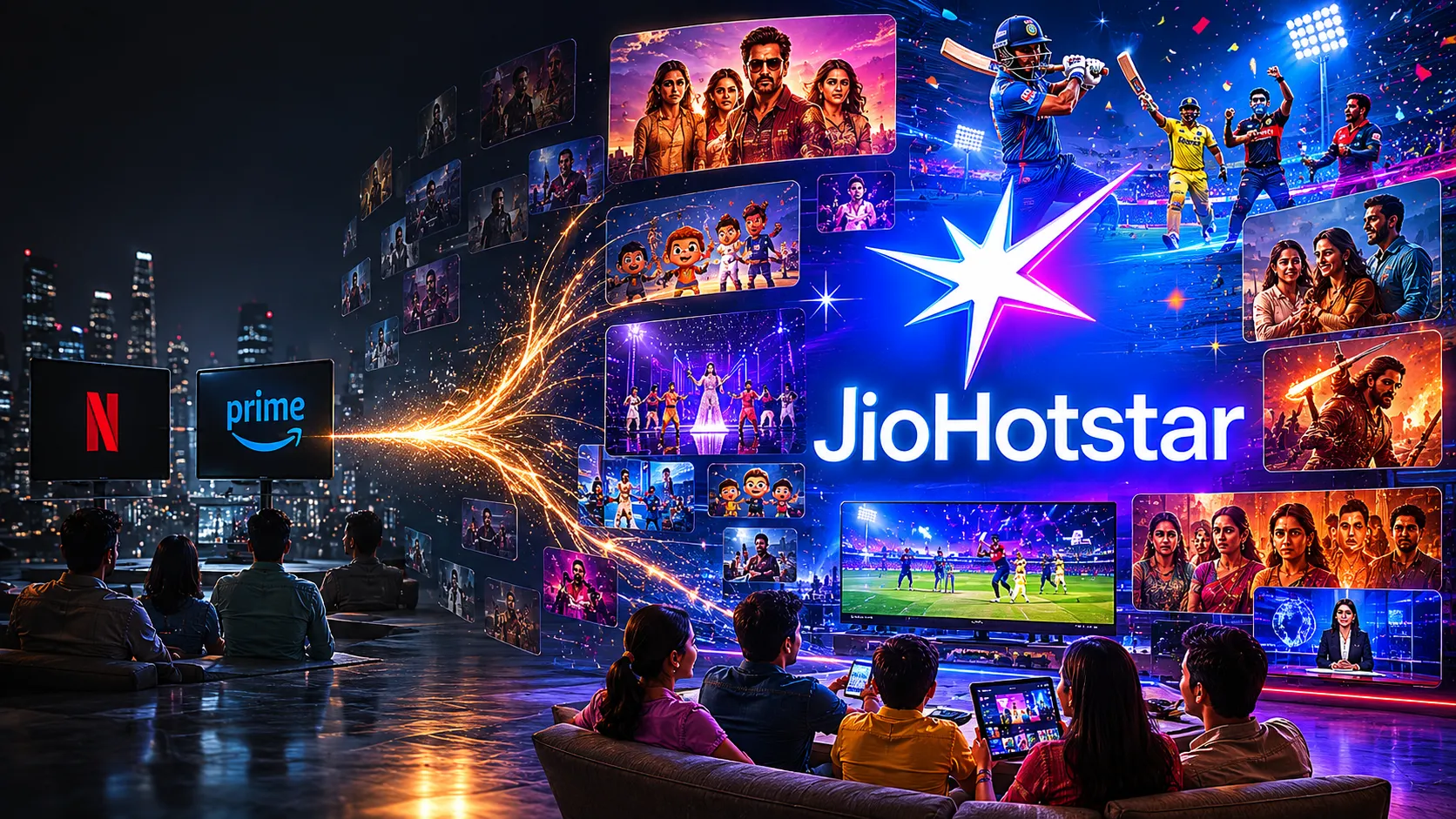
The 547‑Million‑Subscriber Monopoly: One Year After the JioHotstar Merger, the Numbers Are In—and Netflix and Amazon Should Be Terrified
MUMBAI — May 30, 2026 — On May 29, 2025, the merger of Jio Cinema and Disney+ Hotstar created the largest streaming platform in the history of Indian media. A year later, the numbers are in, and they are staggering: 547 million monthly active users—more than Netflix and Amazon Prime Video combined, globally. A content budget of ₹38,000 crore, larger than the entire production spend of the Indian film industry. An IPL digital‑rights deal worth ₹23,758 crore that was once ridiculed as economically irrational and is now being studied as a masterstroke of ecosystem strategy. And a market share that has left Netflix—which has struggled to cross 10 million subscribers in India—and Amazon—which has stopped reporting its India numbers entirely—scrambling to find a response.
The Arithmetic of Domination
The 547 million monthly active users that JioHotstar reported for Q1 2026 are not all paying subscribers—the platform's freemium model, which offers a substantial portion of its content library for free with ads, inflates the user base relative to Netflix's purely subscription‑based model. But the metric that matters is not the user count. It is the engagement. JioHotstar users spend an average of 72 minutes per day on the platform—more than any other streaming service in India, and more than the average Indian spends on social media. The platform has become the default entertainment destination for a generation of Indian consumers, and the network effects that sustain that dominance are self‑reinforcing: the more users spend time on the platform, the more data the platform collects; the more data it collects, the better its recommendation algorithms become; the better its recommendations, the more time users spend. The flywheel is not theoretical. It is measurable, and it is spinning faster than any competitor can match. The content budget of ₹38,000 crore—roughly $4.5 billion—is larger than the entire production spend of the Indian film industry, larger than Netflix's global content budget for India by a factor of approximately 15, and larger than Amazon's by a factor of approximately 10. The budget is being deployed across a strategy that is deliberately, aggressively diversified: live sports (cricket, football, kabaddi), original series (in Hindi, Tamil, Telugu, Malayalam, Kannada, Bengali, Marathi, and Gujarati), licensed films from every major Indian studio, news, kids' content, and an expanding slate of international acquisitions. The platform is not competing with Netflix and Amazon on their terms—premium, English‑language, globally oriented content. It is competing on India's terms: mass, multi‑lingual, sports‑driven, and free at the point of consumption for the majority of its users. The global platforms cannot match that strategy without destroying their own business models. JioHotstar can, because its business model is not streaming. It is the Reliance ecosystem, and the streaming platform is a customer‑acquisition engine for the telecom, retail, and digital‑payments businesses that generate the conglomerate's real returns.