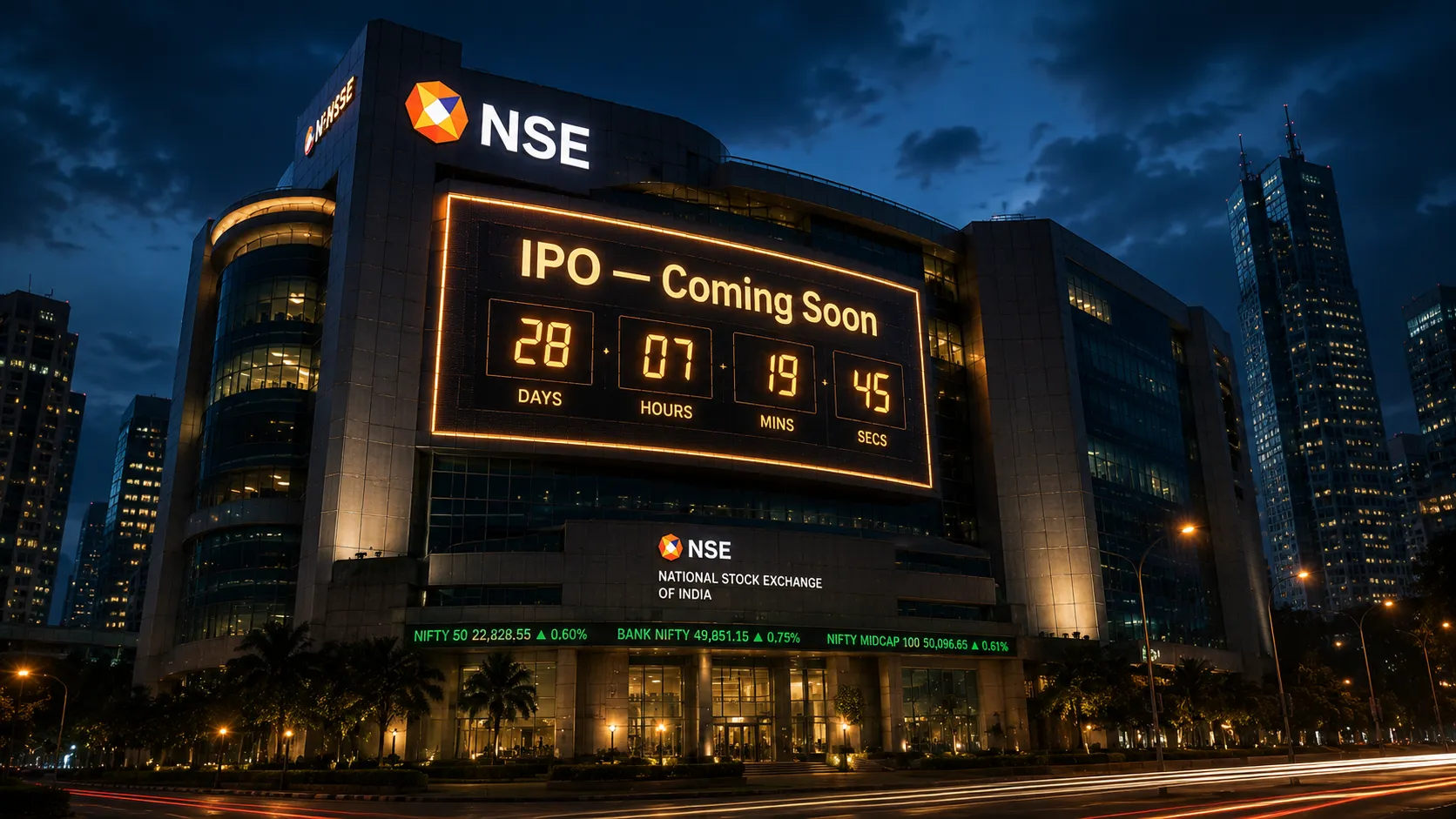
After a decade of delays, regulatory battles, and boardroom drama, the National Stock Exchange is finally ready to file its IPO papers. The valuation? A staggering ₹5 lakh crore. The message to every investor in India? The house is finally open for business.
The file had been sitting in draft for nearly a decade. Ten years of regulatory hurdles, legal battles, boardroom reshuffles, and enough drama to fill a Netflix series. On June 16, 2026, it finally moved.
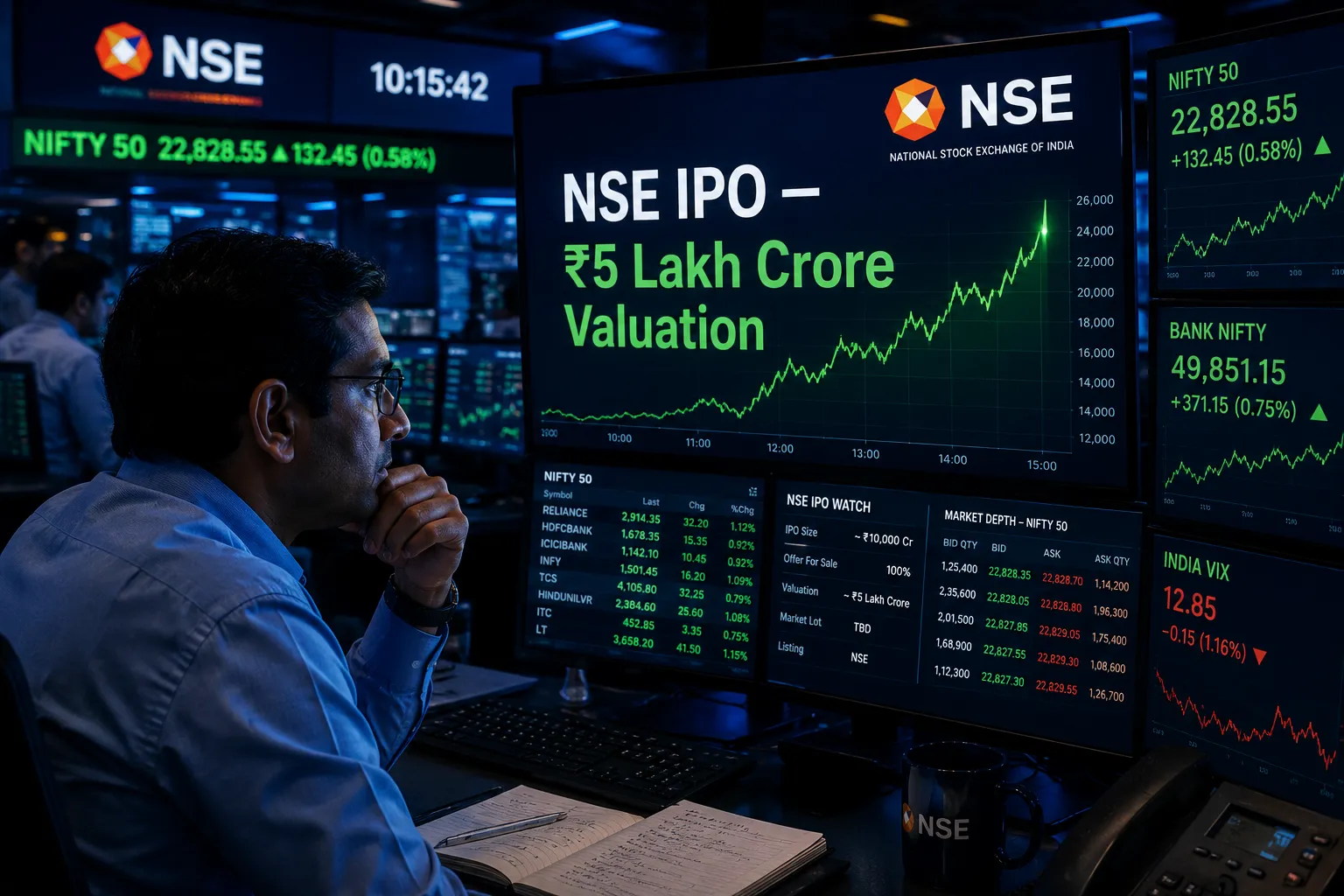
India's largest stock exchange — the National Stock Exchange, the engine that powers the country's $4 trillion economy, the platform where billions of shares change hands every single day — is set to file its Draft Red Herring Prospectus (DRHP) with the Securities and Exchange Board of India (SEBI) by Thursday. The IPO, long-awaited and endlessly speculated about, is expected to value the exchange at over ₹5 lakh crore, with a 4–5% stake likely to be sold via an offer for sale. The issue could exceed ₹20,000 crore, making it one of India's largest public offerings. Targeting a listing window between Navratri and Diwali, the NSE is finally — finally — coming to the public markets.
For the 1.8 lakh shareholders of the exchange, the moment is vindication. For the millions of retail investors who have traded on NSE's platforms for decades without ever owning a piece of it, the moment is opportunity. And for the Indian capital markets, the moment is historic.
The Longest Waiting Room in Indian Finance
To understand why the NSE IPO matters, you have to understand the waiting.
The exchange was founded in 1992, a response to the inefficiencies and scandals of the Bombay Stock Exchange. It introduced electronic trading, dematerialisation, and a national footprint. It grew to become India's largest exchange by volume, overtaking BSE within a decade. But it never listed. The reasons were varied: regulatory complications, promoter disputes, a legal battle with the Securities and Exchange Board of India over governance norms, and the sheer complexity of valuing an exchange that also regulates its own members.
For years, the IPO was "just around the corner." Then it was "delayed indefinitely." Then it was "back on track." Then it was "stalled again." Investors who had bought unlisted shares of NSE at various prices over the years watched their holdings appreciate — and depreciate — as the listing date shifted like a mirage.
Now, finally, the mirage is solidifying.
According to people familiar with the development, the draft red herring prospectus is likely to be filed on June 15 or June 16. The exchange received board approval for the proposed listing plan on February 6, 2026. SEBI has issued a No Objection Certificate. The regulatory hurdles, if not cleared, are at least navigable. The IPO is moving forward.

What the NSE IPO Means for Investors
The NSE IPO is structured entirely as an Offer for Sale (OFS). Existing shareholders — a mix of domestic and foreign financial institutions, including some of India's largest banks and insurance companies — will sell a portion of their holdings. The exchange itself will not receive any fresh capital.
This structure matters. An OFS means the money goes to the selling shareholders, not to the company. For NSE, the listing is about liquidity and price discovery, not about raising funds. For investors, it means they are buying into a well-capitalised, mature business with predictable revenues and a dominant market position.
What does NSE look like as a business? It is, quite simply, India's most important financial institution. Every day, millions of trades are executed on its platforms. Every day, its indices — the Nifty 50, the Nifty Bank, the Nifty IT — move billions of dollars of capital. Every day, its clearing corporation guarantees settlement. It is the backbone of Indian capitalism.
Financially, the exchange is a cash machine. It earns revenue from transaction fees, listing fees, data sales, and technology services. Its margins are among the highest in the financial sector. Its growth tracks the growth of the Indian economy — when India grows, NSE grows.
The valuation of ₹5-5.25 lakh crore reflects that reality. At that level, NSE would be one of the most valuable exchanges in the world, rivaling the Hong Kong Exchange and approaching the valuation of the Intercontinental Exchange. It is a bet on India's future — and a bet that the exchange will continue to be the primary beneficiary of that future.
The Unlisted Market Already Knows
The unlisted market has already priced in the NSE IPO hype. Shares of IFCI, which holds a stake in NSE, have surged 69% so far in 2026 in anticipation of the public offer. IFCI shares jumped 7.95% to ₹91.36 per share on June 15, hitting a fresh 52-week high.
The rally in IFCI is a proxy trade for the NSE IPO. Investors who cannot directly buy unlisted NSE shares have been buying IFCI as a way to gain exposure. The surge is a reminder that the IPO is not just a corporate event — it is a market-moving event with ripple effects across the financial ecosystem.
Other NSE shareholders are also watching closely. The exchange has around 1.8 lakh shareholders, a mix of domestic and foreign financial institutions. For many of them, the IPO represents a long-awaited liquidity event. Some have been holding their shares for decades. The listing will finally give them an exit — or at least a market price.
The Regulatory Background
The NSE IPO has been delayed by a complex web of regulatory issues. The most significant was the exchange's status as a "market infrastructure institution" — a designation that imposes strict governance norms. SEBI had raised concerns about conflicts of interest, particularly the exchange's ownership of its own clearing corporation and its role as a regulator of its own members.
These concerns have been addressed over the years. NSE has restructured its governance, separated its clearing operations, and implemented a series of compliance measures. SEBI has acknowledged the progress. The No Objection Certificate is evidence that the regulator is satisfied, or at least satisfied enough to allow the IPO to proceed.
But regulatory scrutiny will not end with the listing. NSE will continue to be one of the most regulated entities in India. Its actions will be watched by SEBI, the RBI, and the government. The IPO does not reduce its regulatory burden — it increases it.
The Competition: BSE and Beyond
NSE dominates Indian equity trading, but it is not without competition. The Bombay Stock Exchange, its older rival, has been gaining ground in derivatives and has a strong presence in SME listings. The two exchanges compete fiercely for market share, new listings, and technology talent.
The NSE IPO could change the competitive dynamic. A publicly listed NSE will have a market price, quarterly earnings pressure, and the scrutiny of analysts. BSE, which listed in 2017, has already experienced this transition. It has learned to balance short-term performance with long-term strategy. NSE will have to learn the same lesson.
Globally, exchanges are consolidating. The London Stock Exchange, the Hong Kong Exchange, and the Intercontinental Exchange have all grown through acquisitions. NSE, with its dominant position in the world's fastest-growing major economy, is an attractive partner or target. A public listing could make it more accessible to foreign partners — or more vulnerable to hostile approaches.
What It Means for Retail Investors
For the millions of retail investors who trade on NSE every day, the IPO is a chance to own the platform they use. The exchange's brand is ubiquitous — every trading terminal, every broker app, every market update carries the NSE name. Investing in NSE is investing in the infrastructure of Indian capitalism.
But retail investors should be cautious. The valuation of ₹5 lakh crore is based on optimistic projections of India's growth. If the economy slows, if competition intensifies, if regulatory pressures increase, NSE's earnings could be affected. The IPO is not a guaranteed winner — it is a bet on India's future.
The listing window between Navratri and Diwali is symbolic. It is a period of prosperity and new beginnings. For NSE, it is both. A decade of waiting is about to end. And one of India's most important institutions is about to become one of its most important stocks.


