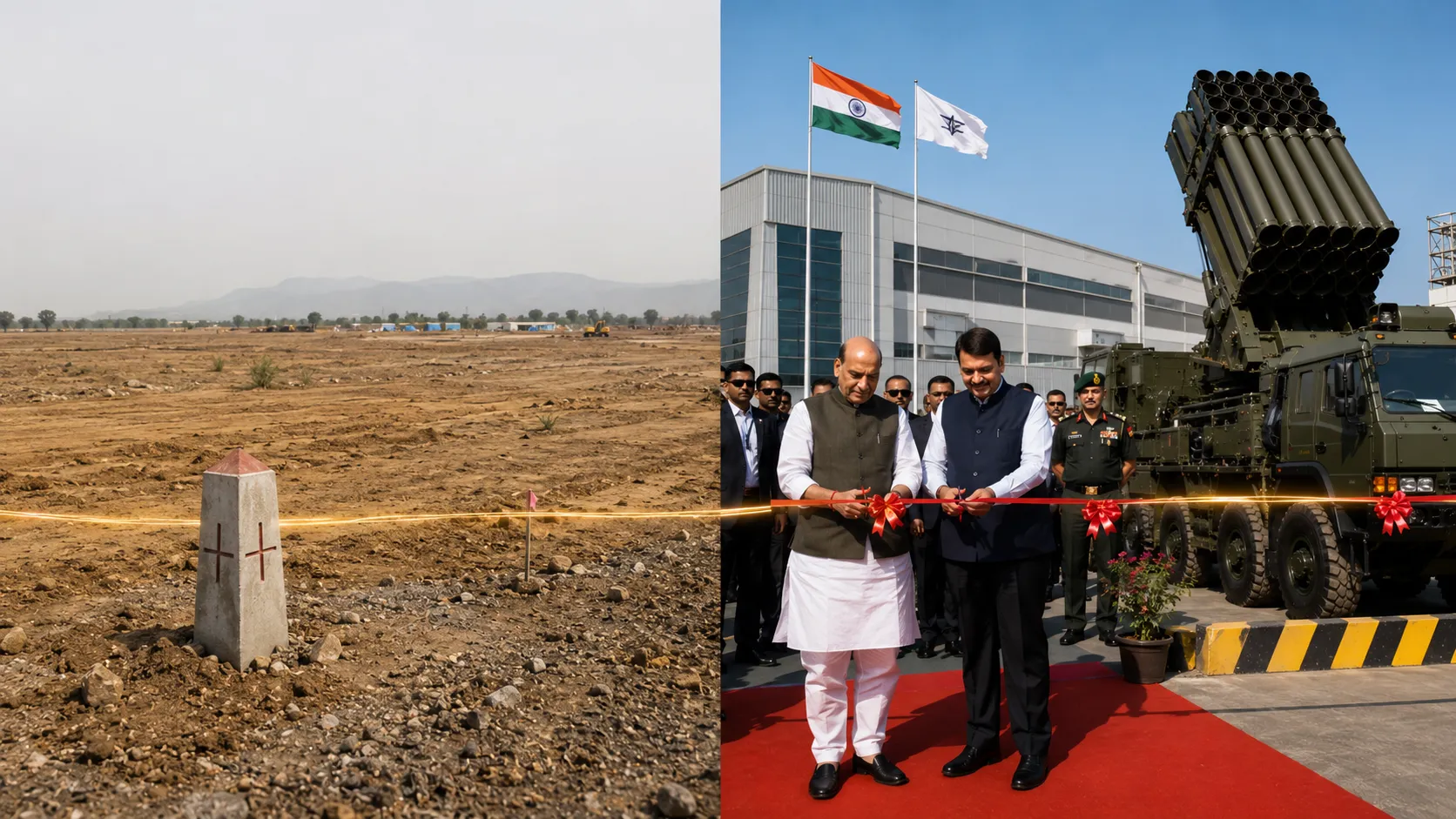
The ₹5,000 Crore Fortress in Shirdi: How a Pune Engineer Built India's Largest Private Weapons Factory on 200 Acres—And Just Flagged Off Its First 300-Kilometre Rocket
SHIRDI, MAHARASHTRA — May 26, 2026 — On a Saturday morning three days ago, Defence Minister Rajnath Singh stood on a dusty construction site in the shadow of the world's most famous pilgrimage town and declared that India was building a "fortress of self-reliance" in the land of Chhatrapati Shivaji. The fortress in question was not a medieval stone structure. It was a 200-acre defence manufacturing complex—the largest private weapons factory ever built in India—that will produce half a million artillery shells a year, manufacture advanced missile and space technologies, build autonomous defence platforms, and house the country's first indigenous 300-kilometre Universal Rocket Launching System. Its name is Suryastra. Its range is the distance from Delhi to Jaipur. And its first units were flagged off to the Indian Army at the inauguration ceremony itself.
The facility belongs to NIBE Group, a Pune-based private sector defence manufacturer run by Ganesh Nibe, an engineer who has spent years building the capabilities that the Indian defence establishment once reserved for state-owned ordnance factories. In the space of a single morning on May 23, the company inaugurated an artillery shell plant with a capacity of 500,000 shells per year, laid the foundation stone for a dedicated missile complex, unveiled indigenous TNT and RDX plant technologies, commissioned a bio-CNG and hydrogen fuel plant, exchanged a memorandum of understanding with U.S.-based Black Sky for satellite assembly, and flagged off the first Suryastra rocket launcher systems to the Indian Army—systems that were ordered under emergency procurement powers invoked after Operation Sindoor.
Maharashtra Chief Minister Devendra Fadnavis announced that the Defence Minister had approved four defence corridors in Pune, Nashik, Ahmednagar, and Nagpur. "This plant bags over ₹5,000 crore rupees investment, and it will have employment generation capacity for 4,000 people," he said. The Defence Minister, standing before the assembled soldiers, officials, and industrialists, delivered a verdict that was as much a declaration of intent as an observation of fact. "After seeing this facility, I can say with certainty that no power in the world can stop India from becoming the world's largest exporter in the defence sector in the next 25–30 years."
The Engineer Who Built a Fortress
Ganesh Nibe is not a household name. He does not give provocative interviews or post viral LinkedIn threads. He runs a privately held engineering and manufacturing company based in Pune, and for most of its history, the NIBE Group was known primarily as a supplier of industrial components and sub-systems—the kind of company that builds the things that other companies use to build their things, invisible to the end consumer, essential to the supply chain.
That changed when the Indian government began opening defence manufacturing to the private sector—a structural shift that has transformed the country's arms industry over the past decade and that has accelerated sharply since Operation Sindoor demonstrated the strategic vulnerability of depending on foreign suppliers for critical munitions. Ganesh Nibe was among the first private-sector entrepreneurs to recognise the scale of the opportunity. Defence production, which was once the exclusive domain of public-sector undertakings and ordnance factories, had been liberalised through a series of reforms: relaxed FDI norms, the Strategic Partnership Model, Positive Indigenisation Lists that reserve more than 5,000 items for domestic production, and innovation schemes like iDEX, ADITI, and the Technology Development Fund. The policy framework was designed to do exactly what it has done: attract private capital, private expertise, and private risk-taking into a sector that the state had monopolised for generations.
The Shirdi complex is the culmination of years of investment, relationship-building, and technology development. Spread across approximately 200 acres in the Savli Vihir Industrial Estate, the facility integrates multiple production lines into a single campus: a 155 mm artillery shell manufacturing plant, an explosives and energetic materials unit, a rocket systems assembly line, a missile complex, a loitering munitions production facility, a space and satellite technology division, and a bio-CNG and hydrogen fuel plant. The scale of the investment—over ₹5,000 crore—is among the largest ever made by a private Indian defence manufacturer. The employment it will generate—3,000 to 4,000 direct jobs, plus thousands more in the MSMEs and ancillary industries that will cluster around it—will transform the economy of the Ahmednagar district.
The artillery shell plant alone is a statement of intent. With an annual capacity of 500,000 155-millimetre shells, it is designed to meet not just the Indian Army's requirements, but the demand of export markets in the Middle East, Southeast Asia, Africa, and beyond. 155 mm is the NATO-standard calibre for artillery ammunition, and the global market for these shells has been stretched to its limits by the Russia-Ukraine conflict, the West Asia situation, and the general rearmament that is reshaping defence budgets worldwide. A factory that can produce half a million shells a year—using indigenous TNT and RDX technologies that were unveiled at the inauguration—is not just a supplier. It is a strategic asset, and the nation that owns it has capabilities that extend well beyond its own borders.
The Suryastra System and the ₹293 Crore Army Contract
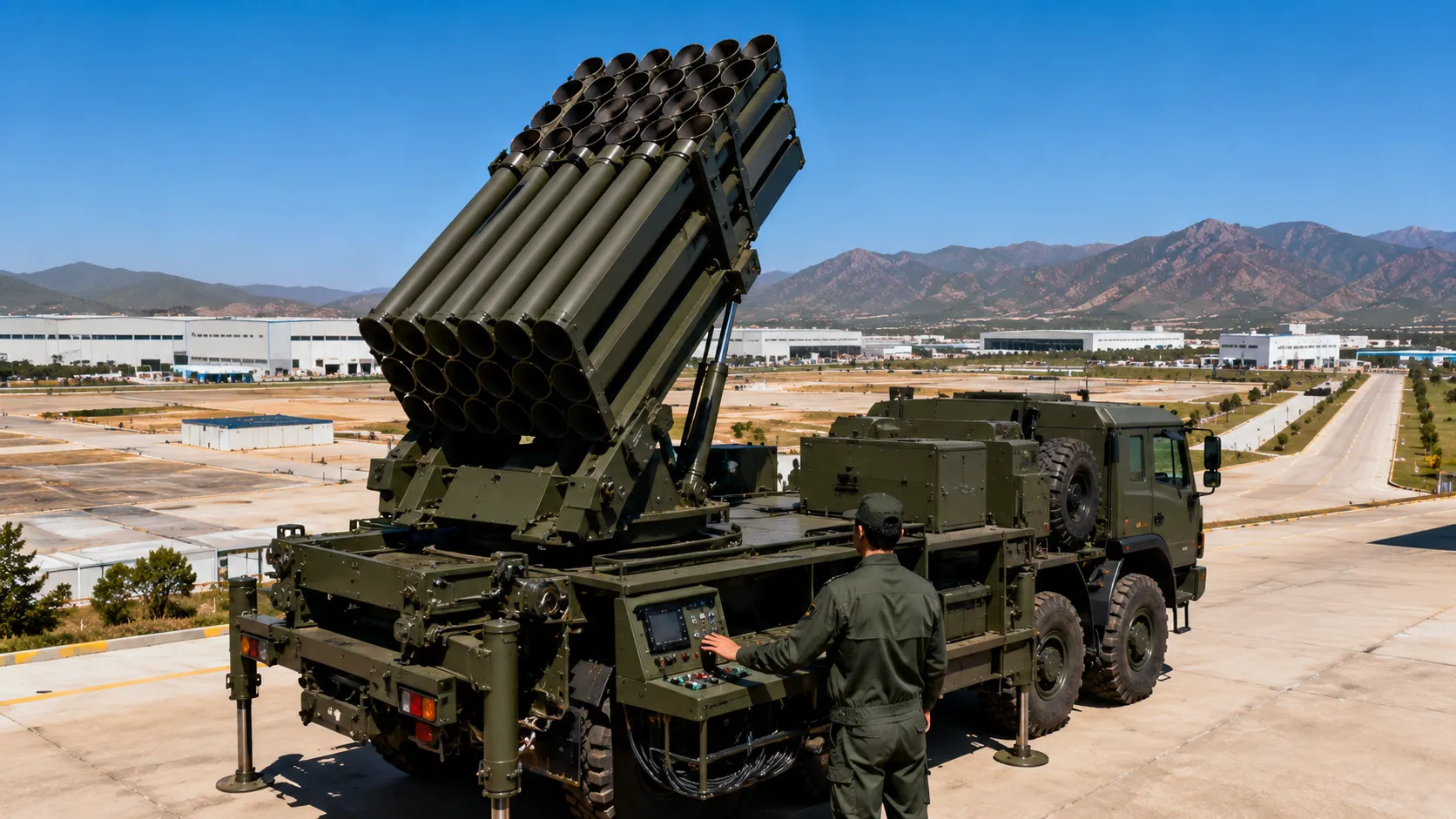
The most strategically significant dimension of the Shirdi complex is not the artillery shells. It is the Suryastra—India's first indigenous, universal, multi-calibre rocket launcher system capable of carrying out precision surface-to-surface strikes at ranges extending up to 300 kilometres.
The system was successfully tested at the Integrated Test Range in Chandipur, Odisha, on May 18 and 19—just days before the inauguration. The 150-kilometre and 300-kilometre range rockets reportedly achieved a Circular Error Probable (CEP) of 1.5 metres and 2 metres respectively, demonstrating a level of precision strike capability that is comparable to the best systems in the world. "The trials were conducted against a procurement order placed by the Indian Army under emergency procurement powers," The Hindu reported. "In January this year, the Army signed a contract worth ₹293 crore with Nibe Limited for the supply of the long-range rocket launcher system aimed at significantly enhancing deep-strike artillery firepower."
The Suryastra is not a single-purpose weapon. It is a universal launcher—capable of firing both guided and unguided rockets of different calibres, mounted on a 6×6 or 8×8 vehicle chassis, designed for "shoot-and-scoot" operations that allow it to fire, relocate, and fire again before an enemy can target its position. In July 2025, Nibe signed a Technology Collaboration Agreement with Israeli defence major Elbit Systems for the manufacturing of the advanced Universal Rocket Launcher system in India. The collaboration marked the first domestic production of a high-precision rocket launcher system with strike capability up to 300 kilometres, further advancing the government's Atmanirbhar Bharat initiative in the defence sector.
The Army's order for Suryastra, placed under emergency procurement powers invoked after Operation Sindoor, is valued at under ₹300 crore. But that initial order is only the beginning. "We are looking for a larger order of 7–9 regiments of the Suryastra that is likely to be valued at more than ₹6,000 crore," Balakrishnan Swamy, Chief Technology Officer at Nibe Defence, told the Economic Times. The math is stark: the first contract was a test. The follow-on contract, if it materialises, would be twenty times as large—and it would make Suryastra one of the most valuable defence programmes ever undertaken by a private Indian company.
The Suryastra was flagged off at the inauguration itself—the first units being delivered to the Indian Army on the same day the complex opened. The Defence Minister, in his remarks, described the system in terms that captured both its technological significance and its strategic symbolism. The Suryastra, he said, would be enough to bring about the "sunset of the enemy's intentions." The name is deliberate. Surya—the sun. Astra—a weapon. The weapon of the sun, built by a private Indian company, on Indian soil, using Indian and Israeli technology, delivered to the Indian Army.
The Elbit Joint Venture and the Propellant Gap
Two days after the inauguration, on May 25, NIBE Group announced a joint venture with Elbit Systems of Israel for the establishment of advanced energetic materials and propellant manufacturing facilities in India. The announcement was made from the same Shirdi complex that had been inaugurated 48 hours earlier, and it addressed a strategic vulnerability that has bedevilled the Indian defence industry for decades: the dependence on imported propellants.
The proposed joint venture will establish a new company to manufacture and supply critical propellant materials—nitro cellulose, nitro glycerine, and single, double, and triple-base propellants—that are essential components of every artillery shell, rocket motor, and missile system in the Indian arsenal. Under the framework, Elbit will provide technical know-how and related support, while NIBE will undertake establishment, investment, and operational responsibilities for the proposed facilities. The venture is expected to contribute towards strengthening indigenous defence manufacturing capabilities and reducing import dependency in critical energetic materials and propellant systems.
The propellant gap is not widely understood outside the defence industry, but it is one of the most significant bottlenecks in India's push for self-reliance in munitions. A country that can manufacture artillery shells but must import the propellant that sends them downrange is not truly self-reliant. It is dependent—on foreign suppliers who may have their own strategic priorities, their own export controls, and their own willingness to withhold critical materials when geopolitical circumstances demand it. The Elbit joint venture is designed to close that gap, and the fact that it was announced at the Shirdi complex—which already houses indigenous TNT and RDX plant technologies—signals that NIBE intends to build a fully integrated energetic materials ecosystem on the same site.
The partnership with Elbit extends beyond propellants. The Suryastra system itself is based on the Israeli PULS (Precise and Universal Launching System) technology, manufactured in India under a Technology Collaboration Agreement signed in July 2025. The system is designed for "shoot-and-scoot" operations—firing its rockets, relocating rapidly, and firing again—and can be mounted on either a 6×6 or 8×8 vehicle chassis, firing both guided and unguided rockets of different calibres. The technology transfer arrangement with Elbit is one of the most significant examples of the emerging defence-industrial partnership between India and Israel, two nations that have found common cause in the development of advanced military technologies.
The Skystriker loitering munition programme, which was also showcased at the inauguration, extends NIBE's capabilities into a new category of weaponry. Loitering munitions—sometimes called "kamikaze drones"—are essentially flying bombs that can circle over a battlefield, identify a target, and dive into it. The company plans to produce a range of loitering munitions, from a smaller variant that will hit targets at 100 kilometres to a larger weapon capable of reaching 1,000 kilometres—roughly the distance from Delhi to Dhaka. The programme represents a significant expansion of India's indigenous strike capabilities, and it places NIBE at the centre of one of the most rapidly evolving segments of modern warfare.
The Private Sector Revolution
The most important dimension of the Shirdi inauguration was not the facility itself. It was what the facility represents: the structural transformation of India's defence-industrial base from a state monopoly to a public-private partnership.
"There was a time when private sector contribution in defence production was negligible," Rajnath Singh said at the inauguration. "It has now reached 25–30 percent. Our objective is to take this figure to 50 percent in the coming years. This is the new India where the private industry is not merely a supplier of nuts and bolts, but is emerging as the innovator and manufacturer of state-of-the-art weapon systems." The numbers tell the story. India's defence exports, which were negligible a decade ago, have surged past ₹38,000 crore and are on track to cross ₹50,000 crore. Private companies, once excluded from the most sensitive segments of the defence market, are now building rocket launchers, artillery shells, loitering munitions, and satellite systems. The Positive Indigenisation Lists, which now cover more than 5,000 items reserved for domestic production, have created a protected market for Indian manufacturers. The Strategic Partnership Model has enabled technology transfers from global defence majors to Indian companies. And the iDEX and ADITI programmes have funded innovation at the earliest stages of technology development.
The Defence Minister emphasised that the outcome of future wars will be determined not by the size of a nation's armed forces, but by its advancements in munitions and automation. "Glimpses of this reality can be witnessed in the ongoing Russia-Ukraine conflict and the West Asia situation," he said. "India demonstrated this capability during Operation Sindoor." The reference to Operation Sindoor—the Indian military action whose details remain classified but whose strategic significance was underscored by the emergency procurement powers it triggered—was a reminder that the capabilities being built at Shirdi are not theoretical. They are operational, and they are being deployed.
The complex is also designed to function as an ecosystem hub. The Defence Minister noted that the facility would create a vast network not just for high-technology industries, but for MSMEs, small-scale industries, and the local economy. The 200-acre site is large enough to accommodate suppliers, testing facilities, and the ancillary industries that cluster around any major defence manufacturing centre. The four defence corridors approved for Pune, Nashik, Ahmednagar, and Nagpur will extend that ecosystem across the state of Maharashtra, creating a defence-industrial belt that could, over time, become as significant to India's strategic capabilities as the aerospace clusters of Toulouse and Seattle are to Europe and the United States.
The Chief Minister of Maharashtra, who had requested the four defence corridors from the Centre, described the NIBE facility in terms that reflected both pride and ambition. "I am happy to say that my request was immediately approved by Raksha Mantri Rajnath ji," he said. "Soon all these defence corridors will be fully functional." He added that the Shirdi complex was equipped with "state-of-the-art" technologies whose details could not be disclosed, but whose capabilities were already demonstrated during Operation Sindoor. "We saw during Operation Sindoor how our indigenous technologies brought Pakistan to its knees," he said. "I am not taking names of the countries whose technology was being used by Pakistan, and we destroyed each of them without even landing on India's land. This is the level of perfection and precision of our technology in the defence sector."
The Black Sky MoU and the Space Dimension
The most forward-looking dimension of the Shirdi complex is not the artillery shells or the rocket launchers. It is the space division. During the inauguration, NIBE Group exchanged a memorandum of understanding with Black Sky, a U.S.-based space-based intelligence and geospatial data company, for cooperation in satellite assembly. The MoU signals that NIBE intends to compete not just in terrestrial defence manufacturing, but in the space sector as well—building the satellites that provide the reconnaissance, communications, and targeting data that modern militaries depend on.
The space dimension of the complex is consistent with the broader trend of convergence between the defence and space industries in India. The Indian government has opened the space sector to private participation, and companies that once built only ground-based systems are now moving into orbit. The NIBE-Black Sky partnership is one of the first examples of an Indian private defence manufacturer entering the satellite assembly business, and it positions the company to capture a share of the growing market for earth observation, signals intelligence, and space-based communications.
The complex also includes the NIBE-GDIL Space and Satellite Complex—a dedicated facility for space and satellite technologies that was part of the inauguration ceremony. The foundation stone for a missile complex linked to the Suryastra system was also laid, and the Defence Minister expressed hope that the missile complex would "provide a new direction to India's future warfare capabilities." The integration of artillery, rockets, missiles, loitering munitions, and space technologies under a single corporate umbrella is a deliberate strategy. NIBE is not building individual products. It is building a platform—a vertically integrated defence-industrial capability that spans the full spectrum of modern warfare, from the artillery shell that delivers the strike to the satellite that guides it.
The company's share price surged 12.41 percent to ₹1,450.50 on the day before the inauguration, reflecting market recognition of the strategic significance of the complex. The stock has been one of the best-performing defence equities in India over the past year, driven by the company's expanding order book, its deepening technology partnerships, and the broader structural tailwind of India's defence-industrial transformation. The ₹293 crore Suryastra contract is the first major order from the Indian Army. The ₹6,000 crore follow-on, if it materialises, would be transformative. The loitering munitions programme, the satellite assembly partnership, and the propellant joint venture with Elbit represent additional revenue streams that have not yet been fully priced into the company's valuation.
What This Signals
The Shirdi complex is not primarily a factory. It is a declaration. The state that once reserved defence manufacturing for itself has concluded that private enterprise can build the weapons of the future faster, more efficiently, and at a scale that the ordnance factories could never achieve. The policy reforms that made this possible—the FDI liberalisation, the Positive Indigenisation Lists, the iDEX and ADITI programmes—are not temporary measures. They are permanent architecture, and they have produced an industrial ecosystem that is now generating revenue, creating employment, and delivering weapons systems to the armed forces.
The broader context is a global defence industry that is being reshaped by the most intense period of rearmament since the Cold War. The Russia-Ukraine conflict has exposed the vulnerability of nations that depend on foreign suppliers for artillery ammunition. The West Asia situation has demonstrated the decisive role of precision-strike capabilities in modern conflict. The weaponisation of trade, supply chains, and rare earth minerals has made self-reliance in defence manufacturing a strategic imperative rather than a policy preference. India's defence exports, which have surged from negligible levels to nearly ₹38,000 crore, are on track to cross ₹50,000 crore—a target that was considered aspirational as recently as five years ago. The NIBE Defence Manufacturing Complex in Shirdi is both a product and a driver of that transformation.
Ganesh Nibe is no longer the Pune engineer running a components business. He is the founder of the largest private defence manufacturing complex in India, the man who delivered the country's first indigenous 300-kilometre rocket launcher system to the Indian Army, and the partner of choice for Israeli and American defence companies seeking access to the Indian market. The 200-acre complex in the shadow of the Shirdi Sai Baba temple is not a pilgrimage site. But it is a temple of a different kind—a monument to the conviction that a nation that manufactures its own weapons writes its own destiny. The Defence Minister said as much on that Saturday morning. "A nation that manufactures its own weaponry writes its own destiny," he declared. The fortress of self-reliance in Shirdi is now operational. The artillery shells are being produced. The Suryastra rockets are being delivered. The missiles are being developed. The satellites are being assembled. The private sector has arrived. The state has welcomed it. The enemies have been put on notice.


