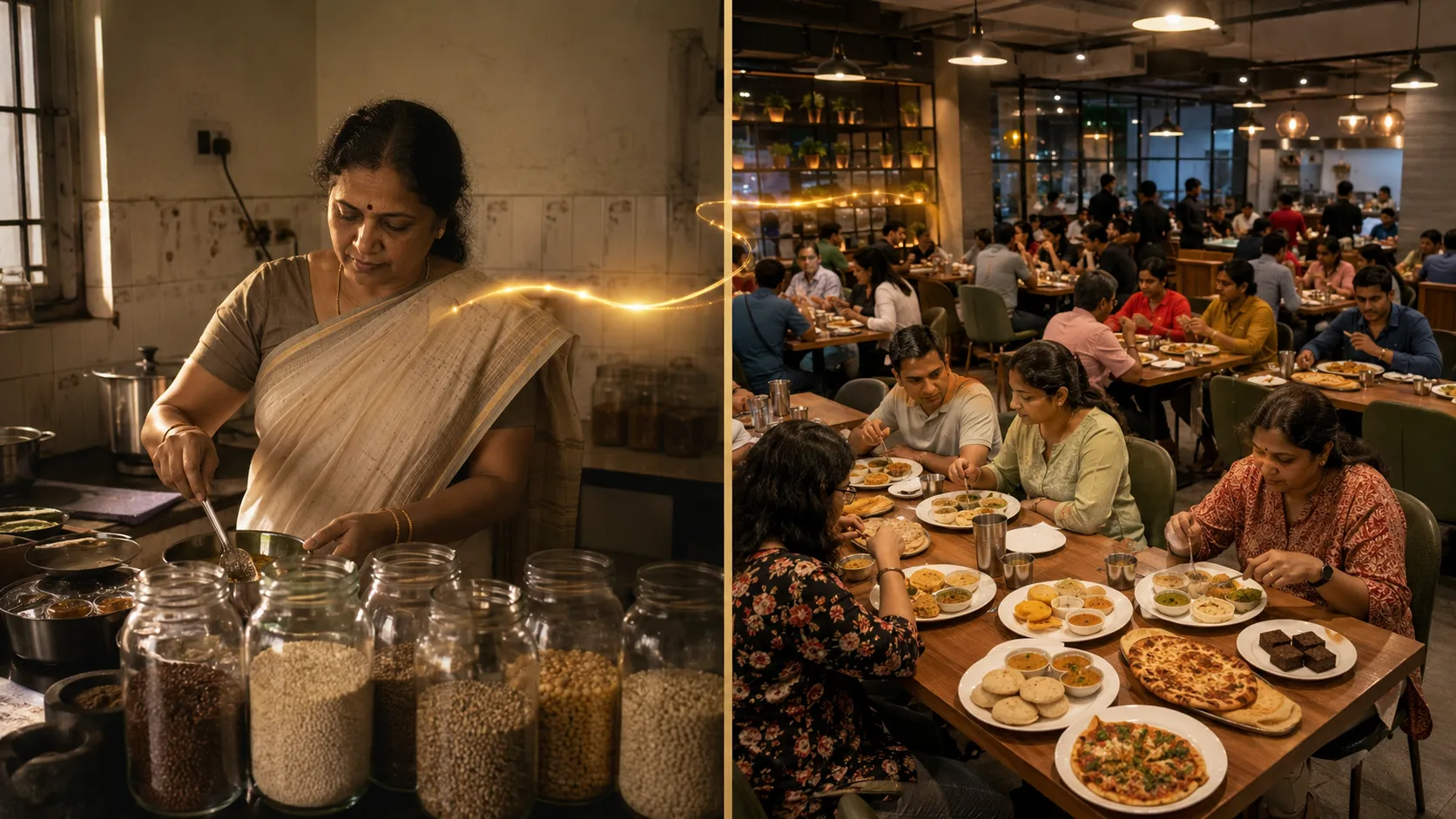
The 48-Year-Old Chennai Homemaker Who Became India's 'Millet Queen': How S. Adhieswari Turned an Ancient Grain Into a Restaurant Empire—With Her Husband as CEO
CHENNAI — May 26, 2026 — In 2015, S. Adhieswari was 48 years old, an electronics engineer by training who had spent most of her adult life as a homemaker, raising children and managing a household in Chennai. She was not a chef. She was not a businesswoman. She had never run a restaurant, never managed a payroll, and never imagined that her love of cooking would lead anywhere beyond her own kitchen. But her body had begun to send her signals she could no longer ignore. Her energy was flagging. Her digestion was sluggish. The refined rice and wheat that formed the backbone of the South Indian diet were taking a toll she could feel but not name. She began experimenting with millets—the ancient grains that her grandmother had served as a matter of course, and that her generation had largely abandoned in favour of polished rice and factory-milled flour.
"I started cooking with millets and noticed a great change in my body," she told the Indulge Express. The transformation was so profound that she began teaching cooking classes, showing other homemakers how to incorporate ragi, kodo, little, foxtail, and barnyard millets into everyday meals. Her students kept telling her the same thing: you should open a restaurant. "Many students recommended that I start an eatery," she said. In 2015, she launched Millet Maagic Meal—the misspelling deliberate, the ambition modest—from a 500-square-foot cloud kitchen in Mylapore, with a single-product menu: a lunch combo prepared fresh each day.
Eleven years later, Millet Maagic Meal is a multi-outlet restaurant chain with dine-in locations in Alwarpet and Anna Nagar, a menu of over 200 millet-based dishes, a dedicated team of bakers, sweet-makers, and food technologists, and a customer base that spans from health-conscious office workers to elderly diners seeking diabetic-friendly alternatives. Adhieswari, the electronics engineer who became a homemaker who became an entrepreneur, is now known across Chennai as the "Millet Queen." Her husband, Suresh Kumar Velusamy, serves as CEO and co-founder, managing the business operations while his wife runs the kitchen. Their son, Aashish Surender, is also a director of the company. What began as a one-woman experiment in healthy cooking has become a family enterprise—and a quietly radical demonstration that the ancient grains that India abandoned can sustain a modern, profitable, growing business.
The Engineer Who Returned to the Ancients
Adhieswari's path to becoming the Millet Queen was not a straight line. She studied electronics engineering—a field that, in the India of the 1980s and 1990s, was overwhelmingly male—and then worked as a teacher, educating the next generation. She married, raised children, and settled into the rhythms of a Chennai homemaker: cooking, managing the household, caring for her family. She had always loved cooking, but it was a private passion, not a professional one. The idea that her kitchen experiments might one day become a business was, for most of her life, unthinkable.
The trigger was health. Like millions of middle-class Indians of her generation, Adhieswari had grown up eating rice—polished, refined, white rice that was a status symbol as much as a staple. Her grandmother's generation had relied on millets: ragi (finger millet), kambu (pearl millet), thinai (foxtail millet), varagu (kodo millet), samai (little millet). These were the grains that had sustained South Indian civilisation for millennia—drought-resistant, nutrient-dense, and perfectly adapted to the region's climate. The Green Revolution of the 1960s and 1970s, with its focus on high-yielding rice and wheat varieties, had pushed millets to the margins. They became "poor people's food," associated with rural poverty and dietary backwardness. The urban middle class abandoned them, and their health paid the price.
Adhieswari's return to millets was, at first, a personal experiment. She began cooking with them, substituting millet flour for refined wheat in dosas and rotis, replacing white rice with millet rice in everyday meals. The effects on her body were dramatic—more energy, better digestion, a general sense of wellbeing that she had not realised she had lost. She began telling friends about what she was eating. The friends told their friends. Word spread. Soon, Adhieswari was teaching informal cooking classes, showing other homemakers how to incorporate millets into their daily meals. The classes were popular—surprisingly so. "Many students recommended that I start an eatery," she recalled. The students were not just being polite. They were telling her something she had not yet fully understood: that there was a market for healthy, millet-based food that was delicious, accessible, and prepared by someone who understood the grains at a level that no restaurant chef did.
In 2015, she launched Millet Maagic Meal. The name was deliberate—"maagic" for the transformative power of the grains, and "meal" for the simple, nourishing food she wanted to serve. She started with a 500-square-foot cloud kitchen in Mylapore, a bustling neighbourhood in central Chennai. She had no investors, no business plan, and no restaurant experience. She had a single-product menu: a lunch combo that changed daily, prepared fresh each morning, and delivered to customers across the city. The combo included a millet-based main course, two vegetable preparations, and a dessert—all made with millets, all cooked in cold-pressed coconut oil, all free of the refined ingredients that defined the standard Indian restaurant meal.
The response was immediate and overwhelming. Within weeks, she was selling out of lunch combos every day. Within months, she had expanded from a single cloud kitchen to a delivery operation that was sending out 85 lunch boxes daily. "In no time, there was a fan following for dishes prepared in our kitchen," she told The Hindu. "Soon I was sending out 85 lunch combos everyday, and, today, we pack over 250 lunch boxes." The one-woman kitchen had outgrown itself. Adhieswari needed help. She turned to her husband, Suresh Kumar Velusamy, who left his own professional commitments to become the company's CEO and co-founder. Together, the couple began scaling what had started as a solo project into a family business.
The Husband-Wife Engine
The dynamic between Adhieswari and Suresh Kumar is the quiet engine that powers Millet Maagic Meal. She is the creative force—the recipe developer, the quality controller, the keeper of the culinary philosophy that has defined the brand since its inception. He is the operator—the business manager, the financial controller, the person who ensures that the restaurants run smoothly while his wife focuses on the food.
The division of labour is not formally negotiated. It is organic, born of years of partnership and a shared commitment to the vision that Adhieswari had launched from their home kitchen. Suresh Kumar's LinkedIn profile describes him as "CEO & Co Founder at Millet Maagic Meal," and his posts reflect a deep engagement with the company's mission. "Millet Maagic Meal is more than just a restaurant," he wrote. "It's a culinary destination that celebrates the versatility and nutritional benefits of millet-based dishes." The message is consistent with Adhieswari's own framing of the brand: not just a place to eat, but a place to discover that healthy food can be delicious.
The couple's son, Aashish Surender, is also a director of the company, making Millet Maagic Meal a true family enterprise. The second generation's involvement suggests that the brand is being built for the long term—not as a lifestyle business that will be sold when the founders retire, but as a legacy that the family intends to sustain across generations. The structure is unusual in the Indian restaurant industry, which is dominated by single-generation founders who rarely build succession plans. The Suresh family is building an institution, and the institution is growing.
The Restaurant That Defied Every Convention
The leap from cloud kitchen to dine-in restaurant was the moment Millet Maagic Meal stopped being a delivery operation and became a brand. In 2018, Adhieswari opened her first physical restaurant in Alwarpet, one of Chennai's most affluent neighbourhoods. The move was a risk. A cloud kitchen requires minimal capital, no front-of-house staff, and no investment in ambiance. A dine-in restaurant requires all of those things, and the failure rate for new restaurants is notoriously high.
The Alwarpet location succeeded because it offered something that no other restaurant in Chennai did: a comprehensive millet-based menu that spanned South Indian tiffin items, North Indian dishes, continental cuisine, and desserts—all made with millets, all vegetarian, all prepared without refined flour, white rice, or commercial pickles. The restaurant served podi idlis made from kodo millet, ragi rotis served with thogayal instead of pickle, millet pizzas with mixed-millet crusts, millet fried rice, millet brownies, and elaneer payasam sweetened with karupatti (palm jaggery). The menu was designed to appeal to every age group, from children who would only eat pizza to elderly diners who needed diabetic-friendly alternatives. "Our USP is the wide range of millet dishes on our menu that appeals to all age groups," Adhieswari told The Hindu.
The second restaurant, in Anna Nagar, opened in September 2023 to considerable fanfare. The inauguration was attended by actress Nakshrathra Nagesh, who lit the ceremonial lamp, and by Chennai's food and fashion bloggers, who had been hearing about the "Millet Queen" for years and finally had a second location to visit. The 40-seater diner expanded the menu further, introducing dishes like millet thattai topped with Indian-style salsa, millet karuvepilai podi idli, and an extensive dessert selection. A meal for two costs approximately ₹800—affordable enough for a regular weeknight dinner, premium enough to feel like an occasion.
The brand's commitment to health is uncompromising. "My focus is always on healthy living and eating," Adhieswari said. "So I provide only thogayals and have totally eliminated pickles in our restaurant. Keeping the health of kids and elderly in mind, savories are fried in cold-pressed coconut oil." The thogayal—a South Indian chutney made from lentils, coconut, and spices—replaces the commercially pickled condiments that most restaurants serve by default. The cold-pressed coconut oil replaces the refined vegetable oils that are standard in commercial kitchens. The millet flour replaces the refined wheat and white rice that define the typical Indian meal. Every substitution is a deliberate choice, and every choice reflects the philosophy that Adhieswari developed in her home kitchen a decade ago.
The restaurant also offers gluten-free products, addressing a growing consumer segment that has been largely ignored by the Indian food industry. The pizzas, brownies, and cookies are all made with millet flour rather than wheat, making them accessible to customers with gluten sensitivities. "I have started baking the savories as it is healthier," Adhieswari said, "and we recently introduced wraps also, which is again gluten-free." The innovation is continuous, driven by Adhieswari's conviction that the possibilities of millet-based cooking have barely been explored. "The quest to keep innovating new products to replace gluten-rich products like wheat and maida and high glycemic index products like white rice is never-ending."
The Women Who Run the Kitchen
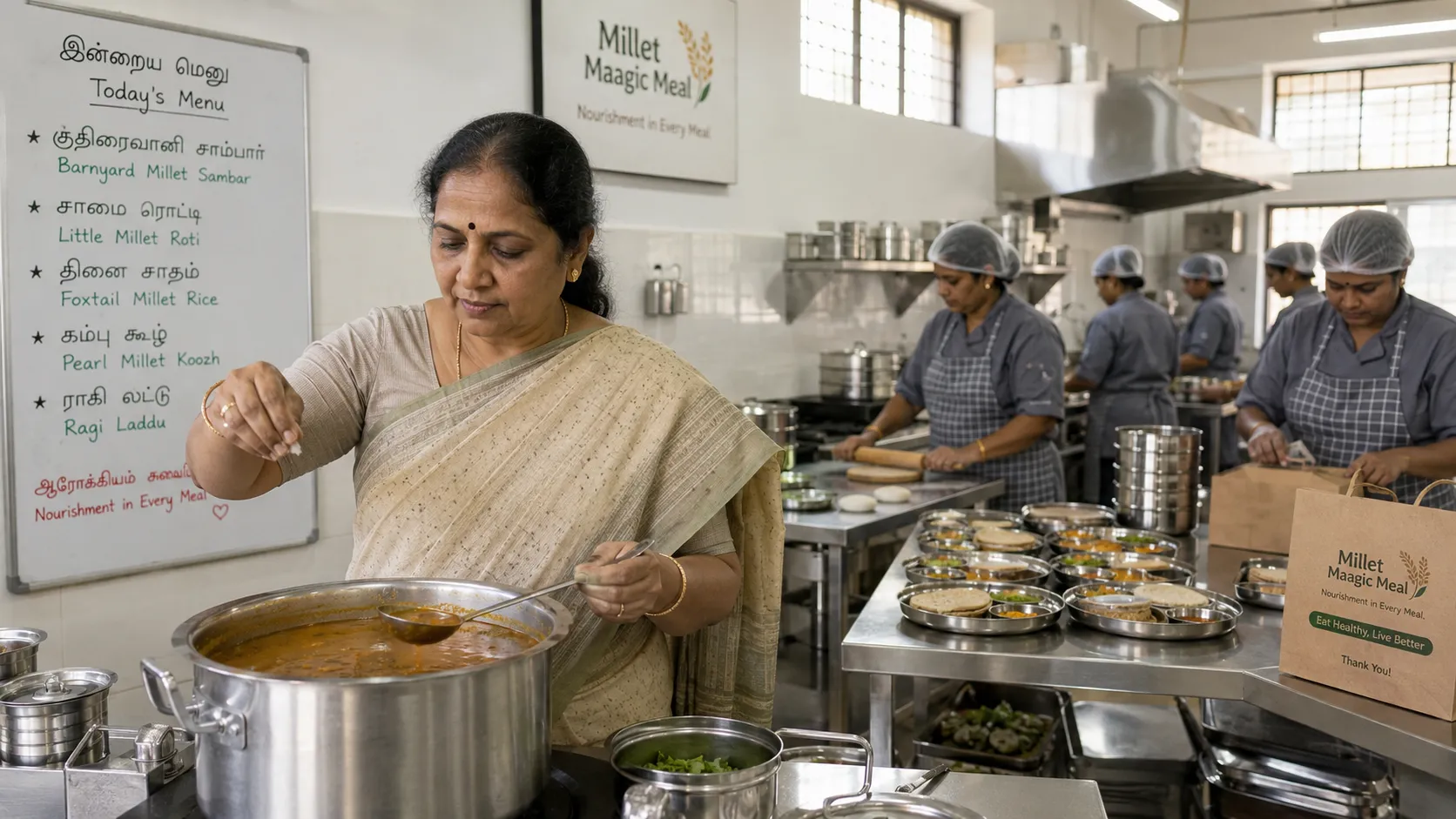
The most strategically significant dimension of Adhieswari's business model is not the menu or the marketing. It is the workforce. When she started, she was the only person in the kitchen—cooking every dish, packing every box, managing every order. As the business grew, she began recruiting and training other women, many of whom had never held formal jobs before. "Initially I was cooking every item in the kitchen, then I gradually began to train women," she told The Hindu. "Today, they run the show under my supervision, and we work in teams."
The decision to build a female workforce was not a diversity initiative. It was a practical response to the realities of the Indian labour market. Women who have spent years as homemakers possess exactly the skills that a restaurant kitchen requires: they know how to cook, they understand flavours, and they are accustomed to managing multiple tasks simultaneously. What they lack—formal employment experience, professional references, the confidence to work outside the home—is easily remedied with training and support. Adhieswari, who had herself made the transition from homemaker to entrepreneur, understood this better than anyone. She built a kitchen in which the barriers that keep women out of the workforce—inflexible hours, hostile environments, the absence of female supervisors—were systematically removed.
The result is a kitchen that is predominantly staffed by women, managed by women, and designed around the needs of women workers. The team now includes a pastry chef who specialises in millet-based baking, sweets and savories masters, and food technologists—all working under Adhieswari's supervision to expand the product line and maintain the quality that has defined the brand since its inception. The kitchen is not just a production facility. It is a training ground, and the women who pass through it emerge with skills, confidence, and employment histories that open doors that were previously closed.
The broader context is an Indian food industry in which women are systematically underrepresented in professional kitchens. The chefs who dominate the headlines, the restaurant groups that attract venture capital, and the culinary schools that train the next generation are overwhelmingly male. The home kitchen, where women have been cooking for millennia, is treated as a source of unpaid domestic labour rather than professional expertise. Adhieswari's kitchen inverts that hierarchy. It treats the skills that women have always possessed as the foundation of a commercial enterprise, and it treats the women who possess those skills as professionals deserving of fair wages, dignified working conditions, and the respect that their expertise commands.
What This Signals
The Millet Maagic Meal story is not primarily about a restaurant. It is about the collision of three structural shifts that are reshaping the Indian food industry—and about the woman who positioned herself at the intersection of all three before anyone else saw the pattern.
The first shift is the health revolution. Indians are living longer, developing more chronic diseases, and becoming increasingly aware that the refined carbohydrates that dominate the standard Indian diet are contributing to an epidemic of diabetes, obesity, and heart disease. The consumer who grew up on white rice and maida is now looking for alternatives, and millets—with their low glycemic index, high fibre content, and rich micronutrient profile—are the most credible alternative available. The second shift is the rediscovery of traditional foodways. The same generation that once dismissed millets as "poor people's food" is now willing to pay a premium for them, provided they are presented in contemporary, appealing formats. The third shift is the rise of women entrepreneurs in the food industry. The barriers that kept women out of professional kitchens are slowly eroding, and the women who are entering the industry are building businesses that reflect their values—healthy, sustainable, community-oriented—rather than replicating the male-dominated, profit-maximising models that defined the previous era.
Adhieswari is not a celebrity chef. She does not have a television show, a cookbook deal, or a venture-capital round. She is a 50-something homemaker who started cooking with millets because her body told her to, who taught other women what she learned, and who built a restaurant chain from a 500-square-foot cloud kitchen because her students told her she should. The empire she has built—two dine-in restaurants, a thriving delivery business, a team of women chefs, and a menu of 200-plus millet-based dishes—is not the product of a strategic plan. It is the product of a conviction, pursued with patience and persistence, by a woman who refused to believe that the grains that sustained her ancestors were too boring, too difficult, or too unfashionable for the modern kitchen.
S. Adhieswari is no longer the homemaker who experimented with millets in her own kitchen. She is the Millet Queen of Chennai, the founder of a restaurant chain that has proved that healthy, traditional, millet-based food can compete with the pizzas, burgers, and refined-carbohydrate meals that dominate the urban Indian diet. Her husband runs the business. Her son is a director. Her kitchen is staffed by women she trained herself. The 500-square-foot cloud kitchen in Mylapore is still there, but it is no longer the centre of the operation. The centre is wherever Adhieswari is standing—tasting a batch of sambar, adjusting a recipe, teaching another woman how to cook with grains that most of the world has forgotten. The millet revolution has many champions. The Millet Queen of Chennai is one of them, and she is just getting started.


