The ₹47 Crore Underwater Robot That Just Put a Kerala Startup on the Global Deep-Tech Map
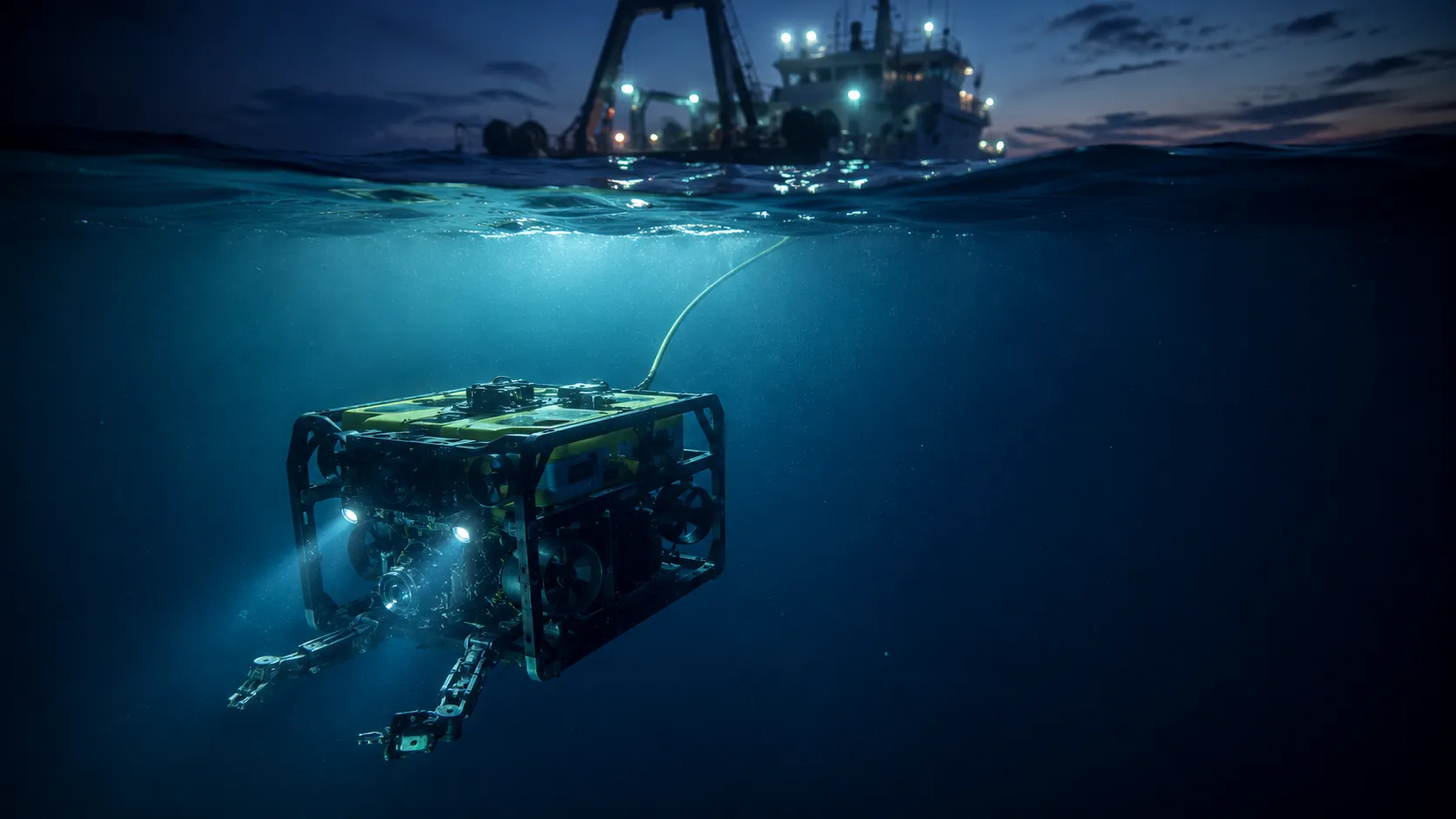
KOCHI — May 24, 2026 — Sometime in the past week, in a wood-panelled conference room in Oslo, a young engineer from Kochi stood before a gathering of Norwegian maritime executives and Indian government officials and described a machine that most of the people in the room had never seen. The machine was an underwater remotely operated vehicle—a robot designed to descend into the darkness of harbours, dams, and offshore platforms, where human divers cannot go, and inspect the critical infrastructure that the global economy depends on but almost never sees. It could operate at depths that would crush a diver. It could navigate in zero-visibility conditions using sonar and AI-powered computer vision. It could relay high-definition video, sonar imagery, and structural diagnostics to a control station on the surface. And it had been designed, built, and tested not in Norway—the world leader in subsea engineering—but in Kerala, at a startup called EyeROV Technologies, founded by alumni of IIT Madras and backed by the Kerala Startup Mission.
The occasion was the first standalone visit by an Indian Prime Minister to Norway in more than forty years. EyeROV had been selected to join the official delegation, participating in the India-Norway CEOs Roundtable and the High-Level Business and Research Summit in Oslo. The company's Chief Technology Officer presented a strategic roadmap for an "India-Norway Marine Tech Innovation Corridor"—a proposal to accelerate bilateral collaboration in deep-tech research, subsea engineering, green shipping, and autonomous underwater systems. The initiative envisages joint research programmes, market access partnerships, and collaborative innovation platforms between companies and institutions from both countries. It was, by any measure, an extraordinary moment for a startup that was founded in a small office in Kochi and that has spent the past several years quietly building the most advanced indigenous underwater robotics platform in India.
The Oslo summit was not a one-off diplomatic gesture. It was the public recognition of a company that has already secured a ₹47 crore contract from the Indian Navy to supply advanced underwater remotely operated vehicles—a deal that is among the largest defence contracts ever awarded to an Indian deep-tech startup. EyeROV has completed more than 100 deployments across ports, dams, nuclear facilities, and offshore energy platforms. Its robots have inspected bridges, located underwater debris, surveyed pipelines, and provided the eyes beneath the surface that India's marine infrastructure has historically lacked. And its presence in Oslo, alongside the Prime Minister, signals something larger than a single company's success: the emergence of India's deep-tech ecosystem as a credible participant in the most advanced technology dialogues on Earth.
The Engineers Who Chose the Depths
EyeROV was founded by Johns T. Mathai and Kannappa Palaniappan, two engineers who met at IIT Madras and who shared a conviction that India's underwater infrastructure was being monitored with technologies that were either imported, outdated, or inadequate.
Mathai, the company's CEO, had studied naval architecture and ocean engineering—a field that, in India, has historically produced more academics and government researchers than entrepreneurs. Palaniappan, the CTO, brought expertise in robotics, computer vision, and autonomous systems. Together, they looked at the vast and strategically critical underwater infrastructure that surrounds the Indian peninsula—ports, dams, bridges, pipelines, offshore oil platforms, naval installations—and saw a gap that no Indian company had filled. The country that operates one of the world's largest navies, that has a coastline of more than 7,500 kilometres, and that depends on its ports for more than 90 percent of its trade by volume was importing almost all of its underwater inspection technology.
The gap was not merely commercial. It was strategic. Underwater remotely operated vehicles—UWROVs—are essential for inspecting port infrastructure, monitoring dam integrity, surveying offshore energy platforms, and conducting naval operations. The global market for these systems is dominated by a handful of companies in the United States, Norway, the United Kingdom, and Japan. India's dependence on imported UWROVs created a vulnerability that became starkly visible during the Galwan Valley border crisis in 2020, when the government accelerated its push for indigenous defence technologies. The Indian Navy, which operates in some of the world's most strategically contested waters, needed underwater robots that could be built, maintained, and upgraded within India. EyeROV was founded to meet that need.
The company's first products were portable, man-portable ROVs—small enough to be carried by two people and deployed from a small boat, a pier, or a dam wall. The early deployments were unglamorous: inspecting the underwater foundations of a bridge in Kerala, surveying a pipeline in Mumbai harbour, checking the intake structures of a hydroelectric dam in the Western Ghats. Each deployment generated data that fed back into the design of the next generation. The robots became more capable, more reliable, and more deeply integrated with the AI-powered analytics platform—named EVAP, for Enhanced Vision Analytics Platform—that the company was building alongside the hardware.
The ₹47 crore Indian Navy contract, signed in late 2025, was the inflection point. It was one of the largest defence orders ever placed with an Indian deep-tech startup, and it validated the company's thesis that indigenous underwater robotics could compete with the established global players on capability, not just on cost. The contract covers the supply of advanced UWROVs designed for naval operations—surveillance, inspection, mine detection, and underwater reconnaissance. The systems are being built in Kochi, with a supply chain that is predominantly Indian, and they will be deployed across the Navy's operational theatres. The deal is not just a commercial transaction. It is a strategic capability transfer—from the global defence industry to an Indian startup, from imported technology to indigenous innovation.
The Blue Economy and the AI Layer
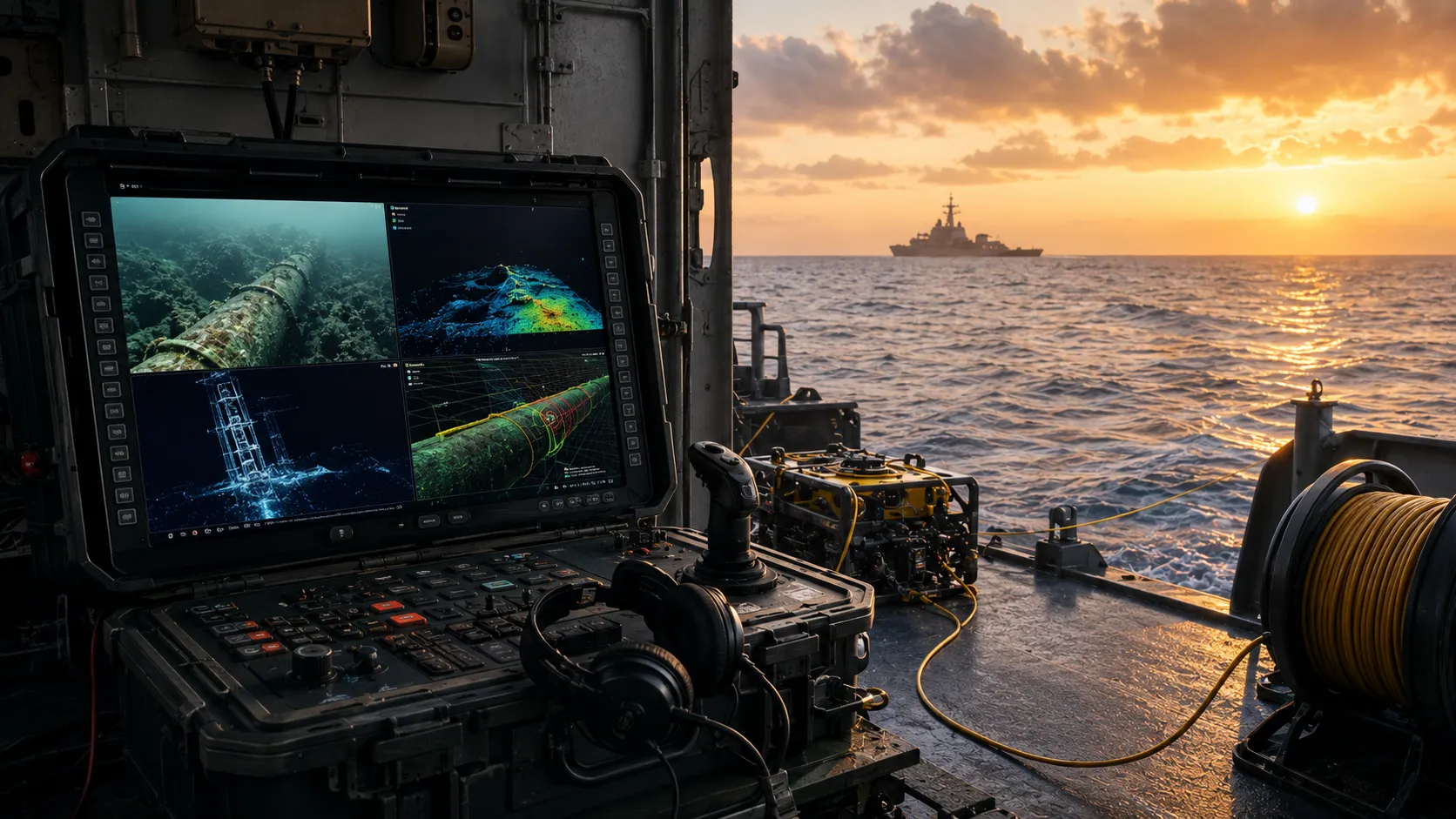
The Norwegian delegation was not solely about defence. EyeROV's proposal for an India-Norway Marine Tech Innovation Corridor reflects a broader ambition that extends well beyond naval procurement. The company has been building an AI-powered analytics platform—EVAP—that applies machine learning to the vast quantities of underwater data that its robots collect. The platform can identify structural defects in dam walls, predict the corrosion rate of pipeline welds, and classify marine species in aquaculture pens—tasks that have historically required teams of human analysts working for weeks.
The platform is designed to be hardware-agnostic. It can ingest data from EyeROV's own robots, from third-party ROVs, from autonomous underwater vehicles, and from fixed underwater sensor networks. The business model is not just selling robots. It is selling intelligence—the ability to transform raw underwater data into actionable insights that can prevent a dam failure, extend the life of an offshore platform, or optimise the feeding schedule of a fish farm. The global market for underwater inspection and monitoring is estimated at more than $5 billion annually, and the share of that market that is AI-powered—driven by predictive analytics rather than reactive inspection—is growing rapidly.
The Norway connection is strategic. Norway is the world leader in subsea engineering, offshore technology, and marine aquaculture. Its companies—Equinor, Kongsberg, Aker Solutions—operate some of the most advanced underwater infrastructure on the planet. Its research institutions—SINTEF, NTNU, the Institute of Marine Research—are at the frontier of ocean science. The India-Norway Marine Tech Innovation Corridor that EyeROV proposed at the Oslo summit is designed to create a formal channel for technology transfer, joint research, and market access between the two countries' marine technology ecosystems. For a startup from Kochi to be proposing such a corridor—and for the Indian government to be endorsing it—is a measure of how quickly India's deep-tech ambitions have evolved.
Anoop Ambika, the Chief Executive Officer of Kerala Startup Mission, described EyeROV's presence at the Oslo summit as a milestone moment for Kerala's startup ecosystem and a reflection of the global recognition that Indian deep-tech ventures are beginning to command. "The participation of a Kerala startup in such a high-level diplomatic and business engagement signals the changing profile of India's innovation economy," industry observers noted, "where specialised deep-tech firms are increasingly becoming part of strategic international collaborations." The statement captures the broader significance of the moment. EyeROV is not an outlier. It is part of a wave of Indian deep-tech startups—in space, in semiconductors, in robotics, in AI—that are moving from the margins of the economy to the centre of strategic international partnerships.
The Deeptech Moment
EyeROV's Oslo moment did not occur in isolation. It arrived the same week that the Technology Development Board announced it had funded 22 deeptech projects under the Research Development and Innovation Fund—a ₹1 lakh crore government initiative designed to propel India's deeptech ecosystem to parity with the best in the world. The same week that Shastra VC, a Bengaluru-based venture firm, launched a $100 million fund targeting early-stage deeptech startups across AI, space, defence, and renewable sciences. The same week that a Campus Fund report revealed that deep tech had become the single largest category among student-led startups in India for the first time, accounting for nearly 17 percent of the student startup funnel.
The alignment of policy, capital, and talent is unmistakable. India's first startup wave was built on services—IT outsourcing, business process management. The second wave was built on consumer internet—the Flipkarts, the Zomatos, the Olas that digitised Indian consumption. The third wave, if the signals of the past week are accurate, will be built on deep technology—the kind of companies that own intellectual property, that require patient capital, and that compete on scientific merit rather than marketing spend. EyeROV, with its ₹47 crore Navy contract, its 100-plus deployments, and its presence at the highest levels of international technology diplomacy, is a case study in what that third wave looks like.
The Kerala Startup Mission's role in EyeROV's development is also significant. KSUM, the state government agency that supports early-stage technology startups, has been one of India's most effective public-sector incubators, providing funding, mentorship, and infrastructure to a generation of deep-tech founders who might otherwise have migrated to Bengaluru or Hyderabad. EyeROV's success is a validation of that model—proof that a startup nurtured in a state government programme can compete for defence contracts, represent India at international summits, and build technology that the global market wants.
The Road Ahead
EyeROV is still a small company. It has not disclosed its revenue or profitability figures. Its ₹13 crore in disclosed funding—from a combination of government grants, venture capital, and the Navy contract—is modest by the standards of Silicon Valley robotics startups. It competes against established global players with decades of experience, deep customer relationships, and manufacturing scale that EyeROV cannot yet match.
But the company has something that none of its global competitors can replicate: the endorsement of the Indian Navy, the backing of the Indian government's strategic diplomacy, and a home market—India's vast and under-inspected underwater infrastructure—that is one of the largest addressable markets for UWROV technology in the world. The ports, dams, bridges, and offshore platforms that EyeROV was founded to inspect are not going away. The Navy that has already placed a ₹47 crore order is likely to place more. The Norway corridor, if it materialises, could open markets and technology partnerships that no Indian robotics company has ever accessed.
The underwater robot that was presented to Norwegian executives in Oslo last week is not a prototype. It is a deployed, operational system, tested over more than 100 missions, paid for by the Indian Navy, and built by engineers in Kochi who have spent years proving that India can build the machines that inspect the infrastructure beneath the waves. The Oslo summit was a milestone. The Navy contract was a validation. The next milestone is scale—and the market, beneath the surface, is vast.


