The ₹300 Crore Zombie That Almost Didn't Rise: How a FWICE Ban, a Don 3 Exit, and a ₹45 Crore Compensation Demand Turned Ranveer Singh's 'Pralay' Into Bollywood's Most Dramatic Pre-Production—Before a Single Frame Was Shot
MUMBAI — May 28, 2026 — Sometime in the early weeks of 2026, as Dhurandhar 2: The Revenge was completing its historic rampage through the global box office, the producers of Ranveer Singh's next film received a phone call that transformed their project from an ambitious creative gamble into a geopolitical standoff. Ritesh Sidhwani, co-founder of Excel Entertainment, had reached out to Birla Studios—the newly established production house that was set to back Pralay, the ₹300 crore zombie epic that was supposed to cement Ranveer's status as the most commercially potent star in Hindi cinema. Sidhwani's message was direct and unambiguous: do not fund this film. Do not begin shooting. Do not proceed with pre-production. Not until the actor who had walked out of Don 3—who had, in Excel's telling, abandoned a project after months of pre-production and left the studio holding ₹40 crore in sunk costs—had resolved the dispute he had created.
The call was a gambit, and the gambit worked. The actor who had refused to pay a single rupee of compensation began negotiating. The film that was supposed to begin shooting in mid-2026 was caught in a paralysis that had nothing to do with the script, the director, or the visual effects. It was a hostage situation, and the hostage was a ₹300 crore zombie epic that had not yet shot a single frame. "Money had been spent on pre-production—scouting location, doing recce, scheduling and budgeting," a source told The Indian Express. "The producers' guild also needs to set a precedent in such cases where either the actors exit or the producers step back. There is merit to their argument."
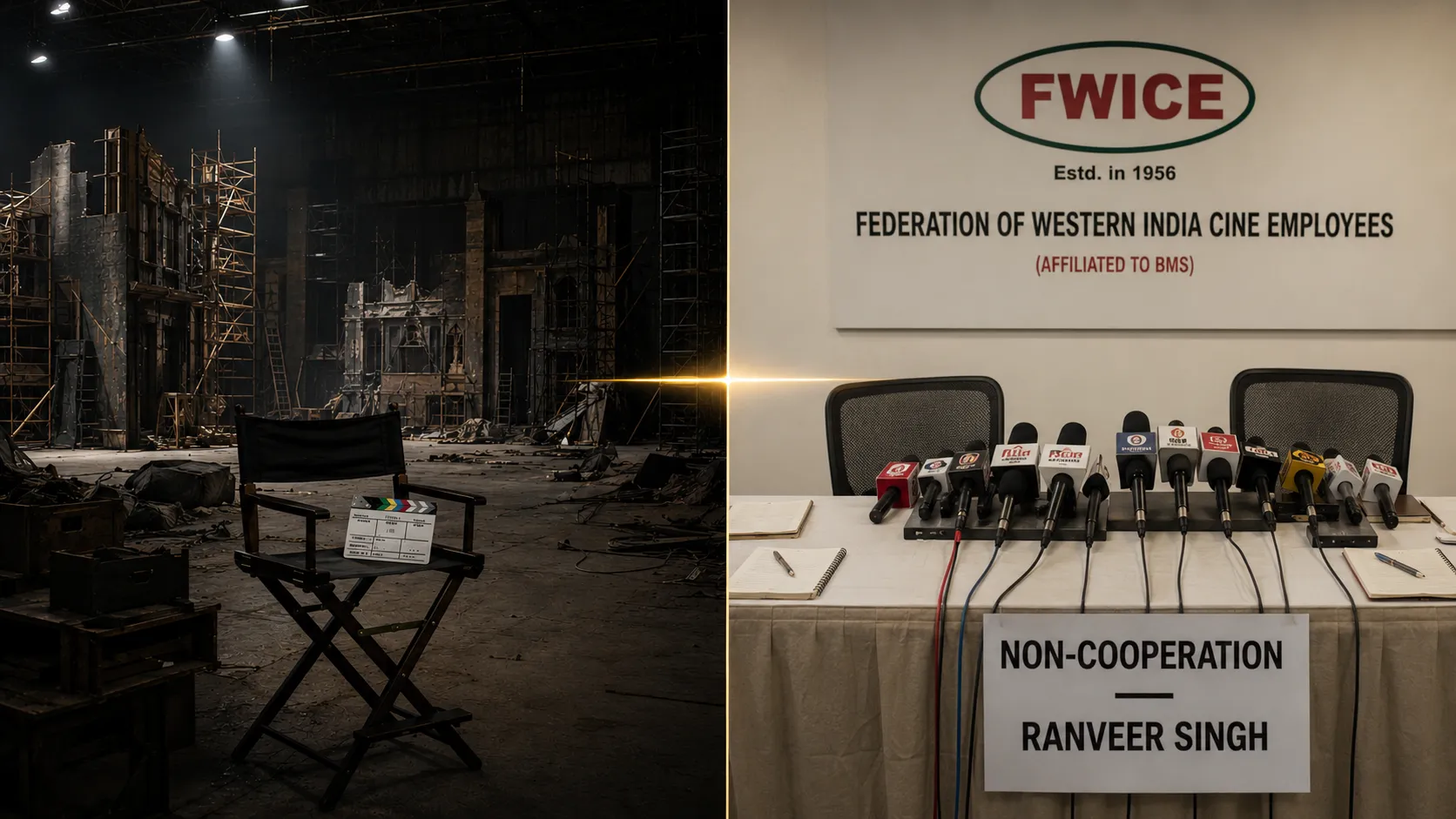
The dispute has since escalated to the Federation of Western India Cine Employees—the powerful union that controls the labour supply for virtually every Hindi film production in the country—which issued a non-cooperation directive against Ranveer on May 25, three days ago. The directive means that none of FWICE's 5,000 active members and 36 affiliated unions—no spot boys, no cameramen, no technicians, no vanity van suppliers—will work on any project involving the actor until he appears in person to resolve the matter. The ban applies across India. It applies to Pralay, which is scheduled to begin shooting in August, with nearly 500 workers expected to be employed across departments. It applies to every advertisement, every endorsement shoot, every public appearance. It is not legally binding—producers can, in theory, hire non-union workers or shoot outside Mumbai—but it is, in practice, a showstopper. "If they don't have vendors, workers, and technicians, who will they shoot with?" FWICE chief advisor Ashoke Pandit asked, in a rhetorical question that the producers of Pralay are now trying to answer. "People underestimate the strength of the federation."
The zombie film that was supposed to be Bollywood's great leap into uncharted genre territory—a dark, dystopian, post-apocalyptic survival thriller set in a crumbling Mumbai, mounted on a scale the industry has never attempted—has become the most dramatic pre-production in recent Indian cinema history. It is a film that has already generated more headlines than most releases, and it has not yet begun to shoot. The ₹300 crore budget has been locked. The script has been finalised. The director—Jai Mehta, son of acclaimed filmmaker Hansal Mehta, making his theatrical debut after co-directing the landmark series Scam 1992—has been developing the project for more than a year. The female lead, Kalyani Priyadarshan, has been cast in what will be her Bollywood debut. The international crew has been assembled. The visual effects plan has been designed. The only thing missing is the permission of the union that controls the workers who will build the film. And that permission, as of today, has not been granted.
The Don 3 Exit That Triggered Everything
To understand why Pralay is in jeopardy, one must first understand the chain of events that began with Don 3—a film that Ranveer Singh was once attached to, that he walked away from, and that has now become the gravitational centre of a dispute that threatens to consume everything he has built since Dhurandhar.
In 2024, Farhan Akhtar and Ritesh Sidhwani's Excel Entertainment announced that Ranveer would take over the Don franchise from Shah Rukh Khan, who had headlined the previous two instalments. The announcement was met with a mixture of excitement and scepticism—the Don franchise is among the most iconic in Bollywood, and the shadow of SRK's performance loomed large over any successor—but it was, by any measure, a major commercial commitment. Pre-production began. Locations were scouted. Budgets were drawn. Ranveer participated actively in the development process, according to Excel's account, and his consent was obtained at every stage.
Then, in late 2025, Dhurandhar happened. The spy thriller, directed by Aditya Dhar and starring Ranveer as a special-operations officer, became the highest-grossing Hindi film in history at the domestic box office. Its sequel, Dhurandhar 2: The Revenge, released in March 2026, surpassed even those numbers. Within the space of four months, Ranveer Singh had been transformed from a star whose commercial appeal was sometimes questioned into the most bankable leading man in Hindi cinema. The leverage he wielded in negotiations with producers had been fundamentally altered—and the project he had committed to before that transformation, Don 3, no longer looked like the best use of his time.
In early 2026, Ranveer walked away from Don 3, citing creative differences with the script. He alleged that there was no bound script, that Farhan Akhtar was an "absentee director" who refused to collaborate or accept feedback, and that Excel had been exploring the possibility of casting Hrithik Roshan in the role before returning to Ranveer after the success of Dhurandhar. He argued that he had not accepted any remuneration from the producers and was therefore not liable for damages. He cited the example of Sanjay Leela Bhansali's shelved Baiju Bawra, for which he had prepared for a year without seeking compensation after the project was called off. "Such developments are inherent to the industry," he argued.
Excel's response was to demand compensation of ₹40 crore—later revised upward to ₹45 crore—for the pre-production expenses it claimed to have incurred in reliance on Ranveer's commitment. When the actor refused to pay, the studio escalated. The Producers Guild of India was brought in to mediate. Two meetings were held. No resolution was reached. Then, in February 2026, Sidhwani made the phone call to Birla Studios that transformed the dispute from a contractual disagreement into an existential threat to Ranveer's next film. Excel was not merely demanding compensation. It was actively attempting to prevent Pralay from being made until the compensation was paid.
The dispute has since become a test case for the Indian film industry's ability to regulate the relationship between stars and producers. At its core is a question that has been simmering for years and that has never been satisfactorily answered: when a star walks away from a film—after pre-production has begun, after locations have been scouted, after budgets have been drawn—who bears the cost? The star, whose participation is the single most important factor in a film's commercial viability? Or the producer, who assumed the risk of the star's involvement and who should have accounted for the possibility of a walkout in the contract? The question is not academic. The answer will determine the balance of power in the industry for a generation. And Pralay, the ₹300 crore zombie epic that was supposed to be Ranveer's most ambitious solo project, has become the battlefield on which the answer will be decided.
The FWICE Directive and Its Fallout
The Federation of Western India Cine Employees entered the dispute in late May 2026, and the consequences for Pralay were immediate. On May 25, FWICE issued a formal non-cooperation directive against Ranveer Singh—a measure that, while not legally equivalent to a ban, is operationally devastating. The federation controls the labour supply for virtually every Hindi film production in the country, and its directive meant that no union-affiliated worker—no spot boy, cameraman, technician, vanity van supplier, or other crew member—would participate in any project involving the actor. "This implies that none of our workers or members, across all crafts, will work on any of his projects," Ashoke Pandit said at a press conference on May 25. "We have requested all producers to take a stand, to join us in solidarity, to speak out against this conduct, and to take a firm decision."
The directive was triggered by Ranveer's refusal to appear in person before the federation to explain his side of the Don 3 dispute. FWICE had sent multiple requests for a meeting. The actor, through his representatives, had declined. "He did not respond to multiple requests to appear in person and explain his side of the story," the federation stated. The directive would remain in force, Pandit said, until Ranveer "decides to meet them personally." No worker across India, including technicians, spot boys, vanity van suppliers, and other affiliated staff, would work with him until the matter was resolved. The ban applied not just to Pralay, but to every project involving the actor.
The impact on Pralay was particularly severe because of the scale of the production. The film is expected to employ nearly 500 workers across departments—stunt performers, lighting crews, costume teams, make-up artists, art department staff, and spot boys. With FWICE overseeing 34 affiliated associations, concerns are growing that the directive could severely impact the film's production logistics. The film is scheduled to begin shooting in August, a timeline that is now in serious doubt. If the dispute is not resolved within the next two months, the entire production schedule will need to be revised—a costly and complex undertaking for a film of this scale.
The producers of Pralay are reportedly exploring legal options. Some are considering approaching the Competition Commission of India against the federation's directive, arguing that it amounts to anti-competitive behaviour under the Competition Act. Industry observers point to a 2017 case involving filmmaker Vipul Amrutlal Shah, where the CCI reportedly ruled that non-cooperation directives restricting producers from hiring non-members and obstructing shoots could amount to anti-competitive behaviour. A producer associated with one of Singh's upcoming films told the Times of India anonymously, "If this situation escalates, we will be forced to approach the CCI."
The producers are also considering a more pragmatic workaround. FWICE's jurisdiction is strongest in Mumbai, where the bulk of the Hindi film industry's labour force is concentrated. But Pralay could, in theory, be shot outside Mumbai—in Hyderabad, in Chennai, or in any other Indian city where local crews are not bound by FWICE directives. "In the worst-case scenario, Ranveer can take the cast and crew and shoot the movie anywhere in India," a source close to the production told Odisha TV. "While the FWICE's stand applies to all of its members, it cannot legally stop non-members from working. If Pralay is shot outside Mumbai, the makers may bypass the FWICE-affiliated workers by hiring local crew members belonging to other unions."
The workaround is legally viable, but it is logistically daunting. Pralay was designed to be shot on elaborate sets built in Mumbai studios. Moving the production to another city would require rebuilding those sets, renegotiating contracts, and managing a crew that is unfamiliar with the project's specific requirements. The cost would be substantial, and the timeline would be extended. For a film that is already carrying a ₹300 crore budget—the largest ever for a standalone Ranveer Singh vehicle—any additional cost or delay increases the financial risk of a project that is already one of the most ambitious bets in Bollywood history.
Ranveer's spokesperson has issued a carefully worded statement that neither concedes nor confronts the FWICE directive. "Throughout the recent developments surrounding Don 3, he has consciously chosen to maintain silence, believing that professional discussions and personal equations are best handled with dignity, maturity, and mutual respect," the statement read. The silence is strategic. The actor's team appears to be betting that the commercial pressure to resolve the dispute—the pressure exerted by the producers of Pralay, by the studio backing it, and by the hundreds of workers whose livelihoods depend on the film proceeding—will eventually force a negotiated settlement. The FWICE directive, in this calculus, is a negotiating tactic rather than a permanent obstacle. The question is how long the negotiation will take—and whether Pralay can survive the delay.
The Zombie That Bollywood Has Never Seen
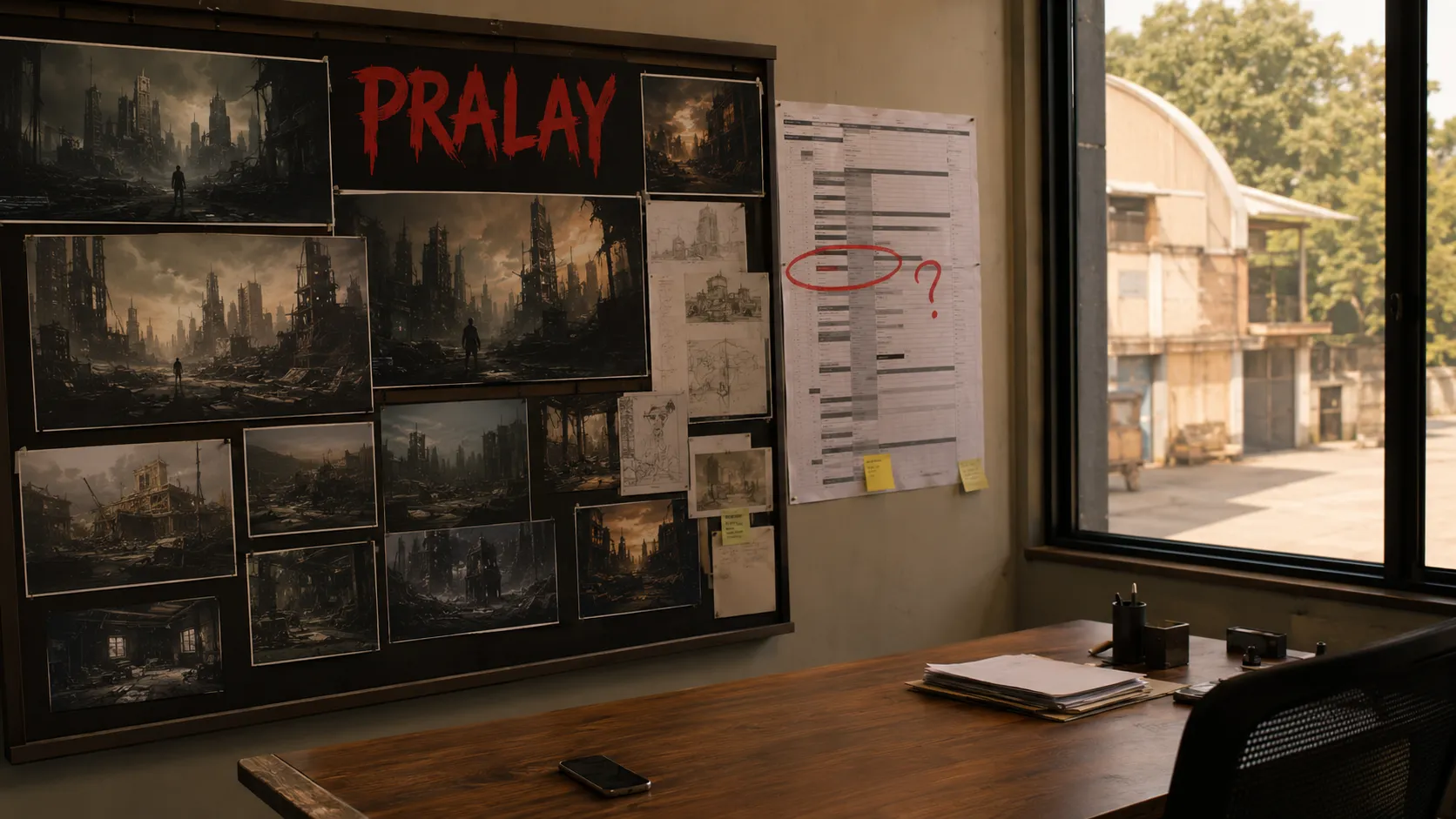
For all the drama surrounding its pre-production, the creative ambition of Pralay remains extraordinary. The film is being described as India's first true zombie epic—a dark, gritty, post-apocalyptic survival thriller set in a crumbling, decaying Mumbai, rendered through AI-driven visuals and practical effects. The genre has been explored in Indian cinema before—Go Goa Gone (2013) treated zombies as comedy, while Miruthan (2016) was a Tamil-language zombie action film—but never at this scale, with this budget, or with this degree of creative ambition. "It's the kind of film that India hasn't made yet, the kind of film that India hasn't seen before," Hansal Mehta told Variety India.
The screenplay was written by Jai Mehta and Vishal Kapoor, the latter known for his work on the series Lootere. The script is an original work—not an adaptation of José Saramago's novel Blindness, as early rumours had suggested, a speculation that Hansal Mehta explicitly denied in an interview with The Hollywood Reporter India. "It's not an adaptation," he said. The story is set in a post-apocalyptic world overrun by zombies, with the action concentrated in Mumbai. The film will reportedly use AI-driven visuals to depict the city in a state of catastrophic decay—crumbling skyscrapers, abandoned streets, the familiar landmarks of the Maximum City rendered unfamiliar through the lens of collapse.
Jai Mehta, the director, is the son of Hansal Mehta, and his appointment represents a deliberate creative risk. Jai co-directed Scam 1992: The Harshad Mehta Story, the landmark 2020 series that won 11 of 14 Filmfare OTT Awards and is widely considered one of the finest pieces of long-form storytelling in Indian screen history. But his experience is in intimate, realistic drama, not in large-scale, VFX-heavy action spectacle. The decision to entrust him with a ₹300 crore zombie epic—his theatrical directorial debut—is either an act of inspired creative faith or a gamble that the storytelling discipline he demonstrated in Scam 1992 can be scaled to the demands of blockbuster filmmaking. The Mehta family's involvement extends beyond Jai's direction: Hansal is producing through his banner True Story Films, alongside Ranveer's own Ma Kasam Films and Sameer Nair's Applause Entertainment.
The international crew being brought on board is another signal of the film's ambition. The visual effects required to render a post-apocalyptic Mumbai—the crumbling infrastructure, the zombie hordes, the large-scale destruction sequences—are beyond the capability of most Indian VFX studios. The producers have reportedly been in discussions with international VFX houses, and the ₹300 crore budget is designed to accommodate the kind of visual spectacle that Indian audiences have historically only experienced in Hollywood imports. "The film aims to combine the meticulous storytelling grit associated with the Mehta name with the massive spectacle of a modern zombie epic," noted Sacnilk in its pre-production analysis.
Kalyani Priyadarshan, daughter of filmmaker Priyadarshan and actress Lissy, has been cast as the female lead in what will be her Bollywood debut. She broke through pan-India with her performance in Dominic Arun's Tamil-language vampire film Lokah Chapter 1: Chandra, and her casting opposite Ranveer represents a deliberate attempt to bridge the gap between the Hindi and South Indian markets. The combination of Ranveer's post-Dhurandhar star power, Kalyani's pan-Indian appeal, Jai Mehta's storytelling credibility, and the sheer visual ambition of the zombie genre has generated anticipation that the trade expects to translate into substantial box-office returns—if the film ever reaches the box office.
The Post-Dhurandhar Ranveer Economy
The Pralay dispute cannot be understood without understanding the commercial transformation that Dhurandhar wrought on Ranveer Singh's career. Before the Aditya Dhar spy thriller released in December 2025, Ranveer was a respected actor whose box-office track record was inconsistent. He had delivered hits—Gully Boy, Simmba, Padmaavat—but also disappointments—83, Jayeshbhai Jordaar, Cirkus. He was considered a risk: an actor of undeniable talent whose commercial instincts did not always align with the market. After Dhurandhar and Dhurandhar 2: The Revenge, which together grossed over ₹1,700 crore worldwide, he was no longer a risk. He was the safest bet in the business.
The numbers tell the story. Dhurandhar (2025) grossed approximately ₹878 crore worldwide. Dhurandhar 2: The Revenge (2026) surpassed ₹890 crore. The combined franchise total now exceeds ₹1,700 crore—making Ranveer the only Hindi film star to have headlined two films that each crossed the ₹850 crore mark. His post-COVID cumulative global gross, including Rocky Aur Rani Kii Prem Kahaani, has crossed ₹2,000 crore. The actor who was once considered a commercial risk is now being discussed in the same breath as Shah Rukh Khan, Salman Khan, and Aamir Khan at their peak. The transformation has fundamentally altered the leverage he wields in negotiations with producers—and it is the exercise of that leverage, in walking away from Don 3, that triggered the dispute now threatening Pralay.
The Excel compensation demand—₹40 crore initially, later revised to ₹45 crore—is a direct consequence of that transformation. The studio that invested in pre-production for a Ranveer Singh film in 2024, when his commercial value was uncertain, is now demanding compensation from a Ranveer Singh whose commercial value has more than doubled. The demand is, in one sense, a straightforward contractual claim: the actor committed to the project, the studio spent money in reliance on that commitment, and the actor walked away. In another sense, it is a recognition that the balance of power between stars and producers has shifted—and that the producers, who have historically been the weaker party in these negotiations, are now fighting back.
The outcome of the Pralay dispute will have implications that extend well beyond a single film. If Ranveer is forced to compensate Excel—or to offer Excel a stake in Pralay as part of a negotiated settlement—the precedent will strengthen the hand of every producer who has been left holding pre-production costs after a star walked away. If Ranveer prevails—if Pralay proceeds without any compensation being paid, and without any stake being ceded to Excel—the precedent will strengthen the hand of every star who wants to walk away from a project after a better offer arrives. The industry is watching, and the outcome of this dispute will shape the terms on which films are made for years to come.
The Excel-Pralay Stake Controversy
The most explosive dimension of the Don 3 settlement negotiations, and the one most directly relevant to Pralay, is the question of whether Ranveer has offered Excel a stake in the film as part of a negotiated resolution. The answer, at this moment, is contradictory, and the contradiction is itself a measure of how fluid the situation remains.
In April 2026, a Free Press Journal report claimed that Ranveer had agreed to return his signing amount—approximately ₹10 crore—to Excel, and had committed to securing the studio an undisclosed percentage of stake in Pralay. The report was widely circulated and treated as confirmation that a settlement was imminent. Within days, sources close to Excel denied the report. "A resolution hasn't been arrived at yet," a source told The Indian Express. "There's no involvement of Excel Entertainment in the project yet." The denial was categorical, but it left open the possibility that a stake in Pralay could become part of a future settlement.
The Excel-Pralay stake question is significant because it would fundamentally alter the commercial structure of the film. Pralay is being produced by Hansal Mehta's True Story Films, Ranveer's own Ma Kasam Films, and Sameer Nair's Applause Entertainment. It is, in effect, a Ranveer Singh vehicle backed by his own production banner, with the creative heft of the Mehta family and the institutional support of Applause. Introducing Excel as an additional stakeholder—particularly as a stakeholder that acquired its position not through creative contribution but through the settlement of a dispute over a different film—would complicate the cap table and dilute the returns of the existing partners. The producers of Pralay have, understandably, been reluctant to accept such an arrangement.
The Producers Guild of India has been mediating the dispute for months, and two meetings have already been held without a resolution. The guild's involvement reflects the broader stakes: the Don 3 exit is not an isolated incident. It is part of a pattern of stars walking away from projects after pre-production has begun, leaving producers holding costs that cannot be recovered. The guild, which represents the collective interests of producers, has an institutional incentive to establish a precedent that discourages such behaviour. The Ranveer-Excel dispute has become the test case, and the outcome will shape the guild's approach to every similar dispute that follows.
A source close to the negotiations told The Indian Express that "money had been spent on pre-production—scouting location, doing recce, scheduling, and budgeting." The producers' guild, the source said, "needs to set a precedent in such cases where either the actors exit or the producers step back. There is merit to their argument, and they have also submitted messages from the actor saying he's on board with script development while he has complained of an absentee director." The reference to an "absentee director" is a pointed one: Ranveer's team has argued that Farhan Akhtar, who was to direct Don 3, was not sufficiently engaged in the project, and that the lack of a bound script and a committed director made it impossible for the actor to continue. The argument shifts the blame from the actor to the producer, and if it prevails, it will limit the financial consequences of Ranveer's exit. If it does not, the consequences could extend to Pralay.
The August Deadline
Pralay is scheduled to begin shooting in August 2026. The date is not arbitrary. The post-Dhurandhar window is valuable—Ranveer's commercial stock will never be higher than it is right now—and any significant delay risks squandering the momentum that the franchise has created. The producers are acutely aware of the deadline, and they are racing to resolve the FWICE dispute before the August start date arrives.
The resolution options are limited. The most straightforward path is a negotiated settlement between Ranveer and Excel, which would remove the underlying grievance that triggered the FWICE directive. If Ranveer agrees to compensate Excel—or to offer Excel a stake in Pralay—the federation's rationale for the non-cooperation directive would dissolve, and the workers would return to the production. The settlement would require Ranveer to make a concession he has so far resisted—a financial acknowledgment of Excel's pre-production costs, even if the amount is negotiated down from the ₹45 crore that Excel originally demanded.
The second path is legal. The producers of Pralay could approach the Competition Commission of India, arguing that the FWICE directive constitutes anti-competitive behaviour that is causing them financial harm. The 2017 Vipul Shah case provides a precedent for such an approach, and the CCI has previously ruled that non-cooperation directives that restrict producers from hiring non-members can violate the Competition Act. But the legal route is slow, and the August deadline is fast. A CCI ruling, even if favourable, would likely arrive long after the scheduled start date.
The third path is operational. The producers could move the production outside FWICE's jurisdiction—to Hyderabad, to Chennai, or to any other Indian city where local crews are not bound by the federation's directives. The workaround is legally viable, but it is logistically complex and expensive. The sets that have been designed for Mumbai studios would need to be rebuilt. The crew would need to be recruited and trained. The timeline would need to be extended. For a film that is already carrying a ₹300 crore budget, any additional cost increases the financial risk.
The most likely outcome is a combination of all three paths: a negotiated settlement that reduces the compensation amount to a level Ranveer can accept, combined with a partial relocation of the production to non-Mumbai locations where the FWICE directive has less force, combined with legal pressure on the federation to limit the scope of its directive. The combination would be messy, expensive, and time-consuming, but it would allow Pralay to proceed—and in the current circumstances, proceeding is the only victory that matters.
The broader context is an Indian film industry that is increasingly reliant on a handful of stars whose commercial value has never been higher—and whose willingness to walk away from projects has never been greater. The Don 3 dispute, the FWICE directive, and the Pralay standoff are all expressions of the same structural tension: the balance of power between stars and producers has shifted, and the institutions that were designed to regulate that balance—the guilds, the unions, the contractual frameworks—have not kept pace. Pralay is not just a film. It is a test case for whether those institutions can adapt—and whether the ₹300 crore zombie epic that was supposed to be Ranveer Singh's most ambitious solo project can survive the battle that is being fought over who controls the labour that will make it.
What This Signals
The Pralay saga is not primarily about a zombie film. It is about the collision of two structural forces that are reshaping the Indian film industry—and about the film that has become the most visible casualty of that collision.
The first force is the commercial transformation of the Indian film star. In the post-pandemic era, a handful of actors—Ranveer Singh, Shah Rukh Khan, Salman Khan, Ram Charan, Yash—have achieved levels of commercial dominance that were unimaginable even five years ago. The franchises they headline are no longer competing against each other; they are competing against every other form of entertainment for the consumer's time and attention, and they are winning. The result is a concentration of power in the hands of a small number of stars who can, effectively, decide which films get made and which do not. The producers who once controlled the industry now depend on those stars for their survival, and the stars know it.
The second force is the institutional response to that concentration of power. The FWICE directive, the Excel compensation demand, the Producers Guild mediation—all of these are expressions of an industry that is trying to reassert control over its most valuable assets. The unions that control the labour supply, the studios that invest in pre-production, and the guilds that mediate disputes are all testing the limits of their power against stars who have never been more powerful. The outcome of those tests will determine the balance of power in the industry for a generation—and Pralay, the ₹300 crore zombie epic that was supposed to be a creative triumph, has become the battlefield on which they are being fought.
Ranveer Singh is no longer the actor who was considered a commercial risk. He is the star who has delivered the two highest-grossing Hindi films in history—Dhurandhar and Dhurandhar 2: The Revenge—within four months of each other, whose cumulative post-COVID gross has crossed ₹2,000 crore, and whose next film has been caught in a standoff that has nothing to do with the script, the director, or the zombies. The dispute that is threatening Pralay is a product of the very success that made the film possible. The actor who is powerful enough to command a ₹300 crore zombie epic is also powerful enough to walk away from Don 3—and powerful enough to be the target of a union directive that has stopped the zombie epic in its tracks. The August start date is three months away. The FWICE directive is still in force. The Excel compensation demand is still unresolved. The zombie film that Bollywood has never seen is waiting to be born. The union that controls the workers who will build it is waiting for an apology. The actor at the centre of the storm is waiting for the right moment to speak. The industry is watching. The clock is ticking.


