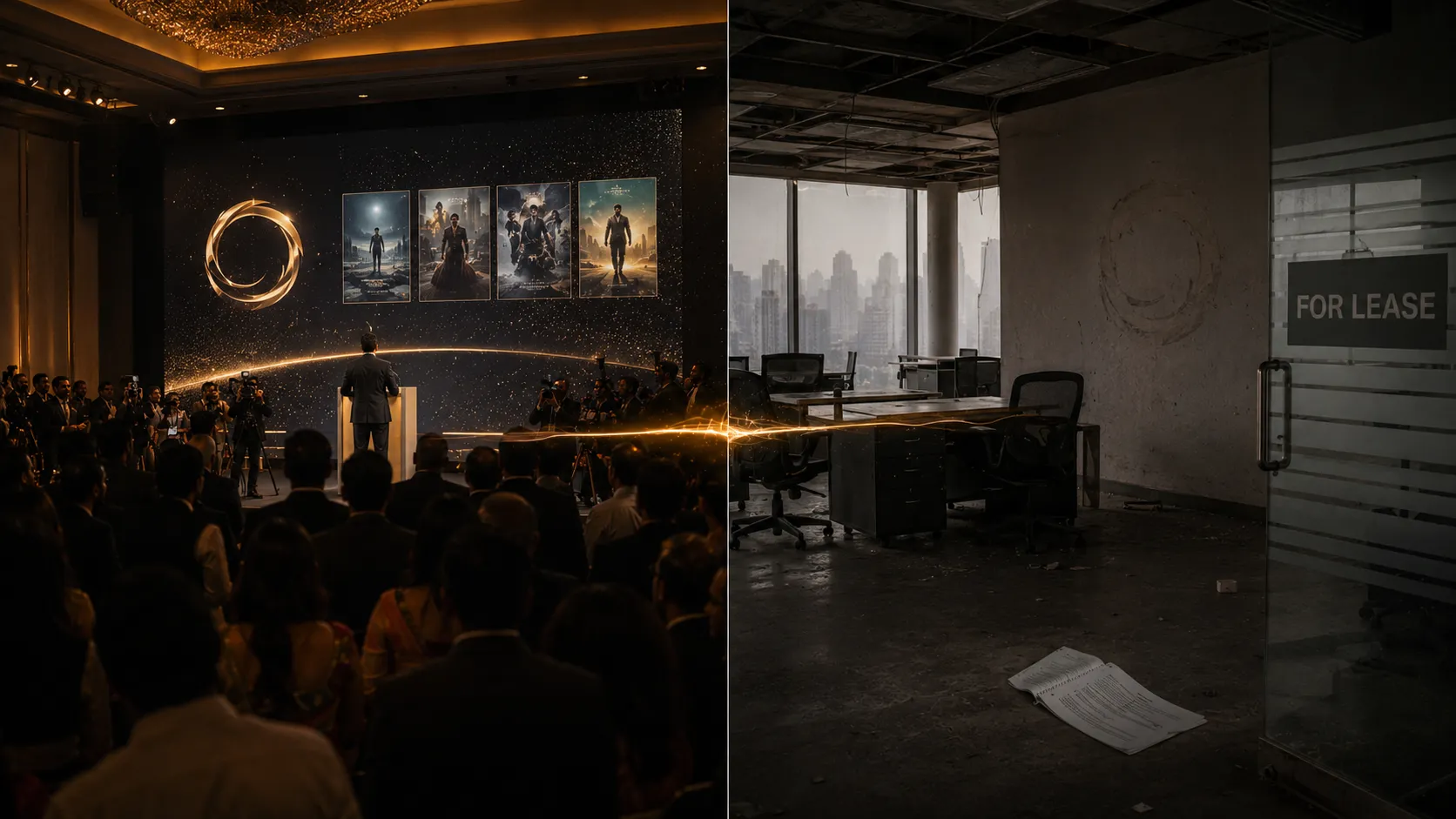
The ₹300 Crore Bonfire: How a Once‑Promising Bollywood Mini‑Studio Burned Through a Fortune in 18 Months—And What Its Collapse Reveals About the Industry's Broken Economics
MUMBAI — May 30, 2026 — In January 2025, a production house launched with a splash that made the front pages of every trade publication in the country. The studio had been founded by a successful talent manager who had spent two decades building relationships with the biggest stars in Bollywood, and who had convinced a consortium of high‑net‑worth investors—industrialists, real‑estate developers, a Gulf‑based family office—to back his vision of a new kind of film company: lean, talent‑first, data‑driven, built for the streaming era. The initial capital commitment was ₹300 crore. The slate, announced at a glamorous launch event at a five‑star hotel, included six films—a mix of star‑driven event movies, mid‑budget content‑driven dramas, and a web series for a major streaming platform. The talent manager, now the studio's CEO, told the assembled journalists that his company would be profitable within two years and would challenge the dominance of the legacy studios that had, in his view, grown complacent and inefficient.
Eighteen months later, the studio is gone. It has produced exactly two films—both of which underperformed at the box office—and its streaming series was cancelled after one season. Its offices in Andheri have been vacated, its staff laid off, its investors are fighting among themselves about who bears responsibility for the losses. The ₹300 crore is gone—spent on star fees, on marketing campaigns that failed to generate returns, on overheads that ballooned far beyond what the business could support. The talent manager who founded the studio has returned to his previous career, representing the same stars he once hoped to compete against. And the industry, which watched the collapse with a mixture of schadenfreude and recognition, has been left to ask itself a question that no one wants to answer aloud: how many other mini‑studios are heading for the same fate?

The Cost‑Structure Trap
The most important cause of the mini‑studio's collapse was not a single bad decision. It was a cost structure that was fundamentally misaligned with the revenue the business could generate. The studio launched with a slate that was designed to compete with the legacy players—YRF, Dharma, T‑Series—but it lacked the infrastructure that those players had spent decades building. It had no distribution network of its own, which meant it was dependent on third‑party distributors who took a significant share of the revenue. It had no in‑house visual‑effects capability, which meant it was paying premium rates to external vendors. It had no library of intellectual property to generate the steady, predictable income—from streaming, satellite, and music rights—that cushioned the legacy studios against the volatility of the box office. It was a startup trying to compete with incumbents on their own terms, and the incumbents' terms were designed to make that competition impossible.
The star‑fee problem was particularly acute. The studio launched with a commitment to a "talent‑first" model—a philosophy that was supposed to mean close creative collaboration with the stars, but that in practice meant paying premium rates to secure the participation of actors who were already committed to multiple other projects. The studio's first two films together spent approximately ₹120 crore on star fees alone—roughly 40 percent of the total capital commitment—before marketing, production, or overheads. The stars who took those fees were, in many cases, the same stars whose talent‑management agency had represented them for years. The conflict of interest was not illegal, but it was structural: the CEO who was supposed to be controlling costs was, in effect, negotiating against himself.
The overhead burden was the silent killer. The studio launched with a team of approximately 80 people—development executives, marketing professionals, finance staff, assistants—before it had produced a single frame of content. The office in Andheri, a premium commercial space with a five‑year lease, was furnished at a cost that exceeded ₹5 crore. The CEO's travel budget, the marketing team's discretionary spending, the consultants who were hired to advise on strategy—each of these was manageable individually, but collectively they consumed a share of the capital that left insufficient margin for the business to survive a single underperforming release. The studio was built for scale before it had earned the revenue to justify that scale. The burn rate was unsustainable, and when the revenue failed to materialise, the burn consumed everything.
The Slate That Wasn't
The mini‑studio's slate—six films, a mix of event movies and mid‑budget dramas—was announced with great fanfare, but only two of the six films were ever produced. The remaining four were cancelled or indefinitely postponed, and the reasons for the cancellations reveal as much about the industry's dysfunction as the studio's own failures.
One film was built around a star whose availability was always contingent. The star had committed to the project verbally—the CEO's relationship with the star, built over years as his talent manager, was supposed to guarantee the commitment—but the star's schedule was controlled by a larger studio that had priority on his dates. When the larger studio's project was delayed, the star's availability window shifted—and the mini‑studio, which had no contractual leverage to enforce the commitment, was forced to wait. The waiting consumed months of development time, during which the project's budget was being revised, its crew was being held on retainer, and its financing costs were accumulating. By the time the star was finally available, the mini‑studio's financial position had deteriorated to the point that the project was no longer viable. The film was cancelled, the star moved on to another project, and the development costs—approximately ₹8 crore—were written off.
A second film was built around a director who had delivered a major hit two years earlier and who was, at the time of the slate announcement, the most sought‑after filmmaker in the industry. The mini‑studio had outbid several larger studios for the director's services, paying a premium that reflected the director's market value at the peak of the cycle. By the time the film was ready to enter production, the director's most recent release had underperformed—not disastrously, but enough to reduce his commercial appeal—and the mini‑studio's investors, who had approved the budget based on the director's previous success, were suddenly reluctant to proceed. The director, who had other offers, walked away. The mini‑studio was left with a script, a partially assembled crew, and another write‑off.
The streaming series that was supposed to be the studio's entry into the digital market was cancelled by the platform after one season. The series had been commissioned at a budget that was, by the standards of the Indian streaming industry, generous—approximately ₹40 crore for eight episodes. But the platform's data, which tracked viewer engagement with a granularity that the studio's executives did not fully understand, showed that the series was losing audience share with each successive episode. The platform exercised its option to cancel—a contractual right that the mini‑studio had agreed to without fully appreciating the risk—and the studio was left with a show that had no home, a crew that had been assembled for a second season that would never be made, and a write‑off that was larger than any of its film projects. The streaming deal, which had been sold to investors as a reliable revenue stream, had become the studio's largest single loss.
The Investor Reckoning
The mini‑studio's investors—the industrialists, the real‑estate developers, the Gulf‑based family office—had been sold a vision of the entertainment industry that was, in retrospect, misleading. They had been told that the streaming revolution had created a new market for content, that the barriers to entry had fallen, that a nimble, talent‑focused studio could compete with the legacy players. The vision was not entirely false. The barriers to entry had fallen, in some respects—the cost of production technology had declined, the streaming platforms were hungry for content, and the audience was more open to new voices than it had been in decades. But the barriers that remained—the distribution networks, the IP libraries, the relationships with stars and exhibitors, the institutional knowledge of how to manage a film business through the inevitable cycles of success and failure—were higher than the investors had been led to believe. The mini‑studio was not competing on a level playing field. It was competing against incumbents who had spent decades building the infrastructure that the mini‑studio had assumed it could do without.
The investor reckoning has now begun. The consortium of high‑net‑worth individuals who backed the studio are fighting among themselves about who bears responsibility for the losses, and the CEO who raised the capital is facing angry questions from the people whose money he lost. The episode has also had a chilling effect on the broader market for entertainment investment. The family offices, the industrialists, and the Gulf‑based investors who were once eager to participate in the Indian film industry's growth are now more cautious—more likely to demand transparency, more likely to negotiate downside protection, more likely to walk away from a deal that seems too good to be true. The mini‑studio's collapse has made it harder for every other startup studio to raise capital—and the legacy players, who watched the collapse with quiet satisfaction, are the beneficiaries. The barriers to entry, it turns out, are higher than they appeared. The graveyard of mini‑studios is filling, and the next entrant will have to work harder than the last to convince investors that it will not end up in the same grave.
What This Signals
The collapse of the mini‑studio is not primarily a story about a single failed venture. It is a story about the structural conditions that make such failures likely—the star‑fee inflation that consumes the largest share of any film's budget, the distribution bottleneck that makes it impossible for new entrants to reach the audience on equal terms, and the streaming‑platform dynamics that turn a guaranteed‑revenue promise into a cancellation risk. The Indian film industry is not a market that rewards innovation and efficiency. It is a market that rewards scale, relationships, and the patient accumulation of infrastructure over decades. The mini‑studio that launches with ₹300 crore and a PowerPoint presentation is not disrupting that market. It is feeding it—providing a fresh source of capital for the stars, the distributors, and the vendors who have learned, over years of boom‑and‑bust cycles, how to extract the maximum value from the newcomers before the newcomers inevitably fail. The mini‑studio graveyard is not a collection of bad decisions. It is a structural feature of an industry that is designed to protect the incumbents at the expense of the entrants. The next mini‑studio that launches with a splash will be told, by the same people who enabled the last one's collapse, that this time will be different. It will not be.


