The ₹30 Crore Note: How AR Rahman's Record-Breaking Ramayana Deal—and His "Terrifying" Hans Zimmer Collaboration—Is Rewriting the Economics of Film Music in India
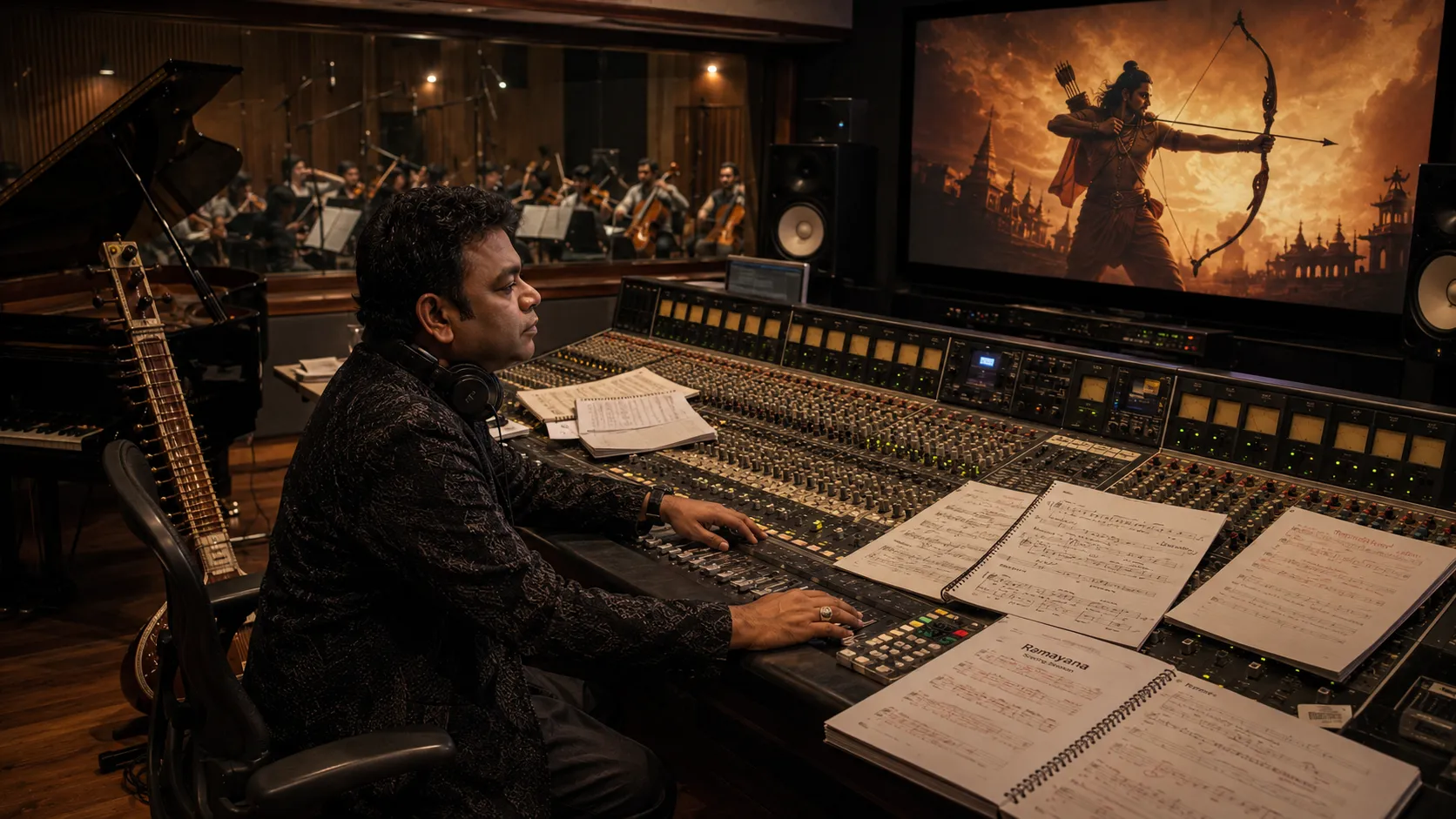
MUMBAI — May 28, 2026 — In the spring of 2026, as Nitesh Tiwari's Ramayana entered its final months of post-production ahead of a Diwali release that the entire Indian film industry is watching with a mixture of hope and anxiety, a single number began circulating through the trade that was, in its own way, as staggering as the film's ₹4,000 crore budget. The number was ₹30 crore. It was not a visual-effects line item or a star's fee. It was the amount that A.R. Rahman, the two-time Academy Award-winning composer, was reportedly charging to create the music for the most expensive film in Indian cinema history—plus a share of the profits.
The figure, first reported by Telugu Cinema and subsequently confirmed by multiple trade outlets including Moneycontrol and Sacnilk, represents the largest upfront payment ever made to a music composer in Indian cinema. Rahman's usual fee, according to industry sources, ranges between ₹12 crore and ₹15 crore per film—already at the top of the market. His remuneration for Ramayana is, by that measure, roughly double his standard rate. And the upfront payment is only part of the deal. "According to the most recent sources, the Academy Award winner would also receive a portion of the revenues in addition to the enormous ₹30 crore," Moneycontrol reported. The profit-sharing component is unprecedented for a music composer in Indian cinema. Composers have historically been treated as work-for-hire—paid a flat fee, however generous, and sent home before the box-office returns began to flow. Rahman's Ramayana deal changes that calculus. If the film performs at the upper end of its projections—worldwide grosses of ₹2,500 crore or more—the profit-sharing component could increase Rahman's total compensation substantially, making it not just the largest music deal in Indian cinema history, but one of the largest talent deals of any kind.
The Hans Zimmer Equation
The most strategically significant dimension of the Ramayana music deal is not the ₹30 crore figure. It is the collaboration between Rahman and Hans Zimmer—the German-born, Hollywood-legend composer whose credits include The Lion King, Gladiator, The Dark Knight, Inception, Interstellar, and Dune. Zimmer is, by any measure, one of the most commercially successful and critically respected film composers of all time. His involvement in an Indian film is unprecedented at this scale, and the pairing of Rahman and Zimmer—two Oscar winners from radically different musical traditions, collaborating on a single score—is one of the most ambitious musical experiments in cinema history.
The collaboration has been, by Rahman's own account, both exhilarating and deeply challenging. "It's terrifying for both of us," he told The Hollywood Reporter in January. "We're scoring something so iconic and so important to the world. So in the promo, I think he had a soundscape, then I took that and added the Sanskrit words at the end and everything." The division of labour between the two composers has been carefully calibrated: Rahman handles the songs and the Indian musical elements—the ragas, the devotional bhajans, the Sanskrit chants—while Zimmer contributes to the background score and the large-scale orchestral themes. The combination is designed to create a musical experience that is simultaneously rooted in Indian tradition and accessible to global audiences. "His name is going to make many people watch the movie definitely," Rahman told Mirchi. "At least a certain section is going to watch what Hans Zimmer has done in an Indian movie."
Zimmer's involvement is also a commercial signal. His name on the poster—alongside Rahman's—tells international audiences that Ramayana is not merely an Indian film with subtitles, but a global event designed to compete with the largest Hollywood productions. The same strategy has been employed by Chinese filmmakers seeking to expand their international reach, and by Korean producers targeting Western audiences. The Ramayana team is betting that the combination of Rahman's Indian credibility and Zimmer's global brand will open markets—particularly in North America, Europe, and China—that have historically been difficult for Indian films to penetrate.
Rahman, speaking to the BBC Asian Network, framed the collaboration in terms that captured both its cultural significance and its symbolic power. "Hans Zimmer is Jewish, I am Muslim, and the Ramayana is Hindu," he said. "It's coming from India to the whole world, with love." The statement was more than a soundbite. It was a deliberate reframing of the film's religious content as a vehicle for cultural exchange rather than sectarian assertion—a message aimed at the international audiences who will determine whether Ramayana's ₹4,000 crore bet pays off.
The practical mechanics of the Rahman-Zimmer collaboration are unusual. The two composers have completed only a few joint sessions so far, Rahman revealed, and the process has required both men to "unlearn" their conventional instincts. "What's complicated is that we're taking something so epic, which every Indian knows, and we have to give them something new," Rahman said. "So what does it take? We have to unlearn certain things, like how our instincts demand, 'Oh, this is how Ramayana should be done,' but also imbibe the timeless quality that exists in the culture." The collaboration with lyricist Dr. Kumar Vishwas—whom Rahman has described as someone whose "every atom… speaks Ramayana"—adds a further layer of cultural authenticity to the project.
The Profit-Sharing Precedent
The most commercially innovative dimension of the Rahman deal is not the upfront fee, but the profit-sharing arrangement that accompanies it. For decades, the Indian film industry has operated on a model in which composers—like screenwriters, cinematographers, and editors—are paid a fixed fee for their work and have no ongoing financial stake in the films they help create. The stars and the producers capture the upside. The creative talent is compensated for its labour, not for its contribution to the film's commercial success.
The Rahman deal breaks that model. By securing a share of the film's profits—the exact percentage has not been disclosed, but trade speculation suggests it could range from 1 percent to 3 percent of the producer's share—Rahman has aligned his financial interests with the film's commercial performance in a way that no Indian composer has done before. If Ramayana succeeds at the box office, Rahman's total compensation will reflect that success. If it does not, the profit-sharing component will be worth less than the headlines suggest. The arrangement is, in effect, a bet—by Rahman on the film, and by the producers on Rahman's ability to deliver music that enhances the film's commercial appeal.
The precedent is significant for the broader creative economy. The Indian film industry has spent decades underpaying its below-the-line talent relative to their contribution, and the Rahman deal—if it becomes public knowledge and is replicated by other composers, writers, and technicians—could begin to shift the balance of power. The star system, which concentrates financial rewards in the hands of a small number of actors, has been remarkably resistant to change. But the logic of profit-sharing is hard to resist: if a composer's work can make the difference between a hit and a disappointment, the composer should share in the upside. Rahman, by virtue of his stature and his negotiating power, has been able to secure what no composer before him could. Whether others can follow his lead will depend on the commercial outcome of Ramayana—and on whether producers, having conceded the principle to Rahman, are willing to extend it to others.
The Rahman Price Signal
The ₹30 crore figure is not merely a record. It is a price signal—a message to the market about the value of music in the economics of modern Indian cinema. For decades, film music was treated as a marketing expense: the songs were released before the film to generate buzz, and the background score was commissioned as an afterthought. The composer was a respected but secondary figure, necessary for the success of the film but not central to its economic structure. The Rahman deal suggests that the industry's hierarchy is shifting. In an era when the largest Indian films are competing with Hollywood blockbusters for global audiences, the quality of the music—the songs, the score, the sound design—is no longer a secondary consideration. It is a primary competitive advantage.
The numbers bear this out. The reported ₹30 crore figure represents roughly 0.75 percent of the film's ₹4,000 crore budget—a rounding error by the standards of a production that is spending hundreds of crores on visual effects and star salaries. But the return on that investment, if the music is successful, will be measured not in the budget percentage but in the cultural impact and the commercial draw that Rahman's name—and Zimmer's—brings to the project. A hit soundtrack can sell millions of units, generate billions of streams, and create a cultural footprint that outlasts the film's theatrical run by decades. The Dangal soundtrack, composed by Pritam, has accumulated billions of streams since the film's release. The Baahubali score, composed by M.M. Keeravani, has become synonymous with the visual language of the franchise. The Ramayana music, if it succeeds, will be the sonic backdrop to one of the most culturally significant films in Indian history—and the ₹30 crore that the producers have invested in Rahman will look, in retrospect, like a bargain.
Rahman's usual fee—between ₹12 crore and ₹15 crore—places him at the top of the Indian composer market, but the Ramayana premium reflects the specific demands of the project. The film requires a musical vocabulary that spans devotional hymns, epic battle themes, romantic duets, and large-scale orchestral set pieces, all of which must cohere into a unified sonic identity that serves the narrative across two films and six hours of runtime. The collaboration with Zimmer adds a layer of complexity—and cost—that no other Indian film has attempted. And the global ambitions of the project demand a musical standard that can compete with the best that Hollywood has to offer. The ₹30 crore figure is not a fee for Rahman's labour. It is an investment in the sonic architecture of a film that must succeed on a global scale, and the producers—Namit Malhotra's Prime Focus Studios, in partnership with Yash's Monster Mind Creations—have concluded that the investment is justified.
The composer's other major project of 2026—Peddi, the Ram Charan sports drama directed by Buchi Babu Sana—carries a substantially lower fee, consistent with Rahman's standard rate. The differential between the two projects illustrates the economic logic of the Ramayana premium: the larger the film, the larger the musical investment, and the larger the composer's compensation. The logic is not unique to India—Hollywood composers like Zimmer and John Williams command fees that reflect the scale of the films they score—but its application to the Indian market is new, and it will be studied by composers, producers, and agents for years to come.
The Ramayana Music Strategy
The musical architecture of Ramayana is, in some ways, as ambitious as its visual effects. The film requires music that serves multiple functions simultaneously: it must anchor the narrative in Indian cultural and religious tradition, it must provide the emotional resonance that transforms spectacle into storytelling, and it must communicate across linguistic and cultural boundaries to audiences who may have no prior exposure to the Ramayana. The solution that the producers have devised—the Rahman-Zimmer collaboration, the involvement of Dr. Kumar Vishwas as lyricist, the emphasis on Sanskrit chants and devotional themes—is designed to meet all three requirements at once.
The recently released teaser, which Rahman scored, provides a preview of the sonic approach. The music blends traditional Indian instrumentation—the sitar, the tabla, the mridangam—with a large-scale orchestral palette that recalls Zimmer's work on Gladiator and Dune. The Sanskrit chants that Rahman incorporated into the promotional material—"I took that and added the Sanskrit words at the end and everything," he said—serve as a bridge between the Indian and the universal, rooting the music in the specific cultural context of the Ramayana while communicating through a sonic language that requires no translation. The approach is deliberate: the Sanskrit syllables carry meaning for those who understand them and function as pure sound for those who do not, creating a musical experience that is simultaneously accessible and authentic.
The two-part structure of the film—Part 1 on Diwali 2026, Part 2 on Diwali 2027—creates additional musical opportunities and challenges. The soundtrack for Part 1 must establish the sonic world of the Ramayana, introducing the themes that will define each character and each emotional register. The soundtrack for Part 2 must develop those themes, deepen their resonance, and bring them to a conclusion that satisfies audiences who have waited a year between instalments. The musical arc across the two films is, in effect, a single composition—six hours of music, composed by two of the world's greatest living film composers, designed to be experienced as a unified work. The ₹30 crore fee, in this context, is not for a single soundtrack. It is for the musical foundation of a franchise that will define Indian cinema for a generation.
The Oscar Calculus
The most speculative dimension of the Rahman deal—but the one that is almost certainly being discussed in the boardrooms of Prime Focus Studios—is the Academy Awards. Rahman has already won two Oscars, for Slumdog Millionaire (2009). Zimmer has won two, for The Lion King (1994) and Dune (2021). The combination of their talents on a single film—particularly a film of the scale and cultural significance of Ramayana—creates the possibility of awards recognition that no Indian film has ever achieved.
The Oscars are not the primary motivation for the Rahman-Zimmer collaboration—the primary motivation is commercial, driven by the global audience that Zimmer's name can attract—but the awards potential is a valuable secondary benefit. A Best Original Score nomination, or even a win, would confer a level of institutional prestige on Ramayana that no Indian film has ever received, and would extend the film's cultural footprint well beyond its theatrical run. The producers, who are betting ₹4,000 crore on the project's success, are leaving nothing to chance. The Rahman-Zimmer collaboration is, in part, an insurance policy—a hedge against the possibility that the film's visual effects, its performances, or its narrative coherence might fall short of expectations. The music, at least, will be beyond reproach.
What This Signals
The AR Rahman Ramayana deal is not primarily about a composer's fee. It is about the structural transformation of the Indian film music industry—and about the recognition, belated but unmistakable, that music is not a secondary expense but a primary competitive advantage in the global marketplace for cinema.
For decades, the Indian film industry treated its composers as craftsmen rather than artists—respected, well-compensated, but ultimately subordinate to the stars and directors who dominated the commercial conversation. The Rahman deal breaks that hierarchy. By securing an upfront fee of ₹30 crore—double his standard rate—and a share of the film's profits, Rahman has established a new benchmark for what a composer's contribution is worth. The benchmark will not be reached by every composer, or even by most. But its existence changes the conversation. The next composer who negotiates with a major studio will be able to point to the Rahman precedent, and the studio will have to explain why the precedent does not apply. The conversation will be uncomfortable for the studios, but it is long overdue.
The collaboration with Hans Zimmer is similarly transformative. It demonstrates that the largest Indian productions can attract the world's most celebrated talent—not as a favour, but on commercial terms—and that the combination of Indian and global musical traditions can produce something that neither could produce alone. The Ramayana score, when it is finally heard, will be the most ambitious musical experiment in Indian cinema history. The composer who is leading it is not just the highest-paid musician in the country. He is, at this moment, the most important—and the ₹30 crore that the producers have invested in him is the clearest signal yet that the industry has finally recognised the value of what he does.
AR Rahman is no longer the young composer who built his first studio in Chennai with borrowed equipment and a conviction that Indian film music could be more than it was. He is the two-time Oscar winner who has scored the most expensive film in Indian history, the collaborator of Hans Zimmer, and the architect of a deal that has rewritten the economics of his profession. The ₹30 crore figure is a record, but it is also an argument—that music is not a cost to be managed, but an investment to be made. The Ramayana soundtrack will be released this Diwali. The industry will be listening.


