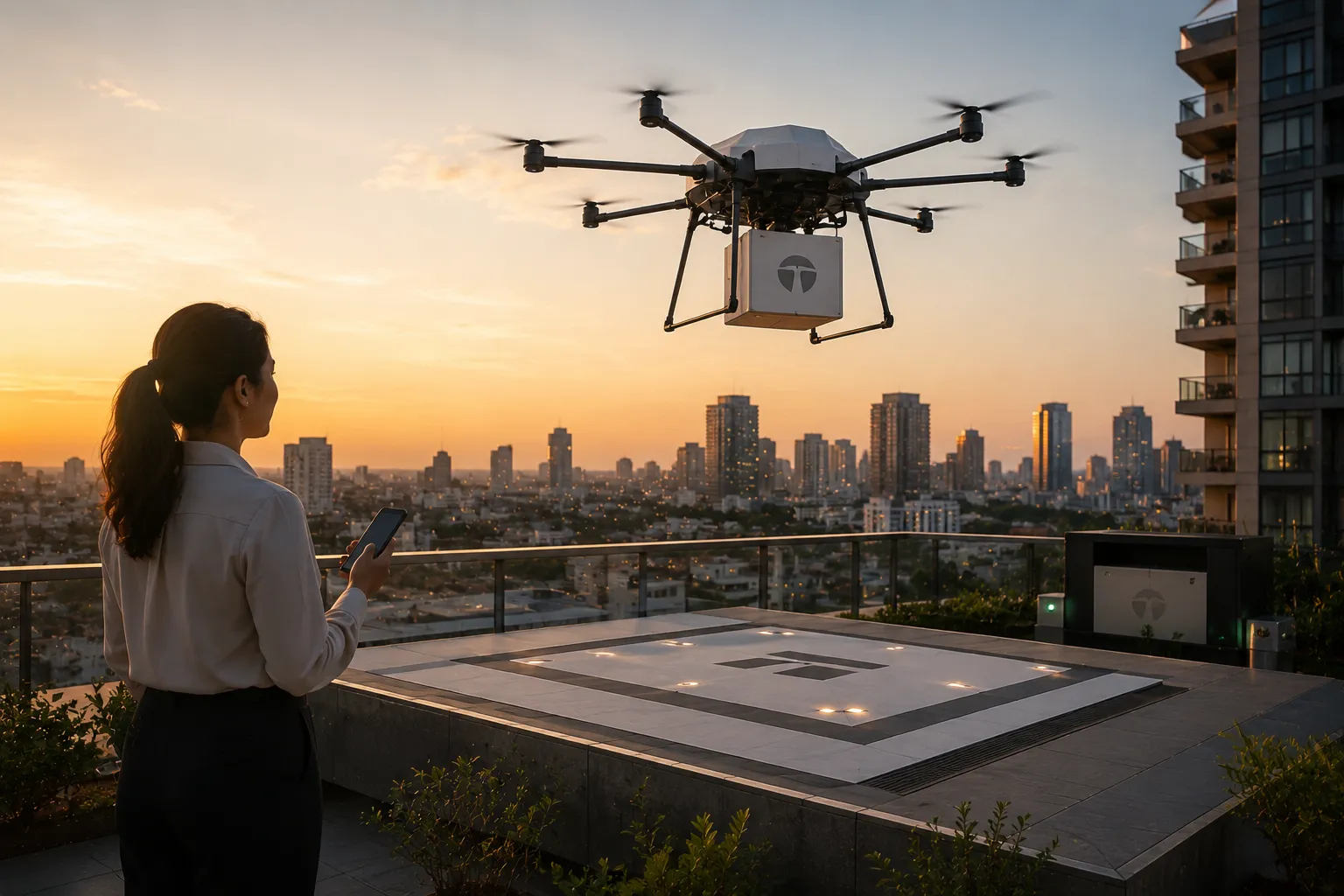
The 30,000‑Drone Army: After Years of Regulatory Paralysis, Delivery Drones Are Finally Taking Over Indian Skies—And the Logistics Industry Will Never Be the Same
BENGALURU — May 30, 2026 — In the summer of 2022, a hexacopter carrying a small package of medicines lifted off from a government hospital in the Vikarabad district of Telangana and flew approximately 15 kilometres to a primary health centre in a remote village that was inaccessible by road during the monsoon. The flight, conducted under a special exemption from the Directorate General of Civil Aviation, was a proof‑of‑concept: a demonstration that an unmanned aerial vehicle could deliver essential medical supplies to a population that was cut off from the conventional logistics network. The drone was operated by a Bengaluru‑based startup called Skye Air Mobility. The flight took 18 minutes. The same delivery by road would have taken four hours. The proof of concept was, by any measure, a success. And then, for three years, nothing happened. The regulatory framework that would allow such flights to scale did not exist. The startups that had developed the technology waited, their drones grounded, their investors impatient, their potential customers—the hospitals, the e‑commerce platforms, the food‑delivery companies—frustrated by the gap between what was technically possible and what was legally permissible.
That era is now over. As of May 2026, approximately 30,000 delivery drones are operating commercially across 12 Indian cities, under the liberalised Drone Rules 2025 that were notified by the Ministry of Civil Aviation in January of last year. The drones are delivering medicines, groceries, food, e‑commerce packages, and, in a growing number of cases, urgent documents and samples between laboratories and hospitals. The companies that are operating them—Skye Air Mobility, Redwing, TechEagle, and a dozen others—have raised over $800 million in combined venture funding. The logistics industry, which spent decades building a delivery network based on trucks, motorcycles, and human couriers, is being forced to adapt to a technology that promises to cut last‑mile delivery costs by up to 70 percent, reduce delivery times from hours to minutes, and reach populations that the conventional network cannot serve. The drone‑delivery revolution, which was stalled for years by regulatory paralysis, has finally arrived—and it is moving faster than anyone expected.
The Regulatory Breakthrough
The single most important variable in the drone‑delivery industry's trajectory was not technology. It was regulation. The Drone Rules 2021, which were the first attempt by the Indian government to create a modern regulatory framework for unmanned aerial vehicles, established the basic architecture—the classification of drones by weight, the requirements for operator registration and pilot licensing, the restrictions on where drones could fly and what they could carry. But the 2021 rules were designed primarily for recreational and small‑scale commercial use, and they imposed a set of constraints—the requirement for visual line‑of‑sight operation, the prohibition on autonomous flight, the limits on payload weight and flight distance—that made a scalable delivery network impossible. The startups that had been developing delivery‑drone technology were forced to operate under a series of special exemptions, each one negotiated individually with the DGCA, each one limited to a specific location, a specific use case, and a specific time period. The exemptions allowed the industry to demonstrate the technology, but they did not allow it to build a business.
The Drone Rules 2025, which were drafted after two years of consultation between the government, the industry, and the military, removed the most significant barriers. The new rules allow autonomous beyond‑visual‑line‑of‑sight flight for drones that are equipped with certified detect‑and‑avoid systems, that are connected to a central air‑traffic‑management platform, and that are operated by licensed drone‑service providers. The rules establish a framework for drone corridors—dedicated airspace, separated from manned aircraft, in which delivery drones can operate without the need for individual flight approvals. The rules also increase the maximum payload weight for commercial drones from 5 kilograms to 25 kilograms, and they allow drones to operate in urban areas, subject to local restrictions on noise, privacy, and public safety. The regulatory framework is not perfect—the industry is still pushing for further liberalisation, particularly on night operations and on flights over densely populated areas—but it is sufficient to support a commercial drone‑delivery industry, and the industry has responded by scaling at a pace that has surprised even the regulators.
The air‑traffic‑management platform, called the Unified Drone Traffic Management system, is the invisible infrastructure that makes the delivery‑drone network possible. The UTM, which is operated by a consortium of private companies under contract to the Airports Authority of India, tracks every commercial drone in the sky, assigns flight paths, de‑conflicts trajectories, and ensures that drones do not collide with each other or with manned aircraft. The UTM is integrated with the national airspace management system, and it is designed to scale to the hundreds of thousands of drones that the industry expects to be operating by 2030. The UTM is the essential infrastructure that the delivery‑drone industry needs, and the government's willingness to invest in it is a signal that the industry is being treated as a strategic priority rather than a regulatory nuisance.
The Economics of the Last Mile
The most powerful force driving the adoption of delivery drones is economic. The last‑mile delivery—the final leg of the journey from the distribution centre to the customer's doorstep—is the most expensive and least efficient segment of the logistics chain. It accounts for approximately 50 percent of the total cost of delivery, and it is constrained by the same factors that constrain every ground‑based logistics network: traffic congestion, fuel costs, labour shortages, and the simple, brute geometry of covering a large number of dispersed delivery points with a finite number of vehicles and drivers. The drone, which flies over the traffic, consumes a fraction of the energy, and requires no human driver, can reduce the cost of the last‑mile delivery by up to 70 percent—a reduction that is large enough to transform the economics of the entire logistics industry.
The cost savings are particularly significant for the three categories of delivery that are most suited to the drone: urgent medical supplies, high‑value e‑commerce packages, and food delivery. The hospital that needs to transport a blood sample to a laboratory 20 kilometres away can send it by drone for approximately ₹200, compared with approximately ₹800 for a dedicated motorcycle courier, and the drone will deliver it in 20 minutes rather than 90. The e‑commerce platform that wants to offer 30‑minute delivery to its premium customers can use drones to serve the high‑density urban neighbourhoods where the cost of ground‑based delivery is highest. The food‑delivery platform that is competing for the same customer can offer drone delivery at a price that is competitive with the motorcycle‑based alternatives, and the drone's speed advantage—10 minutes from restaurant to doorstep, compared with 30 to 40 minutes for a human rider—is a competitive differentiator that the platforms are willing to pay for.
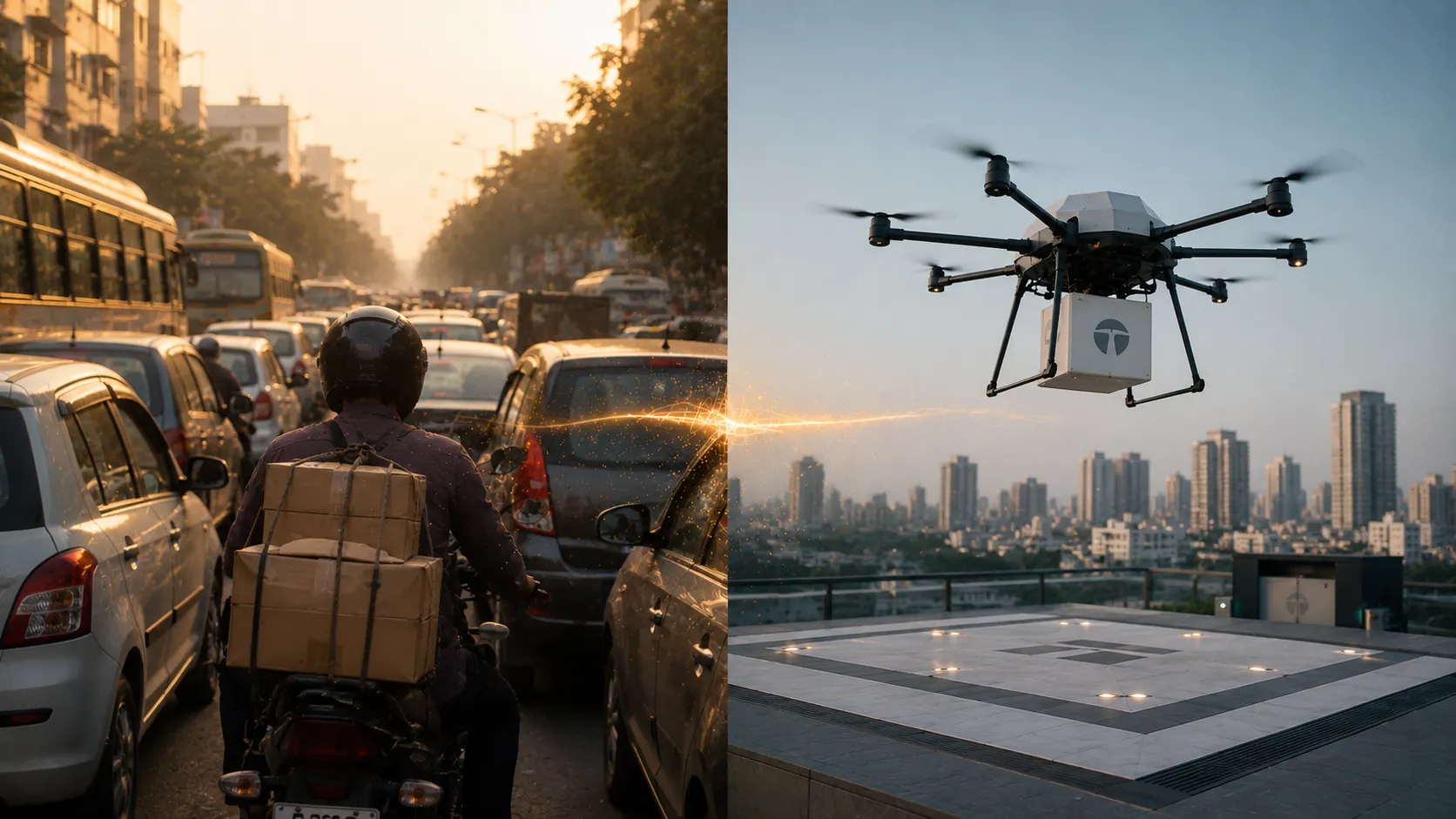
The cost savings are also enabling a new category of delivery that the ground‑based network could never serve: the hyper‑local, ultra‑urgent delivery to remote or inaccessible locations. The primary health centre in a Himalayan village that is cut off by snow for six months of the year can receive essential medicines by drone. The offshore oil platform that needs a replacement part can receive it within hours, rather than waiting for the next supply vessel. The disaster‑relief operation that needs to deliver food, water, and medical supplies to a population that has been cut off by floods or earthquakes can use drones to reach the affected areas before the ground‑based relief teams can arrive. The drone is not merely a faster, cheaper version of the motorcycle courier. It is a new category of logistics capability—a way of reaching places that the ground‑based network cannot reach, and of serving needs that the ground‑based network cannot serve.
The Competitive Landscape
The Indian drone‑delivery market is attracting a growing number of startups, each of which is pursuing a different segment of the market. Skye Air Mobility, which was one of the earliest entrants, has focused on the healthcare segment—delivering medicines, vaccines, and diagnostic samples between hospitals and laboratories—and has established partnerships with several state governments and hospital chains. Redwing, a Bengaluru‑based startup backed by Accel and the IFC, has been building a network for e‑commerce and food‑delivery companies, and has signed commercial agreements with Flipkart, Swiggy, and Zepto. TechEagle, a Lucknow‑based startup, has been focusing on the Tier‑2 and Tier‑3 city markets, where the ground‑based logistics infrastructure is less developed and the drone's advantage is greatest. The competitive landscape is intensifying, but the market is large enough to support multiple players, and the companies that are building their networks today are competing for a share of a market that is projected to exceed $5 billion by 2030.
The global technology companies are also entering the market. Amazon Prime Air, which has been developing its drone‑delivery programme for over a decade, received regulatory approval to begin operations in India in March 2026, and is currently piloting its service in Bengaluru and Hyderabad. Google Wing, which is already operating in the United States, Australia, and Finland, has been in discussions with the Indian government about launching in India. The global platforms bring technology, capital, and operational expertise that the Indian startups cannot match, but they also face the same regulatory, logistical, and competitive challenges that the domestic players face, and their entry into the market is a validation of the opportunity that the Indian startups have been pursuing for years.
The biggest competitive threat to the delivery‑drone industry is not another startup or a global platform. It is the quick‑commerce companies—the Zeptos, the Blinkits, the Swiggy Instamarts—that are building their own delivery networks based on human riders and dark stores, and that are achieving delivery times that are approaching the drone's speed in the most densely populated urban areas. The quick‑commerce company that can deliver groceries to a customer in 10 minutes using a network of hyper‑local dark stores and motorcycle riders is competing directly with the drone company that promises the same delivery time using a different technology. The competition between the two models—human‑powered hyper‑local delivery versus drone‑powered aerial delivery—is just beginning, and the outcome will determine the structure of the Indian logistics industry for the next decade.
What This Signals
The drone‑delivery takeoff is not primarily a story about technology. It is a story about the structural transformation of the Indian logistics industry—a shift from a ground‑based, labour‑intensive, road‑bound model to an aerial, automated, and increasingly autonomous model, and from a delivery network that was designed for the 20th‑century city to a network that is being designed for the 21st‑century one. The 30,000 drones that are currently flying are the leading edge of a fleet that is projected to exceed 500,000 by 2030, and the industry that is building them is creating a new infrastructure—the drone corridors, the UTM platform, the rooftop launch pads, the battery‑swapping stations—that will be as essential to the 21st‑century economy as the roads, the ports, and the fibre‑optic cables were to the 20th. The drone is not merely a delivery vehicle. It is a building block of the autonomous economy, and the economy that is being built around it is larger, faster, and more transformative than the sceptics who dismissed the drone as a toy ever imagined.


