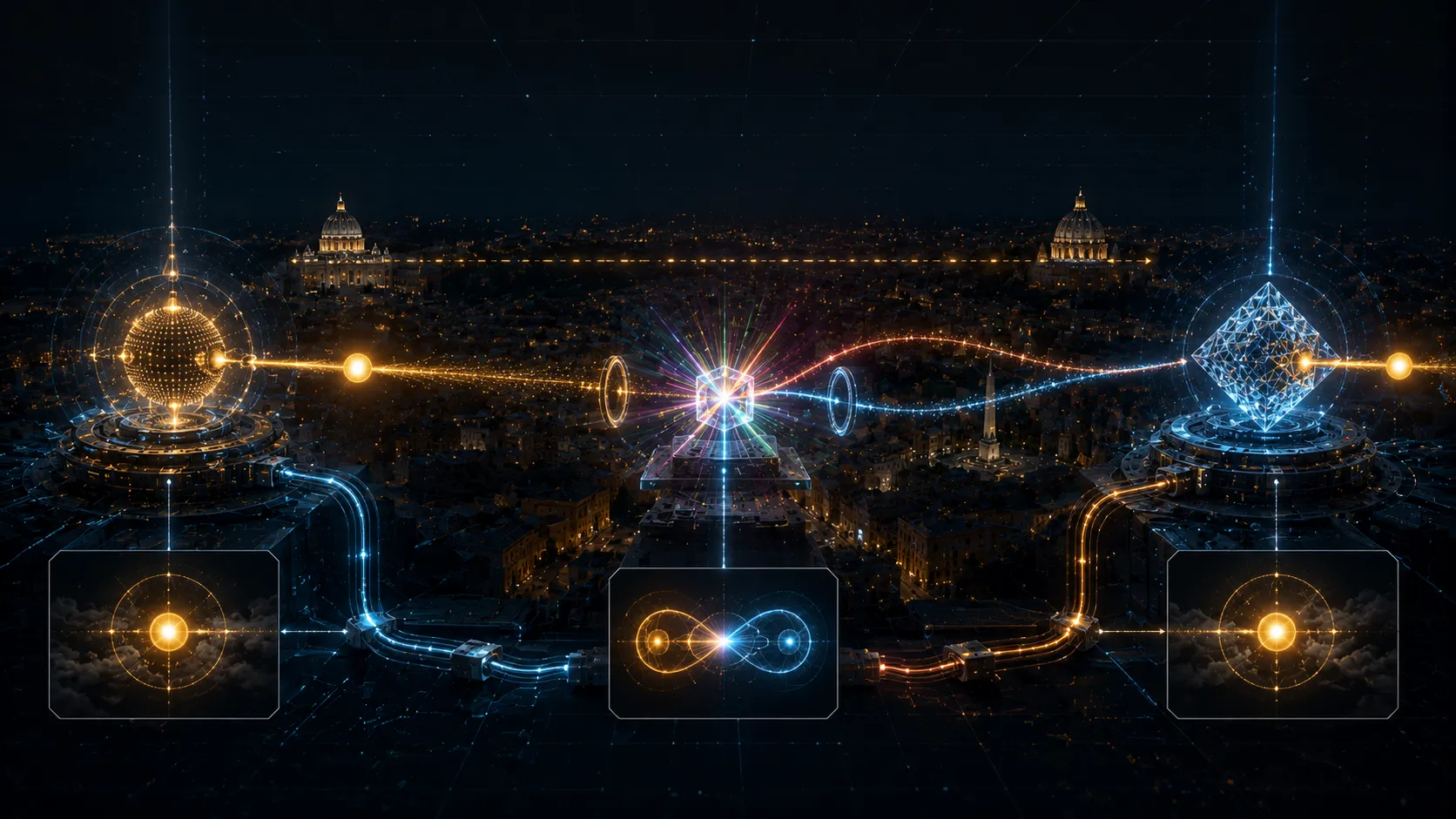
The 270-Meter Miracle: How a Photon Just Crossed Rome Without Moving — and What It Means for the Quantum Internet
ROME — May 18, 2026 — Two university buildings in Rome, separated by 270 meters of open air, a busy street, and the accumulated atmospheric chaos of an ancient city. In one building, a quantum dot — a semiconductor particle small enough to be governed by the strange laws of quantum mechanics — emitted a single photon. In the other building, a second quantum dot, physically different from the first, waited. What happened next, measured by instruments sensitive enough to detect the polarization state of a single particle of light, was something no one had ever done before: the quantum state of the first photon was teleported to the second, across the open-air gap, without either photon ever physically crossing the space between them.
The achievement, published in Nature Communications and now reverberating through the quantum technology community, represents the first successful teleportation between two independent and physically dissimilar quantum dot emitters over a hybrid fiber and free-space network. The fidelity reached 82 percent — comfortably above the classical threshold, meaning the result cannot be explained by any classical physics. The team, coordinated by Sapienza University of Rome with partners across Europe including Paderborn University, pulled off a feat that had been theorized for decades but never demonstrated outside of carefully controlled single-emitter laboratory conditions.
This is not teleportation in the Star Trek sense. No matter was moved. No human was beamed. What was transferred was information — the precise quantum state of a photon — and that, for the architects of the coming quantum internet, is everything.
The Two-Dot Problem
To understand why this experiment matters, one must first understand what had been holding quantum communication back. For years, researchers have demonstrated teleportation — the transfer of a quantum state from one particle to another — using photons generated from a single source. These experiments proved the principle. But they were not networks. A real quantum internet requires information to flow between devices that were not pre-matched at birth, built by different manufacturers, operating on different wavelengths, and separated by real-world distances. It requires, in the language of the field, dissimilar and independent emitters.
The Sapienza-Paderborn team solved this problem by engineering two quantum dots — nanoscale semiconductor structures that emit single photons on demand — with deliberately different electronic and optical properties. The GaAs quantum dots were embedded in nanophotonic cavities and integrated onto piezoelectric actuators to precisely control the electron structure and achieve ultra-low Fine Structure Splitting, necessary for generating high-fidelity entangled photon pairs. They then used external controls — strain and magnetic fields — to tune the emission wavelength and ensure the photons could interfere in the way the teleportation protocol requires. The synchronization was maintained using a GPS-disciplined oscillator, a technique borrowed from classical telecommunications but never before applied to quantum teleportation at this level of precision.
The 270-meter free-space link between the two university buildings was chosen deliberately to mirror the conditions that future quantum networks will face. "Free space quantum links suffer tremendously from environmental conditions such as heat, air quality, rain, and sunlight," Jöns explained. The team had to stabilize, synchronize, and maintain the link over long measurement times, contending with real-world turbulence that no laboratory experiment had ever confronted. "The main challenge was maintaining alignment and signal quality under real-world conditions," said postdoctoral researcher Alessandro Laneve and Professor Rinaldo Trotta of Sapienza University of Rome. The fact that they succeeded — and maintained fidelity above the classical threshold — is as much a feat of engineering as of physics.
A Decade of Patience
The experiment that captured headlines in 2026 was not a sudden breakthrough. It was the culmination of a strategic roadmap laid out more than ten years ago by Professors Jöns and Trotta, who envisioned quantum dots as sources of entangled photon pairs for quantum communication and teleportation protocols. "This result shows that our long-term strategic planning has paid off," Jöns said. "The combination of excellent materials science, nanofabrication and optical quantum technology was the key to our success."
Over approximately three years, a team of doctoral candidates and postdocs from Paderborn University worked intensively on optical measurements, data evaluation, and analysis. The quantum dots themselves were developed with the utmost precision at Johannes Kepler University Linz. Nanofabrication of the resonators was completed by partners at the University of Würzburg. Scientists at Sapienza University of Rome conducted the teleportation experiments. It was a Europe-wide research collaboration spanning four institutions in three countries, each contributing a specialized piece of the puzzle.
The technical infrastructure was equally distributed. The protocol exploited GPS-assisted synchronization, ultra-fast single photon detectors — specifically, superconducting nanowire single-photon detectors from Single Quantum — and active stabilization systems that compensated for atmospheric turbulence. The achieved teleportation state fidelity reached up to 82 ± 1 percent, above the classical limit by more than 10 standard deviations. "Fidelity below the classical threshold would mean you could get the same results with classical particles. So it is mandatory to be above the classical threshold," Jöns said. "The teleportation protocol itself proved more resilient to loss and noise than direct photon transmission, helping us maintain high fidelity even in a challenging urban environment."
The long-term nature of the collaboration is itself a signal about the kind of science that produces foundational breakthroughs. In an era when technology news cycles are measured in hours and investment horizons in quarters, the Rome teleportation experiment was a decade in the making. The quantum dots were not ordered from a catalog. The nanophotonic structures were not off-the-shelf components. The synchronization protocols were not downloaded from a repository. Everything had to be built, tested, refined, and integrated — a process that rewards patience and punishes haste.
Why Quantum Relays Matter
The significance of the Rome experiment extends beyond a single demonstration. It opens a path toward quantum relays — devices that can extend the range of quantum communication beyond the inherent limitations of fiber optic cable. In classical communication, signals degrade over distance and must be amplified by repeaters. In quantum communication, the no-cloning theorem forbids amplification of unknown quantum states. The only way to extend range is through teleportation and entanglement swapping — techniques that this experiment brings closer to practical deployment.
The next target is entanglement swapping between two remote quantum dots, a prerequisite for a functional quantum relay. "Swapping requires at least a four-photon coincidence measurement compared to three for teleportation, making it much harder," Jöns said. He added that he expects continued improvements in emitter brightness and indistinguishability to make that possible, "hopefully next year." The Paderborn press release noted that deterministic quantum sources produce relatively few photon pairs, but that the Rome results confirm the approach is viable for the next phase.
The broader context is a global race toward quantum networking. IBM and Cisco recently emphasized that teleportation and entanglement distribution between separated systems will be essential for distributed quantum computing architectures. In February 2026, Qunnect and Cisco demonstrated metro-scale entanglement swapping over 17.6 kilometers of deployed fiber in New York City — achieving record swapping rates of 1.7 million pairs per hour locally and 5,400 pairs per hour over deployed fiber, with polarization fidelity above 99 percent. That experiment used atomic entanglement sources at room temperature rather than quantum dots, but the complementary approaches — quantum dots for deterministic emission, atomic sources for room-temperature operation — suggest that the quantum networking toolkit is diversifying rapidly.
The Sapienza-Paderborn team has provided a key building block for a solid-state quantum relay. While Qunnect and Cisco demonstrated swapping over fiber with atomic sources, the quantum dot approach offers the advantage of on-demand, deterministic photon generation — a capability that becomes essential as networks scale beyond point-to-point connections into hub-and-spoke architectures serving multiple users simultaneously.
From Three Nodes to Three Thousand
The quantum internet, when it arrives, will not look like the classical internet. It will be built on fundamentally different principles — entanglement rather than packet routing, teleportation rather than signal amplification, quantum repeaters rather than classical switches. And it will enable capabilities that no classical network can match: communication secured by the laws of physics rather than the limits of mathematics, distributed quantum computing that links processors across cities, and quantum sensor networks that achieve precision impossible for any single device.
But to get from laboratory demonstrations to metropolitan-scale deployment, the field must solve a hierarchy of problems. The first is the single-source problem — the constraint that teleportation only worked between photons from the same emitter. The Rome experiment has now solved that problem, demonstrating that dissimilar quantum dots can be tuned and synchronized to serve as independent nodes in a network.
The second is the distance problem. The 270-meter free-space link in Rome is a proof of principle, not a deployed network. Scaling to metropolitan distances — tens of kilometers — will require quantum repeaters that can perform entanglement swapping between remote nodes, extending the range beyond the loss limits of fiber and free-space channels. The entanglement swapping experiment that Jöns expects "hopefully next year" is the next rung on that ladder.
The third is the scaling problem. A quantum network with three nodes — the Sapienza campus configuration — must eventually become a network with three thousand nodes, or three million. That scaling requires standardized hardware, automated synchronization, software-defined orchestration, and the kind of industrial-grade reliability that the classical internet achieved over decades. The Cisco-Qunnect demonstration in New York, with its room-temperature endpoints and centralized cryogenic hub, points toward one architectural solution. The quantum dot approach in Rome points toward another. The field will likely need both.

What This Signals
The Rome teleportation experiment is not a product announcement. There is no startup attached to it, no funding round, no go-to-market strategy. It is a scientific result, published in a peer-reviewed journal, achieved by a consortium of public universities and research institutes. But it is a scientific result with unusually clear engineering implications, and the timing — arriving in the same season that Wall Street is pouring $725 billion into AI infrastructure and the quantum networking industry is achieving record entanglement swapping rates on commercial fiber — gives it a resonance that a purely academic demonstration might lack.
The quantum internet is still years, perhaps decades, from commercial deployment. The challenges are immense: scaling quantum dot production, reducing error rates, maintaining fidelity over longer distances, and building the classical control infrastructure required to orchestrate a network of quantum devices. The Sapienza-Paderborn experiment used a 270-meter free-space link; a metropolitan-scale network would require kilometers. A transcontinental network would require satellites.
But the direction of travel is unmistakable. In November 2025, the foundational teleportation results were published in Nature Communications. In February 2026, Qunnect and Cisco demonstrated entanglement swapping over deployed fiber in New York City. Sometime in the next year, the Sapienza-Paderborn team expects to demonstrate entanglement swapping between two quantum dots — the first quantum relay with deterministic solid-state sources. The sequence of milestones is accelerating, and each one removes a barrier that, a decade ago, was considered fundamental.
"The experiment impressively demonstrates that quantum light sources based on semiconductor quantum dots could serve as a key technology for future quantum communication networks," Jöns said. "Successful quantum teleportation between two independent quantum emitters represents a vital step towards scalable quantum relays and thus the practical implementation of a quantum internet."
The photon that crossed Rome without moving did not carry any secret message. It carried a proof: that information can be transferred between independent quantum devices in a real urban environment, across open air, contending with heat and turbulence and the accumulated noise of a living city. That proof is not the quantum internet. It is the demonstration that the quantum internet is possible — not in theory, but in practice, on a Tuesday afternoon, between two university buildings separated by 270 meters of Roman air.


