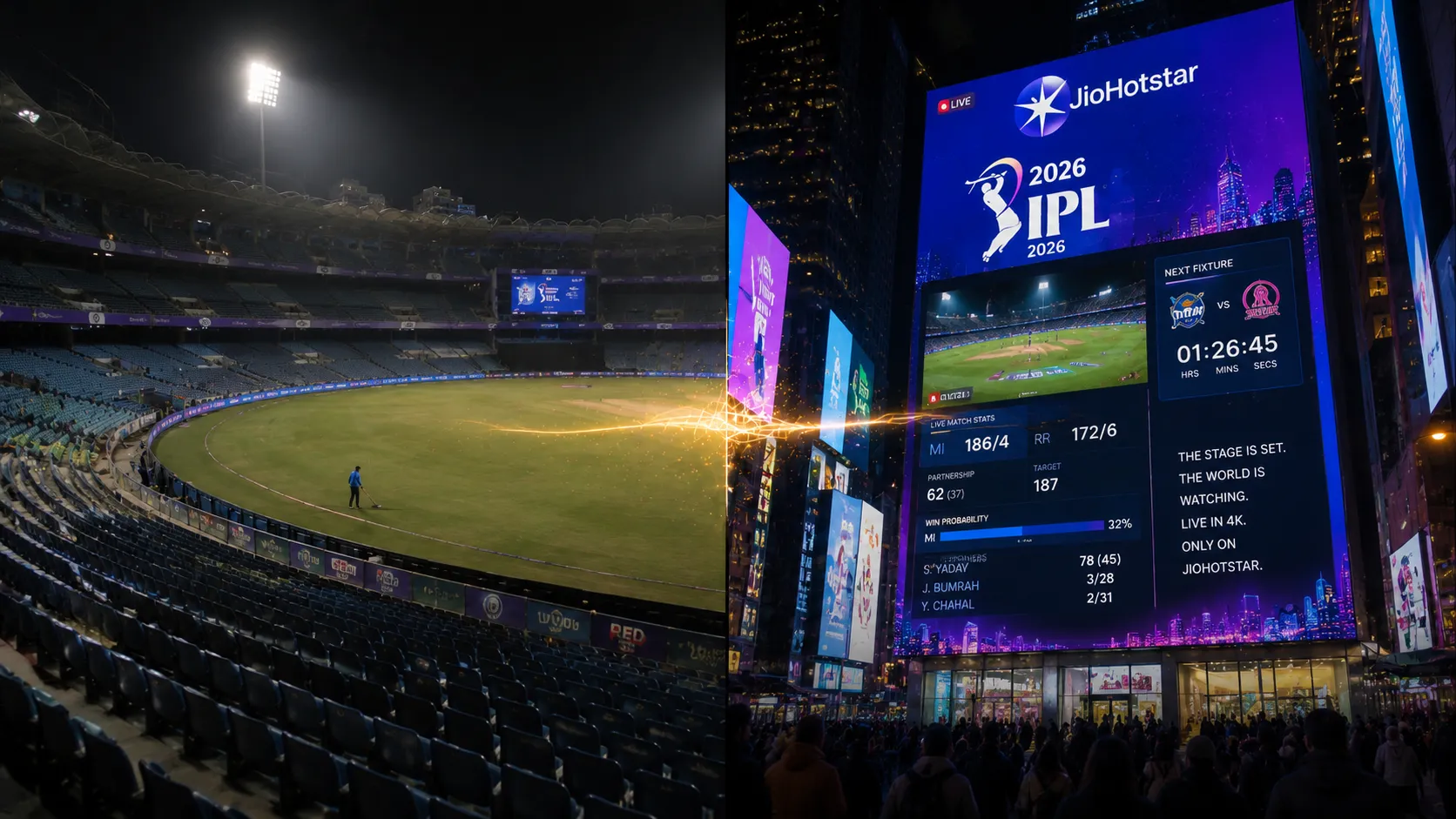
The ₹23,758 Crore Question: One Year Into JioHotstar's IPL Bet, the Subscriber Math Is Brutal—And the Real Winner Isn't Cricket
MUMBAI — May 30, 2026 — In June 2022, when the Board of Control for Cricket in India opened the digital rights for the Indian Premier League to a global auction, the outcome was treated, by most of the business press, as a moment of collective corporate insanity. The rights were sold for ₹23,758 crore—roughly $2.9 billion—to Viacom18, a Reliance‑backed media company that had never operated a major streaming platform and that had no obvious path to recouping an investment that was, by any conventional measure, economically irrational. The analysts who covered the media sector published notes with titles like "Winning the Auction, Losing the War." The executives at Disney+ Hotstar, which had lost the rights after dominating the IPL's digital audience for years, told journalists that the price made no sense. The conventional wisdom was unanimous: Reliance had overpaid. The market would punish the overpayment. The IPL rights were a trophy asset, and trophies are not investments.
Four years later, the analysts have stopped publishing those notes. JioHotstar, the streaming platform that absorbed Viacom18's assets and that now dominates the Indian digital entertainment market, reported in Q1 2026 that the IPL was the single largest driver of subscriber acquisition, engagement, and advertising revenue on the platform. The tournament accounted for approximately 40 percent of JioHotstar's annual user engagement, a figure that translates into roughly 220 million monthly active users during the IPL window—an audience that is larger than the entire subscriber base of every other streaming platform in India combined. The ₹23,758 crore that Reliance committed to the IPL rights is now being discussed not as an expense, but as an investment—a loss leader that opened a market, that acquired customers at a cost that no conventional marketing campaign could match, and that established a monopoly that the global platforms cannot challenge. The IPL bet was not irrational. It was the most strategically sophisticated media investment of the decade—and the people who called it insane are now asking themselves why they did not make the same bet.
The Subscriber Math
The most important metric in the IPL‑rights equation is not the ₹23,758 crore price tag. It is the customer‑acquisition cost. JioHotstar, which offers the IPL to its users at no additional charge—the tournament is included in the platform's ad‑supported free tier, and is available in high‑definition on its premium subscription tier for a modest monthly fee—has been acquiring users at a cost that is dramatically lower than the industry average. The platform added approximately 95 million new registered users during the 2025 IPL season, and retained approximately 60 percent of those users as monthly active users in the off‑season. The effective cost of acquiring a retained user, calculated as a share of the annual IPL rights amortisation, is approximately ₹90—roughly one‑tenth of the cost that a streaming platform would incur to acquire a comparable user through conventional digital marketing. The IPL is not merely a content asset. It is a marketing channel, and the channel is the most efficient in the history of Indian media.

The subscriber math becomes even more compelling when the revenue side of the equation is examined. JioHotstar generated approximately ₹5,800 crore in advertising revenue during the 2025 IPL season—a figure that represents approximately 35 percent of the platform's total annual advertising revenue, and that is growing at a compound annual rate of approximately 25 percent. The platform's ability to monetise the IPL audience through advertising—targeted, programmatic, and increasingly interactive—is far more sophisticated than the broadcast‑era model that the television networks used to monetise the same audience. The digital platform can offer advertisers a level of precision, measurability, and return‑on‑investment that the television networks could never match—and the advertisers are responding by shifting their budgets from television to digital at a pace that is accelerating.
The subscription revenue from the IPL is smaller but growing. JioHotstar's premium subscription tier, which offers an ad‑free IPL experience and access to the platform's full content library, has grown from approximately 8 million subscribers at the start of the 2024 season to over 28 million by the end of the 2025 season—a growth rate that was driven, in significant part, by the IPL's ability to convert ad‑supported free users into paying subscribers. The platform's management has said that the IPL is the single most effective conversion tool in its arsenal—the content that persuades a user who joined the platform for free cricket to pay for the premium experience that the platform offers. The subscriber‑conversion rate from the IPL audience is approximately 4 percent, which is roughly double the industry average for a streaming platform, and the lifetime value of the converted subscriber—measured across the platform's entire content library, not just the IPL—is substantially higher than the cost of acquiring them.
The churn reduction effect is the most underappreciated dimension of the IPL's subscriber economics. The streaming platform's single greatest vulnerability is churn—the user who subscribes for a month, watches a specific series, and cancels. The IPL, which runs for approximately eight weeks each year, functions as a churn‑reduction mechanism—a reason for the user to maintain their subscription across the entire season, and to remain on the platform in the off‑season because they have been exposed, through the platform's recommendation algorithms, to other content that they would not have discovered otherwise. The data that JioHotstar has shared with analysts suggests that the IPL reduces annual churn by approximately 12 percentage points among users who watch at least five matches per season—a figure that translates into millions of retained subscribers and billions of rupees in incremental lifetime value.
The Monopoly Moat
The most strategically significant dimension of the IPL‑rights investment is not the subscriber math. It is the monopoly moat that the rights create. The IPL is the most valuable content property in Indian media—the single event that attracts the largest, most engaged, and most demographically diverse audience of any programme in any language. The platform that controls the digital rights to the IPL controls the gateway to that audience—and the gateway, once established, is extraordinarily difficult for a competitor to breach.
The global streaming platforms—Netflix, Amazon Prime Video—have attempted to compete with JioHotstar by investing in original content, by acquiring the rights to other sports properties, and by building their own relationships with the Indian audience. But the IPL is not merely another sports property. It is the sports property—the one that commands a loyalty, a cultural significance, and a scale that no other event in India can match. The platform that does not have the IPL is a platform that is missing the single most important content experience in the Indian market—and the user who wants to watch the IPL will migrate, for the duration of the tournament, to the platform that has it. The migration is not permanent, but it is disruptive—and the platform that loses the user for eight weeks is a platform that risks losing them permanently. The IPL is not merely a content asset. It is a defensive moat—a barrier that protects JioHotstar from the competitive threat that the global platforms represent.
The monopoly moat is reinforced by the broader Reliance ecosystem. The user who watches the IPL on JioHotstar is, in many cases, the same user who subscribes to Jio's telecom network, who shops on JioMart, who pays through Jio Payments, and who engages with the Reliance ecosystem across multiple touchpoints every day. The IPL is the most visible expression of that ecosystem's integration—the content that drives engagement across the entire platform, and that strengthens the network effects that make the ecosystem so difficult for competitors to replicate. The global streaming platform that competes with JioHotstar on content alone is not competing on a level playing field. It is competing against an ecosystem that can subsidise the content with revenue from telecom, retail, and payments—and the ecosystem's tolerance for losses on the content side is, as the ₹23,758 crore IPL investment demonstrated, virtually unlimited.
The TV Sunset
The most painful dimension of the IPL‑rights story is the impact on the television broadcast market. The IPL's television rights, which were sold separately from the digital rights for ₹23,575 crore to Disney Star, have been a disappointment for the broadcaster—the audience has migrated to digital faster than the Star network anticipated, and the advertising revenue has not grown at the rate that the rights price implied. The television broadcast of the IPL is still profitable—the tournament remains the most‑watched programme on Indian television—but the growth is on the digital side, and the broadcast side is, at best, stable. The future of the IPL is digital, and the broadcaster that is still investing in the television experience is investing in a product that is being disrupted by the same platform that Reliance built.
The television‑versus‑digital dynamic is a microcosm of the broader shift that is reshaping the Indian media industry. The television networks that once dominated the IPL's distribution are now the junior partners in a relationship that is being defined by the streaming platforms. The advertisers that once allocated their budgets primarily to television are now shifting those budgets to digital—driven by the measurability, the targeting, and the return‑on‑investment that the digital platforms offer. The audience that once gathered around the television to watch the IPL is now watching on smartphones, on tablets, on laptops—on screens that are personal, interactive, and connected to the same ecosystem that Reliance has spent years building. The television sunset is not complete, but it is approaching, and the IPL is the event that is accelerating its arrival.
What This Signals
The IPL‑rights reckoning is not primarily a story about cricket. It is a story about the structural transformation of the Indian media industry—a shift from a broadcast model, in which a small number of networks controlled the distribution of content to a mass audience, to a streaming model, in which a single platform, backed by the largest conglomerate in the country, controls the most valuable content asset in the market and uses it to build an ecosystem that no competitor can challenge. The ₹23,758 crore that Reliance committed to the IPL rights is the price of that transformation—a price that was once considered irrational, and that is now being studied as the most strategically sophisticated media investment of the decade. The global platforms that lost the auction are still trying to compete—with original content, with other sports rights, with the global brand recognition that the Indian platforms cannot match. But the IPL is the moat, and the moat is too wide, and too deep, for any competitor to cross. The future of the IPL is digital, and the digital future belongs to JioHotstar.


