The 21-Year-Old, the $3,367 Crore Loss, and the IPO That Could Rewire How India Shops: Inside Zepto's Make-or-Break Summer
BENGALURU — May 20, 2026 — On May 8, 2026, the Securities and Exchange Board of India issued a single-page observation letter that changed the trajectory of one of the most aggressive startups in the country's history. The recipient was Zepto, the quick-commerce company founded in 2021 by two Stanford dropouts who were nineteen years old at the time. The letter meant that Zepto's initial public offering — a monster raise of approximately Rs 8,000 to Rs 9,000 crore, or roughly $1 billion — had cleared its largest regulatory hurdle. The company was now on a countdown: file the updated prospectus, test the waters with institutional investors, and hit the public markets in the July-September quarter of 2026.
Aadit Palicha, Zepto's 21-year-old co-founder and CEO, will be the youngest founder ever to lead a billion-dollar Indian IPO — younger than Bhavish Aggarwal was when Ola listed, younger than Deepinder Goyal when Zomato went public, younger than anyone who has ever stood at the podium of the National Stock Exchange and watched their company's stock begin to trade. He will be 22 by the time the listing happens. He will be responsible for a company that recorded revenue of ₹9,669 crore in FY25 — a 129 percent year-on-year leap — and a net loss of ₹3,367 crore, up 177 percent in the same period. The revenue is breathtaking. The losses are breathtaking. The company's ability to balance the two, in the full glare of the public markets, will determine whether Zepto's IPO is remembered as the moment India's quick-commerce sector came of age — or the moment it flew too close to the sun.
The Two Kids Who Bet on Speed
Zepto was born from a peculiar moment in history. In the summer of 2021, Palicha and his co-founder, Kaivalya Vohra — both Stanford undergraduates, both computer science majors, both still teenagers — were stuck in India during the pandemic, watching the country's e-commerce infrastructure strain under the weight of lockdown demand. The insight that emerged from those months was deceptively simple: Indian consumers wanted groceries not in two days, not in two hours, but in ten minutes. Not because ten minutes was a rational delivery window — it was not — but because the pandemic had collapsed the distinction between "urgent" and "routine." Everything was urgent. Everything was now.
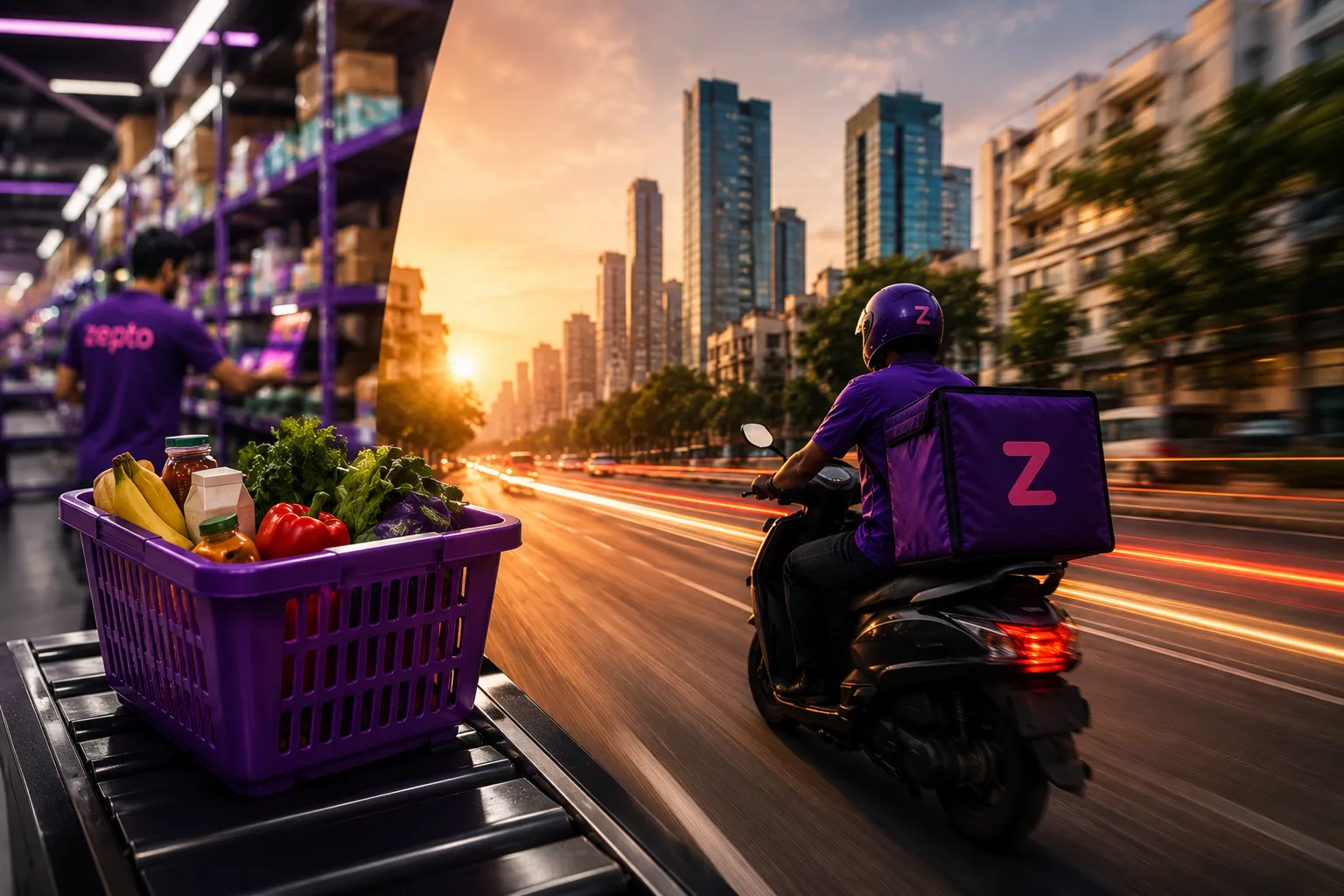
The solution was the dark store — a small, strategically located warehouse, invisible to customers, stocked with a carefully curated selection of 2,000 to 6,000 high-frequency items, connected to a delivery fleet that could reach any address within a two-to-three-kilometer radius in under ten minutes. Zepto did not invent the dark store. But it scaled it with a ferocity that startled its competitors. By early 2026, the company operated more than 900 dark stores across India's top cities, capturing 28 to 30 percent of the quick-commerce market — roughly tied with Swiggy Instamart and within striking distance of Eternal-owned Blinkit, the market leader. Zepto had raised $450 million in October 2025 at a $7 billion valuation, with the California Public Employees' Retirement System, America's largest public pension fund, co-leading the round. It had $600-700 million in cash reserves, a rapidly growing top line, and a burn rate that consumed capital with the appetite of a company that believed victory was a function of speed.
The belief was not unfounded. India's quick-commerce market has expanded with a velocity that has surprised even optimistic analysts. What began as a pandemic-era convenience for urban professionals has become a structural shift in how millions of Indian households buy groceries, toiletries, snacks, electronics, and increasingly, apparel and home goods. Blinkit, the Zomato-owned market leader, has pushed beyond groceries into larger categories. Swiggy Instamart, backed by the deep pockets of Swiggy's public-market capital, has matched Zepto's expansion city for city. Flipkart Minutes and Amazon Now, the quick-commerce arms of India's two largest e-commerce companies, have entered the fray with the patience and capital of incumbents who can afford to lose money for years. The battlefield is crowded, well-funded, and increasingly bloody.
The Math That Makes Investors Sweat
Zepto's financials, as disclosed in its draft IPO filings, present a picture of a company that is simultaneously one of the most impressive growth stories in Indian business history and one of the most aggressive capital-consumption machines the country has ever produced. Revenue of ₹9,669 crore in FY25 — up 129 percent year-on-year — places Zepto among the fastest-growing consumer internet companies ever built in India. The company's mature dark stores are EBITDA-positive at the store level, a metric that management has emphasized in investor conversations, and the company is targeting company-wide EBITDA breakeven within 12 to 15 months of the IPO. The unit economics, in theory, work: each dark store, once it reaches maturity, generates more cash than it consumes.
The problem is that the path to maturity is expensive. Opening a dark store requires real estate, inventory, technology infrastructure, and a fleet of delivery personnel. Marketing — discounts, platform fee waivers, customer acquisition campaigns — consumes an additional share of every revenue rupee. The result is a net loss that has been growing faster than revenue: ₹3,367 crore in FY25, a 177 percent jump from the previous year, driven by the cost of expanding the dark store network and the advertising expenditure required to compete against rivals with deeper pockets and longer runways. Zepto is not unusual in this regard. Swiggy, which listed in 2024, lost money for years before reaching profitability. Zomato, which owns Blinkit, traded below its IPO price for eighteen months before the market rewarded its turnaround. The quick-commerce sector is structurally loss-making in its growth phase, and the bet investors are being asked to make is that Zepto's path to profitability is shorter, steeper, and more defensible than its competitors'.
The cash position tells a sobering story. As of March 2026, Zepto had roughly $600-700 million in cash — a substantial war chest by any standard, but dwarfed by the $1.7 billion held by Swiggy Instamart and the $1.9 billion held by Blinkit. The IPO is not a luxury. It is a necessity. Zepto needs the capital to expand its dark store network, deepen its presence in Tier-2 cities where quick-commerce adoption is still in its infancy, and build the supply-chain technology required to compete against rivals who can subsidize losses from other business lines. The company's market share — 28 to 30 percent — is strong but not dominant. The gap between Zepto and Blinkit, the leader, is narrow enough to be closed but wide enough to require capital. The IPO will determine whether Zepto has the financial firepower to close it.
The Domicile Gambit and the Public Market Bet
One of the most telling details in Zepto's IPO preparations is the company's decision to shift its domicile from Singapore back to India — a move increasingly common among venture-backed Indian startups preparing for domestic listings. The decision was not merely administrative. It was strategic. The Indian public markets have, in the past eighteen months, demonstrated an appetite for consumer technology IPOs that was absent during the previous decade. Swiggy's 2024 listing, while volatile, established that Indian retail investors would buy shares in companies they used every day. Zomato's stock, after an initial period of skepticism, has rewarded patient investors. The pipeline of startups preparing for IPOs — PhonePe, Flipkart, Shadowfax, Shiprocket — suggests that 2026 and 2027 will be the years when Indian venture-backed companies finally deliver the exits their investors have been waiting for.
Zepto is positioned at the front of that pipeline, and the market will judge it accordingly. The IPO's structure — a sizeable fresh issue of approximately Rs 11,000 crore, along with a smaller offer-for-sale by early investors — signals that the company is raising capital primarily to fund expansion, not to provide liquidity to insiders. The investment banking syndicate — Morgan Stanley, Axis Capital, HSBC, Goldman Sachs, JM Financial, IIFL Securities, and Motilal Oswal — is among the largest ever assembled for an Indian internet IPO. The roadshow, expected to begin in the coming weeks, will test whether global institutional investors are willing to value a loss-making, high-growth quick-commerce company at the $7-8 billion range — and whether Indian retail investors, who have become an increasingly powerful force in domestic IPOs, will follow.
The risks are considerable. Zepto operates in a sector where the dominant players — Blinkit and Swiggy Instamart — are backed by listed entities with access to public-market capital that Zepto, for now, lacks. Blinkit's parent company, Zomato, has a market capitalization that provides a virtually unlimited war chest for quick-commerce expansion. Swiggy's listing gives Instamart a similar advantage. Zepto, as a standalone quick-commerce pure play, will need to convince the market that its focus is an asset — not a vulnerability. The bull case is that Zepto's singular focus on quick commerce allows it to optimize every dimension of the business — dark store layout, inventory selection, delivery routing — in ways that conglomerate competitors cannot. The bear case is that focus is not a strategy when your competitors can subsidize losses from adjacent businesses and wait for you to run out of cash.
The Founder Who Will Be Watched
Aadit Palicha is 21 years old. He was a teenager when he founded Zepto. He will be 22 when the company lists. The age invites attention — skepticism from some quarters, admiration from others — but it obscures the deeper question that the IPO will force investors to confront: can a founder who has never experienced a down cycle, who has only known growth, who has built a company in an environment of abundant venture capital and pandemic-fueled demand, navigate the quarterly earnings calls, the activist investor questions, and the relentless scrutiny of the public markets?
Palicha's answer, implicit in the company's decision to pursue an IPO at this moment, is that the public markets are not a threat but an opportunity. The company has raised over $1 billion in private capital. It has built a network of dark stores that reaches millions of Indian households. It has captured roughly a third of a market that did not exist five years ago. The IPO is not a retreat from venture capital. It is an escalation — a bet that the public markets will reward the same growth that private investors have rewarded, and that the discipline of quarterly reporting will sharpen a company that has, by its own admission, burned capital with the abandon of a startup that believed the next round would always arrive.

The next round will not arrive. There will be no more private funding rounds after the IPO — only earnings reports, stock prices, and the judgment of a market that has no patience for companies that cannot demonstrate a credible path to profitability. Zepto's management has told investors it expects to reach company-wide EBITDA breakeven within 12 to 15 months of the IPO. Whether that target is met — and whether the market believes it will be met — will define not just Zepto's fate, but the fate of the dozens of Indian startups watching from the sidelines, waiting to see whether the public markets will welcome a generation of high-growth, loss-making consumer internet companies that were born in the venture-capital boom and must now prove they can survive in the public-market glare.
The observation letter from SEBI arrived on May 8. The countdown has begun. The 21-year-old at the center of it all has one summer to convince the world that his company is worth more than its losses — and that the bet on ten-minute groceries, made when he was still a teenager, was not a pandemic fantasy but a permanent shift in how the world's most populous country buys the things it needs.


