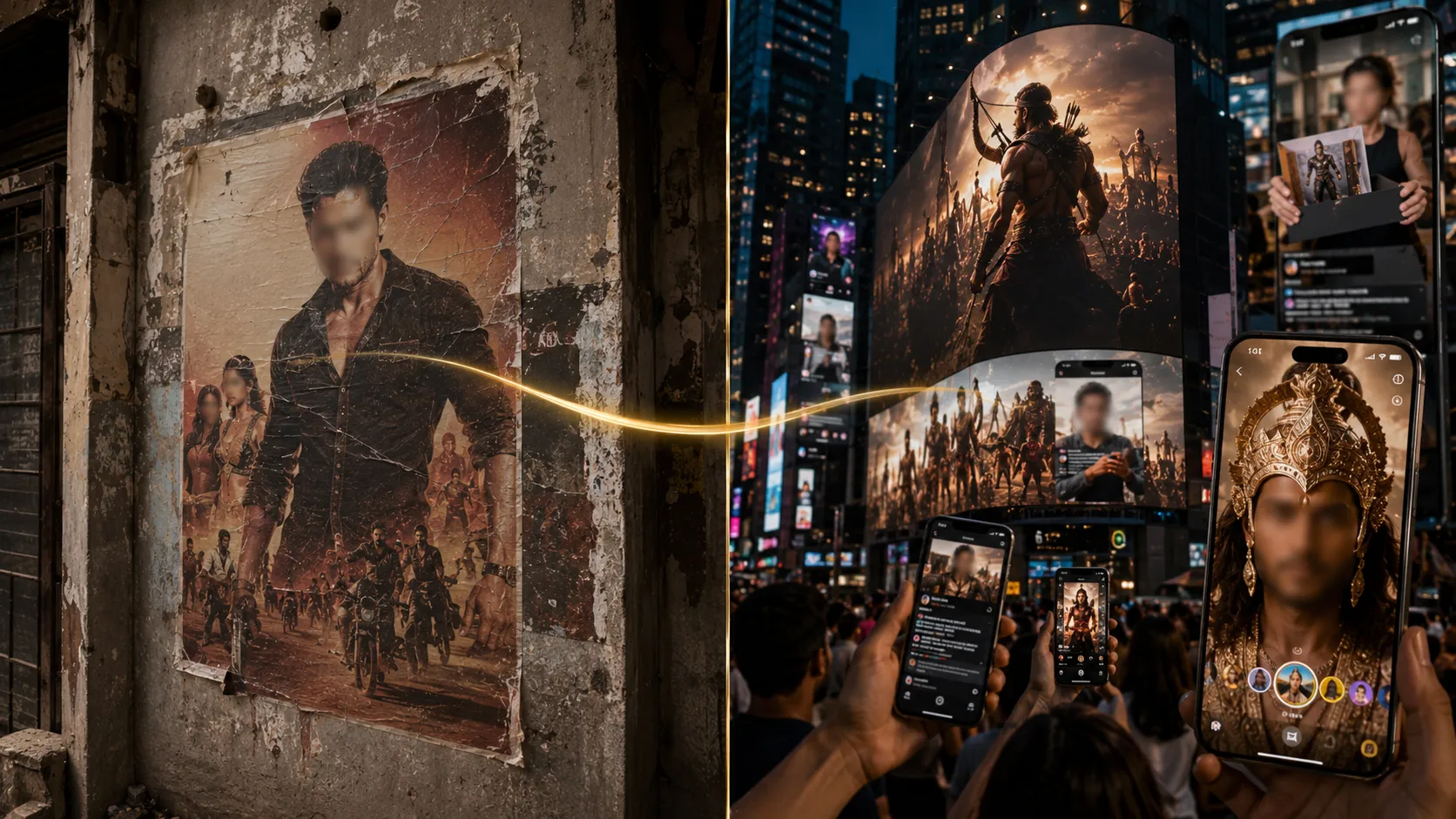
The ₹200 Crore Trailer: How Indian Films Started Spending More on Marketing Than on Stars—And Why That Changes Everything
MUMBAI — May 29, 2026 — In the spring of 2024, a film released in India that spent approximately ₹80 crore on prints and advertising. The figure was not remarkable—the largest Hindi releases had been crossing the ₹50 crore P&A threshold for years. What was remarkable was the line item that had disappeared from the budget. The film's lead actor, one of the most recognisable faces in the country, had taken no upfront fee. His compensation was structured entirely as a share of the film's profits, and the money that would have been allocated to his salary—approximately ₹60 crore—had been redirected into the marketing campaign instead. The film was Jawan. The actor was Shah Rukh Khan. And the decision to swap star fee for marketing spend was, in retrospect, the moment the Indian film industry's centre of economic gravity shifted from the face on the poster to the machinery that sold it.
Two years later, the ₹100 crore marketing budget is no longer exceptional. It is expected. The largest Indian releases of 2026—Dhurandhar 2, Border 2, Ramayana—have each allocated between ₹80 crore and ₹120 crore to marketing and distribution, figures that exceed the total production budgets of all but the most expensive Indian films of a decade ago. The marketing spend on a single major release now rivals the star fee as the largest line item in the budget. And the studios that are allocating capital most aggressively to marketing are the ones that are generating the highest returns—not because the marketing is better, but because the audience has changed in ways that make marketing more valuable than it has ever been.
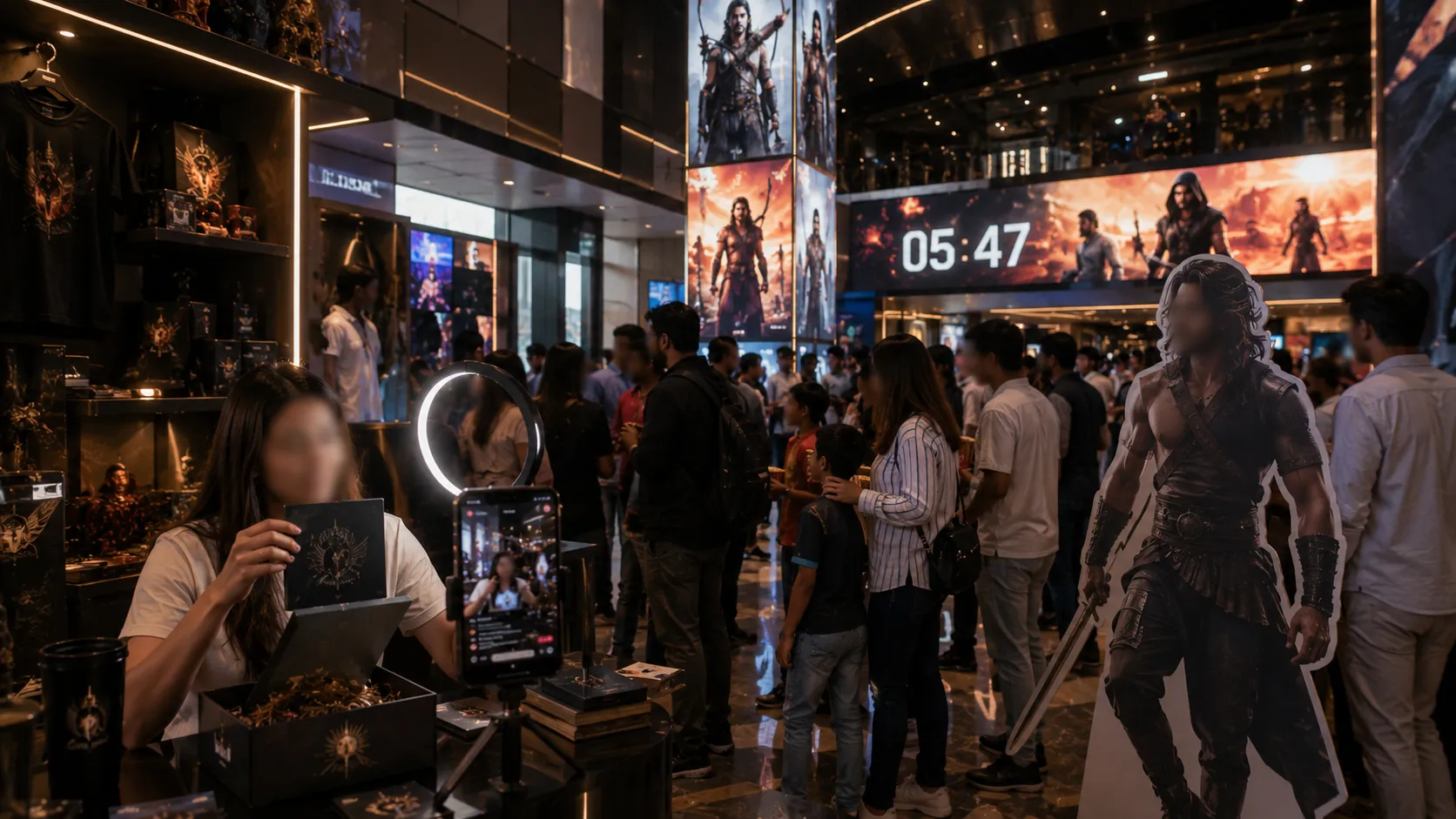
The Arithmetic of the Modern P&A
To understand why marketing budgets have swollen so dramatically, one must first understand what a modern P&A spend actually comprises—and how radically the composition of that spend has changed over the past decade.
In the pre‑digital era, marketing a film was a relatively straightforward exercise. The producer allocated a portion of the budget—typically 10 to 15 percent of the total cost—to print (the physical copies of the film distributed to theatres) and advertising (posters, hoardings, trailers on television, and a handful of press interactions). The campaign was designed to inform the audience that the film was releasing. The star's name on the poster did most of the work. The marketing was an announcement, not an argument.
The modern P&A budget bears almost no resemblance to its predecessor. Print costs have declined sharply as digital projection has eliminated the need for physical film prints. But the savings have been more than absorbed by the explosive growth of digital advertising, influencer marketing, event activations, and the global promotional tours that have become standard for any film with international ambitions. The ₹100 crore marketing budget of a major 2026 release is typically allocated across multiple channels: television and radio (20 percent), digital and social media (35 percent), outdoor and transit (10 percent), influencer and content creator partnerships (15 percent), promotional events and tours (10 percent), and miscellaneous including market research and PR (10 percent). The largest single line item is now digital—a category that barely existed a decade ago and that now consumes more than a third of the total marketing spend.
The digital share is growing fastest not because it is the most effective channel—though it often is—but because it is the most measurable. The studio that spends ₹10 crore on a television campaign has no way of knowing how many of the people who saw the ad bought a ticket. The studio that spends ₹10 crore on a digital campaign can track every impression, every click, every conversion, and every rupee of attributable box‑office revenue. The measurability of digital advertising has made it the preferred channel for studios that are under increasing pressure to justify their marketing spends to investors and financial partners. The result is a marketing budget that is more data‑driven, more targeted, and more expensive than anything the industry has seen before.
The second major driver of marketing‑budget inflation is the globalisation of the Indian film audience. The film that was once marketed primarily to the Hindi‑speaking audience in India is now marketed to the diaspora in 50 countries, in multiple languages, across multiple platforms, with a campaign that must be tailored to the cultural and linguistic specificities of each market. The Dhurandhar 2 campaign, which was among the most ambitious ever mounted for an Indian film, included targeted digital campaigns in North America, the United Kingdom, the Gulf, and Southeast Asia, each one adapted to the local audience and the local platform mix. The cost of running a single, unified campaign for the domestic market has been replaced by the cost of running a dozen parallel campaigns for a global audience—and the cost, unsurprisingly, has risen accordingly.
The Influencer Tax
The third major driver of marketing‑budget inflation is the influencer economy. The Indian film industry has, over the past five years, become one of the largest buyers of influencer content in the world, paying social‑media creators to promote films to their followers through sponsored posts, unboxing videos, reaction clips, and live‑streamed watch parties. The influencer marketing budget for a major release now routinely exceeds ₹10 crore—a figure that is larger than the total marketing budget of most Indian films a decade ago.
The influencer tax is a function of the fragmentation of the Indian media landscape. The audience that was once reachable through a handful of television channels and newspapers is now distributed across dozens of platforms—Instagram, YouTube, Snapchat, Moj, Josh, ShareChat—each of which requires a different content strategy and a different set of creators. The studio that wants to reach a 22‑year‑old in a Tier‑2 city cannot do so through a television ad, because the 22‑year‑old does not watch television. They can do so through an influencer whom the 22‑year‑old follows and trusts. And the influencer charges for access to that trust. The cost of that access has risen as the influencer economy has matured, and the studios are paying it because the alternative—not reaching the 22‑year‑old at all—is worse.
The influencer economy has also changed the timeline of the marketing campaign. The pre‑digital campaign was concentrated in the two weeks before release—the period when television ads and posters would saturate the market and drive awareness. The modern campaign begins months before the first trailer drops, with a slow, steady drip of content designed to build anticipation, engagement, and community before the hard‑sell begins. The influencer who posts a cryptic teaser about a film three months before its release is not selling tickets. They are building a relationship between the film and the audience that will, the studio hopes, translate into ticket sales when the release date arrives. The cost of building that relationship is the influencer tax, and the studios that are paying it most effectively are the ones that are treating their influencers not as a distribution channel but as a creative partner—someone who can build genuine excitement for the film among an audience that is increasingly resistant to traditional advertising.
The Jawan Precedent
The most consequential Indian film of the past five years, from the perspective of marketing economics, is Jawan. Not because it earned ₹1,148 crore worldwide—though that figure is not incidental—but because the financial structure of the film demonstrated that a marketing‑heavy, star‑light model could be more profitable than the star‑heavy, marketing‑light model that had dominated the industry for decades.
Shah Rukh Khan's decision to forgo an upfront fee and take a share of the profits instead was, at one level, a bet on the film's commercial performance. At a deeper level, it was a recognition that the star's value had shifted from the poster to the promotion—that SRK's most valuable contribution to Jawan was not his performance in the film, but his ability to market it. The promotional campaign that SRK led—the Ask SRK sessions on Twitter, the Instagram Lives, the city‑by‑city fan events, the carefully curated media appearances—was the engine of the film's opening. The star had become the marketing, and the marketing had become the star. The distinction between the two categories had collapsed.
The Jawan precedent has been adopted, in modified form, by a growing number of stars who have the leverage to demand it. The profit‑sharing model aligns the interests of the star and the studio in a way that the upfront‑fee model never did: both parties benefit when the film succeeds, and both share the pain when it fails. The model also frees up capital that would have been allocated to the star's fee and redirects it into the marketing campaign—the very thing that is most likely to make the film succeed. The virtuous circle is not automatic, but it is visible, and the studios that are structuring their star deals around it are the ones that are generating the highest returns on their marketing investment.
The Event Film and the Weekend That Must Not Fail
The fourth major driver of marketing‑budget inflation is the rise of the "event film"—the ₹200 crore+ production that must open on 4,000 screens and earn ₹50 crore on its first day to have any chance of recouping its investment. The event film is not merely a movie. It is a cultural moment, and the marketing campaign must create that moment—must convince millions of people that the film's release is something they cannot afford to miss. The cost of creating that conviction, across a fragmented media landscape, in competition with every other form of entertainment, has risen sharply. The marketing budget for an event film now routinely represents 30 to 40 percent of the film's total cost—a share that would have been considered reckless a decade ago and that is now considered essential.
The event‑film marketing campaign is designed to compress the audience's decision‑making window. The studio that is releasing a ₹300 crore film on a Friday cannot afford to let the audience discover it gradually, through word‑of‑mouth, over several weeks. The film must open big, and it must open immediately, because the screens that are allocated to it on the first weekend will be reallocated to a competitor if the opening disappoints. The marketing campaign that precedes the event film is, in effect, a pre‑emptive strike—a saturation bombardment designed to create so much awareness, so much anticipation, and so much fear of missing out that the audience has no choice but to buy a ticket on the first weekend. The cost of that bombardment is the ₹100 crore marketing budget. The alternative—a slow build that allows the audience to discover the film on their own timeline—is not available to the event film, because the event film does not have a slow build. It has a first weekend, and the first weekend must not fail.
The Risk of the Overspend
The most uncomfortable dimension of the ₹100 crore marketing budget is the risk that it will fail. The event film that spends ₹100 crore on marketing and opens to ₹20 crore on its first day has not merely underperformed. It has destroyed capital that cannot be recovered—not through streaming rights, not through satellite deals, not through any of the ancillary revenue streams that the industry has developed to cushion the blow of a theatrical disappointment. The marketing spend is a sunk cost. Once it is spent, it is gone, and the only question is whether the film's box‑office performance justifies the expenditure.
The most expensive marketing failure in recent Indian cinema history is Laal Singh Chaddha (2022), which reportedly spent over ₹50 crore on marketing—a figure that was comparable to the marketing spends of the most successful films of the era—and opened to approximately ₹11.50 crore. The film's total domestic net collection was approximately ₹58 crore, which meant that the marketing spend alone was nearly as large as the film's entire Indian box‑office revenue. The catastrophe was not the result of a bad campaign. The campaign was, by most accounts, well‑executed. The catastrophe was the result of a film that the audience did not want to watch—and no amount of marketing, however brilliant, can force an audience to buy a ticket to a film they have already decided to reject.
The Laal Singh Chaddha disaster is the cautionary tale that haunts every marketing executive who signs off on a nine‑figure P&A budget. The marketing can amplify the signal. It cannot create it. The film must be good enough, or appealing enough, or culturally resonant enough, to justify the amplification. The marketing that precedes a bad film is not merely wasted. It is counterproductive—it draws attention to the film's flaws, accelerates the negative word‑of‑mouth, and ensures that the opening weekend is not merely disappointing, but catastrophic. The studios that are spending the most on marketing are the ones that are taking the greatest risk—and the ones that are most vulnerable to the consequences of a film that the audience rejects.
The AI Horizon
The most significant development on the horizon of film marketing is the application of artificial intelligence to campaign design, audience targeting, and creative optimisation. The AI‑powered marketing campaign is not yet standard practice in the Indian film industry, but it is being tested by a growing number of studios and platforms, and the early results suggest that it will transform the economics of film marketing as dramatically as digital advertising transformed the economics of marketing a generation ago.
The AI marketing platform can analyse millions of data points—social‑media conversations, search trends, historical box‑office patterns, audience demographics—and generate a campaign that is tailored, in real time, to the specific audiences most likely to respond to it. The platform can test dozens of creative variations simultaneously, identify the ones that are performing best, and allocate the marketing budget dynamically toward the channels and the messages that are generating the highest conversion rates. The platform can predict, with increasing accuracy, the opening‑weekend box office of a film based on the pre‑release buzz—and adjust the marketing spend accordingly.
The AI marketing revolution is still in its early stages, and the Indian film industry is not yet a leader in its adoption. But the studios that are investing in AI‑powered marketing capabilities today are the ones that will have a structural advantage over their competitors tomorrow. The AI platform that can reduce the cost of acquiring a ticket‑buyer by 20 percent—or that can increase the conversion rate of a digital campaign by 10 percent—will pay for itself many times over. The ₹100 crore marketing budget of 2026 will, in all likelihood, be the ₹50 crore marketing budget of 2031—not because the studios are spending less, but because the AI is making each rupee go further. The efficiency gains will not be evenly distributed. The studios that adopt AI earliest and most effectively will capture a disproportionate share of the returns. The studios that do not will be left with the same budgets and the same inefficiencies—and the same vulnerability to the Laal Singh Chaddha catastrophe that haunts every marketing executive who signs off on a nine‑figure spend.
What This Signals
The rise of the ₹100 crore marketing budget is not primarily a story about advertising. It is a story about the shifting centre of economic gravity in the Indian film industry—a shift from the star on the poster to the machinery that sells the film, from the face that draws the audience to the campaign that convinces them, from the performance that earns the applause to the marketing that fills the seats.
The star is not dead. The star's name on the poster is still the single most important determinant of a film's opening‑weekend box office, and the largest franchises will continue to depend on the stars who are inextricably linked to their success. But the star's economic role has changed. The star is no longer the marketing. The star is the raw material that the marketing transforms into a cultural event. The distinction is subtle, but it is profound, and it has already begun to reshape the economics of the industry.
The marketing budget that now rivals the star fee is the most visible expression of that shift. The studio that allocates ₹100 crore to marketing is not merely spending money. It is making a bet—that the campaign it builds will be more effective at filling seats than the star it replaced. The bet is not always successful. But when it is—when the campaign catches fire, when the influencers amplify, when the event film becomes the event that everyone must attend—the returns justify the risk. The ₹100 crore marketing budget is here, and it is not going away. The only question is how much larger it will grow—and how much more of the star's fee it will consume.


