The ₹20,000 Crore Carbon Capture: How India Is Building the World's Most Amorphous Climate Tech Market
The ₹20,000 Crore Question
For years, Carbon Capture, Utilisation and Storage (CCUS) was dismissed as an esoteric, high‑cost pipe dream — a technological fig leaf for industries that did not want to stop polluting. But in February 2026, Union Finance Minister Nirmala Sitharaman made CCUS a cornerstone of India's climate strategy, announcing a ₹20,000 crore (∼$2.4 billion) outlay over five years to scale CCUS technologies.
The immediate allocation: ₹500 crore for FY26‑27 under the power ministry. The ambition: reduce emissions from hard‑to‑abate sectors like steel, cement, power and refineries — industries that are also major exporters facing the EU's Carbon Border Adjustment Mechanism (CBAM) tariffs.
The message is unmistakable: India is no longer just trying to reduce emissions through renewable energy. It is betting that it can capture, use and store the carbon it continues to emit — and in doing so, build a world‑class climate tech industry.
The Roadmap: From R&D Testbeds to Commercial Scale
The Budget announcement did not come out of nowhere. In December 2025, the Department of Science and Technology (DST) launched the 'R&D Roadmap to Enable India's Net Zero Targets through Carbon Capture, Utilisation and Storage' — a detailed plan to move CCUS from lab to industrial scale.
The roadmap focuses on five industrial sectors: power, steel, cement, refineries and chemicals. It proposes the creation of carbon capture utilisation testbeds in real industrial environments, with the government approving five such testbeds in the cement sector alone. The funding model is a public‑private partnership (PPP), allowing startups and established players to co‑invest with government support.
Crucially, the roadmap emphasises not just capture, but utilisation. Captured CO₂ can be used as a feedstock to produce industrial goods — from synthetic fuels to building materials to biochemicals — creating a revenue stream that offsets the cost of capture. This shifts CCUS from a pure cost centre to a potential profit centre.
The Startup Pioneers: Varaha, Intrinsic Foundries, New Era Cleantech
Varaha: The $45 Million Carbon Removal Believer
The largest private CCUS‑adjacent investment in India this year came in February 2026, when WestBridge Capital led a $45 million funding round into Varaha, a climate tech startup focused on agricultural carbon removal. The round marks WestBridge's first deal in the climate tech sector — a significant signal that mainstream VC is taking carbon removal seriously.
Varaha's approach is nature‑based: it works with small‑holder farmers to adopt regenerative practices that sequester carbon in soil, then sells verified carbon credits to global buyers. But the company's ambitions extend beyond agriculture, and its $45 million raise demonstrates that Indian climate tech can attract tier‑one institutional capital.
PULL QUOTE #2 “India recently committed INR 20,000 crore over five years to scale carbon capture, utilisation and storage. The policy tailwinds have never been stronger.” — Shantanu Chaturvedi, Partner, Transition VC
Intrinsic Foundries: Turning CO₂ into Biochemicals
If Varaha is natural carbon removal, Intrinsic Foundries is high‑tech carbon utilisation. In February 2026, the Mumbai‑based biomanufacturing startup raised $1.4 million in seed funding led by Transition VC, with participation from Zerodha's Rainmatter and others.
Intrinsic Foundries uses a photobioreactor platform to convert industrial carbon dioxide emissions into biochemicals via microalgae‑based biological conversion. The captured CO₂ is fed to specially engineered algae, which produce high‑value compounds that can be used in cosmetics, nutraceuticals and industrial applications. This creates a closed‑loop system: industrial waste becomes valuable feedstock.
Shantanu Chaturvedi, Partner at Transition VC, noted the favourable policy environment: “India recently committed INR 20,000 crore over five years to scale carbon capture, utilisation and storage. The policy tailwinds have never been stronger”.
New Era Cleantech: Coal Gasification with CCUS
For the most ambitious CCUS project in India today, look to New Era Cleantech, which is developing a large integrated coal gasification and CCUS project in Chandrapur, Maharashtra. The project is designed to convert coal into clean fuels while capturing the resulting CO₂ for storage or utilisation — a model that could be replicated across India's coal‑dependent power and industrial sectors.
The CBAM Catalyst: Why Exports Need CCUS
India's urgency on CCUS is not purely environmental — it is commercial. The EU's Carbon Border Adjustment Mechanism (CBAM) , which went into full effect in 2026, imposes a carbon tax on imported goods from high‑emission sectors including steel, cement, aluminium and fertiliser.
If Indian exporters do not reduce the carbon intensity of their production, they will face a tariff disadvantage in one of their largest markets. CCUS offers a way to continue producing fossil‑based goods while capturing emissions at source — preserving export competitiveness without sacrificing industrial growth.
The Global Indian Takeaway
For the diaspora, India's emerging CCUS ecosystem offers three opportunities.
First, invest in venture funds. Transition VC, which backed Intrinsic Foundries, and other climate‑focused funds are actively raising. The ₹20,000 crore government outlay is designed to crowd in private capital — creating co‑investment opportunities for diaspora investors.
Second, partner on technology transfer. CCUS is a global technology frontier. European and North American companies are developing advanced capture solvents, monitoring systems and utilisation pathways. Diaspora professionals can facilitate licensing agreements or joint ventures between Indian startups and international technology holders.
Third, develop carbon credit markets. India is expected to launch a national carbon credit market in 2027. Diaspora professionals with experience in carbon trading, verification standards or project finance can position themselves as early market participants.
The Final Word
The ₹20,000 crore CCUS scheme is the largest climate tech signal India has ever sent. It acknowledges a difficult truth: even with aggressive renewable energy deployment, India will still be burning coal, making cement and smelting steel for decades. The only way to reach net‑zero by 2070 is to capture, use and store the carbon those industries emit.
The technology is nascent. The economics are uncertain. But the policy signal could not be clearer. India is building a carbon capture industry — and the startups that succeed will not just save the planet. They will export their technology to every other developing economy facing the same dilemma.
The carbon capture revolution is amorphous, expensive and hard. But it is also inevitable.
IMAGE PROMPTS (16:9 orientation)
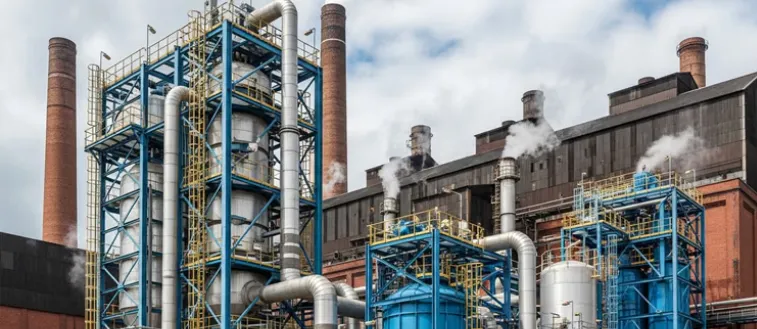
Title Image – “The Testbed” Prompt: 16:9 wide shot of a cement plant with a carbon capture testbed attached — a maze of pipes, absorbers and silos. CO₂ vapour is visible near the capture unit. Indian and EU flags side‑by‑side, referencing CBAM. The sky is hazy but the capture unit is pristine. Mood: Industrial transition, “capturing the future.”
Mid‑Article Image – “The Photobioreactor” Prompt: 16:9 close‑up of Intrinsic Foundries’ photobioreactor – rows of glowing green tubes filled with microalgae, bubbling with CO₂. A technician in a lab coat monitors a screen showing “CO₂ intake: 95% conversion rate.” The algae have a vibrant, almost electric green. Mood: High‑tech, biological, “waste becomes worth.”
Closing Image – “The Budget Moment” Prompt: 16:9 photograph of Finance Minister Nirmala Sitharaman delivering the Budget speech, with the Budget document open to a page showing “₹20,000 crore — CCUS Scheme.” The Parliament chamber, green benches and the Finance Minister’s trademark blue sari. Mood: Historic, policy‑level commitment.
CHART: “India's CCUS Leap – At a Glance (2026)”
Metric | Value | Source |
CCUS scheme outlay | ₹20,000 crore over 5 years | Union Budget 2026 |
FY26‑27 allocation | ₹500 crore | Times of India |
Government carbon capture target (2050) | 750 million tonnes CO₂ | Inc42 / DST |
Hard‑to‑abate sectors targeted | Power, steel, cement, refineries, chemicals | DST Roadmap |
Cement sector testbeds approved | 5 | DST |
Varaha funding | $45 million (led by WestBridge Capital) | Economic Times |
Intrinsic Foundries seed funding | $1.4 million (led by Transition VC) | Inc42 |
New Era Cleantech CCUS project location | Chandrapur, Maharashtra | Daily Pioneer |
Carbon capture roadmap launch date | December 2025 | DST |
EU CBAM full implementation | 2026 | EU Commission |
India net‑zero target year | 2070 | Government commitment |


