TechArtificial Intelligence

The $2 Billion Pivot: How MediaTek Is Quietly Rewiring the AI Cloud—and Leaving the Smartphone Behind

For most of the last twenty years, MediaTek was the invisible giant of the smartphone revolution. It powered the affordable handsets that connected billions of people across Asia, Africa, and Latin America—mid-tier and entry-level devices that never made headlines but quietly built the world's largest mobile chip company by shipment volume. At its peak, MediaTek's name was synonymous with smartphones the way Intel's was with PCs.

By Revathy Pandian · Author16 May 2026New

The $2 Billion Pivot: How MediaTek Is Quietly Rewiring the AI Cloud—and Leaving the Smartphone Behind

HSINCHU, Taiwan — May 2026 – For most of the last twenty years, MediaTek was the invisible giant of the smartphone revolution. It powered the affordable handsets that connected billions of people across Asia, Africa, and Latin America—mid-tier and entry-level devices that never made headlines but quietly built the world's largest mobile chip company by shipment volume. At its peak, MediaTek's name was synonymous with smartphones the way Intel's was with PCs.

That era is closing. Not gradually, not elegantly, but all at once.

In April 2026, MediaTek reported something that would have been unthinkable three years ago: smartphone processor revenue had plummeted 18 percent in a single quarter, dragging overall revenue down 2.7 percent year-over-year to NT$149.15 billion. Global smartphone shipments, the company warned, were on track to decline 15 percent in 2026 as memory chip prices surged and manufacturing costs bit into demand. The engine that had driven MediaTek for a generation was sputtering.

And yet, the company's stock did not crater. Its market capitalization held firm. The reason, buried in the earnings call and amplified in the weeks since, is a pivot of breathtaking speed and audacity. MediaTek is no longer a smartphone chip company. It is becoming a cloud AI infrastructure supplier—and the hyperscalers are lining up.

ChatGPT Image May 16, 2026, 04_13_09 PM.png

The ASIC Awakening

The product driving this transformation is not a smartphone processor. It is something far more specialized, far more lucrative, and far more strategically significant: the AI accelerator ASIC.

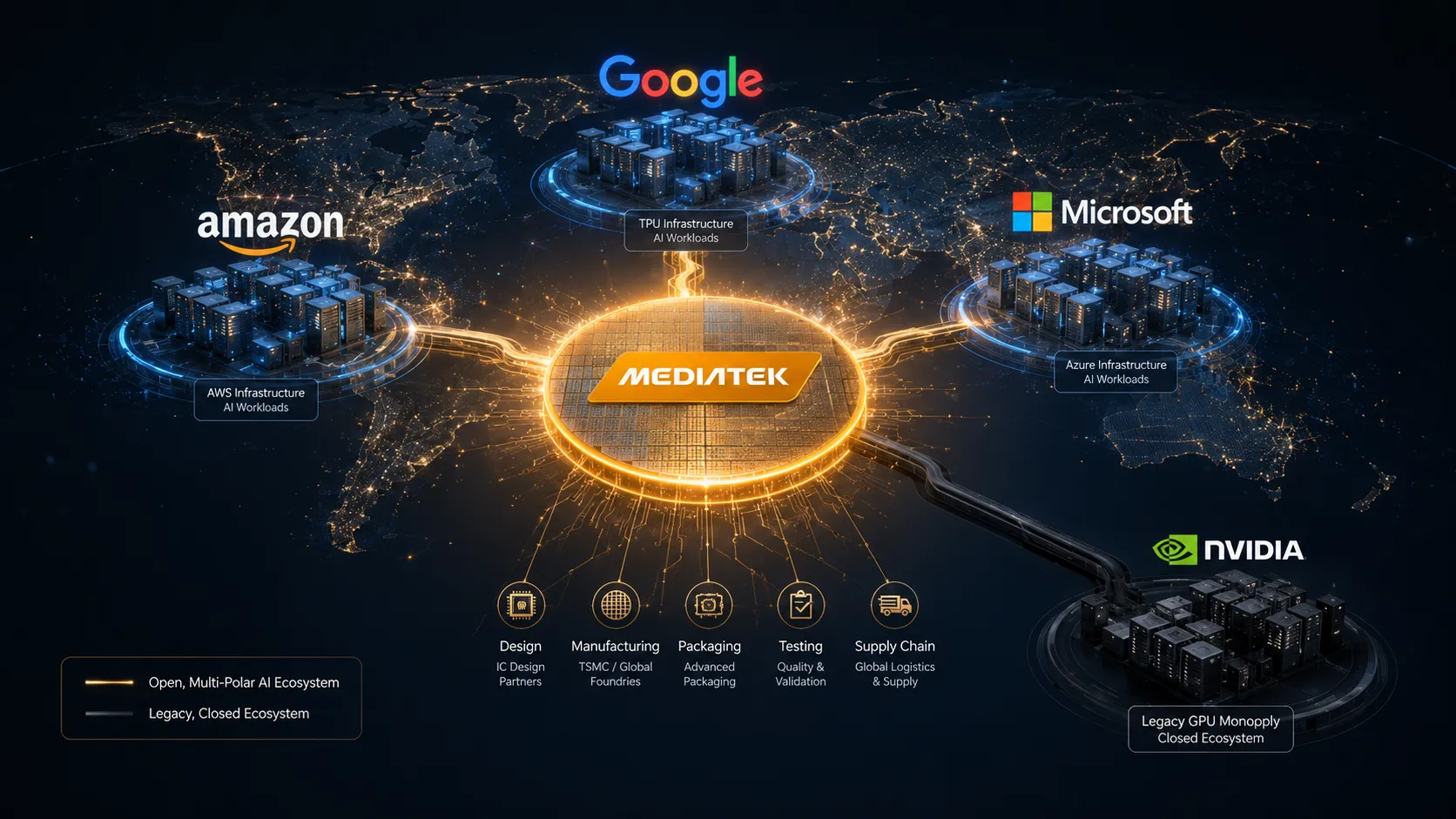
ASICs—application-specific integrated circuits—are custom-designed chips built for a single purpose. In this case, the purpose is training and running the massive AI models that power everything from ChatGPT to Google's search algorithms. Unlike the general-purpose graphics processors sold by Nvidia, which dominate the AI chip market today, ASICs are co-designed with the customer—hyperscalers like Google, Amazon, and Microsoft—and optimized for their specific workloads. They are faster, more efficient, and, once the design is locked in, cheaper to manufacture at scale.

MediaTek's first major cloud ASIC project, widely understood across the industry to be Google's next-generation Tensor Processing Unit, or TPU, is on track for mass production. The numbers attached to this program are staggering. CEO Rick Tsai told analysts that AI ASIC revenue is expected to reach approximately 2 billion in the fourth quarter of 2026 alone,doubling from earlier forecasts of 2 billion in the fourth quarter of 2026 alone, doubling from earlier forecasts of 1 billion. By 2027, the figure is projected to scale to several billion dollars, and a second AI accelerator program—with a different hyperscaler—is already in design, targeting mass production by the end of that year.

To put this in perspective: MediaTek's total revenue in the first quarter of 2026 was about $4.7 billion. In a single quarter later this year, AI chips alone could contribute nearly half that amount. The company's earnings model, built for decades on razor-thin margins in commodity mobile silicon, is about to be reshaped by a high-margin, recurring-revenue business with a direct line into the largest technology infrastructure buildout in history.

Why This Pivot Changes the Semiconductor Map

MediaTek's pivot matters far beyond its own balance sheet. It signals a structural shift in the global semiconductor industry—a shift that has been building for years but is now accelerating into plain view.

For most of the AI era, Nvidia has been the undisputed king. Its general-purpose GPUs, originally designed for video games, proved extraordinarily well-suited to the matrix math that underpins modern AI. Nvidia's market capitalization soared past $3 trillion, and its chips became the most sought-after commodity in technology, with waiting lists stretching into months and prices that only the best-funded enterprises could stomach.

But hyperscalers—the cloud providers that actually deploy AI at scale—have a problem with this arrangement. They do not like being dependent on a single supplier, especially one that charges premium prices for a general-purpose product when what they really need is a custom solution. The result is a massive buildout of proprietary silicon, designed in-house by companies like Google, Amazon, and Microsoft, and manufactured by partners like MediaTek and Broadcom.

MediaTek is emerging as one of the primary beneficiaries of this trend. The company has spent more than a decade developing the SerDes high-speed interconnect technology that is critical to AI chip design. It has invested across optical communications, 400G SerDes, 3.5D packaging, and customized high-bandwidth memory. These are not consumer-electronics technologies. They are the building blocks of data center silicon, and they have positioned MediaTek to compete for cloud AI contracts through the late 2020s and beyond.

The company now targets a 10 to 15 percent share of a data center ASIC market that management estimates will reach 70to70to80 billion by 2027 or 2028. Even the lower end of that range implies a revenue opportunity that dwarfs anything MediaTek has captured in mobile. The pivot is not a hedge. It is a takeover of the company's future.
"MediaTek is no longer a smartphone chip company that also does other things. It is becoming a cloud AI silicon company that still happens to dominate mid-tier smartphones."
6.2.png

The Smartphone Hangover

None of this is to say that the smartphone business is disappearing. MediaTek still derives 49 percent of its revenue from mobile chips. The company remains the dominant supplier of processors for mid-range and entry-level Android devices, and its first 2-nanometer flagship smartphone system-on-chip—featuring enhanced AI and computing capabilities—is expected to launch by late in the third quarter of 2026.

But the structural dynamics have shifted against the mobile market in ways that even the best product execution cannot fully offset. Memory chip prices, particularly for DRAM, have surged as capacity is diverted into AI servers, squeezing margins on lower-cost handsets exactly where MediaTek has historically been strongest. The global smartphone market is maturing. Replacement cycles are lengthening. And the incremental innovation that once drove annual upgrades—slightly better cameras, slightly faster processors—is losing its power to compel consumers.

MediaTek is not abandoning mobile. It is diversifying away from it in real time. The Smart Edge platform, which encompasses tablets, Chromebooks, smart TVs, voice assistants, and automotive processors, grew 13 percent year-over-year in Q1 2026 and now represents 46 percent of total revenue, nearly equal to mobile. Power management chips added another 14 percent sequentially. By the time the ASIC revenue begins flowing at scale in Q4, the company's reliance on smartphones will have declined to a level that would have seemed impossible even eighteen months ago.

The Computex Moment

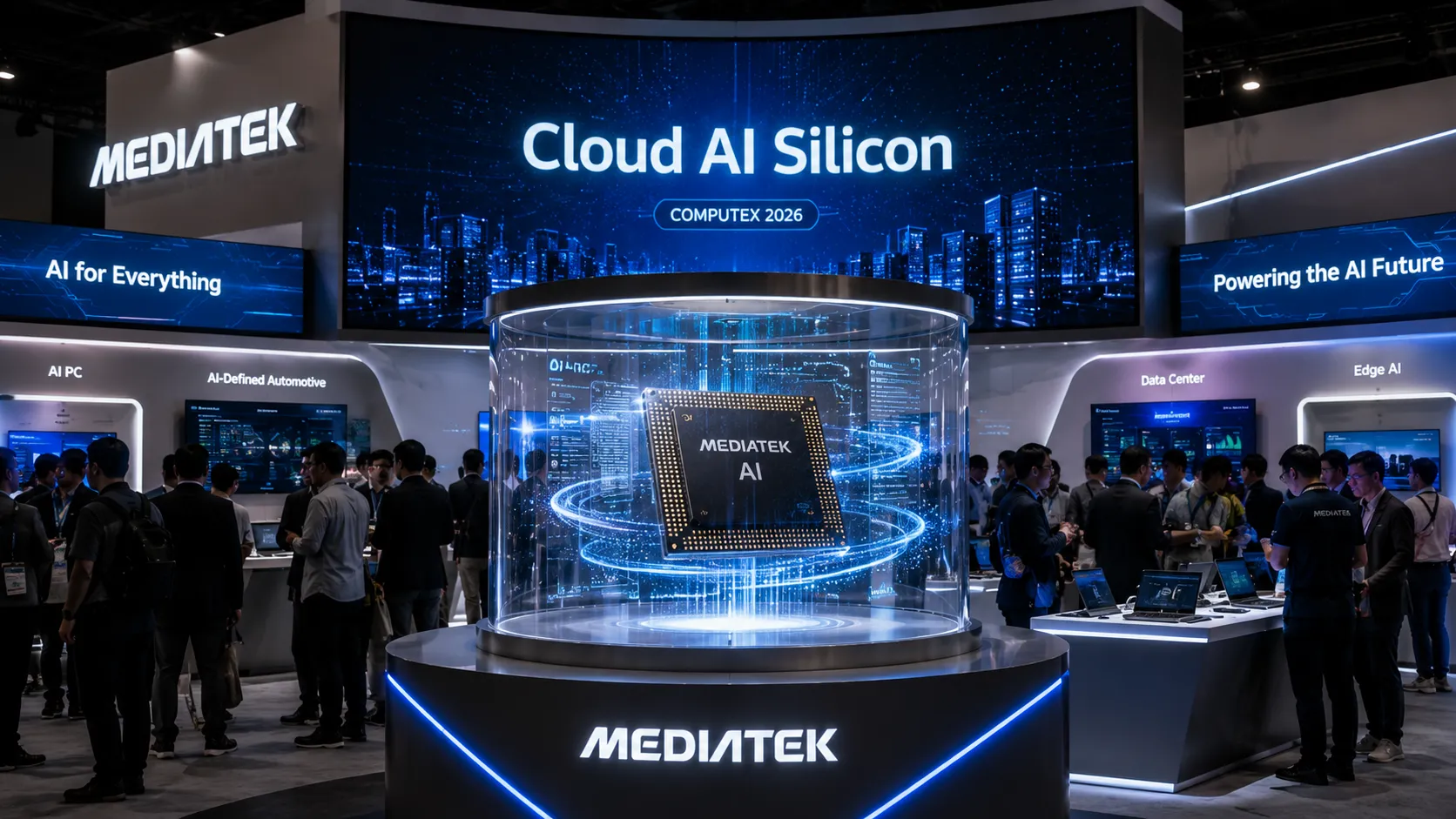
In late May 2026, MediaTek will take the stage at Computex, Taiwan's premier technology trade show. The booth will showcase the consumer-facing products that most visitors expect: the Nvidia-co-developed N1 and N1X laptop chips, the latest smart device and automotive platforms, a range of edge AI silicon. On the surface, it will look like the MediaTek the world already knows.

But behind that consumer facade, a different conversation will unfold. The hyperscalers will be in attendance. The cloud architects. The investors who have watched MediaTek's stock hold steady through a mobile downturn and want to understand why. The Computex moment is not about the products on the show floor. It is about the identity shift that the show floor is designed, carefully, to reveal.

MediaTek is no longer a company that makes smartphone chips and dabbles in other things. It is a cloud AI infrastructure company that still happens to dominate mid-tier smartphones. The distinction is not semantic. It is structural. It will define the company's valuation, its growth trajectory, and its strategic importance for the rest of the decade.

ChatGPT Image May 16, 2026, 04_18_41 PM.png

The Takeaway for Every Entrepreneur

MediaTek's pivot is a case study in what it takes to transform a company while the old business is still generating billions. It is easy to talk about reinvention in the abstract. It is brutally difficult to execute when a mobile revenue base of over $2 billion a quarter is shifting beneath your feet.

The first lesson is about long-cycle R&D. MediaTek's SerDes technology, the key to its ASIC breakthrough, was developed over more than a decade. It was not a reaction to the AI boom. It was a patient, sustained investment in a capability that the company believed would eventually matter. When the moment arrived, MediaTek was ready—not because it was lucky, but because it had been preparing for a decade.

The second lesson is about customer alignment. MediaTek did not try to compete with Nvidia by building general-purpose GPUs. It did not try to sell AI chips on the open market. It embedded itself in the design cycles of the hyperscalers, becoming an essential partner rather than an arms-length supplier. The moat it is building is not just technological. It is relational—a deep integration with the largest technology buyers on Earth that will be difficult for competitors to replicate.

The third lesson is about diversification as survival. MediaTek's mobile business did not collapse overnight. But the structural headwinds—memory prices, market maturity, longer replacement cycles—were building for years. The companies that thrive through industry transitions are not the ones that wait for the crisis to arrive. They are the ones that build the next business while the old business is still healthy enough to fund the transition.

The Road Ahead

MediaTek's pivot is not complete. The ASIC business is still in its earliest stages, with the first major revenue impact not expected until Q4. Execution risks remain: capacity constraints, packaging complexity, the ever-present possibility that a hyperscaler shifts its design strategy or brings more work in-house. The mobile business will continue to generate cash, but it will also remain volatile, subject to memory price swings and the fickle rhythms of consumer demand.

But the direction of travel is unmistakable. MediaTek has spent twenty years building the infrastructure of the mobile internet, one affordable smartphone at a time. It is now building the infrastructure of the AI internet, one custom chip at a time. The pivot from phones to clouds is not a pivot away from the company's identity. It is an evolution toward a future in which the most valuable computing no longer happens in your hand—but in a data center you will never see, running chips you will never know were there.

TagsMediaTekAI ASICCloud ComputingSemiconductor IndustryGoogle TPUData CenterTaiwanRick TsaiBroadcomNvidiaHyperscalersCustom SiliconTechnology PivotEntrepreneurship

Reader reviews

Sign in to rate and review this article.
Loading reviews…


