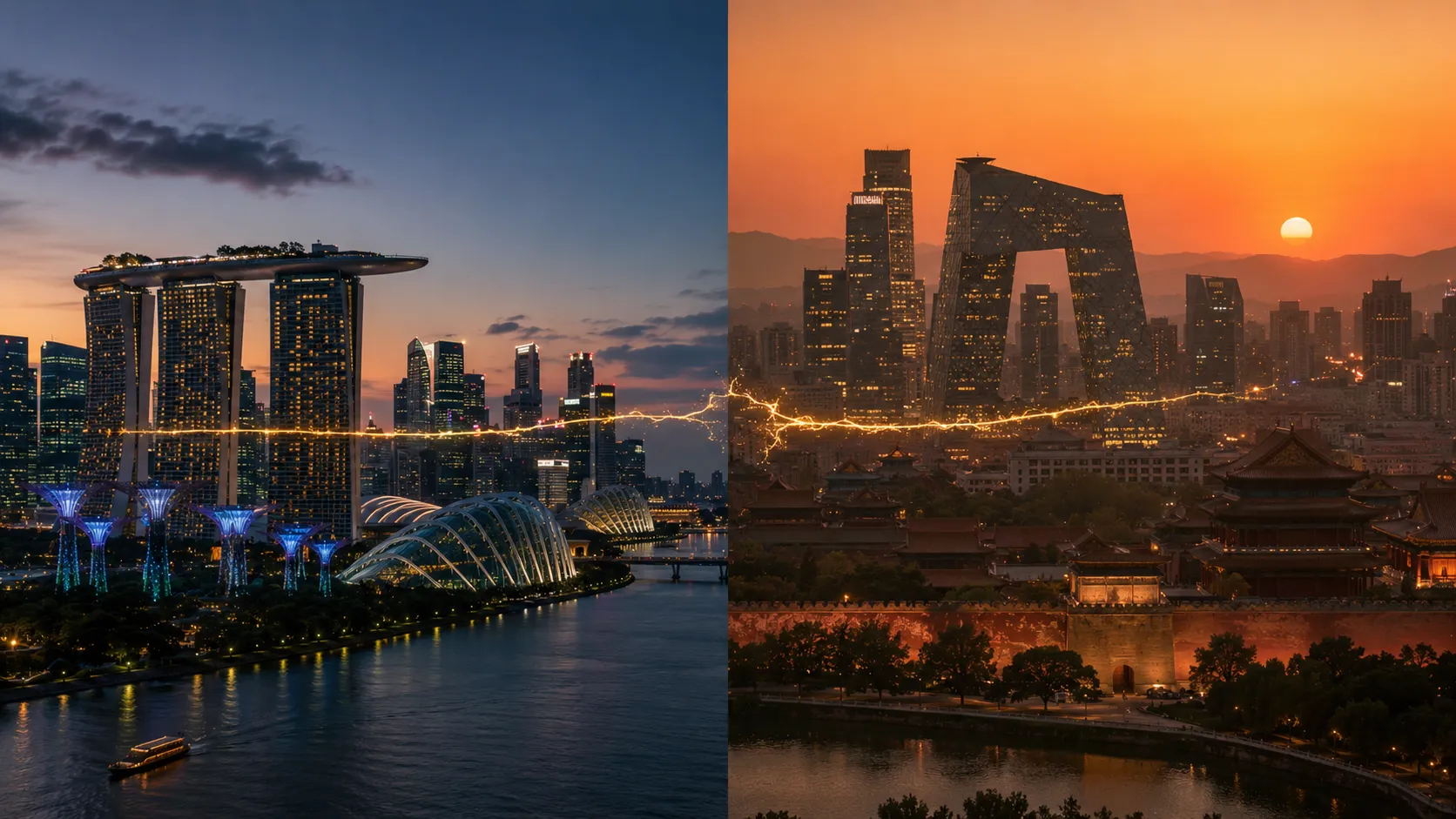
The $2 Billion Deal That Beijing Killed: Inside the Unprecedented Unwinding of Meta's Manus Acquisition—and the $1 Billion Buyback That Comes Next
BEIJING — May 22, 2026 — In December 2025, Meta Platforms announced the acquisition of Manus, a Singapore-based AI startup whose general-purpose AI agents could function as digital employees, independently carrying out tasks such as research and automation with minimal human input. The price was approximately $2 billion. The deal closed. Manus employees moved into Meta offices in Singapore. Capital was transferred. The startup's executives joined the American firm's rapidly expanding AI team. Investors including Tencent Holdings, ZhenFund, and HSG received their proceeds. The acquisition was, by all appearances, complete.
In April 2026, Beijing ordered it undone. The Chinese government, which had launched a review into whether the deal violated investment rules shortly after it was announced, delivered a demand that Meta unwind the entire transaction. Two of Manus's three co-founders were barred from leaving China. The once-celebrated agentic AI pioneer—hailed as a breakthrough that would challenge Silicon Valley's dominance—was suddenly a cautionary tale. And this week, the three founders began exploring a path that is virtually unprecedented in the history of cross-border technology deals: raising approximately $1 billion from external investors to buy back the company that was sold just months ago, at a valuation that would at least match the $2 billion Meta paid.
The discussions, confirmed by multiple people familiar with the matter to Bloomberg and Reuters, are fluid, preliminary, and may ultimately be abandoned. But the fact that they are happening at all is a signal—one of the clearest yet—that the era of frictionless cross-border technology acquisitions between the United States and China is over. The new reality is a world in which deals that are announced, closed, and integrated can still be unwound by government fiat. The implications for startups, investors, and the global technology industry are only beginning to be absorbed.
The Founder Exodus That Made the Deal Possible
To understand how the Manus-Meta deal became one of the most controversial technology transactions in recent memory, one must first understand the geographic maneuvering that preceded it.
Manus was created in China. Its three founders—Xiao Hong, Ji Yichao, and Zhang Tao—built the company's core technology on the mainland, drawing on China's deep pool of AI engineering talent. The company's general-purpose AI agents, capable of independently executing complex multi-step tasks such as research, analysis, and workflow automation, attracted attention from investors and potential acquirers on both sides of the Pacific. But the founders, aware that Chinese regulatory scrutiny of outbound technology transfers was intensifying, made a strategic decision: they relocated their headquarters and key staff to Singapore in 2025, positioning the company as a Singapore-based entity that could be acquired by an American buyer without tripping Chinese investment restrictions.
The maneuver worked—at least initially. Meta announced the acquisition in late December 2025, framing it as a move to expand advanced AI integration across its platforms. The deal was structured through Singapore, technically beyond Beijing's immediate jurisdiction. For several months, the transaction proceeded normally. Employees relocated. Capital was disbursed. The integration began.
Then Beijing launched a review. The National Development and Reform Commission, China's powerful economic planning agency, examined whether the acquisition violated rules governing foreign investment in sensitive technology sectors. The review concluded that it did. In April 2026, Beijing delivered its order: Meta must unwind the deal. Two of the three co-founders—whose names have not been publicly confirmed—were barred from leaving China. The company that had relocated to Singapore to escape Chinese regulatory jurisdiction found itself pulled back into it.
The $1 Billion Buyback That Has No Precedent
The plan now under discussion among the three co-founders is, by any standard, extraordinary. They are in talks with external investors about a funding round that would value Manus at least in line with the $2 billion Meta paid—roughly at the price the American company agreed to in December. The founders may contribute their own capital to bridge any gap between the external raise and the full repurchase price. If the plan proceeds, Manus would be restructured as a Chinese joint venture with the new backers, ahead of a potential initial public offering in Hong Kong.
The obstacles are formidable. Manus's agentic AI technology has already been partially integrated into Meta's systems. Manus employees have been absorbed into Meta's organization. Capital has been transferred, and investors have received their proceeds. Unwinding a completed acquisition of this scale, months after closing, is virtually without precedent. "It's unclear how new owners would carve out Manus's agentic AI technology, much of which has been integrated into Meta's systems," Bloomberg reported, citing people familiar with the situation.
The practical questions are as difficult as the financial ones. How do you separate code that has been merged into a larger platform? How do you reassign employees who have been integrated into new teams, with new reporting structures and new projects? How do you recover capital that has already been distributed to shareholders? Meta representatives did not respond to requests for comment. A Manus spokesperson did not respond to queries from multiple news organizations.
Some investors have expressed interest in joining the repurchase. The reason is straightforward: Manus was projected to generate approximately $1 billion in revenue this year. The company's AI agents—digital employees capable of independently carrying out complex tasks—are among the most advanced of their kind, and the market for agentic AI is expanding faster than any segment of the enterprise software industry. A company with a $1 billion revenue projection, even one being forcibly separated from its acquirer, is worth something. The question is what, and who will pay for it.
The Geopolitical Context
The Manus-Meta unwinding did not occur in isolation. It is the latest and most dramatic escalation in a broader campaign by Beijing to prevent the transfer of sensitive technology to geopolitical rivals—a campaign that has accelerated sharply in 2026.
In the months preceding the Manus decision, Beijing barred major technology firms including ByteDance and Moonshot AI from accepting American capital without prior government approval. It clamped down on offshore Chinese companies seeking to list in Hong Kong. It tightened export controls on advanced semiconductor manufacturing equipment, rare earth minerals, and AI training data. Each of these moves was a signal. The Manus unwinding is an action—a demonstration that Beijing is willing to reach across borders, into completed and settled transactions, to enforce its technology sovereignty.
The U.S.-China technology relationship has deteriorated to a point that would have been difficult to imagine even five years ago. The Trump-Xi summit in mid-May produced no agreement on semiconductor or artificial intelligence technology controls. The U.S. has expanded its own restrictions on advanced chip exports to China. China has responded with its own export curbs and investment restrictions. The two largest economies on Earth are engaged in a slow-motion decoupling of their technology ecosystems, and the startups caught in the middle—companies like Manus, founded in one country, funded by another, acquired by a third—are the first casualties.
The message to Chinese entrepreneurs is unambiguous. "Manus, once hailed as a breakthrough that would challenge Silicon Valley's dominance, is turning into a cautionary tale for Chinese entrepreneurs," Bloomberg reported. The founders who relocated to Singapore to facilitate a deal with an American company are now deliberating what amounts to a partial reversal of that relocation, in addition to unwinding Meta's acquisition. The message to American acquirers is equally clear: Chinese technology assets, even those held through Singaporean or other offshore entities, come with regulatory risk that no amount of legal structuring can fully eliminate.
The Road Ahead
The discussions around the Manus buyback remain fluid. The valuation is under negotiation. The founders may ultimately decide against proceeding. The hurdles—carving out integrated technology, reassigning absorbed employees, unwinding distributed capital—are substantial and may prove insurmountable. Meta, for its part, has not publicly commented on the Chinese government's demand or on the founders' buyback plans.
But the trajectory of the broader conflict is unlikely to reverse. The U.S. and China are building separate technology stacks—separate AI ecosystems, separate semiconductor supply chains, separate pools of investment capital. The era in which a Chinese AI startup could be founded in Beijing, relocated to Singapore, and acquired by a Silicon Valley giant without friction is ending. The Manus unwinding, if it proceeds, will be the first completed acquisition forcibly reversed by a foreign government in the history of the modern technology industry. It will not be the last.
The three founders—Xiao Hong, Ji Yichao, and Zhang Tao—are now at the center of a geopolitical storm they did not create. They built a breakthrough AI company. They sold it for $2 billion. Their own government ordered the deal undone. And now they are being asked to raise $1 billion to buy it back, at the same price they sold it for, in a world that has changed beneath their feet. The agentic AI pioneers who built digital employees capable of independent action have found that the most complex problem they face is not technical. It is the one they cannot solve with code.


